An electric SUV can tow a travel trailer safely only when the exact vehicle, hitch, and loaded trailer are within every applicable limit. There is no universal electric-SUV towing capacity: model year, trim, wheel and tire setup, passenger count, market, trailer equipment, and payload can all change the answer.
Before connecting the trailer, verify the SUV’s rating and payload against the trailer’s actual loaded weight and tongue load, inspect the complete towing system, test brakes and lights, configure the vehicle as its manual directs, and plan charging for substantially higher energy use. The checklist below is designed to help you make that decision without relying on a headline tow rating.
As an Amazon Associate I earn from qualifying purchases.
Start with a compatibility decision, not the advertised tow rating
Read the owner’s manual for the exact model year and configuration, the certification or vehicle labels, and the hitch documentation. Use the figures that apply to your market, wheel and tire combination, passenger count, and installed equipment. A rating published for another trim or market is not a safe substitute.
Some manuals assign different maximum trailer weights according to wheel size or the number of occupants. The Tesla Model Y manual, for example, varies its towing limits by wheel size and passenger count and states that maximum towing capacity assumes the vehicle’s gross vehicle weight rating (GVWR) is not exceeded. That means a trailer figure alone cannot establish compatibility.
#1 Best Overall

- Proportional Mode Brake for Everyday Towing: The Tow-Pro Liberty delivers Proportional Mode braking for smooth on-road control. Easy to install and use, the system reduces push and pull for ultimate towing confidence on roads and highways
- Universal Brake Controller for SUVs & Trucks: Pair with the universal pig tail wiring harness (TPH-025) or one of our vehicle specific brake controller wiring harnesses and switch inserts for factory-style integration (each sold separately)
- What’s Included: Tow-Pro Liberty Electric Brake Controller, Remote Head Assembly, Remote Head Nut, Remote Head Knob, Remote Head Bezel, Remote Head Cable 3’3” (1 m). Supports 1–2 axles. Fits most common trailer braking applications
- No Knee-Knocking and Sway Control: Compact dash dial blends seamlessly into your vehicle while Active Calibration and sway control deliver smooth braking, with or without a trailer to stay steady on roads
- Confidence for The Long Haul: Designed and torture-tested in the Australian Outback, it's engineered for the toughest towing conditions. Trusted for 45+ years, REDARC offers a 2 year limited warranty on this trailer brake controller
Check all of these limits together:
- Maximum trailer weight: the heaviest trailer the vehicle and approved hitch are rated to pull in your configuration.
- Hitch and receiver limits: the approved hitch’s trailer-weight and tongue-load ratings, including any limits for the ball mount or accessories.
- Tongue load: the downward force the coupled trailer applies to the hitch. It must stay within both the vehicle and hitch limits.
- GVWR and payload: the maximum permitted loaded weight of the SUV and the weight it can carry, including people, luggage, accessories and trailer tongue load.
- Axle limits: front and rear axle ratings, which can be exceeded even when total vehicle weight appears acceptable.
- Trailer limits: the trailer’s loaded gross weight, coupler and axle ratings, brakes, tires and any manufacturer tongue-load requirement.
Use the trailer’s real travel weight, not its dry or brochure weight. Add water, propane, food, clothing, batteries, camping equipment, tools, bicycles and anything placed in the trailer after purchase. Weigh the loaded trailer if its actual mass is uncertain. Include every occupant and item in the SUV when calculating remaining payload; the tongue load is carried by the SUV and consumes that payload.
A practical calculation
Begin with the payload shown on the vehicle label or in the manual. Subtract the weight of all occupants, luggage, roof or hitch accessories and other cargo in the SUV. Then subtract the loaded trailer’s tongue load. The result is the remaining payload margin; it must not be negative, and axle and GVWR limits must still be respected. A nominally towable trailer can therefore become incompatible when the SUV is full of people and gear.
Check the coupled stance
After coupling, look at the SUV and trailer on level ground. The combination should sit level according to the vehicle and trailer makers’ instructions. A visibly nose-down or nose-up trailer can indicate incorrect loading, an unsuitable ball mount or an adjustment problem. Do not “fix” an overloaded combination by moving weight without staying within the trailer maker’s loading guidance and the SUV’s tongue-load limits.
The Tool Desk
Outbyte PC Repair FREEClear out junk files and repair common Windows errorsFree Scan →Outbyte Driver Updater FREEScan for outdated or missing drivers - takes under a minuteDriver Scan →Inspect the hitch and every connection
Do this inspection before loading for departure and again after the first short drive. Use only an approved hitch and the hardware specified for the vehicle and trailer.
- Inspect the receiver, hitch mounting points, ball mount, hitch ball, coupler and latch for cracks, deformation, missing hardware, corrosion or looseness.
- Confirm the hitch ball diameter and capacity match the trailer coupler. Close and lock the coupler exactly as the trailer manual describes.
- Attach safety chains or other required secondary retention equipment as specified for your jurisdiction and trailer. Cross chains when the applicable instructions require it, keeping enough slack for turns but not enough to drag.
- Connect the trailer electrical plug fully. Check for damaged pins, a loose socket, chafed cable or a connector that can contact the road.
- Secure the breakaway cable or switch using the trailer maker’s specified attachment point rather than looping it around a removable hitch part.
- After coupling, confirm that the locking mechanism, chains and electrical cable cannot contact the ground, tires or moving suspension components.
Do not tow when any structural part or electrical connection is damaged, loose or unable to lock. A hitch that physically fits is not necessarily approved for the vehicle, and an adapter does not automatically preserve the original rating.
Prepare trailer brakes and lighting
Test every required light before entering traffic: tail lamps, brake lamps, turn signals, marker lamps and the license-plate light where applicable. Have a helper observe, or use a reflective surface, while you operate each function from the SUV.
Trailer brakes are a separate compatibility question from the SUV’s ability to pull the weight. Whether a separate brake system or controller is required depends on the vehicle instructions, trailer brake design and loaded weight, and local law. Confirm the requirement before travel rather than assuming regenerative braking handles the trailer.
Do these 3 things before closing this tab:
1Scan for outdated or missing drivers - takes under a minute2Repair Windows errors before they cause bigger problems3Fix the driver behind crashes, sound loss and screen glitchesBrake-controller compatibility
Some Tesla manuals describe a separately purchased brake controller and a model-specific vehicle connector. That is not a universal claim about all Tesla vehicles or all electric SUVs. Verify four items before buying or installing anything:
Rank #2
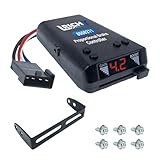
- 🏆【PROPORTIONAL ELECTRIC BRAKE CONTROLLER】Lrichy brake controller uses internal sensors to automatically apply trailer brakes based on your tow vehicle's braking intensity and speed. It intelligently sets the correct braking level and adjusts for hills, delivering reliable stopping power in any situation
- 🏆【WIDE COMPATIBILITY】This proportional controller replaces the Brake-EVN 8508220 and has Smoother braking than the 8507111 Time-Delay Brake IV. It's compatible with various vehicles including Ford, GM, Chevy, Dodge, RAM, Toyota, Jeep, and more with 2, 4, 6, and 8 brakes (1-4 axles). NOTE: Vehicle-Specific Plug & Play Harness Not Included
- 🏆【SIMPLE SETUP & USE】A detailed instruction manual with an easy-to-read LED digital display makes it easy to show settings, real-time diagnostic information, and alarms. For manual braking, simply move the manual lever to the left. Braking force will be applied to the trailer braking system based on the previously set braking force
- 🏆【EASY MOUNTING】Includes brackets and screws for simple installation. Features a plug-and-play port for easy disconnection
- 🏆【SATISFACTION GUARANTEE】Lrichy attaches great importance to product quality and customer shopping experience! We provide 2 Years of warranty service and a refund for product quality issues! If you have any problems, you can contact us via Amazon! Free exchange and refund policy for a truly hassle-free after-sales service!
- Whether your exact SUV is approved for the trailer’s brake type.
- Whether the trailer has electric brakes, a different system, or no service brakes.
- Whether the SUV requires a controller, and which connector or wiring harness the manual specifies.
- Whether installation, adjustment and testing must be performed by a qualified technician under local rules.
With the trailer connected, test braking at low speed in a safe area. The trailer should brake without locking its wheels, pushing the SUV, pulling to one side or causing warning messages. Follow the controller and trailer manufacturer’s adjustment procedure; do not invent a setting from another vehicle.
Set tires, mirrors and visibility for the loaded combination
Tire pressure and condition
Use the towing tire-pressure instructions for your exact SUV and trailer. Do not assume the normal unladen pressure remains correct, and do not use the maximum pressure molded into a tire as a target unless the manufacturer directs it. Check pressures cold, inspect tread and sidewalls, and verify that the trailer tires are rated for their axle loads and are free of bulges, cuts and uneven wear.
Inspect the spare tire or approved repair equipment for both vehicles. A puncture on a loaded trailer can be difficult to manage, so carry the tools and roadside equipment required by the vehicle and trailer manuals.
Mirrors and blind spots
Adjust the SUV’s mirrors after the trailer is coupled so you can see along both sides and behind the trailer. Correctly fitted towing mirrors may help when the standard mirrors do not provide a clear rear view, but they must be suitable for the specific SUV and must not obstruct required lighting or fold unexpectedly. Check blind spots before lane changes and allow additional distance for the trailer’s length.
Use the vehicle’s towing mode correctly
Enable Trailer Mode or the equivalent only as directed by the exact vehicle manual. Depending on the vehicle, the mode can alter stability functions, driver-assistance behavior, regenerative-braking strategy, displayed range or charging settings. Some vehicles engage a towing mode automatically when they detect a trailer electrical connection; others require a manual selection or confirmation.
After connecting the plug, check the instrument display for a trailer icon or confirmation message. If the vehicle does not recognize the trailer, stop and inspect the connector and wiring rather than continuing with unverified settings. Read the manual for restrictions on lane-keeping, adaptive cruise control, automated parking and other assistance systems while towing; a trailer can change sensor coverage and stopping behavior.
Load and secure the travel trailer
Distribute cargo according to the trailer maker’s instructions and keep heavy items low and restrained. Prevent furniture, cylinders, tools and loose camping equipment from shifting during braking or cornering. Close and latch every cabinet, compartment and exterior hatch.
Outdated Drivers Are Slowing You Down
One free scan finds every outdated or missing driver and matches the right update for your exact hardware.Free scan · exact hardware matchPC Slower Than It Used to Be?
A free scan shows the junk files, broken settings and background clutter dragging Windows down - then fixes them in one click.Free scan · Windows 10 & 11Keep the trailer’s measured tongue load within the stated range and below the lowest applicable vehicle, hitch or ball-mount limit. A tongue-weight scale can help you measure it, but the reading is useful only when taken with the trailer loaded as it will travel and on a suitable level surface. Recheck after adding water, moving batteries or changing cargo.
Rank #3

- Slim, low-profile design for a functional, modern aesthetic
- Unique bracket system for improved dash clearance
- Fully adjustable power and ramp time
- Operates 2-6 trailer brakes at a time (1-3 axles)
- No internal moving parts and no leveling required
Carry wheel chocks if the vehicle or trailer manual calls for them. Apply the parking brake and chock the trailer before uncoupling, loading, or walking through a campsite. Make a final walk-around for open windows, unsecured awnings, raised stabilizers, disconnected cables and items that could fall onto the road.
Plan for the range penalty before you leave
Towing increases energy consumption because the SUV must move more mass and push a larger, less aerodynamic shape. The Tesla Model S owner manual states: “Towing a trailer puts additional load on the motor(s), drive train, brakes, tires, and suspension and significantly decreases range.” Treat that as a warning to plan conservatively, not as a universal percentage. The official material available for the vehicles reviewed does not establish one cross-model range-reduction number.
Build a conservative route plan
- Start with the SUV’s real-world range when towing a comparable trailer, if you have a documented figure for your exact combination. Otherwise, plan around a deliberately conservative estimate rather than the unladen dashboard range or laboratory figure.
- Account for trailer mass, frontal area, speed, hills, headwinds, rain, temperature, payload and stop-and-go traffic. These variables can change consumption on the same route.
- Choose charging stops with enough energy margin to reach the next reliable site. Do not make the plan depend on arriving with a nearly empty battery.
- Confirm that the charger’s approach, turning radius, parking bay and exit can accommodate the full SUV-and-trailer length. A station may be operational yet unusable if the trailer blocks a lane or cannot align with the connector.
- Identify an alternative charger near each critical leg. Check opening hours, payment method, connector type and any access restrictions before departure.
- Allow extra time for connecting, maneuvering and possible queueing. A trailer can prevent use of ordinary pull-through spaces, requiring you to disconnect or find a different site.
Station layout and trailer access vary by location and were not established for every network. Inspect the site information and, where practical, confirm access with the operator before committing to a long leg.
Recommended Free Tools
Charging with the trailer attached
Follow the charging-site rules. If the trailer occupies adjacent spaces or blocks traffic, disconnect it only where permitted and secure it with the parking brake and chocks. Never leave a disconnected trailer unattended in a travel lane. Keep the charging cable clear of wheels and walking paths, and reconnect the trailer safely before departure.
Cold-weather towing needs a separate check
Temperature affects battery power, charging speed, tire pressure and road grip. Follow your manufacturer’s cold-weather towing instructions rather than applying advice from another EV.
Hyundai’s 2025 manual gives a specific example: below 0 °C, a low remaining high-voltage battery can reduce power while towing, and the manual advises charging above 50% in that condition. This is Hyundai-specific guidance, not a universal threshold for every electric SUV. Read the exact manual for battery preconditioning, minimum state of charge, snow-chain restrictions and charging limitations.
Before a cold trip, warm or precondition the vehicle while connected to shore power when the manual permits it, check tire pressures after the temperature drop, clear snow and ice from lights and sensors, and leave additional energy margin for detours and slower traffic. Wet, icy or snow-covered roads also increase stopping distance; reduce speed and avoid abrupt steering inputs.
Quick wins for a faster PC:
Clear out junk files and repair common Windows errorsFree Scan →Fix the driver behind crashes, sound loss and screen glitchesFind Drivers →Repair Windows errors before they cause bigger problemsFix Now →Complete this pre-departure checklist
| Area | What to verify | Why it matters |
|---|---|---|
| Vehicle identity | Exact model year, trim, market, wheel and tire setup, passenger count and approved accessories | Ratings and towing instructions can change with configuration. |
| Weights | Loaded trailer weight, tongue load, SUV payload, GVWR and front/rear axle limits | All limits apply together; a trailer’s dry weight is insufficient. |
| Hitch | Approved receiver, ball mount, ball, coupler lock, chains and breakaway attachment | Prevents structural or coupling failure. |
| Electrical | Correct connector, undamaged wiring and confirmed trailer detection | Lighting, brakes and towing-mode functions depend on the connection. |
| Brakes | Trailer brake type, controller requirement, adjustment and low-speed test | Stopping performance and legal compliance depend on the complete system. |
| Lights | Brake, turn, tail, marker and plate lights | Ensures other road users can see your combination and intentions. |
| Tires | Vehicle and trailer pressures, load ratings, tread, sidewalls and spare equipment | Load and heat rise make tire condition critical. |
| Visibility | Mirrors adjusted for both sides and rear, with towing mirrors if necessary | Reduces blind-spot risk during turns and lane changes. |
| Load security | Balanced cargo, restrained items, level stance, closed hatches and chocks | Prevents sway, shifting cargo and campsite movement. |
| Route | Conservative energy estimate, charger spacing, trailer access and alternates | Range and station usability are less predictable while towing. |
| Weather | Cold-weather battery guidance, road conditions and extra energy margin | Low temperature can affect power, range and charging. |
How to compare two possible SUV-and-trailer combinations
If more than one combination appears eligible, compare the complete system rather than the largest headline tow number.
Rank #4

- 【Intelligent braking】Proportional controllers are the safest and most responsive braking system you can install.Proportional trailer brake controllers automatically sense when your tow vehicle slows down or stops. This type of brake controller will replicate your own braking intensity for your trailer's brakes, whether you slow to a gradual stop or have to slam on your brakes
- 【Easy to display】LED Digital display screens show the voltage delivery going from the brake controller to the trailer's brakes. Easy to read, easy to observe vehicle conditions in real time.In case of emergencies, make adjustments in time
- 【Safer and more stable】Fits 1 to 4 axle (2 to 8 brakes) trailers to deliver a signal from your vehicle's brakes to your trailer,both quantity of braking power (result) and rate of the program (sync) can be adjusted to fit your inclination, the street conditions, and kind of trailer,increase the safety of driving.Requires no leveling
- 【Quick installation and use】Wiring ports are available for vehicle-specific brake controller harnesses and provide a quick connection between the controller and the towing vehicle for quick and easy installation or removal
- 【4 Wiring & controls】BLACK-Vehicle Power, RED-Stop Light, WHITE-Vehicle Ground, BLUE-Trailer Brakes
| Comparison point | Questions to answer |
|---|---|
| Weight headroom | How much margin remains below the loaded trailer rating, hitch rating and tongue-load limit? |
| Payload | After passengers, luggage and accessories, how much payload remains for tongue load? |
| Axles and stance | Are both axle limits respected, and does the coupled combination sit level? |
| Braking | Are the trailer brakes, controller, connector and local requirements compatible? |
| Hardware | Do hitch, ball mount, chains, tires and mirrors meet the exact manufacturer specifications? |
| Range | What conservative range is plausible with this trailer, speed, terrain, weather and load? |
| Cold conditions | Does the manufacturer impose battery or state-of-charge guidance for towing in low temperatures? |
| Charging access | Can the full combination enter, use and exit the planned charging locations? |
A combination with a lower published tow rating can be the safer choice if it leaves more payload, tongue-load and range margin. Conversely, a vehicle with a higher rating is not suitable when the hitch, axle, brake or charging constraints fail.
Common mistakes and what to do instead
Using a dry trailer weight
Mistake: comparing the SUV with the trailer’s empty brochure figure.
Better approach: weigh the trailer in travel condition, including water, propane, batteries and camping cargo.
Free tools Windows power users keep installed
One-click scans. No signup required.
Ignoring occupants in the payload calculation
Mistake: treating the full payload as available for the tongue.
Better approach: subtract every occupant, bag and accessory before evaluating tongue load.
Applying another vehicle’s percentage or limit
Mistake: transferring a tongue-load percentage, wheel-size rating or brake-controller assumption from a different SUV or country.
Better approach: use the exact vehicle, trailer and market documentation.
Relying on normal tire pressure
Mistake: leaving pressures at the unladen setting without checking towing guidance.
Best Value

- PROPORTIONAL BRAKING: Advanced proportional braking system automatically matches trailer brake output to your vehicle’s deceleration. Delivers smooth, synchronized braking for improved control and reduced trailer jerking during everyday towing and emergency stops.
- LED DISPLAY: High-visibility LED screen shows braking output, boost setting, and system status in real time. Built-in diagnostic indicators help monitor connection and braking performance for confident towing on every trip.
- BOOST & MANUAL CONTROL: Adjustable boost settings allow you to fine-tune braking response based on trailer weight and road conditions. Manual override lever provides instant trailer brake activation for added control during downhill driving or tight maneuvers.
- EASY INSTALLATION: Designed for fast installation with compatible wiring harness ports. No leveling required for flexible mounting under the dashboard, making setup quick and straightforward. Wiring harness may be required depending on vehicle model and is sold separately.
- 1–4 AXLE COMPATIBILITY: Supports 1 to 4 axle trailers (2–8 brakes). Compatible with most 12V towing vehicles including Ford, GM, Chevy, Dodge, RAM, Toyota, and Jeep. Ideal for RVs, campers, utility trailers, and cargo towing applications.
Better approach: set cold pressures exactly as the vehicle and trailer makers specify.
Planning to the dashboard’s unladen range
Mistake: assuming the displayed range will remain valid with a large trailer.
Better approach: plan conservative legs, keep a reserve and verify trailer-accessible charging locations.
What’s actually slowing this PC down?
Pick the symptom - the matching free tool is one click away.
Assuming every charger is trailer-friendly
Mistake: selecting a station solely because its connector matches.
Better approach: check approach, bay length, turning space, exit path and rules for occupying adjacent spaces.
Installing an unverified brake controller
Mistake: fitting a generic controller without checking the vehicle connector, trailer brake type or installation requirements.
Better approach: follow the exact vehicle and trailer manuals and local regulations, using qualified installation when required.
When to postpone the trip
Do not tow until the issue is resolved if the loaded weights are unknown, any limit is exceeded, the combination cannot sit level, the coupler or chains will not lock, the trailer is not detected electrically, required lights or brakes fail, tire damage is present, or the route lacks a realistic charging margin. A warning message, unusual sway, pulling during braking or a hot tire also warrants stopping in a safe place and investigating before continuing.
Keep the owner manuals for the SUV, hitch and trailer available during the trip. Ratings, software behavior, accessory availability, regulations and charger access can change by country and over time, so recheck them when the vehicle, trailer, wheels, tires or route changes.
Quick Recap
Product prices and availability are accurate as of the date/time indicated and are subject to change. Any price and availability information displayed on Amazon at the time of purchase will apply.




