What’s actually slowing this PC down?
Pick the symptom - the matching free tool is one click away.
Your first trail drive should be a controlled test of the truck, not a contest with the terrain. Identify the exact year and trim, use its owner manual as the authority, inspect the vehicle, choose an easy route with an exit, set tire pressures deliberately, carry recovery and emergency gear, and drive slowly enough to stop before an obstacle becomes a problem. A Colorado ZR2, a Silverado Z71, a Trail Boss, and a two-wheel-drive work truck do not have the same clearance, tires, gearing, recovery points, payload or water limits.
Start with the exact Chevy truck, not the badge
Write down the truck’s model year, model, trim, cab and bed configuration, drivetrain, tire size, factory recovery points, payload rating and every modification. Photograph the door-label information and keep the owner’s manual in the truck or available offline. The manual for that specific vehicle controls tire pressures, drive-mode engagement, recovery-point use, payload and axle ratings, and water limits.
As an Amazon Associate I earn from qualifying purchases.
Do not transfer a specification from a more capable trim. A 2023 Colorado brochure, for example, lists ZR2-specific lift, locking differentials, skid protection, 33-inch tires and recovery hooks. Those features do not automatically apply to a Colorado WT, LT or Trail Boss, much less to a Silverado or a modified truck. A lift, larger tire, bumper, winch or bed load can also change clearances, axle loads and the way the truck behaves.
| Record before planning the route | Why it matters |
|---|---|
| Year, model and trim | Determines the applicable manual, hardware and published limits. |
| 2WD or 4WD; high and low range if fitted | Sets which surfaces and recovery situations are realistic. |
| Tire size, type, load range and condition | Affects traction, sidewall protection, clearance and safe pressure. |
| Factory recovery points | Identifies where a strap or connector may be attached. |
| Door-label payload and axle ratings | Limits passengers, fuel, water, tools, spare and recovery equipment together. |
| Modifications and added weight | May reduce payload or alter approach, departure and breakover clearance. |
Inspect the truck before it leaves pavement
Perform the inspection in daylight on level ground. Fix a defect before the trip; a trail is a poor place to discover a loose wheel, weak battery or damaged sidewall.
#1 Best Overall

- 4 IN 1 TOW STRAP KIT: This towing strap set includes 1 tow strap (3in x 20ft , Orange), 2pcs 3/4" D-ring shackles and 1pcs storage bag.
- RECOVERY STRAP: Our Heavy Duty Tow Strap made from high-level Polyester, Lab Tested and Certified 35,000lbs Break Strength!
- D RING SHACKLES: Ultra-safe D-ring shackle with electro galvanized coating and silicon bumper protector. Lab Tested and Certified 45,000lbs Capacity!
- Versatile Applications: Rugged and top quality, works well with full-size pickups, ATV, SUV, UTV and even boats! This recovery set is ideal for towing large trucks, pulling heavy equipment; An essential tool for off-roaders.
- All-Weather Towing: Our weather-resistant tow strap is perfect for emergency roadside use, maintaining their integrity in rain, snow, or ice, making them a must-have for your vehicle's toolkit.
Wheels, tires and brakes
- Check all tread and sidewalls for cuts, bulges, exposed cords, embedded objects and uneven wear.
- Inspect the spare, its inflation, valve stem, mounting hardware and the tools needed to install it. A spare that cannot be lowered or fitted is not a recovery plan.
- Verify wheel-nut torque with the truck’s specified procedure, especially after wheel or suspension work.
- Look through the wheels for damaged rotors, leaking calipers or loose brake hardware. Confirm the parking brake holds.
Steering, suspension and underbody
- Check for play in tie-rod ends, ball joints and steering components; inspect shocks, springs, control arms and bushings for damage or leaks.
- Look beneath the truck for fluid leaks, loose fasteners, bent skid plates, damaged wiring, hanging exhaust parts and exposed fuel or brake lines.
- Confirm that tow or recovery points are present, undamaged and accessible. Never assume an aftermarket point has the same rating or permitted pull direction as a factory point.
Fluids, electrical systems and visibility
- Check engine oil, coolant, brake fluid, power-steering fluid where applicable, transmission fluid for signs of a leak, windshield-washer fluid and fuel level.
- Test the battery condition, terminals and charging system; a winch or repeated recovery attempts can expose a marginal electrical system.
- Test headlights, brake lights, turn signals, hazard flashers, wipers, washers, horn and all exterior mirrors.
Load and ratings
Count every person, tool, cooler, spare, water container, fuel, recovery item and accessory against the payload on the door label. Keep axle loads within their ratings and secure cargo so it cannot become a projectile on a steep descent. Do not use a ZR2, Z71 or Trail Boss payload assumption for another trim.
Choose a first trail that matches capability and consequences
For a first outing, select a maintained, low-speed two-track route with room to turn around and a bypass for the hardest obstacle. The objective is to learn the truck’s controls and clearances while retaining an easy way out.
Evaluate the route before committing
- Check current weather, closures, legal access, permits and local operating rules.
- Identify the hardest obstacle, not just the trailhead. Rain can turn a mild road into deep mud, a rut into an axle-hanger or a crossing into moving water.
- Confirm where you can stop, reverse or turn around. A blind rise, narrow shelf or off-camber section with no retreat is a poor first obstacle.
- Plan fuel, daylight, cell coverage, navigation and a recovery partner. Tell someone at home the route and return time.
Compare the truck and terrain
| Question | What to assess | Conservative first-trip choice |
|---|---|---|
| Traction and gearing | 2WD or 4WD, low range, lockers and tire tread | Firm terrain with gentle grades; avoid deep mud or loose climbs if traction is uncertain. |
| Clearance and protection | Approach, departure and breakover angles; skid plates; differential and exhaust exposure | Routes without large ledges or hidden rocks. |
| Surface and weather | Rocks, sand, ruts, mud, off-camber slopes and forecast rain | Dry, visible surfaces where a bypass is available. |
| Support | Recovery partner, communication, legal access and nearby assistance | Travel with another capable vehicle when possible. |
| Load and logistics | Passengers, water, tools, spare, fuel and payload | Carry what is needed without exceeding ratings. |
| Reversibility | Ability to scout, bypass or safely back out | Choose obstacles that can be abandoned without damage. |
Set tire pressure deliberately
Use the door-label or owner’s-manual pressure for normal pavement travel. Airing down can enlarge the contact patch and help the tire conform to uneven ground, but it is not a universal setting and it reduces sidewall support. The tire, wheel, load and terrain determine whether a lower pressure is permitted.
Rank #2

- AMERICAN OWNED, FAMILY OPERATED - Join the Rhino USA Family and Support a Father/Son Business With the Best USA-Based Customer Support.
- ULTIMATE STATIC STRAP - Crafted from Durable Polyester, Our Weather-Resistant Strap Ensures Long-Lasting Performance, Superior Strength, and Reliable Protection During Recovery Situations
- USED FOR FLAT RECOVERY - Ideal for Towing or Pulling Vehicles that are Stuck on Flat Surfaces, Providing a Reliable Solution for Recovering Vehicles Without Damaging Them.
- TRIPLE REINFORCED ENDS - High Tensile Loop Ends Provide Protection Against Wear and Tear, Abrasion, and Load Stress, Ensuring Durable and Secure Connection Points When Recovering
- REAL LIFETIME REPLACEMENT - All Rhino USA Products Come With a Lifetime Replacement. If you Encounter any Issues, We'll Ensure You're 100% Satisfied With a Replacement or Refund.
- Read the tire and vehicle information for the exact truck and tire combination.
- Choose a measured off-road target appropriate to that tire and terrain; do not copy a pressure from another truck.
- Measure each tire with a reliable gauge and record the setting. Chevrolet’s Off-Road Air Down Mode, when equipped, can alert at a pressure you select.
- Drive slowly after airing down and avoid sharp steering or high-speed impacts that can unseat a bead.
- Carry a portable 12V compressor, a gauge, valve-core tools and a way to repair a puncture. Air back up before returning to highway speed.
Airing down without an air-up plan leaves the truck vulnerable on the road home. A compressor should have enough duty cycle and hose length for all four tires, and it should connect to a suitable power source without overloading a circuit.
Pack recovery and emergency equipment
Keep equipment accessible rather than buried beneath luggage. Match the rating of every item to the truck’s mass and the recovery method, and follow both the equipment instructions and the owner’s manual.
- Vehicle-rated recovery strap sized for the truck and the expected pull.
- Soft shackles or the manufacturer’s approved connectors for the designated recovery points.
- Traction boards or another suitable traction aid.
- Gloves, eye protection and a way to keep bystanders away from a loaded recovery line.
- Portable compressor, tire gauge, plug or patch supplies appropriate to the tire, jack and wheel tools.
- First-aid kit, drinking water, food, warm or weatherproof clothing and a fire extinguisher suited to the vehicle.
- Headlamps or other lighting, spare batteries, navigation and offline maps.
- Charged phone plus a communication method that works where cellular coverage does not.
Use recovery points exactly as specified
The 2024 Colorado owner’s manual states that recovery hooks are for pulling a stuck vehicle from the front. It says, “Never pull on recovery hooks from the side,” and, “Never use recovery hooks to tow the vehicle.” A side load can bend or tear a mount; towing another vehicle is a different load case from a controlled recovery. Use only approved points, keep people clear of the line’s path and do not improvise with a bumper, suspension arm, ball hitch or tie-down loop unless the manual explicitly permits it.
Rank #3
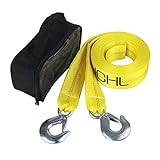
- 2 inch x 20 feet Yellow High Strength Polyester Strap, 20,000Lb Break Strength Capacity
- Extra heavy-duty tow strap made from high tensile strength nylon which makes the product to withstand pressure. 20,000 lbs towing capacity ensures that you can tow just about anything you need.
- Universal Use: Heavy duty tow strap 3"*20 ft, 20,000 LB capacity making it reliable for all possible needs. There's a wide range of uses for Vehicle towing, Pickup Trucks, ATV, SUV .Also you can use it as a tree saver strap or winch extension strap.
- 2 forged safety hooks with retaining clips, ZINC coated finish on hooks offer three times more corrosion resistance.
- Storage Bag: come in a storage bag, Roll up the strap and secure in place in free storage bag. JCHL Team strive to provide you highest quality products and best service, 100% satisfaction guarantee.
Select the correct drive mode and controls
Learn the mode selector, 4WD controls, hill-descent system, traction control settings and any locker procedure at home before the trail. Engagement conditions, speed limits and shift requirements vary by model year and trim, so use the manual rather than a generic sequence.
PC Slower Than It Used to Be?
A free scan shows the junk files, broken settings and background clutter dragging Windows down - then fixes them in one click.Free scan · Windows 10 & 11Crashes, No Sound, or Screen Glitches?
Random freezes, missing sound and display glitches usually trace back to one bad driver. Find and replace yours safely.Free scan · under a minuteTerrain mode
Chevrolet describes Terrain mode as intended for “low-speed, mild off-roading, such as heavy ruts, 2-track or non-road driving.” Use it for the kind of controlled, slow route recommended for a first drive when your truck is equipped and the manual permits it.
Low-range 4WD
Low range, when equipped, multiplies torque and provides fine speed control. Chevrolet describes it as useful for deep sand, mud or snow. Engage it only under the conditions stated in your manual, normally before the difficult section, and use the required stationary or low-speed shift procedure. Do not force a selector or drive in a mode that the manual prohibits on firm pavement.
Rank #4

- Our 2 inch x 20 feet Heavy Duty Tow Strap made from High Strength Polyester, which is more durable and UV resistant as well as for 10% MAX stretch while under load 26,000Lb Break Strength Capacity
- Extra heavy-duty tow strap made from High Strength Polyester which makes the product to withstand pressure. 26,000lbs towing capacity ensures that you can tow just about anything you need.
- Universal Use:There's a wide range of uses for Vehicle towing, Pickup Trucks, ATV, SUV .Also you can use it as a tree saver strap or winch extension strap.The towing strap works in all climates, and will not stretch, shrink
- Storage Bag: come in a storage bag, Roll up the strap and secure in place in free storage bag.
- JCHL Team strive to provide you highest quality products and best service, 100% satisfaction guarantee.
Throttle, steering and braking aids
Use smooth throttle and steering inputs. Let the drivetrain work at walking speed instead of carrying momentum into a rut or ledge. Keep the wheels as straight as practical when climbing an obstacle, brake early on descents and avoid abrupt pedal changes that can break traction. If a feature such as hill descent control is available, understand its activation and limits before relying on it.
Drive the trail one obstacle at a time
- Stop at the trail entrance and confirm drive mode, tire pressure, cargo security and passenger restraints.
- Walk or visually scout blind rises, deep ruts, rocks, mud, off-camber shelves and crossings. Get out rather than trusting a camera view alone.
- Pick the line with the least risk to tires, differentials, rocker panels and exhaust. Keep one tire on firm ground when possible.
- Use low speed and steady momentum only when the surface is known; never use speed to hide an unknown obstacle.
- Pause after each difficult section to check for tire damage, overheating, leaks or a shifted load.
- If the truck starts to sink, slide sideways or lose clearance, stop. Do not keep spinning the tires; spinning digs holes and raises recovery loads.
Passengers should remain belted and keep hands, feet and loose objects inside the cab. Never stand near a tensioned strap or winch line, and never straddle or step over one.
The Tool Desk
Outbyte PC Repair FREEClear out junk files and repair common Windows errorsFree Scan →Outbyte Driver Updater FREEScan for outdated or missing drivers - takes under a minuteDriver Scan →Treat water as an exclusion decision
Never enter rushing water. A crossing can hide a washed-out bottom, move the truck sideways, damage electronics or carry the vehicle downstream. Check depth, current, entry and exit before committing; if you cannot verify a safe exit, turn around.
Best Value

- Our traction rope provides 35,000 LBS of breaking strength, making it an ideal tool for hauling trucks, off-road vehicles, and heavy equipment. The total length of 30 feet and a width of 3 inches make it perfect for any job.
- Our Shackle Hitch Receiver, 3/4 D Ring Shackles (2pcs) are well-filled and reinforced, allowing the belt to withstand high tension and wear at the connection points. This helps to extend the life of the belt and protect your equipment.
- Our tow strap is an essential tool for off-roaders, emergency personnel, farmers, or anyone needing to haul heavy objects. It can be used to easily remove fallen trees, stumps, shrubs, and debris in an emergency, saving you the expenses paid to professionals and waiting for rescue time.
- HORUSDY straps make off-road travel easy and enjoyable. You can pull out stuck cars through the traction belt, making it a great tool for any off-roading enthusiast.
- We provide a lifetime warranty to guarantee a 5-star experience.
The 2024 Colorado owner’s manual lists these standing-water limits by trim:
| 2024 Colorado trim | Listed standing-water limit |
|---|---|
| WT, LT or Z71 | 61 cm (24 in) |
| Trail Boss | 66 cm (26 in) |
| ZR2 | 71 cm (28 in) |
The same guidance warns against water deep enough to cover wheel hubs, axles or the exhaust. These figures apply to the stated 2024 Colorado trims and are not transferable to every Chevy truck, tire, modification or model year. Use the current manual for your truck; modifications, load, current and bottom conditions can make a published maximum inappropriate.
What to do if the truck gets stuck
Stop before the situation worsens
Release the throttle, set the parking brake when appropriate and assess whether the truck is high-centered, buried to the axles, hung on a differential or simply lacking traction. Ask passengers to stay in the cab unless they can stand well clear of the recovery path. If water is rising or the vehicle is unstable, leave the area and call for help rather than attempting a recovery.
Try the least-force option first
- Clear mud, snow or loose material from in front of the tires only when it is safe.
- Use a traction aid under the driven tires if you can place it without reaching near a rotating wheel.
- Back out along the path you just used if the truck can move under its own power without wheelspin.
Set up a strap recovery correctly
- Read the strap and connector ratings and inspect them for cuts, abrasion, bent hardware or contamination.
- Attach only to the approved recovery points identified for your truck. On the Colorado, front recovery hooks are not side-pull or towing points.
- Align vehicles as straight as practical, remove bystanders from the line and agree on a signal or radio channel.
- Apply a smooth, controlled pull; avoid shock loading, jerking or standing in the bight of the strap.
- Stop immediately if a point, connector or vehicle shifts, bends or makes an abnormal sound. Reassess rather than increasing force.
If the truck is deeply buried, damaged or in a dangerous position, professional recovery is safer than escalating force with a larger vehicle. A recovery strap is not a substitute for a winch plan, a rated anchor or knowledge of the truck’s structure.
Finish the trip with a post-trail inspection
Before highway travel, restore the tire pressure specified for road use and verify that the compressor and tools are secured. At the trail exit, inspect:
- Tire tread, sidewalls, wheels and valve stems; check for slow leaks.
- Steering, suspension, brakes and wheel-nut security.
- Skid plates, bumpers, recovery points, differential housings and exhaust.
- Engine bay, radiator openings and underbody for mud, grass or debris that can restrict cooling or damage components.
- Fluids, electrical connectors, lights and any warning messages.
- Recovery gear and cargo for cuts, deformation, contamination or missing parts.
Clean mud from the radiator and underbody where appropriate, repair punctures before the next drive and photograph damage while it is fresh. Record the route, tire pressure, drive modes used, obstacles encountered and any near miss. That log helps you choose a more demanding trail—or recognize that a particular modification or load needs attention—without guessing next time.
Quick Recap
A first-trip checklist
| When | Confirm |
|---|---|
| At home | Exact manual; route, weather, closures and legal access; payload calculation; vehicle inspection; spare and recovery-point check. |
| At the trailhead | Fuel, passengers and cargo secured; communications and navigation working; tire target set; drive mode understood; turnaround identified. |
| At each obstacle | Stop, scout, check depth and exit, choose a reversible line, keep bystanders clear and proceed at controlled speed. |
| Before highway travel | Inspect for damage, remove debris, repair or isolate a puncture, restore road pressure and secure all gear. |
Product prices and availability are accurate as of the date/time indicated and are subject to change. Any price and availability information displayed on Amazon at the time of purchase will apply.
Recommended Free Tools




