The Tool Desk
Outbyte Driver Updater FREEScan for outdated or missing drivers - takes under a minuteDriver Scan →Outbyte PC Repair FREERepair Windows errors before they cause bigger problemsFix Now →Pack a sport-touring motorcycle by following the lowest applicable limit, placing heavy items low and near the motorcycle’s center, balancing both sides, and securing every bag to the mounting points specified for that luggage system. Finish with a clearance inspection for the wheel, exhaust, lights, controls, and suspension. Then ride conservatively and recheck the load after the first short distance and at regular stops.
There is no universal “safe luggage weight” for sport-tourers. The controlling figures come from your exact motorcycle owner’s manual and the luggage maker’s instructions, including the motorcycle’s maximum loaded weight, axle limits, rack or case ratings, and any model-specific speed guidance.
As an Amazon Associate I earn from qualifying purchases.
Why secure packing matters on a sport-touring motorcycle
Luggage changes a motorcycle’s mass, weight distribution, aerodynamic profile, and the way it responds to steering and braking. A high or rear-heavy load can make the bike feel reluctant to turn or unstable during transitions. A load that exceeds an axle, rack, case, or overall motorcycle limit can also overstress components even when the bag appears firmly attached.
Manufacturers consistently warn that a loaded motorcycle can handle differently and require more stopping distance. The correct response is not simply to add more straps. An overloaded or incompatible luggage system remains unsafe regardless of how tightly it is tied down.
#1 Best Overall
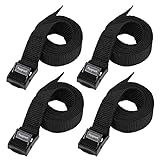
- LIGHTWEIGHT BUT STURDY. Made from unique cam buckles and strong brine yarn webbing, these lashing tie down straps are lightweight for easy carry & storage, and super sturdy to offer a long-term performance
- SIZE MEASUREMENT. 0.75 inches width, 48 inches/ 4 ft length lashing straps. 4 pcs per pack
- CAPACITY. Load capacity: 260lbs, Breaking strength: 350lbs
- EASY TO USE. Cam buckles are fast and easy to tie down or untie your small cargo. No need to spend lots of time on unreliable knots, or too heavy ratchet type mechanism
- MULTIPURPOSE. Ayaport cam buckle tie down straps are widely used to securing small cargo, luggage, packing, camping gear or household goods etc. A must have cam buckle tie down straps for every family
- Use the motorcycle’s own maximum overall weight and axle limits.
- Use the separate limits for each case, rack, pillion, mounting kit, and bag.
- Keep heavy contents low, close to the motorcycle’s center, and balanced between sides.
- Attach bags only as their instructions specify.
- Prevent straps or luggage from reaching the rear wheel, exhaust, lights, controls, or other moving or hot parts.
- Adapt speed and braking technique to the loaded motorcycle.
Find the limits that govern your load
Start with documentation, not the volume of the bags. A large case does not establish a large payload, and a rack’s appearance does not establish its rating. Check the owner’s manual for the motorcycle’s permissible overall weight and front and rear axle loads. Then check the luggage documentation for case, rack, mounting, and bag limits. If the limits differ, the lower applicable limit controls.
What the motorcycle’s total weight includes
A KTM owner manual’s loading section defines total weight as the motorcycle ready for operation with a full tank, the rider and passenger with protective clothing and helmet, and luggage. That definition illustrates why a case’s advertised capacity cannot be considered in isolation: rider, passenger, fuel, accessories, and cargo may all count toward the motorcycle’s permitted overall weight. Read the definition in your own model’s manual because wording and limits vary.
Examples of model-specific figures
The following figures are examples from specific manufacturer documents, not general sport-touring recommendations.
Crashes, No Sound, or Screen Glitches?
Random freezes, missing sound and display glitches usually trace back to one bad driver. Find and replace yours safely.Free scan · under a minuteWindows Errors? Fix Them Before They Spread
Repair common Windows errors and clear accumulated junk for a smoother, more stable PC - no reinstall needed.Free scan · no reinstall| Document or product | Published figure | How to use it |
|---|---|---|
| KTM 2022 owner manual for the model covered by that manual | 430 kg maximum permissible overall weight; 160 kg front axle maximum; 270 kg rear axle maximum | Apply only to the specified KTM model and edition after confirming that your manual is the same one. |
| KTM 2022 owner manual for the model covered by that manual | 130 km/h (80.8 mph) maximum speed with baggage | This is a model-specific loaded-speed instruction, not a universal limit for touring motorcycles. |
| Harley-Davidson accessory guidance for the described bag application | 25 lb (11.4 kg) total for the bag, contents, and attachments when carried on a passenger pillion | Use only for the specified bag and motorcycle application. A rack-mounted bag must also remain within the rack limit. |
| Kawasaki catalogue entries for specified luggage systems | 3 kg maximum for each side of a listed semi-soft pannier set; 3.0 kg for a listed 30 L top case | These ratings belong to the listed products and fitments, not to all Kawasaki or other motorcycle luggage. |
Make a limit checklist
- Motorcycle maximum permissible overall weight.
- Front axle maximum.
- Rear axle maximum.
- Maximum load for each pannier, top case, rack, pillion bag, or auxiliary bag.
- Maximum load for the mounting rack, brackets, and fitting kit.
- Any restriction on combining side cases with a top case or another accessory.
- Any loaded-speed instruction in the motorcycle or luggage manual.
Do not copy a capacity from another sport-tourer, another model year, or a visually similar case. If the manual does not state a value, treat it as not established rather than guessing.
Confirm the luggage system fits your exact motorcycle
Fitment is a separate question from capacity. A case can be strong enough yet unsuitable because the required rack, cover, lock, bracket, or fitting kit is missing. Model-specific catalogues commonly list these components separately and may prohibit particular combinations.
Rank #2

- Flat cargo stretch straps
Check model and year compatibility
- Identify the motorcycle’s exact model designation and model year.
- Confirm that the pannier or top-case carrier is listed for that motorcycle.
- Check whether a separate rack, side bracket, cover, adapter, or fitting kit is required.
- Verify whether the intended side cases and top case may be used together.
- Check the luggage manual for the permitted mounting points and fastener arrangement.
Do not substitute improvised brackets or assume that a rack from a related model has the same load rating. A lock, a rigid shell, or a high-volume case provides convenience and protection from weather; none proves that the load is within the motorcycle’s structural limits.
Choose the arrangement for the trip
| Luggage type | Useful characteristics | Questions to answer before loading |
|---|---|---|
| Hard panniers | Fixed side storage with a defined carrier and closure system | What is the limit for each side, and does the carrier permit a top case at the same time? |
| Semi-soft panniers | Flexible capacity and often removable inner or waterproof bags | How are the bags retained, and what is the maximum load per side? |
| Top case | Convenient access and a central mounting position | What are the case and rack limits, and how does the higher rear load affect handling? |
| Rack or pillion bag | Useful for light, compact cargo when a rack or passenger seat is available | Is the permitted load for the rack, pillion, bag, contents, and attachment hardware stated separately? |
| Inner bag or liner | Makes a removable load easier to carry and can provide weather protection | Is it included or optional, and is it made for the exact case and model? |
For example, Kawasaki listings describe waterproof liners included with some semi-soft systems and optional inner bags for certain quick-release panniers. Treat those as product-specific features and verify current fitment before purchase.
Quick wins for a faster PC:
Clear out junk files and repair common Windows errorsFree Scan →Fix the driver behind crashes, sound loss and screen glitchesFind Drivers →Repair Windows errors before they cause bigger problemsFix Now →Pack heavy items low and keep the motorcycle balanced
The safest general arrangement is a compact load supported close to the motorcycle’s center, with weight distributed between the front and rear wheels. The KTM loading guidance explicitly recommends securing luggage as close as possible to the center and distributing weight evenly between the front and rear wheels.
Sort the contents before they go in
- Heavy, dense items: place low and close to the motorcycle’s center. Examples include tools, compact cooking equipment, and dense clothing layers.
- Medium-weight items: distribute between the two side cases and the central luggage location.
- Light, compressible items: use the upper part of cases or a light top bag without creating a tall, loose stack.
- Frequent-use items: keep accessible without placing them where they can interfere with the rider’s movement or controls.
Do not put all the heavy contents in one pannier to make the other side easier to access. Side-to-side imbalance can make the motorcycle pull or feel different during turns. Divide comparable items between the side cases and keep the total weight of each side within its own rating.
Keep the load clear of the rider and motorcycle
A bulky item must not restrict steering, throttle, brake, clutch, foot controls, passenger movement, suspension travel, or the rider’s ability to place both feet securely. It must not cover the tail light, indicators, reflectors, or license plate where those items are required to remain visible. Check clearances with the motorcycle upright and, where practical, with the suspension compressed under the load.
Rank #3

- 4-Pack Multi-Scene Tie-Down Straps : Comes with 4 elastic luggage straps, specially designed for securing cargo on motorcycles, bicycles, ATVs, UTVs, vans and watercraft, meeting all your daily and outdoor fastening demands.
- Adjustable Stretch Design : 1" wide with adjustable length from 20" to 50" (max stretch to 55"), built-in natural rubber core delivers excellent elasticity, and the loop end design ensures easy and secure attachment without extra buckles.
- Superior Load & Tensile Strength : Boasts 100 lbs load capacity and 300 lbs tensile strength, crafted from premium polyester, natural rubber and engineering plastic for long-lasting durability, wear and tear resistance.
- Smooth & Practical Construction : Features a smooth exterior finish that prevents scratching to your vehicle and cargo, the stretchable design fits items of various sizes tightly and avoids slipping during riding or transportation.
- Lightweight & Easy to Store : Weighing only 15.5 ounces in total, these straps can be easily coiled and stowed in saddle bags, pockets or tool kits, perfect for on-the-go use and impromptu cargo securing needs.
Close and contain every item
Use the case’s internal straps, dividers, or liner where provided. Close zippers, latches, and lids completely. A loose bottle, tool, or shoe can move inside a case, change the balance, or damage the closure. Waterproof liners and removable inner bags can simplify packing, but they do not increase the case’s permitted payload.
Recommended Free Tools
Secure each bag using its designed mounting method
Mounting instructions differ between a rack bag, pillion bag, pannier, and top case. Follow the instructions for that exact product rather than copying a strap pattern from another motorcycle.
- Inspect the mounting points. Look for damaged rails, cracked brackets, missing fasteners, worn webbing, or distorted attachment loops. Repair or replace damaged parts before loading.
- Position the bag as instructed. Keep it centered on the rack, fully seated on the carrier, or aligned with the case’s locating points.
- Route straps around suitable fixed structure. Harley-Davidson’s luggage guidance describes securing straps to the rack or passenger upright to prevent shifting. Use only attachment structures approved for your bag and motorcycle.
- Keep webbing flat. Avoid twisted straps, sharp edges, exhaust components, and places where the strap can be pinched by a lid or bracket.
- Tighten the attachment. Remove slack without crushing the bag or overloading the mounting hardware.
- Secure the strap ends. Tie or retain every excess end so it cannot flap into the rear wheel, chain, belt, brake, or suspension.
- Close the bag and lock or latch it. A closed lid is not a substitute for the required external attachment.
- Perform a pull test. Pull the bag in several directions. Harley-Davidson’s instructions include checking attachment and pulling a rack bag to verify that it is secure. The bag should not shift independently of the rack or approved mounting structure.
- Check symmetry. Confirm that both side cases are seated and latched identically and that one side is not hanging lower.
- Repeat the check after a short ride. Stop in a safe location, inspect the straps and fasteners, and retighten only if the product instructions permit it.
Adding extra straps does not make an overloaded or incompatible bag safe. Extra retention may be useful when the manufacturer provides an auxiliary strap kit, but the approved mounting method and all load limits still apply.
Complete a clearance walk-around
Walk around the fully loaded motorcycle before starting the engine. Check both sides and look from low angles as well as standing height.
- Rear wheel: no strap, buckle, liner, or loose fabric can reach the tire or wheel.
- Chain, belt, and sprocket area: no loose material can be drawn into the final drive.
- Exhaust: luggage and straps remain clear of hot exhaust components. Heat shields do not make direct contact acceptable unless the luggage instructions specifically allow it.
- Lighting: the tail light, brake light, turn indicators, reflectors, and plate remain visible as required.
- Suspension: the bag cannot contact the tire, mudguard, shock, or linkage when the suspension moves.
- Controls: handlebars turn fully left and right without touching luggage, straps, or tank bags.
- Rider and passenger position: neither person is forced onto a strap, buckle, hot surface, or unstable edge.
- Fasteners and closures: every latch, zipper, buckle, and rack fastener is fully engaged.
Do not rely on a quick glance at the parked motorcycle. Move the handlebars through their full range, inspect the underside of bags, and check the rear wheel area directly.
Rank #4

- UPGRADED STRETCH STRAP. This upgraded motorcycle luggage strap features a new stretch design, making it easier and safer to use and more sturdy. Keep your belongings secure during your ride with this sturdy strap
- LIGHT BUT STURDY METAL BUCKLE. Motorcycle luggage straps are made of zinc alloy buckle and stretch nylon strap. Metal buckle is more stronger than the plastic buckle, and super sturdy to offer a long-term performance
- STRONG & ADJUSTABLE STRAPS. The bike rack straps consists of an elastic part ( much tougher and safer than bungee cord) and a nylon webbing (easy to adjust to the right length)
- SIZE MEASUREMENT.0.75'' width for the motorcycle packing stretch straps.The length can be stretchy from 15 inches to 52 inches to secure your travel luggage
- EASY TO USE. Soft loop design on the packing straps end can keep your motorcycle or dirt bike scratch free
Ride for the loaded condition
The first few miles should be treated as a handling check. Accelerate, brake, and corner smoothly in a low-risk area, allowing more space than usual. A loaded motorcycle can require more stopping distance and may react more slowly to steering inputs.
Adapt speed and following distance
Use the loaded-speed guidance in your exact motorcycle and luggage manuals. The 130 km/h (80.8 mph) figure in the cited 2022 KTM manual applies only to the model covered by that manual. It must not be presented as a general sport-touring speed limit. If your documentation gives no special speed figure, remain within applicable road laws and reduce speed whenever the loaded motorcycle feels less stable or requires more stopping distance.
Recheck at the first stop
After a short initial ride, inspect every bag, strap, latch, and rack connection. Continue checking at fuel stops or other regular breaks. The KTM loading guidance specifically calls for luggage to be checked regularly. Look for new strap slack, rubbing marks, heat damage, shifted cases, loose fasteners, or a bag that has begun to rotate on its mount.
Troubleshoot common packing problems
| Symptom | Likely cause | Action |
|---|---|---|
| One side feels heavier in turns | Uneven contents or one case carrying more dense items | Stop safely, redistribute the contents, and verify each side remains within its own limit. |
| Rack bag shifts during the pull test | Incorrect attachment point, slack strap, or incompatible rack | Remove the load and remount it exactly as instructed. If it still moves, do not ride until the approved mounting solution is identified. |
| Strap end hangs near the wheel | Excess webbing was not retained | Stop before riding and secure the end so it cannot reach the wheel or drivetrain. |
| Bag or liner touches the exhaust | Incorrect position, excessive bulge, or insufficient clearance | Reposition or remove the luggage. Do not assume a heat shield makes contact safe. |
| Top case makes steering feel light or vague | Heavy or high rear load | Move dense contents lower and closer to the center, reduce the load, and follow the case and motorcycle limits. |
| Case latch will not close normally | Overfilled case or contents pressing against the lid | Remove items and repack. Never force the latch or use it to compress an overloaded case. |
| Lights or reflectors are partly covered | Bag positioned too far rearward or cargo too tall | Reposition the luggage or remove it until all required lighting and reflectors are clear. |
| Fastener loosens after riding | Vibration, incorrect hardware, or damaged mounting point | Stop, inspect the hardware, and follow the manufacturer’s repair or tightening procedure before continuing. |
Build a practical touring load
For a short day ride
Use the smallest compatible luggage arrangement that holds the essentials. Keep dense tools and spare parts low, place rain gear and frequently used layers where they are accessible, and avoid filling a top case simply because space remains. A light, compact load makes it easier to preserve the motorcycle’s original balance.
What’s actually slowing this PC down?
Pick the symptom - the matching free tool is one click away.
For a multi-day tour
Divide clothing and personal items between the side cases rather than concentrating them in the top case. Put the densest items low and central, reserve a small accessible compartment for documents and emergency equipment, and use a removable inner bag if the luggage maker provides one. Keep the contents of each case within its individual limit even when the combined luggage appears to have spare capacity.
Best Value

- 【DOUBLE LOAD-BEARING CAPACITY】Upgrade Material-Lashing straps are made from high-strength polyester fiber. Compared to polypropylene fiber material, its load-bearing capacity reaches two times that (about 660 lbs). The cargo straps deliver stable and secure tension for all your fastening needs. As heavy-duty tension straps, they effectively lock small items in place without slipping, making them a trustworthy choice for both indoor and outdoor use.
- 【THIN BUT VERY STURDY】Tie-Down Strap feature wear-resistant construction for long-lasting durability. The Carbon steel Cam buckle can effectively lock the strap. The black surface can prevent metal corrosion, making it more durable and reusable multiple times
- 【EASY TO USE】Featured with user-friendly cam buckles, these pull straps allow for fast tying down and untying of small cargo. No more struggling with unreliable knots or bulky ratchet mechanisms—just a simple pull and lock to get the job done in seconds. This design makes the cam strap a hassle-free option for daily packing and cargo fixing.
- 【SPECIFICATION】1 inches in width and 59 inches/5 ft in length, ideal as mini tie down straps for small-scale securing tasks. Each pack includes 4 pieces of cinch strap, which can double as adjustable tie down straps to fit different cargo sizes—perfect for users seeking compact yet functional strap solutions.
- 【WIDELY USE】These packing straps are incredibly versatile, serving as ladder straps for ladder rack to secure ladders firmly during transportation, and as compression straps to bundle luggage, camping gear, household goods, and more. As essential utility straps for every family, they work seamlessly as ladder straps, tiedown strap, and adjustable strap to meet diverse securing demands in life and outdoor activities.
For two-up travel
Account for the passenger’s weight, protective clothing, helmet, and luggage in the motorcycle’s total-weight calculation. Confirm the permitted passenger-pillion or rack-bag limit for the exact accessory. A bag that is acceptable when mounted to a rack may have a different limit when carried on the passenger pillion.
How to compare luggage options
When choosing between systems, compare the practical details that affect safe loading rather than volume alone.
| Comparison point | What to verify | Why it matters |
|---|---|---|
| Fit and compatibility | Exact model/year, required brackets and fitting kit, and permitted combinations | An apparently compatible case may require a different carrier or may not be approved with another case. |
| Permitted load | Motorcycle, axle, case, rack, and mounting limits | The smallest applicable rating governs the usable load. |
| Retention | How the case or bag locks to the carrier and how straps are routed | A secure closure and a secure vehicle attachment are separate requirements. |
| Weather protection | Sealed shell, included waterproof liner, or optional inner bag | Weather protection helps protect contents but does not change structural capacity. |
| Convenience | Removable inner bags, one-key operation, and ease of carrying into lodging | Convenience can improve touring usability without being evidence of a higher load limit. |
Product catalogues can change, so verify the current listing and installation manual before buying or combining components. If a catalogue does not state a load value for your exact system, do not infer one from a similar product.
Final pre-departure checklist
- Exact motorcycle and luggage manuals have been checked.
- Overall, axle, rack, case, and bag limits are all respected.
- Rider, passenger, fuel, accessories, and luggage are included wherever the manual requires them.
- Heavy contents are low and near the motorcycle’s center.
- Side luggage is balanced and each side remains within its own limit.
- Every bag is mounted using the specified rack, fitting kit, and attachment points.
- Straps are tight, flat, and retained away from moving parts.
- Exhaust, wheel, drivetrain, suspension, controls, and lighting are clear.
- Cases and bags are fully closed and latched.
- A pull test shows no independent movement.
- Loaded speed and stopping-distance changes have been considered.
- The load will be inspected again after the first short ride and at regular stops.
The reliable method is deliberately conservative: use the exact limits, keep the mass central and balanced, mount the luggage as designed, inspect every clearance, and reduce speed for the changed handling. Manufacturer specifications are model-specific; no single luggage weight or strap arrangement is safe for every sport-touring motorcycle.
Quick Recap
Product prices and availability are accurate as of the date/time indicated and are subject to change. Any price and availability information displayed on Amazon at the time of purchase will apply.




