Outdated Drivers Are Slowing You Down
One free scan finds every outdated or missing driver and matches the right update for your exact hardware.Free scan · exact hardware matchWindows Errors? Fix Them Before They Spread
Repair common Windows errors and clear accumulated junk for a smoother, more stable PC - no reinstall needed.Free scan · no reinstallMaintain an electric reach stacker by first identifying its battery chemistry, voltage and drivetrain layout, then separating operator checks from qualified electrical service. Every shift, inspect for damage, leaks, corrosion, loose visible connections, warning messages, wheel or tyre problems and abnormal travel, braking or lifting. Charge only with the approved equipment. Keep high-voltage battery modules, inverters and energized circuits isolated and under the control of trained technicians.
There is no universal service interval, lubricant specification or charging schedule for every reach stacker. Use the exact machine manual, battery documentation and site lockout procedure for those details. The framework below helps operators and fleet teams organize safe work without treating a small pedestrian stacker manual as a heavy reach-stacker maintenance schedule.
As an Amazon Associate I earn from qualifying purchases.
Start with the machine’s electrical architecture
“Electric reach stacker” describes a class of equipment, not one standardized design. A battery-electric heavy machine may use a high-voltage lithium-ion traction pack that feeds one or more traction inverters and motors. An older or differently configured machine may use a low-voltage lead-acid battery for starting or auxiliary loads. A smaller stacker may use sealed GEL batteries. The inspection and service rules are not interchangeable.
Quick wins for a faster PC:
Clear out junk files and repair common Windows errorsFree Scan →Scan for outdated or missing drivers - takes under a minuteDriver Scan →Repair Windows errors before they cause bigger problemsFix Now →Read the data plate, battery label and operator manual before touching the battery compartment. Record the manufacturer, model, serial number, battery type, nominal voltage, capacity, charger model and any battery-management-system information. If those details do not agree, stop and ask the manufacturer or authorized service organization to resolve the discrepancy.
#1 Best Overall

- 【36V 25A 1250W Fast Charger & Wide Applications】36V forklift battery charger is suitable for all 36V vehicles equipped with 100AH-200AH lead-acid batteries. It features 3 connectors: a SB50A Anderson plug, an M8 ring terminal, and a SB175A Anderson plug, making it compatible with a variety of devices such as forklifts,floor washers,sightseeing cars,golf carts,electric pallet trucks,scissor lift platform,etc., facilitating charging of variety of battery packs and charging points, plug and play.
- 【Overcharge Protection Smart Charging Technology】36V charger adopts advanced 5-level smart charging technology, and the charging process is automatically controlled by the charging program, which can automatically adjust the charging voltage and current. When the battery is close to being fully charged, it will automatically reduce the AMP output and enter trickle charging mode. Once the battery is fully charged, it will automatically shut down, so you can charge overnight with peace of mind.
- 【8 Protection Functions Design - Safe Charging】36 volt forklift battery charger is designed with safety in mind, has perfect protection systems, and is designed with overcharge/overheat/overcurrent/overvoltage/reverse connection/short circuit/no-load protection and other functions. In addition, in order to protect the battery, the 36v charger sets a maximum charging time (15 hours). When the charging time reaches 15 hours, the charger will automatically stop charging to prevent overcharging.
- 【IP67 Waterproof & Superior Heat Dissipation】The 36V forklift battery charger is made of high-quality die-cast aluminum, making it small and lightweight at only 6.2lbs/2.8 kg. Furthermore, The inside of the forklift charger is fully potted and provides IP67 protection, you don't have to worry about the charger being damaged by water, dust or vibration. The 36V forklift charger also features a cooling fan for effective cooling and stable operation.
- 【Charging Status Indicator】36V forklift battery charger is designed with a three-color LED indicator, so you can always know the battery charging status through the indicator. Red/Green Flash:Waiting mode or no-Load; Red Flash: Low Charging(80%); Green Flash: Trickle Mode(≈ 100%); Green On: Fully Charged(100%).
| Battery arrangement | What the operator may normally do | What requires the exact manual and trained service |
|---|---|---|
| High-voltage lithium-ion traction battery | Visual inspection of accessible surfaces, warning display, charging connection and obvious damage; keep the area clean and dry. | Opening modules, insulation tests, contactor or fuse work, thermal-management service, software diagnostics and any energized-circuit work. |
| Flooded lead-acid battery | Only the checks authorized for that battery, such as exterior condition and, where specified, electrolyte level. | Charging settings, ventilation requirements, electrolyte handling, cable torque and any internal repair. |
| Sealed GEL or other maintenance-free battery | Exterior inspection, cleanliness, secure connections and charger compatibility. | Opening the case, adding liquid, changing charge parameters or testing beyond the maker’s procedure. |
Kalmar’s guidance for battery-electric heavy equipment describes lithium-ion modules as largely maintenance-free but still subject to scheduled checks by qualified personnel. It also emphasizes charger and machine interoperability and battery-health monitoring. Treat that as general electric-equipment guidance, not as a substitute for your reach stacker’s service schedule.
Perform a pre-use walk-around every shift
Use the machine’s inspection checklist and complete the walk-around before operating or charging. A smaller lithium pedestrian stacker manual from EKKO lists hydraulic leakage, support wheels, battery state, brake operation and travel and lift functions as pre-use checks. Those are useful examples of inspection categories, but they are not a complete heavy reach-stacker schedule.
Inspection sequence
- Look at the machine from a safe distance. Check for impact damage, bent guards, displaced covers, fluid on the floor and anything obstructing the mast, carriage, reach mechanism or access steps.
- Inspect the battery compartment and visible cables. Look for cracked housings, swelling, leaks, heat discoloration, exposed conductors, damaged insulation, loose-looking plugs and signs of corrosion. Do not remove covers to gain access to concealed high-voltage parts.
- Check indicators before movement. Read battery, isolation, temperature, brake, traction and general fault messages. Record the exact code or display wording rather than relying on memory.
- Examine wheels and tyres. Look for cuts, chunks, embedded objects, unusual wear, loose hardware and anything that could affect stability or tracking.
- Inspect the mast and load-handling hardware. Look for hydraulic oil, damaged hoses, abnormal chain or attachment condition and anything that could interfere with the reach, tilt, lift or lower functions.
- Check the charging connection. The connector, cable, socket and protective cap should be clean, dry and undamaged. Do not use a connector that is hot, discolored, cracked or difficult to seat.
Make only permitted functional checks
With the area clear and the operator manual permitting it, test steering, service and parking brakes, travel in both directions, reach, lift and lower controls at low speed or stationary as specified. Listen for new grinding, clicking, whining or hydraulic noise. Note hesitation, surging, delayed braking, uneven acceleration, drift, excessive vibration or a change in lift speed. A functional check is not permission to bypass an interlock, enter a danger zone or operate with a known fault.
Conditions that require a stop
- Any high-voltage, isolation or battery-temperature warning.
- Smoke, a burning smell, hissing, unusual heat, swelling, venting or visible electrolyte.
- Exposed or damaged high-voltage cable, connector or enclosure.
- Brake, steering, traction, lift or lowering behavior that is abnormal or unpredictable.
- A hydraulic leak, damaged wheel or tyre, structural crack or load-handling defect.
- A charger or battery connector that overheats, arcs, will not latch or shows damage.
Park safely, lower and secure the load-handling equipment, isolate the machine according to the site procedure and report the condition. Do not clear a warning merely to return the machine to service.
Maintain the battery according to its chemistry
Clean and inspect accessible surfaces
Keep the exterior of the battery compartment, covers and connectors clean and dry. Remove loose dirt with the method allowed by the machine manual. Check for cracks, leaks, corrosion, impact marks, loose fasteners, damaged labels and evidence of heat. Moisture or conductive contamination around a high-voltage connector is a reason to stop and escalate, not a cue to spray or wipe inside the connector.
Never assume that a battery terminal-cleaning brush, grease or water is appropriate for every battery. A brush is relevant to the conventional lead-acid terminal task described in a SANY manual; it is not a reason to open a sealed or lithium-ion pack.
Rank #2

- Fast Charging & Wide Application: 24V/30A/1250W fully-automatic smart charger, ideal for all 24 Volts lead-acid battery-powered vehicles (forklifts, floor scrubbers, golf carts, patrol cars, etc.); Plug-and-play, connect battery terminals, insert 110V plug, 3s self-test then charge, auto-stop when full; 7-stage smart charging with trickle mode prevents overcharging, extends battery life; Built-in cooling fan ensures stable operation
- Intelligent Temperature Compensation & 3-Color Indicator Light: Upgraded with a built-in temp sensor to adjust charging voltage per ambient conditions for optimal performance; Red and Green flash: waiting mode or no-Load, Red flash: low charging(80%), Green flash: trickle mode, Green on: fully charged(100%)
- Six Safe Charging Protections: Built-in circuit safeguards provide overvoltage & overcurrent protection. No output without battery connection, reverse-connection/short-circuit cuts off internal circuits to avoid damage, auto-shuts down at high temps and resumes charging when cooled
- IP67 Waterproof, Shockproof & Temperature-Resistant: Durable aluminum body for daily wear. IP67 waterproof/ dustproof & automotive-grade shockproof for outdoor use. Wide temp range (-20℃~+45℃) adapts to various environments
- 9.8 FT Cable & Anderson Plug: The 24 volt battery charger comes with a 9.8ft heavy-duty cable (4.9ft power cord and 4.9ft charging cable) and battery quick connector to charge your vehicle quickly and safely. The charger additionally comes with a spare plug connector and 2 terminal pins for wider use
Flooded lead-acid: follow the battery-specific procedure
The 2019 SANY manual describes a conventional lead-acid battery. For that particular system, it directs the user to check electrolyte weekly, add pure water if the level is low, clean oxidized terminals and cable joints with a copper wire brush, tighten the joints and apply protective grease. Those instructions are chemistry- and model-specific. They must not be copied to a sealed, GEL or lithium-ion battery, and they do not establish a universal reach-stacker interval.
If your own manual authorizes electrolyte inspection, wear the stated personal protective equipment, keep ignition sources away, use only the specified water and never overfill. Do not disconnect or reconnect a battery unless the manual gives the sequence and the machine is isolated. Battery acid burns and charging gas can create serious hazards; site ventilation and emergency-wash requirements apply.
Sealed GEL and maintenance-free batteries
The Triton manual identifies its stacker batteries as maintenance-free GEL. That means an operator should not add water or open the battery. Inspect the case, terminals, cables and charger connection as directed, and report swelling, cracks, leakage or heat. The fact that a smaller stacker uses GEL does not prove that another machine does.
High-voltage lithium-ion packs
Do not open a high-voltage module, remove covers, probe terminals, bypass an interlock or perform an insulation test unless you are trained, authorized and following the manufacturer’s isolation and test procedure. High-voltage work can remain dangerous after the key is removed because stored energy may persist. Kalmar identifies specialist competence and scheduled checks of electrical insulation and thermal-management systems as essential for battery-electric equipment.
Operators can report displayed state-of-charge or health information, charging interruptions and temperature warnings. Technicians should use the approved diagnostic system and service documentation to interpret those values. Do not set a generic voltage, temperature cutoff or state-of-charge limit from another machine.
Do these 3 things before closing this tab:
1Repair Windows errors before they cause bigger problems2Scan for outdated or missing drivers - takes under a minute3Clear out junk files and repair common Windows errorsCharge and park the machine without improvising
- Confirm compatibility. Match the charger to the machine and battery documentation. Voltage, connector, communication protocol and charge profile must all be approved; a physically fitting plug is not proof of compatibility.
- Prepare the area. Follow the manual’s rules for ventilation, fire prevention, access control, housekeeping and separation from ignition sources. Keep exits and emergency equipment clear.
- Inspect before connection. Check the cable, plug, socket and battery inlet for dirt, moisture, heat damage or bent contacts. Do not charge a battery that is hot, damaged, leaking or under a fault warning until qualified personnel approve it.
- Connect and start the charge exactly as specified. Use the machine’s normal sequence and observe the charger and machine indicators. Do not use extension leads, adapters or altered settings unless the manufacturer expressly permits them.
- Monitor abnormal behavior. Stop and isolate the process if there is smoke, smell, unusual heat, arcing, repeated faulting or a communication error. Follow the site emergency procedure.
- Disconnect in the approved order. Allow the charger to end the cycle or use the documented stop control before unplugging. Do not pull on the cable or disconnect under load unless the equipment is designed for that action.
The available manuals describe different battery types, so no generic charge duration, storage percentage or temperature limit can safely be published for every reach stacker. Obtain those values from the battery maker and the machine manual.
Rank #3

- 1.【Powerful 30-AMP Charging】 Our 24V battery charger delivers a powerful 30-Amp charging current, capable of fully recharging a 24V 100Ah lead-acid battery in just 4 hours. The 24v forklift battery charger features advanced digital smart technology, with a fully automatic charging program that ensures high output voltage/current accuracy and excellent stability. Plus, it achieves an impressive 94% charging efficiency.
- 2.【3 Connection - Wide Application】 Our 24 volt battery charger lets you instantly switch between three connector types—SB175A Anderson, SB-50 Anderson, and M8 terminal—in just one second. This 24V battery charger is widely used in scissor lifts, forklifts, electric pallet trucks, floor scrubbers, marine vessels, golf carts, and more.
- 3.【Aluminum Alloy Housing & IP67 Waterproof】 Manufactured from die-cast aluminum alloy housing, our 24v scissor lift charger delivers superior IP67 waterproof protection. Beyond this, the aluminum construction significantly enhances heat dissipation while providing outstanding impact resistance and tolerance to extreme temperatures—ensuring reliable operation in the toughest conditions and ensuring long-term durability.
- 4.【Intelligent Temperature Compensation & Status Indicators】 24v forklift battery charger adjusts voltage based on ambient temperature for optimal charging. Clear 3-color LED indicators show charging stages: Red (less than 90%), Yellow (between 90% and 99%), Green Flash (trickle mode), Green On(full charge), simplifying user monitoring.
- 5.【Comprehensive 8 Protection for Safe Charging】 Our 24v pallet jack battery charger features protection against over-voltage, over-current, overheating, no-load conditions, short circuits, reverse polarity, over-charging, and includes timed charging, ensuring safe charging operation.
Define what “drivetrain” means on your model
On an electric reach stacker, the drivetrain may include the traction motor or motors, inverter or controller, reduction gearbox or axle, drive wheel, brakes, high-voltage cables and connectors, cooling components and control software. Some machines integrate these parts into a drive axle; others separate them. The component layout determines the inspection points and lubricant requirements.
| System | Operator-level observations | Service questions for the OEM schedule |
|---|---|---|
| Traction motor and inverter | Fault messages, hesitation, surging, unusual noise, smell or heat. | Cooling flow, insulation, connector torque, software diagnostics and motor-bearing or seal procedures. |
| Reduction gearbox or drive axle | Oil leakage, new whine or grinding, vibration and abnormal temperature compared with normal operation. | Correct oil grade, level and change interval; seal, bearing and fastener procedures. |
| Drive wheels, tyres and hubs | Uneven wear, damage, loose hardware, poor tracking or loss of traction. | Wheel-nut torque, hub inspection and replacement limits for the specific machine. |
| Brakes | Longer stopping distance, pulling, noise, pedal or control changes and warning indicators. | Brake adjustment, friction-material limits, hydraulic or electronic checks and test method. |
| Cooling circuits | Visible leaks, blocked vents, fan noise or temperature warnings. | Coolant type, bleeding, filter or heat-exchanger service and electrical isolation. |
Traction motor, inverter and cables
Keep ventilation openings and cooling surfaces free of dust where the manual allows operator cleaning. Look for chafed cables, damaged conduit, loose external clamps and contamination around connectors. Never open an inverter or motor terminal box for a visual inspection unless the manufacturer’s procedure authorizes it. A fault that appears only under acceleration, after warming up or during regenerative braking should be recorded with the operating conditions; that information helps a qualified technician reproduce it safely.
Gearbox, axle and lubrication
Electric drive eliminates engine oil and filter changes, but it does not eliminate gear oil, axle oil, seals or bearings where the design uses them. Check for fresh leakage and listen for a change in gear noise. Do not top up with a familiar automotive lubricant. The correct fluid, fill level, cleanliness standard, drain procedure and torque values are model-specific.
Recommended Free Tools
Wheels, tyres and brakes
Reach stackers carry loads high above the ground, so wheel and brake condition affects stability as well as stopping. Investigate vibration, steering pull, wheel damage, irregular tyre wear and any change in braking response immediately. Never rely on regenerative braking alone unless the machine manual identifies it as the required service brake performance.
Hydraulics and load-handling components
Inspect hoses, fittings, cylinders, chains, rollers, carriage, forks and attachments for leaks, damage and abnormal movement. Electric propulsion does not make the mast, reach mechanism or hydraulics maintenance-free. Use the specified hydraulic fluid and contamination controls, and keep people clear of suspended or elevated loads during diagnosis.
Clean electrical equipment with the approved method
Do not pressure-wash a reach stacker or direct water at batteries, connectors, inverters, motors or control cabinets. The EKKO manual instructs users to clean the electrical system with compressed air and not water; apply that only where the exact equipment manual permits it. Compressed air can drive dust into seals or propel debris, so use the pressure, nozzle distance and personal protective equipment specified by the manufacturer.
Rank #4
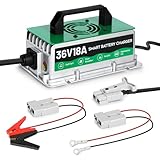
- 【36V 18A Fast Charger & Wide Applications】36V forklift battery charger is suitable for all 36V vehicles equipped with 100AH-200AH lead-acid batteries. It features 3 connectors: a 50A Anderson plug, an M8 ring terminal, and an alligator battery clip, making it compatible with a variety of devices such as forklifts, floor washers, sightseeing cars, golf carts, electric pallet trucks, scissor lift platform, etc., facilitating charging of variety of battery packs and charging points, plug and play.
- 【Overcharge Protection Smart Charging Technology】36V charger adopts advanced 5-level smart charging technology, and the charging process is automatically controlled by the charging program, which can automatically adjust the charging voltage and current. When the battery is close to being fully charged, it will automatically reduce the AMP output and enter trickle charging mode. Once the battery is fully charged, it will automatically shut down, so you can charge overnight with peace of mind.
- 【8 Protection Functions Design - Safe Charging】36 volt forklift battery charger is designed with safety in mind, has perfect protection systems, and is designed with overcharge/overheat/overcurrent/overvoltage/reverse connection/short circuit/no-load protection and other functions. In addition, in order to protect the battery, the 36v charger sets a maximum charging time (15 hours). When the charging time reaches 15 hours, the charger will automatically stop charging to prevent overcharging.
- 【IP67 Waterproof & Superior Heat Dissipation】The 36V forklift battery charger is made of high-quality die-cast aluminum, making it small and lightweight at only 4.8 lbs/2.4 kg. Furthermore, The inside of the forklift charger is fully potted and provides IP67 protection, you don't have to worry about the charger being damaged by water, dust or vibration. The 36V forklift charger also features a cooling fan for effective cooling and stable operation.
- 【Charging Status Indicator】36V forklift battery charger is designed with a three-color LED indicator, so you can always know the battery charging status through the indicator. Red/Green Flash:Waiting mode or no-Load; Red Flash: Low Charging(80%); Green Flash: Trickle Mode(≈ 100%); Green On: Fully Charged(100%). In addition, When the battery is low (battery voltage is below 52V), the 36V forklift battery charger will restart and charge again.
Before cleaning, isolate the machine as required, remove loose items from the work area and protect openings that the manual says to protect. Never clean an energized high-voltage compartment.
Build a preventive-maintenance program around the OEM schedule
Use the following framework to assign responsibility without inventing intervals. The “operator” tasks are condition checks; the “qualified technician” tasks require the exact manual, tools and isolation procedure.
| Work point | Operator or supervisor | Qualified technician |
|---|---|---|
| Each shift or before use | Walk-around, warning review, visible battery and cable inspection, wheel and tyre check, permitted brake/travel/lift test, fault recording. | Not normally required unless a defect is found. |
| Each charge | Verify charger compatibility, inspect connector and observe for heat, smell, damage or charge interruption. | Investigate repeated faults, abnormal temperature or failed communication. |
| At the battery interval stated by the OEM | Provide records and report changes in range, charging time or warnings. | Battery-health, insulation, thermal-management and diagnostic checks; chemistry-specific service. |
| At the drivetrain interval stated by the OEM | Report noise, vibration, leaks and performance changes. | Gearbox or axle lubricant service, brake inspection, wheel-hardware checks, motor and inverter tests, cooling service and software updates as specified. |
| After an impact, fault or water ingress | Stop, isolate and preserve the fault information. | Damage assessment, electrical safety tests and return-to-service approval. |
Schedule work by operating hours, calendar time, duty severity and the manufacturer’s instructions. Heavy loads, outdoor dust, corrosive environments, frequent short charging events, steep ramps and repeated impacts can justify a different inspection plan, but only the OEM can set the safe interval for a particular model.
Independent reader supportYour contribution helps us test, update, and keep practical guides available for everyone.Diagnose symptoms without creating a second hazard
| Symptom | Safe first action | Escalation |
|---|---|---|
| Battery warning or sudden loss of range | Stop in a safe place, record the display and operating conditions, and do not repeatedly reset the warning. | Qualified battery or controls technician checks the approved diagnostic data. |
| Charging stops or connector becomes hot | Stop charging using the documented control and isolate if required. | Inspect charger, inlet, contacts and battery communication with the manufacturer’s procedure. |
| Traction surges, hesitates or loses power | Remove the machine from service and record load, direction, speed and temperature conditions. | Technician checks inverter, motor, cables, controls and fault history. |
| New grinding, whining or vibration | Stop if the change is severe or accompanied by heat, leakage or loss of control. | Inspect drive wheel, axle, gearbox, bearings and mounts using model-specific limits. |
| Brake or steering response changes | Do not continue normal operation. | Qualified personnel test the brake and steering systems before release. |
| Hydraulic leak or uneven lifting | Lower and secure the load if safe, isolate and contain the leak. | Technician repairs the hydraulic or load-handling system and verifies operation. |
Do not substitute a generic scan tool, jumper wire, improvised resistor or “quick” high-voltage test for the documented procedure. If the fault involves an energized circuit, battery enclosure, inverter or motor controller, use trained personnel and the manufacturer’s isolation instructions.
Keep records that reveal deterioration
A useful record links the machine serial number to the battery serial number, charger, operating hours and service events. Log date, hour-meter reading, state-of-charge or health value shown by the machine, charge interruptions, warning codes, abnormal noise or heat, leaks, corrective action and the person who released the machine.
Trend changes rather than relying on one reading. A gradual increase in charging interruptions, reduced available energy, repeated thermal warnings or recurring drivetrain faults deserves investigation even if the machine still moves. Preserve photographs of damaged connectors, leaks and warning displays, but do not remove covers to obtain them.
Best Value

- 【Widely Used 24V 30A Fast Battery Charger】24 volt charger is suitable for vehicles with 24V 150AH~300AH lead-acid batteries such as electric pallet jack, forklift, golf cart, electric scissor lift platform, walk behind floor scrubber. Pallet jack charger has 30A fast charging speed, and is not affected by change of the input AC voltage. Its charging time is shorter than conventional chargers and is twice as efficient as conventional models. It is the most advanced electronic charger at present.
- 【Fully Automatic Smart 24V Forklift Charger】24 volt forklift battery charger is a fully automatic intelligent fast charging equipment. 24V golf cart charger only requires connecting vehicle battery, plugging in 110V power supply, turn on the power switch, and then it will automatically charge after self-checking for 3-4s. The whole process does not require manual monitoring, and the output will stop automatically after it is fully charged, the fully charged indicator will light up to remind you.
- 【Trickle Charging & Battery Repair】This 24V charger adopts advanced microcontroller 5-stage smart charging technology. It can automatically adjusts the current and voltage and controls the charging time to protect the battery from overcharging. When the battery is about to be fully charged, it will enter trickle charging mode to help extend battery service life. Forklift battery charger 24V also can repair batteries with vul.canized plates. Long-term charging will not damage the battery.
- 【Smart Temperature Control & Built-in Cooling Fan】24V forklift battery charger adopts intelligent temperature control technology, which can automatically adjust the working temperature of electric pallet jack charger to ensure the normal operation of pallet jack battery charger. The golf cart battery charger is equipped with a cooling fan to effectively cool the 24v floor scrubber battery charger and make it work smoothly.
- 【7 Protection Functions】1.Overvoltage/Overcurrent protection; 2.Overheating protection; 3.Overcharge protection; 4.Short circuit protection; 5.Reverse polarity protection; 6.Timing charging protection(15h); 7.No load protection. When a fault occurs, forklift charger will auto stop working to protect charger and vehicle from damage. If overheating is detected, the fault light will light up. Cooling fan will continue to work to cool charger until yellow light goes out then you can use it again.
What to compare when selecting or replacing machines
For a fleet purchase or replacement decision, maintenance implications extend beyond advertised battery capacity.
| Comparison point | Questions to ask |
|---|---|
| Battery chemistry and voltage | Is it high-voltage lithium-ion, flooded lead-acid, sealed GEL or another design? Which tasks are operator checks and which require certified technicians? |
| Capacity and charging system | Does the charger communicate with the battery and machine? Are charging locations, ventilation and access suitable for the duty cycle? |
| Service documentation | Are inspection intervals, fluids, isolation points, torque values and fault procedures clearly supplied for the exact model? |
| Local technical support | Can qualified personnel perform high-voltage, insulation, thermal-management and drivetrain work in your region? |
| Drivetrain access | Are motors, axles, gearboxes, brakes, cooling parts and connectors accessible without unsafe disassembly? |
| Diagnostics and data | Does the machine expose battery health, charge history and fault information that maintenance teams can retrieve? |
| Duty and environment | Will loads, shift length, ramps, dust, moisture, temperature and impacts match the machine’s approved operating conditions? |
What electric drive changes—and what it does not
Electric propulsion removes diesel engine oil and filter changes. Karl Sohlberg, Service Solutions Design Manager at Kalmar, and Per-Erik Johansson, Technology Manager Electrification at Kalmar, state: “The removal of the diesel drivetrain from the machine will lead to less scheduled maintenance, as engine oil and filter changes are no longer required.”
That reduction does not make the whole machine maintenance-free. Kalmar also states: “However, most of the wear and tear on the machine’s load handling components and other systems will still be exactly the same on a battery-electric machine, so the difference in scheduled maintenance requirements will not be as dramatic as, for example, on a consumer electric car.”
What’s actually slowing this PC down?
Pick the symptom - the matching free tool is one click away.
Kalmar presents a potential 20–25% reduction in maintenance costs for electric heavy load-handling equipment and up to a 90% reduction in equipment lifetime emissions from electrification. These are Kalmar’s stated expectations, not guaranteed results for every reach stacker or an independent model-specific study. Actual cost depends on battery life, duty cycle, service access, electricity and charger infrastructure, technician rates and the machine’s remaining mechanical wear.
The maintenance rule that matters most
Use the operator checklist to find visible and functional problems early, but use the exact OEM manual to decide what may be opened, tested, lubricated, charged or returned to service. Treat chemistry-specific battery instructions as non-transferable, keep water away from electrical equipment unless the manual explicitly allows it, and escalate every high-voltage, brake, steering, load-handling or serious drivetrain fault through the site isolation process. That division between routine observation and qualified intervention is the safest model-agnostic way to maintain an electric reach stacker.
Quick Recap
Product prices and availability are accurate as of the date/time indicated and are subject to change. Any price and availability information displayed on Amazon at the time of purchase will apply.




