Start storage with a fully charged battery, then prevent the vehicle’s small electrical loads from draining it. Most owners can do that with a compatible automatic battery maintainer or by disconnecting the battery if the vehicle’s manual permits it. Check the battery and vehicle instructions first: charging requirements, safe disconnection steps, and suitable voltage thresholds vary.
Prepare the battery before storage
- Check the instructions. Read the vehicle owner’s manual and the battery label or manufacturer’s manual. Confirm the battery chemistry, charging limits, and vehicle-specific procedure for disconnecting or isolating the battery.
- Inspect the battery and cables. Look for a damaged or swollen case, corrosion, loose connections, worn cables, and dirt on the case. Clean only as the battery maker directs, using appropriate eye protection. Interstate describes cleaning the case and terminals with baking soda and water and using a wire brush on terminals; follow your battery’s instructions before applying a cleaning method. Interstate’s storage guidance
- Fully charge it before parking the vehicle. A discharged lead-acid battery is more vulnerable to sulfation and freezing. Use a charger or maintainer compatible with the battery, and follow its charging profile. A voltage reading can help assess charge, but it is not a full battery-health test and should be interpreted using the exact battery maker’s guidance.
Choose how to prevent drain
While a vehicle sits, parasitic electrical loads can draw down its battery. Choose between maintaining the battery while it remains connected and isolating it from those loads. Neither approach suits every vehicle: consider the battery type, vehicle electronics, storage conditions, duration, and whether safe electrical power is available.
| Approach | When it may suit | What to check |
|---|---|---|
| Compatible automatic maintainer | You can safely provide power where the vehicle is stored, or the vehicle’s small electrical loads cannot be isolated. | Confirm compatibility with the battery chemistry and vehicle, start with a full charge, and follow the manufacturer’s instructions. A maintainer is not automatically interchangeable with a basic trickle charger. ODYSSEY cautions that continuous charging can overheat a battery. ODYSSEY’s charging and storage FAQ |
| Disconnect or isolate the battery | The vehicle’s procedure permits it and you can accept possible effects on electronics, settings, or access. | Check the vehicle manual before disconnecting. Isolating the battery can stop vehicle drain, but disconnection may affect vehicle electronics or settings. Follow the vehicle-specific sequence. |
If you use a maintainer
Use a maintainer that matches the battery and install it as directed by both the battery and vehicle manufacturers. First bring the battery to full charge; then let the maintainer counter small electrical loads during storage. Do not assume a device is suitable just because it is labeled a charger or maintainer.
If you disconnect the battery
Follow the vehicle manual first. Interstate’s general procedure is to remove the negative terminal before the positive terminal, then reconnect positive before negative. The vehicle maker’s instructions take precedence because the disconnection procedure and its effects can be vehicle-specific. Interstate’s battery storage instructions
#1 Best Overall
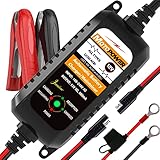
- Charger, Maintainer & Desulfator - An all-weather battery charger, battery maintainer, trickle charger, and battery desulfator. Perfect for charging and maintaining all 12-volt lead-acid, flooded or sealed maintenance free batteries (AGM and gel cell).
- Automatic Desulfation & Optimization - Automatic detection of battery sulfation problem. Applying with pulse current technology to desulfate the batteries effectively. Optimize the battery performance during charging without any manual operation.
- Energy Saving & Spark Free - Zero output in standby mode. No battery drain when connecting with the battery. Spark proof during lead connection for safety.
- Multi-level Safety Protection & Timer Set Up - Overcharge, short circuit and reverse polarity protected. Charge the battery up to 14.4V and Maintain the battery at 13.6V for long time to avoid gasing and to extend the battery life. 24-hour Timer is set up in the program to terminate the charge and enter the maintaining mode once the voltage is above 14V to ensure safety.
- Easy Operation -Just plug-in, connect to the battery and start charging or maintaining your battery. The desulfation is working automatically during the charing. No manual operation.
Check charge during storage
If the battery is not on a compatible maintainer, inspect it and check its charge periodically. Interstate recommends checking stored-battery water level and state of charge every 45–60 days; that is Interstate’s guidance, not a universal interval. Follow the battery maker’s schedule and requirements, including any water-level checks applicable to your battery type.
Voltage references also differ by manufacturer. Interstate’s FAQ says a charged car battery should measure 12.6 volts or higher. ODYSSEY advises recharging its battery before it reaches 12.2 volts, which it identifies as 50% state of charge. These are manufacturer-specific references, not interchangeable thresholds for all batteries. Use the guidance for your exact model, and do not treat one voltage reading as proof of battery health. Interstate’s battery FAQ · ODYSSEY’s battery FAQ
Rank #2

- Efficient, Energy-Saving, and Fast Charging: The TowerTop 12v battery charger offers 4 adjustable current settings (2A/10A/25A/AUTO) to meet your diverse needs. With a max charging current of 25A, you can fully charge a 100Ah battery in under 3.5 hours. Achieving an 85% charging efficiency (industry average 75%), this battery chargers is more efficient, increasing charging speed by 1640% compared to 2A car battery charger. Not only is it energy-efficient, but it also saves you a lot of wait time
- Fully Automatic Charging for Convenience and Safety: This 12 volt battery charger automatically detects battery status and starts charging automatically within 30 seconds if you forget to press Start. After a full charge, it enters pulse repair mode, turns off the screen to save energy, and maintains a safe voltage for long-term storage. If voltage drops, it restores full power. The smart battery charger also remembers your last settings, ensuring seamless operation even after a power outage
- All-in-One Compatible Design: Designed for 12V sealed lead-acid batteries in cars, boats, RVs, power sports, and deep-cycle batteries, including 12V STD, AGM, GEL, Wet, MF, EFB, calcium and deep-cycle batteries
- HD LCD Screen and 8-Stage Intelligent Charging: With true 8-stage smart charging (desulfurization, soft start, bulk charge, absorption, analysis, repair, float, and pulse maintenance), it optimizes battery life and repairs batteries without overcharging or damaging them. The HD LCD screen allows you to view the charging stage and parameters at any time rather than leaving you guessing, keeping you informed of the charging status
- Battery Repair: Independent desulfurization and repair buttons allow you to manually desulfurize and repair your battery to restore lost battery performance, helping to revive old/idle batteries and extend battery life. If your battery cannot be charged, you can try the "repair" mode to fix it. Note: It cannot repair completely drained batteries
Account for cold temperatures and storage time
Charge level affects a lead-acid battery’s exposure to freezing. Interstate gives approximate freeze points of −75°F (−59°C) for a fully charged battery and 15°F (−9°C) for a discharged battery. These are Interstate’s figures, not a guarantee for every battery or condition; do not store a discharged battery in the cold. Interstate’s battery FAQ
Storage-life estimates are also model- and condition-specific. ODYSSEY says that, at 77°F, its fully charged battery can be stored for about two years before needing recharge. Do not apply that estimate to another brand or model, or use it instead of checking the manufacturer’s storage instructions. ODYSSEY’s battery FAQ
Rank #3
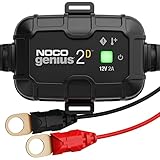
- MEET THE GENIUS2D — The all-new direct-mount onboard battery charger for an under-the-hood battery charging system and year-round battery maintenance.
- DO MORE WITH GENIUS — Designed for 12-volt lead-acid (AGM, Gel, SLA, VRLA) batteries, including flooded, maintenance-free, deep-cycle, marine and RV batteries.
- DIRECT MOUNT — Securely attaches near the battery using a durable snap-fit mounting bracket and installs easily into most surfaces with truss-head self-tapping screws for a hassle-free, reliable setup.
- ENJOY PRECISION CHARGING — An integrated thermal sensor dynamically adjusts the charge based on ambient temperature, preventing overcharging in hot weather and undercharging in cold, ensuring optimal battery performance.
- CHARGE DEAD BATTERIES — Charge batteries from as low as 1 volt, or use Force Mode to manually charge completely dead batteries down to zero volts. Perfect for recovering deeply discharged or neglected batteries.
When storage adjustments are not enough
If the battery repeatedly loses charge, has a damaged or swollen case, or fails a battery health test, have it tested by a battery professional. A maintainer or disconnection can address storage drain, but it cannot repair a failing battery. ODYSSEY’s guidance on battery condition
Quick Recap
Product prices and availability are accurate as of the date/time indicated and are subject to change. Any price and availability information displayed on Amazon at the time of purchase will apply.




