Recommended Free Tools
The Mazda RX-7 FD earned its reputation through a clear sports-car brief: a light, low, front-midship, rear-drive coupe powered by a twin-turbo rotary. Mazda launched the third-generation RX-7 in Japan in December 1991, and the car won the inaugural Japan New Car of the Year award from the Automotive Researchers’ and Journalists’ Conference of Japan (RJC). Its engineering, styling and final Spirit R edition explain why the FD is celebrated—though those facts alone do not establish how much films, games or tuning culture contributed to its fame.
What does “FD” mean?
The FD is the third generation of Mazda’s RX-7. It launched in Japan in December 1991 under the ɛ̃fini RX-7 name; Mazda says it became popularly known as the “FD.” The generation is also commonly identified by its FD-3S chassis code.
Mazda’s development concept was to create “the best rotary-engine pure sports car.” That was the company’s stated ambition, not a claim that the car was objectively the best sports car in its class. The resulting package and Mazda’s documented recognition help explain the FD’s lasting standing among Japanese sports cars.
Why was the FD’s engineering distinctive?
A compact rotary and twin turbos
At its December 1991 launch, Mazda specified a two-rotor 13B rotary engine with sequential twin turbochargers and an output of 255 PS. The company paired it with a front-midship layout—engine positioned behind the front axle—and rear-wheel drive. Mazda’s English corporate history lists a 4.9 kg/PS power-to-weight ratio for the launch car. Mazda’s 1990–1999 corporate history
Outdated Drivers Are Slowing You Down
One free scan finds every outdated or missing driver and matches the right update for your exact hardware.Free scan · exact hardware matchPC Slower Than It Used to Be?
A free scan shows the junk files, broken settings and background clutter dragging Windows down - then fixes them in one click.Free scan · Windows 10 & 11#1 Best Overall

- AUTHENTIC REPLICA: Highly detailed 1:18 scale diecast model of the Mazda RX-7 FD, featuring stunning candy red exterior paint and gold-finished wheels
- PREMIUM DESIGN: Die-cast metal construction with opening doors, hood, and detailed interior components for authentic collector-grade quality
- DISPLAY FEATURES: Comes in a collector's display box with clear window, perfect for showcasing this precision-crafted model
- DIMENSIONS: Large 1:18 scale provides impressive detail, making it an ideal size for display or collection purposes
- COLLECTOR'S ITEM: Part of the prestigious Pink Slips series, featuring authentic sports car styling and premium craftsmanship
Balance as a design target
Mazda says its development team weighed several alternatives, including rear-midship and three-rotor layouts, as well as naturally aspirated and turbocharged power. It settled on front-midship, rear-drive as the best basis for the car. Its goals included 50:50 weight distribution, low yaw inertia, a low center of gravity and a power-to-weight ratio below 5.0 kg/PS. Mazda’s English history records the launch specification at 50:50 and 4.9 kg/PS; these are Mazda-published figures, not independent test results. Mazda’s FD development history
The FD also used all-aluminum double-wishbone suspension at all four wheels, according to Mazda’s launch timeline. These choices support the idea of a car designed around balance and response rather than simply engine output.
Rank #2

- Authentically licensed product from the Fast & Furious Saga.
- As seen in Fast & Furious Tokyo Drift, Han's Mazda RX-7 has been taken directly from the big screen and brought to you in a 1:32 scale die - cast model
- Crafted from durable materials such as 100% die - cast metal and premium rubber tires.
- Our superior casting method allows us to capture the feature rich details of the Han's Mazda RX-7, regardless of size!
- This premium die - cast model is a must have for any Fast & Furious collection
How did the FD’s design support its sports-car brief?
Mazda describes the FD’s shape as low-nosed, with a compact cabin and pronounced front and rear fenders formed to complement low-profile tires. The flowing profile was not separate from the engineering story: the company connects the form to the car’s sports-performance purpose. The result is a distinctive silhouette without needing to claim that one styling feature alone made the car famous. Mazda’s FD development history
What changed over the FD’s production run?
Mazda’s official history records several updates. The output figures below are Mazda-published specifications; they should not be treated as identical for every model year or market.
Rank #3

- Contents: The Savanna RX-7 sports car equipped with a rotary engine known as Mazda's original technology in 1978, and the 3rd generation RX-7 was released in the late 1991 with Hot Wheels motif. The car name has been changed from the 2nd generation Savannah RX-7 to RX-7. The exterior has been modified to an organic form that uses a lot of curves and curves, and was produced until 2003 by changing the shape of the foot and improving the engine power. Often called "Effdi" from the model FD3S. The FD3S is the last RX-7 and the last rotary engine vehicle with turbo, so it is still very popular today. This release is inspired by drift specifications, and features a guard pipe installed instead of the front spoiler that is easy to hit with
- Country of Origin: Malaysia; Recommended Age: 3 years and up
- Perfect Gift: Perfect as a birthday gift, Christmas gift, or anniversary gift for kindergarten or school entrance celebrations
| Date | Mazda-recorded change |
|---|---|
| August 1993 | First minor change, revised grades and the limited RZ, which came standard with low-profile 17-inch sports radial tires. |
| January 1996 | Output increased to 265 PS, and the rear gained three-round taillights. |
| January 1999 | Output rose to 280 PS. Mazda also records improved turbocharger efficiency, revised suspension and tires, a larger front air duct and rear spoiler, and a passenger airbag made standard alongside the driver airbag. |
The increases from 255 to 265 and then 280 PS are a useful outline of the Japanese model’s evolution, not a substitute for checking the specification of a particular car. Market, year and version matter. Mazda’s FD model history
Why does the RJC award matter?
Mazda records that the third-generation RX-7 won the inaugural Japan New Car of the Year award from the Automotive Researchers’ and Journalists’ Conference of Japan (RJC). The company cites the car’s styling and handling. That award is a concrete sign of contemporary Japanese recognition and supports calling the FD a celebrated sports car. It does not quantify public popularity or establish the scale of its later international following. Mazda’s 1990–1999 corporate history
Rank #4
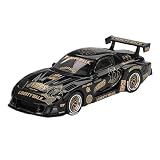
- Brand new box, Comes in a blister pack.
- Real rubber tires, Authentic detail.
- Detailed interior, Exterior.
- Authentic Paint & Graphics
- Die-cast metal body and chassis
What made Spirit R a fitting final chapter?
Mazda announced Spirit R on March 25, 2002, as the final limited series and said FD-3S production would end in August of that year. The series came in three configurations:
| Spirit R type | Seats | Transmission |
|---|---|---|
| Type A | Two | Five-speed manual |
| Type B | Four | Five-speed manual |
| Type C | Four | Four-speed automatic |
All three shared BBS 17-inch wheels, red-painted brake calipers and a special-finish interior panel. Mazda described the FD as a representative sports car for the company; that is Mazda’s own characterization, rather than an independent critical assessment. The end-of-production edition gave the FD a defined farewell instead of letting the generation simply disappear from the catalogue. Mazda’s Spirit R announcement
What can—and can’t—be said about its “legend” status?
The strongest documented case is the one Mazda’s history supports: the FD was conceived as a pure rotary sports car, combined a distinctive engine and front-midship, rear-drive layout with explicit balance targets, and won a major Japanese new-car award for styling and handling. Its Spirit R final series also marked a notable close to the generation.
Those facts make “JDM legend” a reasonable editorial description of the FD’s reputation, but they do not prove how much its global fame came from films, video games, drifting or aftermarket tuning. Nor do the cited records establish a total-production figure, sales total, market share or audience-popularity statistic. For owners looking into period parts or restoration support, Mazda Classic Mazda lists FC/FD reissued parts and final-procurement information; check the part number, chassis and year, and market compatibility before relying on a listing. Mazda Classic Mazda owner support
Quick Recap
Product prices and availability are accurate as of the date/time indicated and are subject to change. Any price and availability information displayed on Amazon at the time of purchase will apply.




