Recommended Free Tools
The safest sequence is straightforward: verify the car’s identity and records, inspect the actual vehicle with a written checklist, test-drive it in conditions that match your driving, and pay an independent mechanic for a written pre-purchase inspection before you commit. A history report can reveal recorded events, but it cannot tell you whether the engine, gearbox, brakes or suspension are healthy today.
1. Start with identity, paperwork and history
Do not begin with paintwork or a test drive. First establish that the car you are being shown is the car described in the advert and documents, and find out what can be verified about its past. A mismatch in identification, mileage or ownership history is a reason to pause before spending time or money on an inspection.


As an Amazon Associate I earn from qualifying purchases.
Record the vehicle’s identifying details
Ask the seller for the vehicle identification number (VIN) or the local equivalent, registration number, make, model, engine specification and current mileage. Write these down before you arrange a viewing. You need the same details when requesting a history report, checking recalls or asking a mechanic for an inspection quote.
The Tool Desk
Outbyte Driver Updater FREEFix the driver behind crashes, sound loss and screen glitchesFind Drivers →Outbyte PC Repair FREEClear out junk files and repair common Windows errorsFree Scan →Document requirements depend on where the vehicle is registered and sold. In the United Kingdom, official guidance tells buyers to use the registration number, make and model, and MOT test number to compare information with DVLA records, MOT history, recall information and the V5C log book. That is a UK process, not a universal list of documents. In another country, the equivalent records may have different names, formats or access rules.
#1 Best Overall
Compare the car with its documents
At the viewing, compare the VIN or other vehicle identification marking on the car with the registration and ownership paperwork. Check the engine number too where the local documents record it and where the number is accessible. Make sure the make, model, body type, fuel type, colour, registration and stated mileage are consistent.
Do not accept a casual explanation for a discrepancy until you have independently verified it. A replacement engine, imported vehicle, clerical error or change of registration can sometimes explain a difference, but you need documentary evidence and confirmation from the relevant authority before proceeding.
Review service and inspection records
Ask to see invoices, service-book entries, inspection certificates and receipts for major work. Compare the recorded work with the manufacturer’s recommended maintenance schedule for that engine and model. Look for evidence of routine oil and filter changes, spark-plug replacement, coolant servicing, timing-belt or timing-chain work where applicable, brake maintenance and replacement of tyres or batteries.
Records are most useful when dates, mileage, workshop identity and parts or work performed are clear. A stack of undated invoices, a stamped book with no supporting detail or a seller’s verbal assurance is weaker evidence than itemised documentation. Missing records do not prove neglect, but they increase the value of a thorough independent inspection and reduce the confidence you should place in the asking price.
Check recalls and reported history
Use the official recall service for the vehicle’s market when one is available. Obtain a vehicle-history report from an appropriate provider if that service operates in your jurisdiction. Depending on local coverage, a report may show ownership events, recorded mileage, accident or insurance claims, flood damage, import status and inspection or test history.
Treat every report as a record of what was reported, not a complete biography of the car. Unreported collisions, repairs paid for privately and faults that never generated a record may be absent. A clean report therefore does not establish that the car is mechanically sound.
Understand what history checks cannot prove
The US Federal Trade Commission states: “A vehicle history report is not a substitute for an independent vehicle inspection.” The report can help you decide whether a car deserves a viewing and can reveal reasons to walk away, but only a physical assessment can investigate current leaks, wear, corrosion, fault codes and mechanical condition.
Quick wins for a faster PC:
Scan for outdated or missing drivers - takes under a minuteDriver Scan →Repair Windows errors before they cause bigger problemsFix Now →Fix the driver behind crashes, sound loss and screen glitchesFind Drivers →| Check | What it can help establish | What it cannot establish |
|---|---|---|
| Vehicle-history report and official records | Reported identity, ownership or mileage events, accidents or flood records, recalls, and inspection or test history where the jurisdiction records them | The car’s current mechanical condition; unreported damage and faults may not appear |
| Independent pre-purchase mechanical inspection | Current mechanical concerns, safety issues and a prioritized repair list with estimates | A guarantee that no future fault will occur |
2. Arrange a viewing that allows a real inspection
Plan the appointment so you can examine the car in daylight, on level ground and when the engine is cold. Ask the seller not to warm it up before you arrive. A warm engine can hide difficult starting, smoke or noises that appear only after the car has sat overnight.
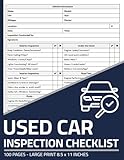
Take a torch, gloves, paper towel, a phone for photographs and a written checklist. A printed used-car inspection checklist or a mechanic-prepared form can keep your observations consistent. It is an organising aid, not a substitute for professional assessment and it cannot rule out hidden damage.
Inspect the exterior and body structure
- Walk around the car and compare the colour, gloss and panel gaps from several angles. Uneven gaps, overspray on rubber seals, paint texture that differs between panels or fasteners with tool marks can indicate previous repair.
- Look for dents, ripples, corrosion bubbles and cracking around wheel arches, sills, doors, the boot or tailgate and the underside of the bumpers.
- Check the windscreen and other glass for chips, cracks and a vehicle-identification marking that does not match the rest of the car.
- Inspect all lamps, lenses, mirrors, wipers and washer jets. Turn each light on and check that the dashboard shows no unexplained bulb warning.
- Compare the four tyres, including the spare if fitted. Note tread depth, uneven wear, sidewall damage, age markings and whether the tyres are the correct size and load rating.
- Look beneath the car for fresh fluid on the ground or wet components. A clean, dry surface is encouraging but does not prove that a leak will not appear under pressure or after a drive.
Pay attention to the petrol-cap-door area. New Zealand transport guidance specifically includes this area in its inspection advice because damage, poor fit or signs of repair can reveal a previous impact or fuel-system problem. Treat anything unusual as a prompt for further investigation, not as a diagnosis you can make from sight alone.
Check the interior and controls
- Open and close every door, the bonnet and the boot. Confirm that locks, handles, hinges, seals and child-safety locks work properly.
- Inspect the seats, carpets, roof lining and boot floor for excessive wear, dampness, staining or a strong air-freshener smell that could be masking moisture.
- Turn on the ignition without starting the engine. Warning lamps should illuminate for a self-check and then go out after the engine starts. A lamp that never appears, remains lit or returns during the drive needs professional diagnosis.
- Test the horn, indicators, hazard lights, headlights, brake lights, interior lights, electric windows, mirrors, central locking, heating, ventilation, air conditioning, infotainment and parking sensors or camera.
- Check that seat belts latch, retract and lock when pulled sharply. Verify that airbags and restraint-system warnings behave normally.
- Confirm that the odometer display, trip computer and service reminders operate. Compare the displayed mileage with the records and history report.
Examine the engine bay without taking risks
With the engine cold, look for oil or coolant residue, damaged wiring, loose hoses, cracked belts, corroded terminals and missing covers. Check fluid levels and colour against the manufacturer’s instructions, but do not open a pressurised coolant system when hot. A very clean engine bay can be innocent detailing or an attempt to remove evidence of a leak; the mechanic should determine which.
Ask whether the engine-management light or any other warning light has recently been reset. A recently cleared fault can leave no warning on the first drive while the underlying problem returns later. A diagnostic scan by an independent technician is more informative than relying on the dashboard alone.
3. Test-drive the actual car in representative conditions
Before driving, confirm that the seller’s insurance arrangements cover you for a test drive where local rules require it. New South Wales guidance specifically advises checking insurance before driving. If the seller will not allow a properly insured drive, you do not have enough evidence to buy confidently.
Use a route that exposes different behaviour
Choose a route that includes ordinary streets, stop-and-go traffic, a faster road and, if practical, a hill. North Carolina guidance and a US government buyer guide both recommend varied conditions such as hills, highways and frequent stops. If your normal use is mostly urban, include low-speed manoeuvres and repeated starts; if you regularly travel on motorways or steep roads, test those conditions too.
- Start the engine from cold if possible. Note how quickly it fires, whether the idle is stable and whether there is unusual smoke, vibration or rattling.
- With the car stationary, select each transmission position as appropriate. An automatic should engage without a severe clunk or long delay; a manual should select gears without grinding and have a clutch that does not slip or judder.
- Accelerate gently and then more firmly when safe. Watch for hesitation, misfiring, surging, excessive noise or a warning light.
- On a quiet, legal stretch, brake progressively and then more firmly. The car should remain straight without pulling, shuddering or producing grinding noises.
- Drive over representative but safe road surfaces. Listen for knocks, rattles and changes in steering feel. A rhythmic clunk from the front end can be associated with worn drive-shaft joints, according to New Zealand guidance, but only an inspection can identify the cause.
- Check steering self-centres after a turn, the vehicle tracks straight and the steering wheel does not vibrate at speed. Note any pulling, wandering or excessive play.
- Use the heater and air conditioning during the drive. Watch the temperature gauge and check that the engine reaches and maintains its normal operating range.
- After parking, leave the engine running briefly and inspect the ground for fresh drips. Smell for fuel, coolant or burning oil, and report anything unusual to the mechanic.
Write down noises, warning lights, handling changes and performance concerns while they are fresh. Driving alone is not proof of mechanical condition; an official Indiana buyer guide recommends using a trusted mechanic even after a test drive.
4. Pay for an independent pre-purchase inspection
Before agreeing to buy, hire a mechanic who is independent of the seller. Give the mechanic the VIN, advertised mileage, service records and your notes from the viewing and drive. Ask for a full pre-purchase inspection rather than a narrow roadworthiness or safety check.
Why a dealer inspection is not enough
A car described as “certified,” “approved” or “dealer-inspected” can still benefit from an assessment by a technician who does not have a financial interest in the sale. FTC consumer guidance says an independent mechanical inspection remains advisable even when a dealer supplies an inspection or certification. A safety inspection may ask only whether the vehicle is currently unsafe to drive; a broader mechanical inspection looks for wear, leaks, impending failures and maintenance needs.
Request a written report and estimates
Ask the mechanic to identify the vehicle by VIN or registration and mileage, list defects by urgency and provide repair-cost estimates where possible. The report should distinguish immediate safety issues from repairs that can be planned and from observations that need monitoring.
Rank #4

- These driver's vehicle inspection report (DVIR) books comply with DOT regulations 49 CFR 396.11 and 396.13.
- Our DVIR inspection book contains a vehicle inspection checklist that comprehensively lists specific tractor/truck and trailer parts to help simplify the inspection process. This allows drivers to quickly mark any needed repairs.
- DVIR books include essential DOT regulations which are printed on the inside cover to remind drivers of the DOT-required procedures they must follow. And there are instructions for filling out a DVIR form to simplify the completion.
- This package comes with 10 books. Each book contains 35 sets of DVIR forms, in duplicate. In total, you will receive 350 forms. Compact 8.5" x 5.5" size facilitates easy handling and record-keeping.
- Our inspection report books are made of carbonless, premium paper that withstands daily use. Whether you manage a single vehicle or a large commercial fleet, our DVIR book is an essential tool for ensuring the safety and compliance of your operations.
Use the written findings in your decision, not just in negotiation. Add the estimated cost of urgent and near-term work to the purchase price. If the total no longer fits your budget, or the mechanic finds structural damage, serious corrosion, engine or transmission problems, walk away rather than hoping the seller’s promise will solve it.
The inspection has a cost and cannot predict every future failure. Its value is reducing uncertainty before you take ownership of an expensive machine.
What if the seller refuses?
A seller who prevents an independent inspection removes one of the most important safeguards in the buying process. The FTC advises considering another dealer in that situation. You can offer to pay the inspection fee and use a mobile inspector or a nearby workshop, but do not waive the inspection merely because the seller says the car is perfect.
5. Make sense of the evidence before you decide
Keep the evidence in one folder: identity checks, history results, service records, your checklist, photographs, test-drive notes and the mechanic’s report. Resolve contradictions rather than averaging them away. For example, a low-mileage dashboard reading combined with sparse records and worn pedals deserves clarification, not an assumption that one source must be wrong.
Green flags
- Identification details match the car and local paperwork.
- Service entries and invoices form a coherent mileage and date sequence.
- Recall actions are recorded as completed or can be scheduled with a confirmed remedy.
- The seller permits a cold start, representative drive and independent inspection.
- The mechanic’s report finds only routine, budgeted maintenance.
Reasons to pause or walk away
- VIN, engine number, registration or ownership details do not match.
- The seller will not provide basic identifying information or records.
- Fresh paint, structural ripples, unexplained corrosion or flood indicators appear.
- Warning lights are missing, remain illuminated or return during the drive.
- The car overheats, misfires, smokes, pulls under braking or has serious fluid leaks.
- The seller refuses an independent inspection or pressures you to pay before one occurs.
6. Keep jurisdiction-specific requirements separate
Registration, roadworthiness, inspection certificates, recall databases, insurance and ownership-transfer rules vary by country and sometimes by state or province. Do not assume that a UK V5C and MOT process, a US title and history report, or an Australian insurance rule applies where you live. Before paying a deposit, check the current requirements of your vehicle-registration authority and confirm how outstanding finance, taxes, inspection status and transfer documents are handled locally.
Official guidance from the United States, United Kingdom, New South Wales and New Zealand supports the same broad sequence—verify records, inspect, drive and obtain independent mechanical advice—but the paperwork and legal checks must be adapted to your jurisdiction.
Quick Recap
7. A compact day-of-viewing checklist
- Bring the VIN or registration details, service records and a written checklist.
- Confirm the seller permits a cold start, insured test drive and independent inspection.
- Match the car’s identity markings and specification to the documents.
- Photograph exterior damage, tyre wear, warning lights and any fluid residue.
- Test every major control and record dashboard warnings.
- Drive through conditions that resemble your normal use.
- Write down noises, vibration, handling, braking and temperature behaviour.
- Arrange the independent inspection before signing or paying the balance.
- Read the written report and add repair estimates to the purchase cost.
- Proceed only when the identity, history, condition and total cost make sense together.
Product prices and availability are accurate as of the date/time indicated and are subject to change. Any price and availability information displayed on Amazon at the time of purchase will apply.




