A weak or erratic spark can cause a misfire, rough idle, or hard starting, but symptoms and trouble codes alone do not prove an ignition part has failed. Record the codes and misfire data, inspect the affected cylinder, and follow the vehicle’s service procedure with the correct test equipment. Ignition specifications and safe test steps vary by vehicle, so use the service information for your exact year, make, model, and engine.
Choose a safe diagnostic route
Start with what you can establish without disturbing parts: note when the symptom occurs and read the vehicle’s diagnostic information. A basic owner-level check can find obvious plug or connector problems; spark and circuit testing requires the right equipment and familiarity with the vehicle’s procedure.
| Route | What it can establish | Limits |
|---|---|---|
| Basic inspection and code read | Stored or pending codes, freeze-frame conditions, and visible damage or poor connections | A generic code reader cannot prove that a coil is weak; cylinder-level misfire data may require an enhanced scan tool with coverage for the vehicle. |
| Service-manual-led testing | Can help isolate a plug, coil, wiring, or control-circuit fault when the prescribed test is followed | Requires a suitable spark tester, exact vehicle procedures and specifications, and safe test setup. |
For example, the GM procedure for a 2007 Chevrolet Silverado 1500 5.3L V8 uses spark testing and coil-swap logic; the Toyota procedure cited here covers a 2007 Tundra 4.7L V8. Neither application supplies universal steps or specifications for other vehicles.
1. Record symptoms, codes, and misfire data
Before clearing codes or replacing parts, write down whether the problem happens during a cold start, warm idle, acceleration, under load, or in wet conditions. Use a compatible scan tool to retrieve stored and pending diagnostic trouble codes and freeze-frame data. If available, record cylinder-specific misfire counts and the conditions when they rise.
Do these 3 things before closing this tab:
1Repair Windows errors before they cause bigger problems2Fix the driver behind crashes, sound loss and screen glitches3Clear out junk files and repair common Windows errors#1 Best Overall

- Scope of application: The spark plug tester is universal and suitable for testing and troubleshooting small or large internal/external engines such as engines, trucks, automobiles, lawn mowers, marine engines and motorcycles. It is the preferred product in any personal or professional machinery store or automobile garage.
- About use: Just connect the tester between the spark plug and the spark plug wire, and it takes about 30 seconds for the internal combustion engine to troubleshoot. If the engine can emit spark, the tester bulb reflects the spark and lights up, so as to quickly find the fault point and bad circuit of the spark plug.
- Excellent material selection: It adopts excellent rubber and metal, high-temperature resistant wire and environmental friendly acetate plastic. It works in high and low temperature environment without impact and is durable.
- Product size: 2.28 inch metal interface, 4.44 inch shaft/lamp housing, 6.53 inch sheath/cable; The internal bulb lasts for several years and is replaced by a transparent housing.
- Service: If you have any questions about the product, please contact us in time, and we will provide you with satisfactory solutions.
A misfire code identifies a condition, not its cause. It does not, by itself, establish that the plug or coil is faulty. Toyota’s 2007 Tundra procedure considers scan-tool data and proceeds through plug inspection, spark testing, and engine checks rather than treating a cylinder code as a parts diagnosis: Toyota misfire diagnostic procedure.
2. Inspect the affected cylinder
With the engine off, follow the vehicle’s service procedure and inspect the affected spark plug and accessible ignition components. Look for a damaged or poorly seated connector, contamination, corrosion, or a damaged coil boot or wire. Check that the plug is the correct type and inspect its electrode condition and gap against the specification for your exact engine.
Rank #2

- Connect the tool between the spark plug and the plug wire
- The short wire is double ended to offer a straight boot and a 90-degree boot on one tool.
- With the engine running, the tool flashes a mirror image of the ignition spark.
- Quickly diagnose problems with all ignition systems
Do not assume that a gap or resistance value from another vehicle applies. The cited Toyota and Mitsubishi applications specify different plug details. The Mitsubishi bulletin also cautions against adjusting the gap of its specified iridium plug. Follow the plug manufacturer’s guidance and the vehicle’s service information rather than bending or cleaning an electrode by default: Mitsubishi service bulletin hosted by NHTSA (July 27, 2022).
3. Test spark using the prescribed setup
Use a suitable automotive spark tester and the procedure for the vehicle’s ignition design. Do not hold a plug or coil by hand while cranking, improvise a ground, or disconnect components with the ignition on unless the service procedure explicitly directs it. Keep hands and leads clear of moving parts; stop if you are not sure how to set up the test safely.
Free tools Windows power users keep installed
One-click scans. No signup required.
Rank #3

- Engine Spark Plug Tester: Spark plug ignition tester can quickly diagnose ignition and engine problems and defects, troubleshooting spark plug connections, contact points, damaged cables wait. This is a practical diagnostic tool for any engine with spark plugs
- How to Use: Connect the black skin of the tester to the spark plug and the metal end of the tester to the spark plug coil. After starting the engine, if the ignition circuit has been completed, spark tester automotive light will flash
- Materials: The probe of this spark tester is made of plated shaft, the optical housing is made of friendly plastic, and rubber straight jacket and cable. Spark plug tester for small engines will not easily rust and corrode during use
- Wide Application: The inline spark plug tester is a must have diagnostic tool for any engine with a spark plug, it fit for all internal and external combustion engines, cars, trucks, motorcycles, chainsaws, trimmers, snow-blowers, generators engines etc
- Package Includes: 2 x inline spark plug testers. If test results are inaccurate or hard to read under bright lighting, please retry the test in a dimmer environment
A GM service procedure for a 2007 Chevrolet Silverado states, “An erratic or weak spark is considered a no spark condition.” That is the procedure’s interpretation for its diagnostic test, not a universal numeric spark specification: GM service procedure reproduced by Operation CHARM.
Test setups are application-specific. A Mitsubishi bulletin describes one method involving disabling injector connectors, attaching a good spark plug to the coil, grounding the plug electrode, and cranking the engine. It is not a general instruction for other vehicles; different systems may require a designated tester, different precautions, or a crank-time limit. Use the exact service-manual procedure for your vehicle, including any instructions to disable fuel or ignition.
Rank #4
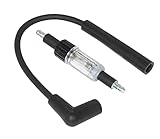
- Gives a Visual Check of the Ignition System.
- Quickly diagnose problems with all ignition systems. Connect the tool between the spark plug and the plug wire.
- The tool is double-ended to offer a straight boot and a 90boot on one tool. With the engine running, the tool flashes a mirror image of ignition spark.
4. Check whether the fault follows the coil
If the service procedure permits a coil swap, move the suspect coil to a known-good cylinder and recheck the misfire data under comparable conditions. If the misfire moves with the coil, that supports a coil fault. If it stays with the original cylinder, the coil swap has not identified the cause; it does not clear the ignition system as a whole.
The cited GM procedure continues with control-circuit testing when the misfire does not follow the coil. It also checks coil ground and plug-wire resistance, but those are examples of vehicle-specific checks—not resistance targets to apply elsewhere. For a no-spark result, follow the applicable circuit tests before considering a control-module fault.
The Tool Desk
Outbyte Driver Updater FREEScan for outdated or missing drivers - takes under a minuteDriver Scan →Outbyte PC Repair FREEClear out junk files and repair common Windows errorsFree Scan →Best Value

- Pitch Adjustment Function: The spark plugs tester is equipped with a pitch adjustment valve and a round knob, which can adjust the observation pitch of the spark plugs according to the needs of different car models, and at the same time can effectively avoid the occurrence of misfire and burnt ignition coils
- Quality Materials: The use of metal connectors to ensure durability and excellent electrical conductivity, to ensure that the current transmission between the inline spark plug tester and the spark plug is stable and efficient, to improve the accuracy of the test
- High Visibility Design: The spark tester for small engine's viewing area scale values are in white font, making it easy to read the scale clearly when measuring gap values from 0 to 40k, even in bright light conditions. This high visibility design enhances ease of operation and accuracy
- How to Use: This ignition coil tester tool is equipped with rubber-coated ground wire, grounding alligator clips and springs for safe and stable introduction of high voltage current. To use, attach the alligator clip to the engine, connect the other end to the spark plug wire and check the spark length through the small window. The longer the spark gap, the stronger the coil
- Widely Applicable: The spark tester has an overall length of 4.5 inches, a cable length of 19.7 inches and a diameter of 0.92 inches. Designed to ensure compatibility with a wide range of automotive ignition systems, it is an ideal tool for automotive maintenance, small engine inspections, ignition coil testing, and lawn mower maintenance
If the fault remains on the same cylinder, continue through the OEM diagnostic flowchart. Depending on the vehicle and findings, the cause may involve the plug, wiring, fuel delivery, an air leak, compression, or another mechanical condition. Toyota’s procedure continues to engine checks after its plug and spark checks.
5. Verify the repair
After a confirmed repair, clear codes only when appropriate and use the vehicle’s prescribed repair-verification procedure or drive cycle. Recreate the conditions recorded at the start and check whether the misfire returns. The cited GM procedure calls for diagnostic repair verification, while a Ford OBD-II procedure specifies a misfire-monitor repair-verification drive cycle: Ford OBD-II misfire monitor verification procedure.
Quick Recap
When to stop and get help
- Stop testing if you cannot safely set up the spark test or identify the correct service procedure.
- If the malfunction indicator lamp is flashing, the engine is running very poorly, or the vehicle is unsafe to drive, do not continue a road test. Consult the owner’s manual and arrange qualified diagnosis.
- Do not replace a coil, plug, or control module solely because a code names a cylinder or a visible spark appears weak. Confirm the fault using the vehicle-specific diagnostic flow.
Product prices and availability are accurate as of the date/time indicated and are subject to change. Any price and availability information displayed on Amazon at the time of purchase will apply.




