Choose motorcycle engine oil by matching the specifications in the owner’s manual for your exact model year and market. Check the required SAE viscosity, JASO classification and, where listed, API category and exclusions. There is no one oil grade or class that suits every motorcycle.
Start with the owner’s manual
Find the engine-oil specifications for your motorcycle’s exact model year and market. Use those requirements rather than choosing by brand, a general climate rule or a recommendation for a different motorcycle. Specifications can vary between models—even within the same manufacturer’s range.
For example, Honda’s CMX1100 owner’s manual specifies JASO MA, while its Dio110 scooter manual specifies JASO MB. Those examples illustrate why the individual manual—not a general rule about motorcycles or scooters—must decide.
How to read the oil specifications
SAE viscosity grade
SAE is the viscosity grade. Honda’s CMX1100 manual explains that “The SAE standard grades oils by their viscosity.” A grade such as 10W-30 is an example of an SAE marking, not a universal recommendation. Use the grade specified in your manual; do not substitute a grade based only on broad climate advice.
What’s actually slowing this PC down?
Pick the symptom - the matching free tool is one click away.
#1 Best Overall

- Up to 10X better friction protection vs. JASO T903:2016 friction std. and up to 5X better wear protection vs. industry standards in IVA engine tests
- Reformulated premium full synthetic with advanced technology and superior additives to maximize horsepower, acceleration, fuel efficiency and oil life
- Exceptional wet clutch protection helps prevent slippage for smooth shifting and maximum performance
- Enhanced protection against deposits and sludge that can reduce oil flow
- Meets or exceeds requirements of API SL and JASO MA-2 for 4-stroke motorcycles including Honda, Yamaha, Kawasaki, and Suzuki
JASO classification
JASO T 903 covers oils for four-stroke motorcycle engines. The label’s JASO classification is a separate requirement from SAE viscosity. MA, MA2 and MB are different performance classifications, not a simple low-to-high quality scale. Manufacturers may specify different classes for different engine and clutch designs; follow the class listed for your motorcycle.
The JASO T 903:2023 application manual explains the standard. JASO also publishes a filed-product list dated November 1, 2025, with product details including viscosity and performance classification. Treat the list as a way to verify filed product information, not as a recommendation for your motorcycle.
Rank #2

- Up to 3X better durability vs. industry standards in sequence IVA engine tests
- Superior wet clutch protection to ensure smooth shifting plus consistent power transfer and acceleration
- Formulated to maximize horsepower and minimize wear on critical moving parts, while safeguarding against harmful deposits that can reduce oil flow
- Improved formula for enhanced friction protection
- Meets or exceeds requirements of API SL and JASO MA-2 for 4-stroke motorcycles including Harley Davidson, Honda, Yamaha, Kawasaki, Suzuki and others
API category and exclusions
API is another oil quality and performance marking. Check your manual for the required API level and any excluded labels, rather than assuming that a higher-looking API category overrides the SAE or JASO requirements. For instance, Honda’s CMX1100 manual calls for API SJ or higher and excludes oils marked “Energy Conserving” or “Resource Conserving.” See the API guide to oil categories and classifications for an explanation of its service categories and quality marks.
Use this checklist before buying
- Identify the motorcycle: confirm its exact model, model year and market, then consult its owner’s manual.
- Record the required SAE grade: match the viscosity exactly as specified.
- Record the JASO class: check whether the manual names MA, MA2, MB or another requirement.
- Check API requirements: match the stated minimum category and avoid any labels the manual excludes.
- Verify the specific product: compare its actual label and stated motorcycle application with every manual requirement. Product pages may condition suitability on the manufacturer’s viscosity recommendation; for example, see Motul’s product listings.
Why matching a few label fields may not be enough
Meeting the named viscosity and classifications does not always establish that an oil suits a particular motorcycle. Honda’s CRF250L owner’s manual cautions that oils meeting the listed standards can still differ in characteristics and may not be suitable for that motorcycle. It also warns against unnecessary friction-reducing additives. Follow the manual’s guidance rather than adding products or assuming that any oil with several matching marks is appropriate.
Free tools Windows power users keep installed
One-click scans. No signup required.
Rank #3

- Complete OEM Compatibility: Compatible with Honda, Kawasaki, Yamaha, Bombardier, Arctic Cat, Can-Am, Polaris, Argo, Linhai, Suzuki, and many others
- No-Compromise Performance: Advanced 100% synthetic ester formulation with built-in friction modifiers delivers superior clutch engagement, stable viscosity, and consistent performance under high thermal stress and at high RPMs
- Meets & Exceeds OEM Specifications: Exceeds JASO MA-2 for motorcycle engines and wet clutch integrated transmission, as well as API SL / SN, meeting all Japanese OEM warranty requirements
- Exceptional Wear & Oxidation Protection: High oxidation stability resists oil thickening, sludge, and varnish while shear-stable VI improvers protect against viscosity breakdown in severe service and racing conditions
- Smooth, Fast Shifting Performance: Optimized frictional characteristics provide quick, smooth gear changes, excellent clutch feel, and reliable protection for cam lobes, chains, and other highly loaded components in small 4T engines in motorcycles, scooters, off-road dirt bikes, etc
When comparing oils
Compare products only against the requirements for a specific motorcycle. A useful comparison includes the manual-required SAE grade, JASO classification, API minimum and exclusions, the product’s stated motorcycle application, and local availability. A product’s brand or a classification by itself cannot establish that it is right for a different model.
For example, a product page may list a four-stroke oil as JASO MA2 (2023) and give its viscosity as 10W-50 or 20W-50. Those are product specifications, not general recommendations; the manufacturer’s viscosity requirement for your motorcycle still governs.
Quick Recap
Best Value
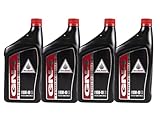
- Set of 4 Genuine Pro Honda factory GN4 4-Stroke 10W-40 SJ motorcycle oils. This oil is specially formulated for motorcycles and it works well with our vintage wet-clutch Honda's!
- "Honda set the standard for motorcycle oil when it introduced GN4 way back in 1975. We selected the highest-quality base stocks and created an additive package specifically designed for the unique requirements of motorcycle and ATV engines. Constant testing and development give today’s GN4 even better shear resistance, viscosity stability and cleanliness to meet the requirements and stresses of a new era of engine technology."
- 32 fl. oz. / 1 Quart / 946 ml
- Honda OEM Part Number: 08C35-A141M02
Rank #4
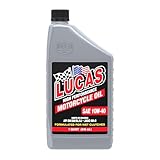
- Lower oil temperatures
- Longer oil life
- Longer component life
- Less noise and fewer leaks
- All Lucas motorcycle oils meet JASO specifications
Product prices and availability are accurate as of the date/time indicated and are subject to change. Any price and availability information displayed on Amazon at the time of purchase will apply.




