Choose motor oil by matching two separate requirements in your owner’s manual or the vehicle maker’s service information: the SAE viscosity grade (such as 5W-30) and the required performance category or manufacturer approval. Viscosity describes how the oil flows at specified temperatures; API and ILSAC categories describe performance requirements. A bottle that matches only one of those items is not automatically suitable.
Identify the exact engine, record every required designation, and then verify the bottle label and product data against the complete list. Do not select a universal grade based only on climate, vehicle age, or another car’s recommendation.
As an Amazon Associate I earn from qualifying purchases.
What you must match
Motor-oil selection has at least two independent checks. Treating them as interchangeable is the source of many incorrect recommendations.
| Requirement | What it describes | Where to find it | What a mismatch means |
|---|---|---|---|
| SAE viscosity grade | How the oil flows at specified temperatures | Owner’s manual or manufacturer service information | The oil may not meet the engine’s designed flow requirement, even if its API category is correct. |
| API or ILSAC performance category | Performance properties and tests the oil is intended to meet | Manual, service information and the product label | The oil may not provide the required performance, even if its viscosity is correct. |
| Automaker approval | A manufacturer-specific approval or standard, when required | Manual, service information and product data sheet | A broadly marketed oil can still fail the vehicle maker’s stated approval requirement. |
| Diesel compatibility | Whether the diesel category is permitted for this engine | Engine-maker instructions and the category information | Diesel categories are not automatically backward compatible; some are explicitly non-interchangeable. |
The American Petroleum Institute’s Motor Oil Guide states: “Vehicle requirements may vary. Follow your vehicle manufacturer’s recommendations on SAE oil viscosity.” That instruction applies even when a different grade appears popular in your region.
#1 Best Overall
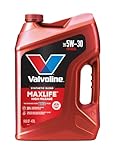
- Formulated for engines with 75,000 miles or more, Valvoline MaxLife High Mileage synthetic blend is formulated with seal conditioners to help prevent oil leaks and reduce oil consumption
- Delivers 20% better wear protection and 15% better sludge defense than industry standards to help prevent engine breakdown
- Extra detergents safeguard against friction, corrosion and deposits to keep high-mileage engines clean
- Advanced friction-fighting additives help maximize performance and improve fuel efficiency
- Provides performance benefits for high mileage, new and re-built engines alike
How to find your vehicle’s exact requirement
Start with the engine and model year, not the oil shelf. A single vehicle name can cover multiple engines, markets and service conditions, each with different requirements.
- Identify the exact vehicle and engine. Confirm model year, engine size or code, fuel type and, where relevant, turbocharging or diesel configuration. Use the vehicle identification information in the manual or manufacturer service system.
- Open the oil specification section. Look for “engine oil,” “lubricants,” “fluids,” “maintenance specifications” or a similar heading. Check the scheduled-maintenance section as well as the technical specification pages.
- Record the complete SAE grade. Copy the grade exactly, including both numbers and the “W,” for example 0W-20, 5W-30 or 15W-40. If the manual lists several grades, also copy the temperature or operating conditions attached to each option.
- Record the performance category. Note every API or ILSAC designation, such as an API service category or an ILSAC GF category. Do not replace this with a generic phrase such as “synthetic oil” or “premium oil.”
- Record any automaker approval. Some engines require a named manufacturer approval in addition to an SAE grade and API or ILSAC category. Write the approval exactly as printed.
- Check footnotes and regional instructions. A chart may distinguish gasoline and diesel engines, severe service, emissions equipment or different markets. Those conditions are part of the requirement.
- Save the information before shopping. Photograph the page or write one line containing the engine, SAE grade, category and approval. That prevents a familiar-looking bottle from becoming a guess.
If the manual and a retailer listing disagree, use the current vehicle-maker instruction for your specific engine and market. Do not use a recommendation copied from another model.
What “5W-30” and other SAE grades mean
An SAE viscosity grade is a classification of oil flow at specified temperatures. It is not a complete description of oil quality, additive performance or automaker approval.
Recommended Free Tools
The first number and the W
In a multigrade such as 5W-30, the number before the “W” describes the cold-temperature viscosity class. The “W” refers to winter. A lower first number represents a different cold-flow class; it does not, by itself, prove that the oil is right for a particular climate or engine.
The second number
The number after the “W” identifies the high-temperature viscosity class used in the SAE classification. A 5W-30 and a 5W-40 therefore share a cold class but differ in the high-temperature class. Neither is automatically a substitute for the other.
Why climate alone is not enough
Temperature can matter when a manufacturer offers multiple permitted grades, but climate is not a license to select any grade that seems suitable. The engine’s clearances, lubrication system, emissions equipment and calibration determine what the manufacturer permits. Use the temperature chart and conditions in the manual rather than a general internet rule.
Rank #2

- 6X better wear protection on critical engine parts than industry standards**
- 1.3X better sludge protection than industry standards*
- 3X Stronger against viscosity breakdown than leading full synthetic^
- Protection for 10,000 miles between oil changes
- Meets or exceeds the following specifications: API SP/SN PLUS/SN | ILSAC GF-6 | GM dexos1 Gen 3 | Meets Ford WSS-M2C947-B1 | Meets Ford WSS-M2C962-A1 |
Why age is not enough
“High-mileage” or older vehicles do not automatically authorize a different viscosity. If the manufacturer specifies one grade, changing it solely because the vehicle is old, consumes oil or has a high odometer reading can move the oil outside the documented requirement. Ask a qualified technician to diagnose a symptom instead of treating viscosity as a repair.
The Tool Desk
Outbyte PC Repair FREEClear out junk files and repair common Windows errorsFree Scan →Outbyte Driver Updater FREEFix the driver behind crashes, sound loss and screen glitchesFind Drivers →When the manual lists more than one grade
Use only the alternatives the manual lists, and follow their stated temperature ranges or operating conditions. If the manual permits 0W-20 in one range and 5W-30 in another, the chart—not a bottle’s marketing copy—decides which option applies. If no condition is stated, verify the ambiguity with the vehicle maker or an authorized service source.
API and ILSAC categories: the performance check
API and ILSAC designations address performance requirements, not the oil’s SAE flow class. API’s consumer guide explains that the API Service Symbol communicates the performance level, viscosity grade and other information. Read the viscosity and performance portions as separate fields.
Current gasoline categories in 2026
API’s guide lists ILSAC GF-7A and GF-7B as current categories introduced in March 2025. GF-7B is limited to SAE 0W-16 oils. GF-6A and GF-6B became obsolete on October 1, 2026; as of October 13, 2026, they should not be described as current categories.
| Category | Status and scope | How to use the information |
|---|---|---|
| ILSAC GF-7A | Current; introduced March 2025 | Use only when the vehicle’s required viscosity and other approvals also match. |
| ILSAC GF-7B | Current; introduced March 2025; limited to SAE 0W-16 | It cannot be treated as a general replacement for another viscosity. The engine must permit 0W-16. |
| ILSAC GF-6A | Obsolete after October 1, 2026 | Do not label it current. Follow the vehicle maker’s current instructions if an older manual names it. |
| ILSAC GF-6B | Obsolete after October 1, 2026 | Do not label it current. Its former 0W-16 scope does not change the vehicle’s required grade. |
Can a newer gasoline category be used in an older engine?
API says the latest gasoline-engine service category includes the performance properties of earlier gasoline categories and can be used in older gasoline engines where an earlier category was recommended. That statement concerns the performance category only. It does not authorize changing the SAE viscosity or ignoring an automaker approval.
What’s actually slowing this PC down?
Pick the symptom - the matching free tool is one click away.
Diesel categories require extra caution
Do not assume that a newer diesel category includes every earlier category. API specifically cautions that diesel categories do not always provide earlier-category performance.
Rank #3

- 3X Stronger than the leading full synthetic*
- 10X Better high stress performance**
- 20,000 miles between oil changes***
- Viscosity breakdown as measured in Kurt Orbahn test on 5W-30 grade
- As measured in Seq IX test under high load/torque conditions vs. API SQ test limits
API FA-4 is a clear example: it is not interchangeable with, and is not backward compatible with, CK-4, CJ-4, CI-4 PLUS, CI-4 or CH-4. Whether FA-4 is suitable depends on the engine maker’s recommendation. A diesel engine requiring CK-4 should not receive FA-4 merely because FA-4 is newer.
Manufacturer-specific approvals can be decisive
An automaker approval is a separate requirement from both SAE viscosity and API or ILSAC category. The approval may be tied to wear protection, emissions-system compatibility, fuel economy, drain-interval conditions or other engine-specific testing. Only the vehicle maker’s documentation establishes whether it is required.
When an approval is listed, look for the exact approval wording in the oil maker’s technical data, not just a statement that the product is “recommended for” a brand or “meets industry standards.” If the documentation says the oil is formally approved, confirm that the approval applies to the exact product and viscosity you are buying.
If the manual gives an API or ILSAC category but no automaker approval, do not invent one. If it gives an approval but no category, do not substitute a category based on a similar engine. Match what is actually specified.
How to read an oil bottle and verify the claim
- Find the complete SAE grade. Compare every character with your written requirement. “5W-30” is not the same designation as “5W-40,” even though both begin with 5W.
- Find the API or ILSAC mark and wording. Confirm that the performance category is the one the manual requires or that API identifies as an acceptable newer gasoline category for the application.
- Check the manufacturer approval. If one is required, verify the exact approval in the product’s technical information.
- Check the engine type. A gasoline label is not automatically suitable for a diesel engine, and diesel compatibility restrictions can be specific to the category.
- Check the product identity. Make sure the label and technical sheet refer to the same product name and viscosity. Do not rely on a shelf tag that combines several variants.
API says its engine-oil quality marks may be displayed only by marketers licensed through its Engine Oil Licensing and Certification System (EOLCS). The marks are therefore controlled licensing symbols, not generic graphics that any seller may apply. API 1509 defines the licensing and certification system; the official registry lists the 24th Edition from July 2026, amended September 23, 2026.
How to compare two candidate oils
Compare candidates in this order. A lower price, a familiar brand, a synthetic label or a claim about extreme temperatures cannot compensate for a failed requirement.
Rank #4

- 3X Stronger than the leading full synthetic*
- 10X Better high stress performance**
- 20,000 miles between oil changes***
- Viscosity breakdown as measured in Kurt Orbahn test on 5W-30 grade
- As measured in Seq IX test under high load/torque conditions vs. API SQ test limits
| Comparison question | Candidate A | Candidate B | Decision rule |
|---|---|---|---|
| Exact SAE viscosity required? | Record the printed grade | Record the printed grade | Reject any candidate that does not match a permitted grade for the vehicle and conditions. |
| API or ILSAC category? | Record the printed category | Record the printed category | Choose the required category or an API-recognized newer gasoline category where applicable; do not assume diesel equivalence. |
| Automaker approval required? | Record approval or “not stated” | Record approval or “not stated” | If the manual requires an approval, select the candidate with documented approval for that exact product. |
| Diesel restriction? | Check engine-maker instructions | Check engine-maker instructions | Reject a category that the engine maker does not permit, including FA-4 where CK-4 or another non-interchangeable category is required. |
| Label legitimacy? | Check API mark and product data | Check API mark and product data | Prefer documentation that supports the printed claims and API licensing requirements. |
A practical search phrase is the complete requirement, such as “motor oil [required SAE grade] [required API/ILSAC specification].” Add the automaker approval if one is listed. Search only after you know the vehicle’s requirements; otherwise the first result can steer you toward an incompatible grade.
Quick wins for a faster PC:
Clear out junk files and repair common Windows errorsFree Scan →Fix the driver behind crashes, sound loss and screen glitchesFind Drivers →Common mistakes and how to correct them
Choosing by viscosity alone
Symptom: The bottle has the right-looking 5W-30 or 0W-20, but the API, ILSAC or approval information is absent or wrong.
Correction: Recheck the performance category and approval. Viscosity answers the flow question; it does not establish the oil’s complete suitability.
Choosing by API category alone
Symptom: The category is current, but the viscosity differs from the manual.
Correction: Keep the category and viscosity checks separate. A newer category does not authorize a new SAE grade.
PC Slower Than It Used to Be?
A free scan shows the junk files, broken settings and background clutter dragging Windows down - then fixes them in one click.Free scan · Windows 10 & 11Crashes, No Sound, or Screen Glitches?
Random freezes, missing sound and display glitches usually trace back to one bad driver. Find and replace yours safely.Free scan · under a minuteAssuming “newer” always works for diesel
Symptom: A newer diesel designation is substituted without consulting the engine maker.
Best Value

- Designed for vehicles with 75,000 miles or more, Valvoline MaxLife Full Synthetic High Mileage Motor Oil helps maximize engine life and performance for the many miles still ahead
- Formulated with seal conditioners to help prevent oil leaks, reduce oil consumption, and improve fuel economy
- Delivers 50% stronger wear protection than industry standards for superior defense against friction and wear
- Provides 20% stronger sludge defense than industry standards to protect against harmful buildup and deposits
- Offers 2.5X better heat protection than industry standards to safeguard engines in extreme conditions
Correction: Check the manufacturer’s diesel instruction. API warns that diesel categories do not always include earlier performance, and FA-4 is specifically not interchangeable with CK-4, CJ-4, CI-4 PLUS, CI-4 or CH-4.
Using climate or vehicle age as the primary rule
Symptom: A recommendation is based on a cold winter, hot summer or high mileage rather than the manual.
Correction: Use the manufacturer’s viscosity chart and conditions. Climate and age may help choose among explicitly permitted options, but they do not create new options.
Do these 3 things before closing this tab:
1Repair Windows errors before they cause bigger problems2Fix the driver behind crashes, sound loss and screen glitches3Clear out junk files and repair common Windows errorsTrusting an unverified API symbol
Symptom: A package displays an API-style mark, but the seller cannot support the claim.
Correction: Look for the licensed API quality marks and confirm the product information. API limits use of its marks to EOLCS-licensed marketers.
Treating an obsolete category as current
Symptom: A listing calls GF-6A or GF-6B the latest ILSAC category after October 1, 2026.
Correction: Check current API information. GF-7A and GF-7B are the current gasoline categories as of the October 2026 information cited here; GF-7B is limited to 0W-16.
A repeatable buying procedure
- Write down the exact engine and market.
- Copy the permitted SAE grade or grades and any temperature conditions.
- Copy the required API, ILSAC and automaker approval wording.
- Separate gasoline and diesel instructions before comparing products.
- Filter products by exact SAE grade first.
- Check the API or ILSAC category on each remaining product.
- Verify any manufacturer approval in the technical documentation.
- For diesel applications, confirm that the category is explicitly permitted; do not infer compatibility from its age or name.
- Check that API quality marks are used under the EOLCS licensing system.
- Keep the manual page and the product data together until purchase and service.
Quick checklist before purchase
- Correct vehicle, engine and model year identified
- SAE grade copied exactly from the manual
- API or ILSAC category recorded
- Automaker approval recorded, if required
- Gasoline or diesel application confirmed
- Any temperature or service-condition footnote checked
- Product label matches the complete requirement
- API quality mark and licensing claims appear credible
- No substitution based solely on climate, age, popularity or a newer-sounding category
The safest choice is the oil whose viscosity, performance category and required approval all match the vehicle maker’s current instructions. When those three checks agree, the label is doing its job; when any one differs, stop and verify rather than guessing.
Quick Recap
Product prices and availability are accurate as of the date/time indicated and are subject to change. Any price and availability information displayed on Amazon at the time of purchase will apply.




