Recommended Free Tools
The most reliable car-maintenance budget is built from your vehicle’s own maintenance schedule, your driving conditions, the car’s repair history, and written local estimates—not from a universal monthly average. List what is due in the next 12 months, add repairs already identified, divide the planned total by 12, and keep that amount in a separate savings account. Then control repair bills with written estimates, approval limits, records, and a coverage check before buying any optional service contract.
Start with the maintenance schedule for your car
Open the owner’s manual and find the maintenance schedule for your engine, model year, mileage, and type of driving. The schedule is the starting point because intervals can differ substantially between vehicles and between normal and severe operating conditions. The Federal Trade Commission’s Auto Repair Basics guidance states: “Follow the manufacturer’s maintenance schedule in your owner’s manual for your type of driving.”



As an Amazon Associate I earn from qualifying purchases.
Do not replace the manual with a generic online checklist. A schedule may specify time intervals, mileage intervals, or whichever comes first. It can also separate routine items from inspections and replacement intervals. Record the exact interval and the next due mileage or date for each item.
Account for your actual driving conditions
Use the manual’s definition of severe or special operating conditions if it provides one. Frequent short trips, unusually heavy loads, dusty environments, extreme temperatures, towing, or extensive stop-and-go use may place a vehicle in a different schedule category. Do not assume that a shop’s shorter interval is automatically required. Ask the shop to identify the manual section or vehicle-specific reason for any recommendation that exceeds the manufacturer’s schedule.
Separate maintenance from symptoms
Scheduled work is predictable: inspections, fluid service, filters, belt checks, tire rotations, and other items listed by the manufacturer. A warning light, noise, vibration, leak, hard starting, or change in braking is not a scheduled interval. Put it on a separate repair list, because diagnosis and repair timing are uncertain until a technician inspects the vehicle.
Build a 12-month list of expected costs
Create one worksheet for the next year. Include every scheduled item that falls within the period, work already identified by an inspection or mechanic, and consumables that your records show are approaching replacement. The sources available for this guidance do not establish a universal annual maintenance cost, so your list—not an internet average—determines the target.
| Worksheet column | What to enter | Why it matters |
|---|---|---|
| Item | For example, oil service, tire rotation, brake inspection, belt replacement, or a diagnosed repair | Prevents vague totals that hide individual obligations |
| Source | Owner’s manual, dated inspection, repair order, or written estimate | Shows whether the cost is scheduled, observed, or provisional |
| Due trigger | Mileage, calendar date, or condition | Lets you place a lumpy expense in the right month |
| Estimated amount | Written local estimate, or “estimate needed” | Avoids treating an unpriced repair as zero |
| Confidence | Scheduled, diagnosed, or uncertain | Helps you distinguish predictable spending from risk |
| Paid and remaining | Actual invoice amount and unpaid balance | Keeps the forecast current after work is completed |
Get local prices where the manual cannot provide them
Maintenance intervals come from the vehicle documentation; prices come from your market, parts choices, labor rates, taxes, and the shop’s policies. Request written estimates from qualified local repair shops for work that is due or likely to be due. If a repair is only a possibility, label the amount as a planning estimate rather than a bill you definitely owe.
Free tools Windows power users keep installed
One-click scans. No signup required.
For a complicated or expensive job, seek a second opinion before authorizing it. Give the second shop the diagnostic findings and proposed scope, and ask whether its estimate covers the same work. Comparing unlike scopes can make one quote appear cheaper when it simply omits parts, labor, or a required related service.
Turn the list into a monthly set-aside
Use this editorial budgeting method:
Monthly set-aside = (scheduled costs due in the next 12 months + known repairs + other expected vehicle work) ÷ 12.
This is a planning formula, not an FTC formula and not a promise that every year will cost the same. If the worksheet totals $1,800 for the coming year, the planned contribution is $150 per month; that number is an illustration of the calculation, not a recommended amount for every car.
Handle expenses that do not arrive evenly
The division creates a steady contribution even when bills are irregular. Keep a separate line for each large item and note its due month. If a $900 job is expected in month six, six earlier contributions need to accumulate enough to pay it. A calendar reminder several weeks before the due month gives you time to obtain or refresh estimates.
Deal with an overdue or newly purchased vehicle
If maintenance is overdue, calculate a one-time catch-up amount separately from the normal 12-month reserve. Combining overdue work with routine contributions can leave the car under-maintained while you wait for the account to build. For a recently purchased used vehicle with incomplete records, start with the manual, obtain a baseline inspection, and mark uncertain items as provisional until a technician documents their condition.
Choose where to keep the money
A separate savings account can reduce the temptation to spend the maintenance money elsewhere. Automate a transfer after each payday or on the same date every month. The account is a sinking fund for expected ownership costs; it is not a guarantee against every failure. Keep an additional emergency cushion if your household cannot absorb an unplanned breakdown, but do not assign a universal percentage or dollar figure without knowing the vehicle and your finances.
Use the car’s history to make the forecast more accurate
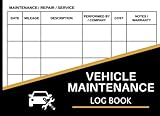
Maintain a dated record of mileage, work performed, parts, labor, shop, symptoms, and total paid. Save invoices and inspection sheets as photographs or PDFs if you use a digital system. A paper logbook, spreadsheet, or maintenance app can all work; the important feature is that the information is complete and retrievable.
Record the details that affect future decisions
- Service date and odometer reading.
- Work requested, diagnosis, and work actually authorized.
- Parts supplied, including whether the invoice identifies their type or warranty.
- Labor charges, diagnostic charges, taxes, and other fees.
- Technician’s observations about remaining tread, brake wear, leaks, corrosion, belts, hoses, or other inspected components.
- Warranty supplied on the repair and its expiration terms.
The FTC specifically gives oil changes, tire rotations, belt replacement, brake pads, and inspections as examples of records to keep. Records can help you avoid duplicating work, identify recurring problems, demonstrate maintenance when coverage requires proof, and improve the next year’s estimate.
Review the forecast at useful checkpoints
Reconcile the worksheet after every service visit. At each oil service or inspection, move completed items to the paid column, add newly identified work, update mileage, and ask whether the technician’s observation is urgent, monitorable, or cosmetic. Recalculate the next 12 months when the vehicle reaches a major mileage interval or when its condition changes.
Rank #4

- Made in USA - Proudly produced in Ohio by a Veteran-owned business
- This book will help you remember your last oil change /last service appointment. You can easily track all services, mileage and maintenance for multiple automobiles - great for business or personal use.
- The yearly expense summary is a very important part of this book. The yearly summary page is a perfect tool for your tax prep and your budget. After every month you should log your total business miles and personal miles in the “Annual Mileage Summary” page.
- This book comes in two convenient sizes, 8.5” x 11” - perfect to fit into any binder or clipboard that you may use for business and 5” x 7” which is the perfect size to fit into your glove compartment!
- Our unique cover is a semi-rigid transparent cover that leads to a sturdy book that resists stains and wrinkles. Reorder SKU: LOG-100-57CW-PP(Auto-Maintenance)
Control the repair bill before work begins
A surprise repair bill often starts with an unclear authorization, not with the mechanical failure itself. Before work begins, ask for a signed written estimate. FTC Auto Repair Basics guidance says the estimate should describe the condition to be repaired, the parts and anticipated labor, and when the shop must obtain approval before exceeding the specified amount.
What a useful written estimate contains
- The customer concern and the condition or fault found.
- Diagnostic work, diagnostic fees, and whether that fee is credited toward the repair.
- Each proposed repair, part, quantity, and price.
- Labor hours or the method used to calculate labor, plus the labor rate.
- Shop supplies, disposal fees, taxes, towing, and other charges.
- Expected completion timing and any stated parts availability issue.
- The warranty on parts and labor.
- A clear dollar limit or procedure for obtaining your approval before additional work.
Ask the advisor to explain which work is necessary to make the vehicle safe or operable, which work prevents likely damage, and which work is optional. Have the estimate identify whether the quoted job is a diagnosis, a repair, or both. Do not authorize an open-ended instruction such as “fix whatever you find.”
Set an approval rule you can enforce
Write your authorization limit on the estimate: for example, the shop may perform only the listed work and must call before any additional charge. Confirm how approval will be recorded—signed paper, text message, email, or another method—and keep the message. State whether a diagnostic teardown requires separate approval. Laws governing estimates and repair authorization vary by state and locality, so check the consumer-protection rules that apply where the work occurs.
The Tool Desk
Outbyte PC Repair FREEClear out junk files and repair common Windows errorsFree Scan →Outbyte Driver Updater FREEScan for outdated or missing drivers - takes under a minuteDriver Scan →Inspect the final repair order
When you collect the car, compare the final repair order with the estimate and your approvals. The FTC says a completed repair order should identify each repair, the parts supplied and their costs, labor charges, and odometer readings at intake and completion. Check that declined work is not listed as completed, that the promised warranty appears, and that unexplained additions are resolved before payment.
Best Value
Compare repair shops on more than the lowest quote
Use the same written scope when comparing shops. A low total can reflect fewer operations, different parts, a lower labor allowance, or omitted fees.
| Comparison point | Questions to ask |
|---|---|
| Scope | Does the estimate address the same diagnosis, parts, labor, fluids, programming, and testing? |
| Parts | What part type is proposed, and what warranty applies? |
| Labor pricing | Is labor hourly, flat-rate, or another method, and are diagnostic hours separate? |
| Technician experience | Does the shop regularly service your make, model, engine, or system? |
| Additional work | Will the shop obtain approval before exceeding the estimate? |
| Repair warranty | What is covered, for how long, and are there geographic or parts restrictions? |
| Documentation | Will you receive the diagnosis, measurements where relevant, and a detailed repair order? |
For expensive or technically complicated work, a second opinion can be cheaper than authorizing the wrong repair. Provide both shops with the same symptoms and test results, and ask what evidence supports each proposed fix.
Decide whether an optional service contract fits
An auto service contract is an optional agreement, separate from the manufacturer’s warranty. It is not proof that the seller is affiliated with the manufacturer, and an “extended warranty” label does not by itself explain what is covered. The FTC advises checking the contract, the seller, and the existing warranty before buying.
What’s actually slowing this PC down?
Pick the symptom - the matching free tool is one click away.
| Question | What to compare |
|---|---|
| Total cost | Upfront or financed price, recurring charges, taxes, and cancellation terms |
| Coverage | Covered systems, parts, services, wear items, and diagnostic charges |
| Exclusions | Maintenance, pre-existing conditions, corrosion, modifications, or other excluded causes |
| Deductible | Amount per visit, repair, component, or occurrence |
| Repair location | Approved shops, geographic limits, and whether your preferred repairer can participate |
| Claims process | Pre-approval, inspection, documentation, and time limits |
| Payment | Direct payment to the shop or reimbursement after you pay |
| Existing coverage | Overlap with a new-car, used-car, powertrain, emissions, or parts warranty |
| Administration | Contract administrator, seller reputation, transfer rules, and cancellation or refund provisions |
Compare the contract’s total cost and restrictions with the vehicle-specific reserve you can build. A contract may reduce the size of a particular covered bill, but it can also exclude the failure you experience or require procedures that delay payment. Setting money aside is another option identified by the FTC. Keep maintenance records because a warranty or contract may require proof that the vehicle was maintained.
Prioritize spending when the budget is short
If the reserve cannot cover everything, ask the shop to divide the estimate into safety-critical work, damage-prevention work, routine work that can be scheduled, and cosmetic or convenience work. Request the consequences and safe monitoring interval for each deferred item in writing. Do not defer a repair merely because it is inconvenient if the technician identifies a safety risk or a condition that could damage another component.
Before using credit or a payment plan, obtain the complete repair price, interest, fees, and payment schedule. Financing can solve a timing problem while increasing the total cost; it should not substitute for understanding the diagnosis and authorization terms.
A repeatable monthly workflow
- Set a calendar date. Once a month, open the maintenance worksheet and savings account.
- Update mileage. Compare current mileage with the next manual interval and any inspection recommendations.
- Move the planned contribution. Transfer the calculated monthly amount to the maintenance account.
- Refresh known work. Add written estimates, remove completed items, and change provisional amounts when better information arrives.
- Check upcoming timing. Confirm that the balance will cover the next due item; obtain an estimate early if it will not.
- File records. Save the invoice, repair order, approval messages, and warranty information together.
Common budgeting mistakes and their fixes
- Using one average for every car: replace it with the manual, driving conditions, history, and local estimates.
- Treating a shop recommendation as self-proving: ask why it differs from the manual and what evidence supports it.
- Budgeting only routine service: add diagnosed repairs and items approaching replacement, while labeling uncertain work as provisional.
- Approving work verbally with no limit: require a written estimate and a documented approval threshold.
- Choosing the lowest incomplete quote: compare identical scopes, parts, labor, fees, and warranties.
- Losing records: keep mileage, invoices, repair orders, and coverage documents in one retrievable system.
- Buying a contract without reading exclusions: compare coverage, deductibles, repair-location rules, pre-approval, reimbursement, and overlap first.
- Assuming an “extended warranty” is factory coverage: verify the contract administrator and its relationship, if any, to the manufacturer.
What your completed plan should show
At any point, you should be able to answer four questions: what the manual says is next, what your car’s records show, how much the next 12 months are expected to cost, and what the shop must obtain your approval to do. That visibility turns maintenance from an occasional financial shock into a scheduled household expense, while written estimates and complete records limit the uncertainty that remains.
Quick Recap
Product prices and availability are accurate as of the date/time indicated and are subject to change. Any price and availability information displayed on Amazon at the time of purchase will apply.




