Free tools Windows power users keep installed
One-click scans. No signup required.
A DIY RC car prototype turns steering forces at the car into sensations in a custom remote. In a project reported by Hackaday on August 6, 2024, a bidirectional load cell measures forces in the steering mechanism; a pair of ESP32 microcontrollers sends data wirelessly; and motors in a 3D-printed controller provide haptic feedback. It is a maker experiment, not a commercial controller or a demonstrated performance or safety upgrade.
How the force-feedback loop works
Ordinary RC steering sends commands from the remote to the car. Force feedback adds a return path: information about resistance or movement at the car’s steering mechanism travels back to the operator, where the controller produces a physical sensation.
- Measure at the car: A bidirectional load cell sits inside the steering mechanism and detects steering force.
- Send the data: Two ESP32 microcontrollers use ESP-NOW for the wireless link between car and controller.
- Recreate the sensation: Motors fitted to a custom 3D-printed controller provide haptic feedback to the operator.
Hackaday’s report does not identify the ESP32 board models, motor models, or a complete parts list, so those details should not be inferred from the project description.
Why the load cell mattered
The creator first explored a mathematical model as a way to avoid sourcing expensive parts, but that approach reached a dead end. The project then used a bidirectional load cell to measure force directly in the steering mechanism.
What’s actually slowing this PC down?
Pick the symptom - the matching free tool is one click away.
#1 Best Overall

- STEM TOY CARS FOR KIDS: Totally 2 set different car toys. These cars include two styles: wireless remote control and solar powered,can be played indoors and outdoors
- BUILD R/C AND SOLAR CAR BY YOURSELF: You can build your own cars and learn about the circuit diagram of remote control,solar panel that collects solar heat energy into an electric energy drive motor. Designed to motivate children to love science and build children's confidence
- UNIQUE GIFT IDEA: Our kits designed for kids age 8-12 are cool stuff for a budding inventor, very suitable for elementary students to show their talents in a science fair. Packaged in a beautiful gift box, these assembled electronic gadgets are perfect gifts for boys for birthdays and Christmas
- LEARN BY PLAYING: Fun Projects! Encourage your kids to enjoy DIY STEM activities. By playing with these electric toy kits, children's curiosity and interest in physics will be stimulated, and they'll know how much fun it is to create a simple model car by themselves
- EASY TO ASSEMBLE: Circuit connection is very simple, NO welding, suitable for kids to complete independently. Includes detailed instructions make it much easier and convenient to assemble the models
In an August 7, 2024 comment carried by Hackaday, creator Indeterminate Design compared that setup with an experiment measuring servo current. The creator reported direction-dependent minimum sensing thresholds of approximately 80 g in one direction and 130 g in the other for the servo being used, while reporting the load cell accurate to about 5 g. Those are figures for this creator’s particular setup, not general specifications for hobby servos or load cells.
That comparison illustrates a practical distinction: servo-current sensing infers force from the electrical behavior of the servo, while a load cell measures force at the mechanism. In this experiment, the creator found the load cell more useful. The report does not establish that a load cell will outperform every current-sensing arrangement, or that every RC steering assembly has room for one.
Rank #2

- BUILD, CODE & DRIVE YOUR OWN ROBOT CAR: Turn coding, electronics and engineering into a working programmable robot car you can assemble, program and drive; ideal for weekend family projects, STEM classrooms, coding clubs, robotics lessons and maker challenges
- EXPLORE FPV, LINE TRACKING & OBSTACLE AVOIDANCE: Control the robot with the ELEGOO app or IR remote, view live FPV video through the onboard camera, follow black lines, avoid obstacles with the ultrasonic sensor and explore multiple interactive driving modes
- BEGINNER-FRIENDLY BUILD WITH GUIDED WIRING: Keyed XH2.54 connectors help reduce wiring mistakes, while the illustrated tutorial and example programs guide beginners step by step from chassis assembly and module connection to programming and the first successful run
- GO BEYOND ASSEMBLY WITH CREATIVE CODING: Program with Arduino IDE to explore movement, sensors and control logic, then modify example code to create custom routes, reactions and robotics experiments that develop coding, problem-solving and engineering skills
- COMPLETE RECHARGEABLE STEM ROBOTICS KIT: Includes an ELEGOO UNO R3 controller board, ESP32-WROVER-based camera and Wi-Fi module, line-tracking and ultrasonic sensors, motors, IR remote and a 2000 mAh rechargeable lithium-ion battery; recommended for ages 8+ with adult guidance for first-time builders
Why timing and filtering affect the feel
Force feedback depends on more than detecting a force. The signal has to reach the controller at a useful time and retain enough detail to feel informative. Hackaday notes that precise timing was important to avoid steering-wheel jitter, while filtering had to reduce noise without erasing high-frequency force information.
- Too much jitter can make the controller feel unstable or uneven.
- Too much filtering can smooth away rapid changes that help convey what the wheels are encountering.
- Communication and processing delay can separate a force at the car from the sensation felt at the remote.
The report identifies these as engineering concerns but does not publish latency measurements or a controlled evaluation of the resulting feel.
The Tool Desk
Outbyte Driver Updater FREEScan for outdated or missing drivers - takes under a minuteDriver Scan →Outbyte PC Repair FREERepair Windows errors before they cause bigger problemsFix Now →Rank #3

- 【Drifting Motion】 When the car is moving forward at high speed and suddenly turns left or right, the car will perform a drifting motion.
- 【Self-centering Steering】Designed with a self-centering feature, the car automatically returns to its original alignment after making a turn.
- 【Perfect for STEM education】 this toy encourages critical thinking, problem-solving, and hands-on exploration of engineering concepts.
- 【Long-Distance Remote Control】 Equipped with a powerful remote control, this toy car can be operated from distances of up to 160 feet in open areas. Children can explore and have fun with the car even from a significant distance, promoting outdoor play and exploration.
- 【Interference-Free Racing】Multiple cars can be raced simultaneously without interference from one another. Kids can enjoy thrilling races with their friends and family, fostering healthy competition and social interactions.
What sensations the prototype reportedly conveys
Hackaday says the system can convey bumps and understeer, as well as sensations associated with drifting or driving over grass. These are descriptions of what the project’s feedback communicates, not measured improvements in lap times, reaction time, driving skill, or safety.
The creator also cautioned in an August 7, 2024 comment that RC steering forces felt quite low and that RC car suspensions may not be designed with force feedback in mind. The creator suggested that low forces could relate to protecting servos and handling jumps, while noting that further testing remained to be done.
Rank #4
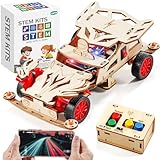
- STEM Learning Fun: This wooden remote control car building kit for kids ages 8-12 is a perfect STEM toy to engage your child in hands-on learning. It is ideal for science projects and stem activities, promoting creativity and problem solving skills.(Battery Not Included/ Product size:6.89*4.13*2.36in)
- Build Your Own RC Car: The model car kit for kids includes all necessary parts for assembly, and children are able to enjoy the process of building their own RC car with the help of a mini screwdriver and detailed instructions. Once completed, they can have hours of fun driving their creation. It's a great STEM kit for kids ages 8-10 10-12, also suitable for teenage.
- Perfect Gift For Kids: not only a DIY crafts kit but also an science kit for kids age 8-12. This stem building toys is a unique gift for Birthday, Graduation, Easter basket, Back-to-School, 5th grade graduation gifts, Christmas, Halloween, Thanksgiving & Valentine Day present. Ideal gift for 8, 9, 10, 11, 12-16 year old boys girls. Excellent choice for parent-child interaction.
- STEM Toys for ages 8-13: This wood car model building kit captivates boys aged 8-10 by fostering exploration of scientific concepts, motor functions, and understanding of energy conversion. Serving as an STEM project for kids ages 8-12, blending education with entertainment. Assembly promotes hand-eye coordination and ignites imagination, enhancing both physical and intellectual development in a fun and creative way.
- Durable And Safe: Made of non-toxic plywood. Smooth surface and rounded corner design keep your kids safe while assembling these wooden 3d puzzles for kids ages 8-13. Kids can color and decorate, making their woodworking creation unique. Ideal for displaying in bedrooms, playrooms, or study spaces.
What would matter in adapting the idea
The project is best understood as an example of a feedback architecture, not a ready-to-install upgrade. Anyone adapting the concept would need to assess the sensing method, available space in the steering mechanism, signal quality, and how the controller turns force data into a useful sensation.
- Sensing: A direct force sensor, a servo-current estimate, or a model each entails different trade-offs in measurement, integration, and calibration.
- Direction and sensitivity: The creator’s current-sensing experiment produced different minimum thresholds by direction, while the load cell was reported accurate to about 5 g in this setup.
- Packaging: The report describes a load cell inside the steering mechanism but does not provide dimensions, weight, or compatibility information for other cars.
- Feedback tuning: Filtering must balance noise reduction against retaining useful detail, and timing must avoid jitter.
- Controller hardware: The report establishes that the remote was custom and motorized, but does not identify a commercial controller or specify the motors.
A separate Stanford CHARM Lab student project, The Little Car that Could, explores haptic teleoperation for a mobile robot. It is a different system and should not be treated as validation of the RC steering prototype. Its project account discusses issues including filtering latency, motor saturation, wheel slip, and the absence of field testing; those observations are context for haptic teleoperation generally, not test results for this RC car.
Quick Recap
Best Value

- BLACK AND GOLD WITH DISPLAY IMPACT: The contrasting body colors give this model an immediately recognizable identity, helping the finished model stand apart in a car collection before any light or control feature is activated.
- OPENING DOORS ADD INTERACTION: Functional opening doors create another point of engagement after assembly and encourage a closer look at how the exterior panels, cabin area, and surrounding structure fit together.
- APP AND 2.4GHZ REMOTE INCLUDED: Builders can select app control or the handheld remote for motorized indoor driving, giving families and hobbyists flexibility in how they operate the completed car.
- 790+ PIECES FOR AGES 8 AND UP: The construction process offers a substantial step-by-step challenge for capable younger builders, teens, and adults while keeping the 1:14 result manageable for home display.
- LEDS BRING OUT THE FINISH: Integrated lighting complements the black-and-gold color scheme during motion and adds a contrasting detail when the model is arranged for photos or shelf presentation.
Sources and scope
- Hackaday, “RC Car Gets Force Feedback Steering,” Bryan Cockfield, August 6, 2024 — project description and creator comments.
- Stanford CHARM Lab, “The Little Car that Could” — related but separate mobile-robot haptics project.
Product prices and availability are accurate as of the date/time indicated and are subject to change. Any price and availability information displayed on Amazon at the time of purchase will apply.




