What’s actually slowing this PC down?
Pick the symptom - the matching free tool is one click away.
The Porsche 959 earned its ahead-of-its-time reputation by turning a Group B rally project into a road car packed with unusually advanced technology. Its sequential twin-turbo engine, electronically controlled all-wheel drive, adjustable suspension and 317 km/h top speed helped redefine what a production sports car could be. “Time couldn’t touch it” is a metaphor for that lasting influence—not a claim that the cars are immune to age or maintenance.
Why Porsche developed the 959
The 959 began with a question about the 911: how far could Porsche extend its rear-engine design, and could four-wheel drive make it more capable? Porsche pursued those ideas through a Group B competition project, expecting racing development to accelerate work on a road car. The result became both a technology demonstrator and a production sports car.
| # | Preview | Product | Price | |
|---|---|---|---|---|
| 1 |

|
1/24 Porsche 959 | $28.64 | Buy on Amazon |
| 2 |

|
Porsche 959 1/24 Tamiya | $28.94 | Buy on Amazon |
| 3 |

|
Hot Wheels Porsche 959 | $14.99 | Buy on Amazon |
| 4 |
![Hot Wheels Porsche 959 #591 5 Spoke Wheels, Blue [Coolest to Collect car]](https://m.media-amazon.com/images/I/51fvhSjotJL._SL160_.jpg)
|
Hot Wheels Porsche 959 #591 5 Spoke Wheels, Blue [Coolest to Collect car] | $14.99 | Buy on Amazon |
| 5 |
|
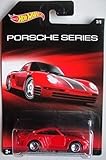
HOT WHEELS PORSCHE SERIES RED PORSCHE 959 3/8 () | $22.99 | Buy on Amazon |
The milestones are distinct. Porsche Newsroom says the production model debuted at the IAA in 1985; Porsche describes the road car as launching in 1986, with customer deliveries beginning in 1987. The car’s development and competition program therefore preceded the arrival of customer cars.
What made the 959 so advanced?
Sequential twin-turbocharging
Porsche calls the 959 the first production car with a twin-turbo boxer engine using sequential turbocharging. Rather than having both turbos operate in the same way across the rev range, the system brought them into action in sequence to help reduce turbo lag—the delay between pressing the accelerator and feeling boost. Porsche’s claim is specific to a production twin-turbo boxer engine with sequential turbocharging; it should not be broadened into a claim that the 959 introduced every form of turbocharging.
Quick wins for a faster PC:
Repair Windows errors before they cause bigger problemsFix Now →Fix the driver behind crashes, sound loss and screen glitchesFind Drivers →Clear out junk files and repair common Windows errorsFree Scan →#1 Best Overall
- This plastic model kit requires plastic cement and paint for assembly, and they are sold separately.
The engine also used water-cooled, four-valve cylinder heads, an advanced arrangement for a 911-based road car. Together, these features aimed to make high output more usable rather than simply pursuing a large peak figure.
All-wheel drive managed electronically
The 959 paired electronically controlled all-wheel drive with ABS. In practical terms, the system could manage how drive was distributed between the axles rather than relying on a fixed, unchanging split. That mattered in a car developed with both road performance and demanding competition conditions in mind: traction was part of the engineering package, not an afterthought.
Rank #2
- Plastic Model Kit-Assembly Required
- Glue and Paint sold separately
Suspension that adapted to conditions
Drivers could pre-select among four shock-absorber programs, while speed-dependent self-levelling helped maintain ride height as conditions changed. The electronically controlled chassis combined those features to give the car a broader operating range than a fixed setup could offer. Porsche’s descriptions establish the systems, though they do not by themselves prove that each was the first of its kind in automotive history.
How fast was the Porsche 959?
Porsche gives the 959 a top speed of 317 km/h. Porsche Newsroom describes that as the then-record top speed for a series-production sports car; its 2024 history likewise calls it the world’s fastest production car at launch. The qualification matters: this was a period-specific production-car record, not a claim that the 959 remains the fastest car today.
The Tool Desk
Outbyte PC Repair FREERepair Windows errors before they cause bigger problemsFix Now →Outbyte Driver Updater FREEFix the driver behind crashes, sound loss and screen glitchesFind Drivers →Rank #3
- Hot Wheels Blue Porsche 959 1:64 Scale Collectible Die Cast Metal Toy Car Model #591
Did the Porsche 959 win the Paris-Dakar?
Yes. Porsche says all three 959s that entered the 1986 Paris-Dakar Rally finished, taking first, second and sixth after roughly 14,000 kilometres. The result showed the value of developing the car’s technology under extreme conditions, but the rally entries were competition 959s, not ordinary customer road cars.
The related Porsche 961 had a different assignment. A circuit-racing derivative of the 959, it finished seventh overall at Le Mans in 1986. That was a notable result for the 961, but it should not be attributed to the road 959 or confused with the Dakar victory.
Rank #4
- Hot Wheels Porsche 959 #591 5 Spoke Wheels, Blue
How many Porsche 959s were made, and what did they cost?
Porsche Classic lists a production run of 292 cars, a figure also given in Porsche Newsroom’s museum record. Porsche’s museum model record states a historical price of DM 420,000. Separately, Porsche Stories reported a price of US$225,000 when customer deliveries began in 1987. Those are figures in different currencies and source contexts, not directly interchangeable prices.
Independent reader supportYour contribution helps us test, update, and keep practical guides available for everyone.Why the 959 still matters
The 959’s influence was not limited to its short production run. Porsche’s 2024 history says the car catalysed the decision to equip future turbocharged sports cars with all-wheel drive. Its legacy is therefore visible not just in its record-setting performance, but in the direction it helped establish for Porsche’s later road cars.
Best Value
- 1:64 Scale Collectible Die Cast Metal Toy Car Model ~ 3in long
That is the sense in which the 959 is a supercar time could not catch: its key ideas remained relevant beyond the moment when its top speed was a record. The metaphor does not mean that a 1980s car escapes wear, specialist servicing or the practical realities of ownership.
Keeping a 959 on the road
For owners, Porsche Classic says selected centres have certified expertise for repairs and parts replacement. Its 959 service-parts catalog covers the 1987–1988 model and lists 2,300 part numbers. That is a specific manufacturer-supported route for maintenance; it is not a guarantee that every part or service is available everywhere.
Quick Recap
Sources
- Porsche Newsroom: 959 technology
- Porsche Classic: 959 model information
- Porsche Newsroom: museum model record
- Porsche Stories: 959 history
- Porsche Newsroom: motorsport history
- Porsche Classic: genuine parts
Product prices and availability are accurate as of the date/time indicated and are subject to change. Any price and availability information displayed on Amazon at the time of purchase will apply.




