Free tools Windows power users keep installed
One-click scans. No signup required.
The cheapest current Model 3 is the Rear-Wheel Drive version. In practical terms, a properly installed 240-volt home circuit is an overnight solution, a regular 120-volt outlet is emergency-level slow, and a Supercharger is best used for a short range-restoring stop rather than a guaranteed full-battery session. Tesla’s figures are estimates of range added under stated conditions, not fixed 0–100% charging times.
The exact published figures, electrical requirements and the conditions that change them are set out below, using Tesla specifications available on October 17, 2026.
As an Amazon Associate I earn from qualifying purchases.
The cheapest Model 3 and its published charging figures
Tesla’s current entry configuration is the Model 3 Rear-Wheel Drive. Tesla lists a starting price of $38,630 and an EPA-estimated 321-mile range on its current Model 3 product page, accessed October 17, 2026.
What’s actually slowing this PC down?
Pick the symptom - the matching free tool is one click away.
| Use case | Tesla-published figure | What it means |
|---|---|---|
| Home charging with Wall Connector or Mobile Connector | Up to 30 miles of range per hour at 32 amps (7.7 kW) | A suitable 240-volt circuit can replenish a typical overnight driving day. |
| Standard household outlet | About 2–3 miles of range per hour | Useful for supplemental or emergency charging, but slow for routine high-mileage use. |
| Model 3 Rear-Wheel Drive on a Supercharger | Up to 170 miles added in 15 minutes | A maximum range-added claim, not a promise of a full charge in 15 minutes. |
| Tesla Supercharging support table | Model 3: up to 175 miles in 15 minutes | A broader Model 3 maximum; the vehicle-specific specification is the more conservative figure for the entry Rear-Wheel Drive car. |
The 170-mile specification comes from Tesla’s Model 3 Rear-Wheel Drive product information. Tesla’s general Supercharging support page gives the 175-mile maximum for Model 3. Both are conditional “up to” figures, so the car’s charging screen and Tesla app are the best indicators for a particular session.
#1 Best Overall

- Dual Voltage Level 1 & 2: Charge at 120V/12A (1.44kW, 2-5 miles/hr) with the included NEMA 5-15 adapter or at 240V/16A (3.84kW, 9-12 miles/hr) with the NEMA 6-20 plug. One SEGUMA portable tesla charger gives you two charging options for everyday home charging, backup charging, and travel
- EV Charger for Tesla Vehicle-Seguma 16A mobile ev charger for tesla is specifically designed for Tesla vehicles, engineered with standardized North American Charging Standard (NACS) connector, works flawlessly with Tesla Model-Y/X/3/S/Cybe truck
- Wireless Charging Door Control-The portable mobile car charger for tesla has a button on the connector that wirelessly opens the charging port door, eliminating the need for physical keys or buttons and making charging more convenient
- Intelligent Charging-The Seguma level 1 charger offers protection against leaks, grounding, voltage issues, overcharging, and overheating. It automatically shuts off when your Tesla is fully charged. Tip: Install a home circuit breaker for extra safety
- Extended 25FT Cable-The 25-foot cable allows easy tesla charging at home or public stations. The included portable storage bag lets you take the tesla home charger anywhere, making it ideal for travel, road trips, or visits. Perfect accessory for Model Y
What “charging time” means for an electric car
A gasoline-car question such as “how long from empty to full?” does not map neatly to public fast charging. Tesla quotes miles added because charging power changes during a session. The battery generally accepts power fastest at a lower state of charge, then the car reduces power as the battery fills to protect the cells. Temperature, battery size, ambient conditions, station capability and vehicle configuration also change the result.
Consequently, a 15-minute Supercharger stop can restore a large amount of driving range without taking the battery from zero to 100 percent. A near-full session takes disproportionately longer than the first part of the charge. For everyday planning, decide how many miles you need for the next leg, then stop when the car’s estimate reaches that target.
Charging the entry Model 3 at home
240 volts and 32 amps: the practical daily setup
Tesla states that both its Wall Connector and Mobile Connector can deliver the same maximum rate for Model 3 Rear-Wheel Drive: 32 amps, up to 30 miles of range per hour. Tesla’s Wall Connector table associates that rate with approximately 7.7 kW. This requires a suitable 240-volt circuit, correct breaker and wiring, and installation that complies with local electrical rules.
Do these 3 things before closing this tab:
1Scan for outdated or missing drivers - takes under a minute2Repair Windows errors before they cause bigger problems3Fix the driver behind crashes, sound loss and screen glitchesAt that rate, adding 50 miles takes about 1 hour 40 minutes in idealized range arithmetic; 100 miles takes about 3 hours 20 minutes; and 200 miles takes about 6 hours 40 minutes. These are planning estimates based on Tesla’s range-per-hour figure. Charging losses, voltage variation, battery temperature and the car’s taper near a high state of charge can make the wall-clock time longer.
What a Wall Connector does
The Tesla Wall Connector is the fixed, higher-convenience option. It is mounted at the parking space and connected to a dedicated circuit sized by an electrician. Tesla describes it as the recommended fixed home solution. A permanent installation avoids handling a portable cable at every charge and can provide the 32-amp maximum when the circuit and installation support it.
The Wall Connector does not make the battery charge at a guaranteed constant speed. The vehicle remains in control of the current, and the available rate can be lower if the circuit is smaller, the car is cold or hot, or the battery is already near full.
Rank #2
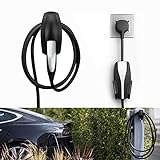
- COMPATIBLE WITH TESLA MODEL 3/MODEL Y/MODEL X/MODEL S CHARGER: Seven Sparta Charging Cable holder is a perfect holder to hang your charging cable from in the garage.
- KEEP YOUR CHARGING CABLE NEATLY AND SECURE: The cable organizer is much better than a normal hook. It does a good job of keeping the cable off of the ground, and protect your cable from falling down accidentally.
- SAFE ABS MATERIAL: The charger cable organizer is made from high quality ABS plastic, pass fireproofing grade testing. The bearing capacity can reach above 30KG at least. Prior to purchasing, we recommend confirming the product's size and material.
- EASY & SECURE INSTALLATION: The charging cable holder takes just minutes to install. The charger head fits snugly into the slot, with a notch to prevent it from sliding out.
What the Mobile Connector does
The Mobile Connector is portable and is useful for renters, travel or a home that already has a suitable outlet. Tesla’s table shows the same 30-mile-per-hour maximum when the connector is supplied by a 240-volt, 50-amp circuit configured for 32-amp output. The actual outlet, adapter, breaker and circuit capacity determine the permitted current; plugging into a higher-rated receptacle does not by itself make the car charge faster.
Portability is the main advantage over a Wall Connector. The trade-off is that you must use an appropriate outlet and may need to move or inspect the cable more often. An electrician should verify the receptacle, grounding, weather exposure and continuous-load requirements before regular use.
120-volt household outlet: possible, but very slow
Tesla says a standard household outlet supplies about 2–3 miles of range per hour. Recovering 100 miles at that rate takes roughly 33–50 hours before charging losses and other slowdowns. Recovering 200 miles takes approximately 67–100 hours under the same simple arithmetic.
This option can work when the car is parked for several days, when daily driving is minimal, or as a temporary fallback. It is not a practical primary solution for a driver who regularly uses a large portion of the battery each day. Use a sound, properly grounded outlet; avoid damaged extension cords and shared circuits; and stop if the plug or receptacle becomes unusually warm.
Home-option comparison
| Option | Electrical supply | Published rate for entry Model 3 | Installation and portability | Best fit |
|---|---|---|---|---|
| Wall Connector | Dedicated 240-volt circuit; rate depends on circuit size | Up to 30 miles per hour at 32 amps/7.7 kW | Fixed installation; electrician and code-compliant wiring required | Owners with a regular parking space and daily charging needs |
| Mobile Connector on 240 volts | Suitable 240-volt outlet; Tesla’s maximum example is a 50-amp circuit configured for 32-amp output | Up to 30 miles per hour at 32 amps | Portable; outlet and adapter must support the selected current | Renters, travelers and homes with an appropriate existing circuit |
| Mobile Connector on 120 volts | Standard household outlet | About 2–3 miles per hour | Portable; no high-voltage circuit installation, but outlet condition matters | Low daily mileage or temporary backup charging |
How long a Supercharger stop takes
Interpreting the 15-minute claim
For the entry Rear-Wheel Drive Model 3, Tesla publishes up to 170 miles added in 15 minutes. Tesla’s general support table lists up to 175 miles in 15 minutes for Model 3. Those numbers describe maximum range added under Tesla’s stated test conditions. They do not establish a universal time from an empty battery to 100 percent.
PC Slower Than It Used to Be?
A free scan shows the junk files, broken settings and background clutter dragging Windows down - then fixes them in one click.Free scan · Windows 10 & 11Outdated Drivers Are Slowing You Down
One free scan finds every outdated or missing driver and matches the right update for your exact hardware.Free scan · exact hardware matchAt the beginning of a trip, a short stop can therefore restore substantial highway range. The final portion of a session is slower as the battery approaches a high state of charge, so remaining for a complete top-up can take much longer than the first 15 minutes. If you only need enough energy to reach the next charger or destination, leaving earlier is usually the time-efficient choice.
Rank #3

- UP TO 9X FASTER CHARGING SPEED: The IYILO electric vehicle charging station delivers up to 46 miles of range per hour at 48A (11.5kW) via hardwired installation (60A breaker & licensed electrician required). Current is adjustable in 1A increments from 6A to 48A. Charges up to 9 times faster than a standard Level 1 charger
- AUTOMATIC CONNECTOR OVERHEAT PROTECTION: Worried about overheating during daily charging? The IYILO Level 2 EV Charger features an advanced NTC temperature sensor built directly into the NACS (Tesla-style) connector, enabling real-time temperature monitoring with live data displayed in the app. If the connector temperature exceeds 221°F (105°C), the system will automatically reduce charging power or completely shut off charging to prevent damage to your EV and ensure safe home charging.
- UTILITY CHARGING PROGRAM SUPPORT: IYILO is currently joining local utility EV charging programs and has been listed on several official portals, including but not limited to ComEd, PSEG (NJ), PSEG-LI, Seattle City Light, Salt River Project, Portland General Electric, Oregon DOT, and Georgia Power ect. Through these programs, you can take advantage of local policy support and incentives. Moving forward, we will continue expanding our partnerships with major utilities and public agencies.
- INTELLIGENT APP & SMART CHARGING CONTROL: The IYILO App features a smart, intuitive interface to set Time-of-Use (TOU) rates, track energy usage and cost, and manage multiple user accounts. It supports multiple charging modes, such as Scheduled charging and RFID card, while also offering OTA remote upgrades, ensuring optimal performance and longer lifespan. Note: Supports 2.4GHz WiFi only; 5GHz not supported
- COMPATIBLE WITH ALL NACS (J3400) EVS & PHEVS: The IYILO Level 2 EV Charger is designed with a native NACS connector and a 25ft heavy-duty charging cable, delivering seamless compatibility with all NACS-equipped electric vehicles and plug-in hybrid vehicles across North America. Engineered for Tesla-style charging standards, it ensures reliable daily home charging performance. Note: For J1772-equipped EVs, a compatible J1772 adapter is required (adapter not included)
Why two Tesla pages show 170 and 175 miles
The figures refer to different Tesla pages and levels of specificity. The Model 3 Rear-Wheel Drive product specification gives the vehicle-specific “up to 170 miles added in 15 minutes” figure. The Supercharging support page presents “Model 3 | Up to 175 miles in 15 minutes” as a general Model 3 maximum. Treat 170 miles as the safer planning ceiling for the cheapest configuration, and regard neither value as guaranteed for every station or season.
Conditions that determine your actual result
- State of charge: A low battery generally accepts power faster than a nearly full battery.
- Battery temperature: A cold or overheated pack may charge more slowly until it reaches a suitable temperature.
- Preconditioning: Navigating to a Supercharger can allow the vehicle to prepare the battery, while arriving without conditioning may reduce the initial rate.
- Station capability and occupancy: The charger’s available power and any site-specific limits affect the session.
- Ambient temperature: Weather changes battery conditioning and the energy required for cabin heating or cooling.
- Vehicle configuration: Tesla’s published range-added values vary by Model 3 version and test conditions.
- Charge target: Setting a high target invokes the slower end-of-charge taper for longer.
Step-by-step: setting up reliable home charging
- Identify your daily requirement. Estimate the miles you normally drive between parking periods. A driver who uses 40–80 miles per day can usually recover that amount during a normal overnight 240-volt session at Tesla’s published maximum rate.
- Check the parking location. Confirm that the cable can reach the charge port without crossing a traffic path, becoming a trip hazard or sitting where it can be driven over.
- Have the circuit evaluated. For a Wall Connector or 240-volt Mobile Connector use, have a qualified electrician verify voltage, breaker size, conductor capacity, grounding, outlet type and local permit requirements. Continuous EV charging must be treated as a sustained electrical load.
- Choose fixed or portable equipment. Select the Wall Connector for a dedicated permanent installation; select the Mobile Connector when portability or an existing compliant outlet matters more.
- Set the current conservatively. Use the circuit and Tesla equipment limits rather than assuming the highest possible amperage. If the circuit is shared or smaller, the vehicle may need a lower setting.
- Plug in and confirm the session. The vehicle screen and Tesla app should show that charging has started, the present power and an estimated completion time. Check the outlet and connector during the first sessions for heat, odor or signs of damage.
- Schedule charging if useful. The car can be plugged in while charging is scheduled for a preferred time, such as an off-peak utility period. The schedule changes when charging starts, not the maximum rate the circuit can safely provide.
Step-by-step: planning a Supercharger stop
- Enter the destination in the car’s navigation. The vehicle can identify charging stops and account for the expected state of charge on arrival.
- Arrive with a realistic target. Decide whether you need enough energy for the next leg, a reserve for weather and traffic, or a higher state of charge for a destination without charging.
- Allow battery conditioning. Following the in-car route to the selected Supercharger gives the vehicle an opportunity to prepare the battery. Detouring or arriving very early can change the initial charging rate.
- Monitor the live estimate. Use the car’s displayed miles and time remaining rather than the maximum published figure. The estimate reflects your battery temperature, state of charge and the connected charger.
- Unplug when the target is met. Staying for the slowest final percentage is often unnecessary when another stop or destination charger is available. Move the car promptly after charging so the stall is available to other drivers.
Which setup makes sense for different owners?
You have off-street parking and drive most days
A 240-volt installation is the most useful arrangement. The published 32-amp rate can replace a substantial daily commute overnight, reducing the need to visit a Supercharger for routine energy. Choose a Wall Connector when the parking space is permanent; choose a Mobile Connector when portability or an existing suitable outlet is more important.
You rent or cannot install a 240-volt circuit
A 120-volt outlet can keep a lightly used car topped up over long parking periods, but it may not recover a high-mileage day by the following morning. Ask the property owner or an electrician about a dedicated 240-volt circuit before relying on the outlet for regular charging. Do not assume that a household receptacle is suitable simply because it is physically close to the parking space.
The Tool Desk
Outbyte PC Repair FREERepair Windows errors before they cause bigger problemsFix Now →Outbyte Driver Updater FREEScan for outdated or missing drivers - takes under a minuteDriver Scan →You take frequent long trips
Use home charging to begin each trip with the desired range, then plan short Supercharger stops around food, rest and navigation requirements. The advertised 15-minute maximum is most useful as a range-restoration benchmark; it is not a reason to plan every stop around a full battery.
Common charging problems and fixes
The car charges more slowly than the published home rate
- Confirm whether the supply is 120 or 240 volts and whether the equipment is limited to a lower current.
- Check the vehicle’s charging screen for a reduced-amp setting or an electrical fault.
- Account for a cold or hot battery and a high state of charge, both of which can trigger tapering.
- Have an electrician inspect the circuit if the outlet, plug or cable is hot, discolored, loose or damaged.
A 120-volt session adds almost no range overnight
That result is consistent with Tesla’s 2–3-mile-per-hour estimate, especially after household voltage variation and charging losses. Reduce daily energy use, leave the car parked longer, or arrange a compliant 240-volt circuit rather than using an unsafe extension-cord workaround.
A Supercharger session does not reach the advertised miles in 15 minutes
The maximum applies only under favorable conditions. Check the starting state of charge, battery temperature, station power and vehicle configuration. If the battery is cold, navigate to the charger and allow conditioning; if the battery is already high, the taper is expected. The live vehicle estimate is the relevant figure for that stop.
Bottom line for the entry Model 3
For regular use, plan on a suitable 240-volt, 32-amp home connection as the practical answer: Tesla rates it at up to 30 miles of range per hour, which makes overnight replenishment realistic for most driving patterns. A standard 120-volt outlet is a slow backup at about 2–3 miles per hour. On a Supercharger, the entry Rear-Wheel Drive version is rated for up to 170 miles in 15 minutes, while Tesla’s general Model 3 support table says up to 175; actual results depend on battery state, temperature, station capability and the vehicle’s configuration.
Quick Recap
Product prices and availability are accurate as of the date/time indicated and are subject to change. Any price and availability information displayed on Amazon at the time of purchase will apply.