Quick wins for a faster PC:
Clear out junk files and repair common Windows errorsFree Scan →Scan for outdated or missing drivers - takes under a minuteDriver Scan →There is no single charging time for an electric truck. Depending on the vehicle, battery, charger and state-of-charge window, a stop can take roughly 45 minutes, about 1–2 hours, or most of a day. Manufacturer examples include 45 minutes for a specified 10%–80% charge using a 750 kW Megawatt Charging System, 70 minutes for a specified Mercedes-Benz eActros 600 charge at 400 kW, 90 minutes for a Scania configuration using 375 kW CCS2, and 1.2–1.8 hours for several 2026 Isuzu NRR EV battery configurations. Those figures describe different trucks and charge windows, so they are not interchangeable.
To estimate your own stop, identify the exact model and battery, the charger’s delivered power, the truck’s maximum acceptance rate, the starting and target state of charge (SOC), and the temperature. The amount of energy you need to add—not simply the size of the battery—determines how long the truck must remain connected.
As an Amazon Associate I earn from qualifying purchases.
Manufacturer charging-time examples
The following figures are manufacturer estimates, not independent, like-for-like tests. Each time is valid only for the stated vehicle configuration, charger and SOC range.
The Tool Desk
Outbyte PC Repair FREERepair Windows errors before they cause bigger problemsFix Now →Outbyte Driver Updater FREEScan for outdated or missing drivers - takes under a minuteDriver Scan →| Truck or configuration | Battery information | Charging setup | Published window | Approximate time |
|---|---|---|---|---|
| Scania heavy-duty truck | 720 kWh usable capacity configuration | CCS2 at 375 kW | 10%–80% | 90 minutes |
| Scania heavy-duty truck | 720 kWh usable capacity configuration | MCS at 750 kW | 10%–80% | 45 minutes |
| Mercedes-Benz Trucks eActros 600 | 621 kWh battery | CCS2, up to 400 kW; estimate based on a 400 kW, 500 A DC fast-charging station | 10%–80% | Approximately 70 minutes |
| 2026 Isuzu NRR EV, 60 kWh battery | 60 kWh | 42 kW DC | 20%–90% | Approximately 1.2 hours |
| 2026 Isuzu NRR EV, 100 kWh battery | 100 kWh | 70 kW DC | 20%–90% | Approximately 1.2 hours |
| 2026 Isuzu NRR EV, 140 kWh battery | 140 kWh | 80 kW DC | 20%–90% | Approximately 1.5 hours |
| 2026 Isuzu NRR EV, 180 kWh battery | 180 kWh | 80 kW DC | 20%–90% | Approximately 1.8 hours |
Scania also illustrates the effect of depot power with a full-charge example: about 13–14 hours on a 40 kW depot charger versus 1–2 hours on a 360 kW charger. Those are full-charge examples and should not be compared directly with the 10%–80% or 20%–90% partial-charge figures in the table.
#1 Best Overall

- 【Compatibility】Support all Best Choice Products 12V round hole charging port Kids Electric Ride On Car, 12V Battery Charger for Children Ride On Toys Jeep Kid Trax Dynacraft Kids Jeep Car Mercedes-Benz Truck Audi Range Rove BMW I8 Kidzone Bumper Car Charger
- 【Safety Certification】Our 12V Battery Charger have passed Safety certified. Fast charging and provide overcharge protection system/short circuit/overload protection/overheat protection.
- 【AC Input /Output 】Input : 100V -240VAC 50/60Hz. /Output:12VDC 1000MA / 5 Ft Power Cable / 2.1mm x 5.5mm Center Positive Barrel Plug
- 【Smart LED light】 Red light when charging, Green light when full.
- 【After-Sales Service】We provide 1 year warranty service, and 3 month unconditional return. Please contact us with any questions or concerns
The Isuzu values are for a US medium-duty truck and should not be generalized to heavy tractors or electric pickups. Isuzu also states that DC charging in cold regions can require up to one additional hour for the cited NRR EV configurations. Mercedes-Benz Trucks says its approximately 70-minute figure can change with battery temperature, ambient conditions, battery condition and SOC calibration.
Why charging time varies so widely
Battery capacity and energy added
A battery’s kWh rating tells you how much energy it can store. Charging from 20% to 90% adds 70 percentage points; charging from 10% to 80% adds the same 70 percentage points, but the actual energy differs when the batteries have different capacities. A 720 kWh pack needs substantially more energy for a given percentage increase than a 180 kWh pack.
For a rough planning check, calculate the energy window as usable battery capacity multiplied by the percentage points to be added. Then compare that energy with the charger and truck’s real charging rate. This is only an estimate because charging losses, tapering and thermal limits mean the battery does not receive the charger’s nameplate power continuously.
What’s actually slowing this PC down?
Pick the symptom - the matching free tool is one click away.
Rank #2

- Only support charging for the batteries of 24V children's electric cars, and the socket shape needs to be consistent.
- OUTPUT:24V800mA,INPUT:100-120V (Please make sure your battery is 24V or 28.8v)The Charger is UL certified
- Indication Light: Red light on when charging, green light on when fully charged(Make sure the battery is not damaged before purchasing)
- If your battery has not been used for more than two months, please check if it is damaged.
- More replacement parts can be searched for "ToiCottage"
Charger output is not the same as truck charging speed
A station advertised at 400 kW or 750 kW can deliver that power only when the electrical supply, connector, station and vehicle all support it. The truck may have a lower maximum acceptance rate, or the station may share power with another vehicle. Scania identifies both charger power and the vehicle’s charging capacity as determinants.
For example, connecting a truck limited to 80 kW to a 350 kW cabinet does not make it charge at 350 kW. Conversely, a truck capable of high-power charging cannot use that capability at a low-power depot connection. Check the truck’s maximum DC rate and the station’s sustained, not merely peak, output.
Starting and target state of charge
Published times always describe a SOC window. A 10%–80% stop, a 20%–90% stop and a 0%–100% charge are different tasks. Starting very low can add time because the battery-management system may initially limit power, while charging near full generally slows as the cells approach their upper voltage limit.
Rank #3

- UNLEASH PEAK POWER: Delivers a massive 250-amp engine start to instantly revive dead batteries, cars, trucks, SUVs, RVs, and high-performance rides are operational when you need them.
- MORE CONTROL OVER CHARGING: Take command with a 135-minute timer for precision manual control, allowing users to customize the charging process for specific battery needs.
- REDUCE DOWNTIME WITH FAST CHARGING: Quickly bring deeply discharged batteries back to life with powerful 25-amp and 50-amp boost charges, reducing downtime and keeping all your vehicles—from daily drivers to classic cars to ATVs—running smoothly.
- UNMATCHED VERSATILITY: Handle virtually every job with one device that supports 6V and 12V standard, AGM, gel, and deep-cycle batteries across automotive, marine, and power sport vehicles.
- COMPLETE PACKAGE: Includes (1) SC1445 Manual Timer-Controlled Wheeled Battery Charger and Engine Starter, (1) User Manual
Scania’s charging guidance emphasizes that full charges are rarely necessary and uses a 20%–80% example for planning. A route stop should therefore be sized to the energy required for the next leg and the next practical charging opportunity, rather than automatically targeting 100%.
Recommended Free Tools
Charging-power taper
DC fast charging is not a constant-power process. The truck may accept close to its advertised peak during part of the session, then reduce power as SOC rises or battery temperature changes. The final portion to 100% is usually the slowest. That is why multiplying battery capacity by a percentage and dividing by the charger’s headline kW will usually produce an optimistic result.
Temperature and weather
Cold batteries can accept less power until they warm to an appropriate operating range. The battery-management system may limit the rate to protect the cells. Isuzu’s 2026 NRR EV brochure warns that cold-region DC charging may take up to one additional hour for the listed configurations. Hot conditions can also trigger thermal limits, especially after sustained driving or repeated fast-charging sessions.
Rank #4
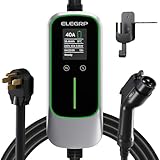
- Fast & Adjustable Charging: Up to 9.6 kW (37 mph), 7x faster than Level 1, with 5 current levels (16/20/24/32/40A) to match home capacity, plus 1–12H timing delay for off-peak charging, reducing costs and easing range anxiety
- Plug & Extended Reach: NEMA 14-50 plug fits 240V outlets for true plug-and-play use, while the 25FT cable offers flexible reach across garages and driveways, eliminating the need to reposition vehicles for easier daily charging
- ETL Certified & ELEGRP PBE Protection: Fully ETL certified, ELEGRP’s exclusive PBE technology combines full-link overheat protection with a triple-layer safety system, ensuring safer, more efficient charging. Includes a 2-year warranty
- All-Weather Indoor & Outdoor Use: IP67-rated for durability in rain, snow, and extreme temps (-21°F to 121°F), with a portable design that supports home, travel, and outdoor charging, delivering reliable performance anywhere
- Universal Compatibility: Works seamlessly with Mercedes, Chevy, Ford, Mustang Mach-E, Cadillac, Hyundai Ioniq, Kia EV6/EV9, Nissan Leaf, Chevy Bolt, Chrysler Pacifica Hybrid, and all PHEV/BEV. Tesla compatible with NACS adapter (sold separately)
Allow extra time when the truck arrives cold-soaked, has been working hard in extreme heat, or is parked outdoors in severe weather. Preconditioning availability and behavior depend on the truck and charging system, so confirm the procedure in the vehicle documentation.
Battery condition and SOC calibration
Battery aging, cell imbalance, state-of-charge estimation and calibration can affect the time shown by the vehicle. Mercedes-Benz Trucks lists battery condition and SOC calibration among reasons its eActros 600 estimate may differ in operation. A displayed 20% is therefore a planning reference, not a guarantee that every session will begin or end at the same power level.
Connector and charging standard
The connector must match both the truck and the station. The cited Scania examples use CCS2 and also describe the Megawatt Charging System (MCS). A station with the wrong connector, insufficient current rating or incompatible communication protocol cannot provide the truck’s maximum rate. Availability of CCS variants and MCS equipment differs by market, vehicle version and installation date.
Best Value

- 【AC Input /Output 】Input : 100V -240VAC 50/60Hz. /Output:24V DC 1000mA / 5 Ft Power Cable / 2.1mm * 5.5mm Center Positive Barrel Plug
- 【LED DISPLAY】Red Charging /Green Fully Charged
- 【Compatible Models】Compatible with the majority of 24V Children Ride On Car ( for Ferrari Lamborghini Mercedes BMX X6 Kid TRAX Disney GMC JEEP Hello Kitty SUV RC Car and so on )
- 【Safety certification】Our products have passed Safety certified. Fast charging and provide overcharge protection system/short circuit/overload protection/overheat protection/ Exceed 10 years Lifespan
- 【Notice】A:that wether the charger's charging hole is compatible. B:the input voltage is 100-240V for this charger. Please confirm insert correctly. C:Please do not overcharge. When the ligth is green, please remove the charge. Please contact us with any questions or concerns.
How to estimate a real charging stop
- Identify the exact truck. Record make, model, model year, market and battery configuration. “Electric truck” can mean a medium-duty work truck or a heavy-duty tractor with a much larger pack and different charging hardware.
- Check usable capacity. Use the manufacturer’s usable kWh figure when available, rather than assuming the nominal pack size is fully accessible.
- Set the SOC window. Note the truck’s current SOC and the target SOC needed for the next route segment. Write the endpoints explicitly, such as 25%–75%.
- Verify the truck’s acceptance limit. Find the maximum AC or DC charging power and the compatible connector in the truck specifications. This is the ceiling even if the station is rated higher.
- Verify the station’s delivered power. Check whether the quoted kW is per outlet, shared between outlets, or a short-duration peak. Confirm that the electrical service can sustain the rate.
- Allow for taper and conditions. Add a buffer for the slower upper-SOC portion, cold or hot weather, battery condition, and possible queuing or power sharing.
- Plan around the route. Estimate the energy required for the next leg and use driver rest or loading time when practical. A shorter, well-timed partial charge can be more efficient than waiting for a full battery.
Depot charging versus en-route fast charging
Overnight or shift-based depot charging
Low-power AC or DC depot equipment can be appropriate when trucks remain parked for many hours. Scania’s illustration of 13–14 hours on 40 kW shows why a low-power connection can still work for an overnight schedule. Depot charging reduces the need to find a high-power public station, but the fleet must have enough outlets, electrical capacity and dwell time for every vehicle.
High-power en-route charging
High-power DC charging is designed to fit within a planned break or loading period. Scania lists 90 minutes for a specified 10%–80% session at 375 kW CCS2 and 45 minutes for the same configuration at 750 kW MCS. Those times depend on the 720 kWh usable-capacity configuration and the stated power; they are not a universal promise for every truck using CCS2 or MCS.
En-route planning must also account for station access, connector availability, traffic, queuing and whether another vehicle is drawing power from the same installation. A nominally faster charger may not shorten the trip if it requires a detour or is unavailable when the truck arrives.
Do these 3 things before closing this tab:
1Scan for outdated or missing drivers - takes under a minute2Repair Windows errors before they cause bigger problems3Fix the driver behind crashes, sound loss and screen glitchesCommon planning mistakes and how to avoid them
- Comparing unlike SOC windows: Put the starting and target percentages beside every quoted time. Do not compare a 10%–80% estimate with a full-charge estimate.
- Using charger power as the answer: The truck’s acceptance limit, connector and site power can all reduce the rate.
- Assuming the final 20% is quick: Charging normally tapers at high SOC. Stop when the route requirement is met unless a full charge is genuinely needed.
- Ignoring temperature: Cold-region operation can add up to one hour to the cited Isuzu examples, and other trucks can also limit power in unsuitable conditions.
- Treating a manufacturer estimate as a test result: The figures cited here come from manufacturer specifications and guidance, not a shared independent test under identical conditions.
- Buying a generic cable or home charger: Commercial truck charging is vehicle- and infrastructure-specific. Connector type, current, communication, installation and electrical capacity must all be compatible.
- Planning only for battery percentage: Use the energy needed for the next route leg, payload, terrain and weather. Two trips starting at the same SOC can require different charge amounts.
What to ask a fleet or charging provider
Before committing to a route or depot installation, request the truck-specific maximum rate, connector type, expected session duration for your chosen SOC window, and any temperature-related limits. Ask whether the quoted kW is continuous and whether power is shared. Confirm the site’s electrical connection, operating hours, payment or access rules, maintenance arrangements and geographic coverage. MCS rollout, CCS compatibility and local installation standards can change by market and date.
For a fleet, record actual arrival SOC, departure SOC, energy delivered, session duration and ambient temperature. Those records let you replace a brochure estimate with a route-specific operating range without confusing one vehicle’s performance with another’s.
Bottom line
Electric-truck charging can take about 45 minutes to several hours for a planned partial stop, or 13–14 hours on a low-power depot connection in the illustrative Scania example. The useful answer is always tied to the truck, battery, charger, SOC window and conditions. Use the manufacturer’s exact charging limits, plan for power taper and weather, and charge only to the SOC required for the next part of the route.
Quick Recap
Product prices and availability are accurate as of the date/time indicated and are subject to change. Any price and availability information displayed on Amazon at the time of purchase will apply.




