BMW used hardware-in-the-loop (HIL) simulators to develop and safeguard the Hydrogen 7’s engine controls with real controller hardware connected to a real-time model of the engine and vehicle signals. That let engineers test repeatable operating conditions, electrical faults and communication with other controllers without depending on a complete vehicle for every test. The system extended BMW’s existing engine-model platform and grew from two initial HIL systems to four for the program.
What a hardware-in-the-loop simulator does
A HIL bench puts a real electronic control unit (ECU) in a closed loop with simulated parts of the system it controls. The simulator calculates the model’s behavior in real time, turns that behavior into electrical signals for the ECU, then reads the ECU’s outputs and feeds them back into the model. In this way, engineers can exercise production-relevant controller hardware and software while the engine, sensors, actuators or other vehicle systems are represented by models and test hardware.
dSPACE’s Dr. Peter Waeltermann described HIL in 2016 as an integral part of electronic development for testing control functions, with ECUs operating in a closed loop with components simulated in real time. In the Hydrogen 7 program, BMW and its partners used that approach to integrate hydrogen-specific engine-control tasks into the existing development process, as described in a 2007 National Instruments case based on a MicroNova and BMW conference presentation.
Why BMW tested the controls on a HIL bench
Repeatable conditions before vehicle testing
A simulator can present the controller with the same modeled operating point repeatedly. That makes it useful for developing and checking control functions under controlled conditions, including cases that would be difficult or inconvenient to reproduce consistently on a running engine or road vehicle. HIL does not eliminate engine or vehicle testing; it provides a controllable development and verification environment that can be used alongside them.
The Tool Desk
Outbyte PC Repair FREERepair Windows errors before they cause bigger problemsFix Now →Outbyte Driver Updater FREEScan for outdated or missing drivers - takes under a minuteDriver Scan →#1 Best Overall

- Includes museum issued collector's manual. Official BMW licensed product.
- 200 part kit. No glue or special tools necessary; build it yourself in about 3 hours
- 1:2 scale transparent working model; see all parts move through the high quality plastic casing
- Working five-speed gearbox; flip through the legendary BMW gearbox and witness the engineering
- Original engine sound; recorded from an actual r90 airhead flat six. Once built, press the button and experience the engine's sights and sounds
Faults and signals without every physical component
Engineers can inject electrical and sensor errors and observe how the controller responds. BMW’s setup used electrical dummy loads in place of real injectors and ignition plugs for most tests, while its simulator generated Hydrogen 7-specific inputs for the engine controls. This enabled bench testing without using those engine components as the load in each test.
Testing interactions across controllers
The engine ECU does not operate in isolation in a vehicle. BMW connected the engine-control hardware with the immobilizer and central gateway controllers, and integrated vehicle communication buses. That let the test setup cover controller interactions and communications as well as engine-control functions.
Rank #2

- Model Compatibility: Fits N52B30 engines in E81, E88, E82, E90, E91, E60, F10, E85, E70, and E84 vehicles.
- Vehicle Application: Designed for X1, X3, X5, and Z4 models equipped with 2.5L or 3.0L L6 gas engines.
- Engine Specification: Matches 2.5 Liter and 3.0 Liter inline six cylinder configurations found in listed chassis codes.
- Production Range: Suitable for vehicle model years spanning from 2004 through 2015 as indicated in the product title.
- Functional Purpose: Serves as a rebuilding kit to restore equipment function for the specified N52B30 engine platform.
How BMW’s Hydrogen 7 HIL system was built
An existing model platform adapted for hydrogen operation
BMW integrated hydrogen-specific engine tasks into its engine-model platform, which had already been used for serial development. Implemented in Simulink, the platform included component and control models as well as scaling between physical quantities and the electrical values used at the controller interface. Using an established platform provided a basis for the hydrogen work rather than requiring a wholly separate model environment.
Real engine-control hardware and vehicle controllers
The motor-control system used two master-slave controller pairs, with each pair controlling one bank of the V-12 engine. The HIL setup also included the immobilizer and central gateway controllers to make the bench’s controller environment more representative of the vehicle’s.
Rank #3
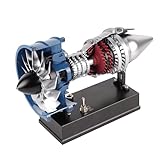
- Realistic & Authentic: The lifelike & visually stunning model provides a realistic depiction of a full-sized engine with main components including a first-stage fan, high-pressure rotor assembly, combustion chamber, high-pressure turbine assembly, low-pressure turbine assembly, and exhaust nozzle.
- High-Quality Construction: Made of high-quality metal, the meticulous model, full of detail and features, undergoes precision casting and CNC machining, along with sandblasting and anodized coloring treatment on the surface, ensuring durability and accuracy the same as the real model.
- Dynamic Display: Featuring a semi-transparent magnetic casing, this model offers a clear view of the engine's internal mechanics in motion when powered by the electric motor. The quick-release magnetic cover allows for effortless assembly and disassembly, making it ideal for demonstrations while protecting delicate components. Equipped with a sturdy mounting bracket and throttle control lever, this kit delivers an immersive hands-on experience with aviation engineering.
- DIY Assembly: Consists of 170+PCS (including screws & nuts) and comes with tools and paper-based English instructions. You will personally experience the entire assembly process, from small parts to the final completed model, constructing an awe-inspiring turbofan engine model.
- STEM Education: As an educational tool, this model unravels the internal workings of a turbofan engine, imparts knowledge about aerospace engineering, and stimulates interest, creativity, and awe for industrial technological achievements
Electrical interfaces, loads and hydrogen-specific signals
The bench acquired controller inputs and outputs and used electrical dummy loads for most injector and ignition-plug tests. It generated signals specific to the Hydrogen 7’s four adjustable camshafts, six knock sensors and continuous lambda sensing. CAN, BSD and other vehicle buses were integrated; configurable signal processing was supported by FPGA hardware.
A dedicated safety-controller test setup
The CleanEnergy controller was a redundant, two-channel safety controller. Its HIL benches needed to supply electrical error signals, including high-current faults, and emulate both resistive and inductive actuator loads. Its software was designed in MATLAB/Simulink, with autocode generated through Atena and TargetLink. This specialized testing complemented the motor-control HIL setup rather than simply duplicating it.
Rank #4

- 【Build Your Own 911 Engine Model】Measured as 8.07*6.81*5.71in (L*W*H), This exquisitely designed V8 engine model features realistic details like a transparent cylinder head, simulated piston movement, and a turbocharger. Its compact design accurately mimics the inner workings of a real V6 engine, making it a unique and engaging mini engine toy.
- 【USB Charging Motor Design】This V6 engine kit includes a motor (Rechargeable Battery Included) and a USB charging cable, enabling the model toy to be electrically driven. You can watch the movement of the internal pistons through the transparent cylinder heads on both sides and get a sense of how the V6 engine powers the car.
- 【Realistic 911 Engine Model】Inspired by the 911 sports car, vividly simulating the 911 engine. Transparent cylinder head design allows you to see directly through it how the valve train works together inside. You will see this V6 Engines has precise piston. Compatible with LEGO 911 technic.
- 【Safe High Quality Material】This V6 engine kit is made of ABS material, non-toxic and odor-free, and is tested by ASTM and CPSIA to ensure a safe and building experience. If you encounter any issues such as missing pieces or non-functional motor, please feel free to contact us!
- 【Ideal Gift for Technic Car Fans】This V6 engine model, designed for people who like technic car and mechanical engineering, suitable for LEGO collectors adults, teens and boys. Ideal gift for any special occasion, such as Christmas, Birthdays, STEM educational events, etc. All products of my company have been strictly tested before shipping.
What the case reports about the vehicle and test-system scale
The BMW Hydrogen 7 was a bi-fueled 12-cylinder V-engine vehicle. The figures below are reported in the 2007 National Instruments/MicroNova/BMW case; they describe the program and its setup, not current production specifications.
| Reported item | Value | Qualification |
|---|---|---|
| Engine output in hydrogen mode | 191 kW | Reported by the 2007 National Instruments/MicroNova/BMW case |
| Maximum torque in hydrogen mode | 390 Nm | Reported by the 2007 National Instruments/MicroNova/BMW case |
| Liquid-hydrogen tank capacity | 168 liters | Tank storing hydrogen at approximately −250 °C, as reported in the 2007 case |
| Liquid-hydrogen storage | 8 kg | Reported by the 2007 case |
| Initial HIL systems for engine-control development | Two | The case says two more were established after intensive manual and automated use |
| Additional HIL systems for Hydrogen 7 development | Two | Added after the initial systems, according to the 2007 case |
| HIL systems across the broader BMW development environment | More than 60 | Reported in the 2007 case; not a Hydrogen 7-only count |
| Compact systems in the universal BMW engine-controller setup | Ten | Reported in the 2007 case as part of the broader setup |
Automation, reuse and the trade-offs
Portable automated tests
BMW used TraceTronic ECU-Test to automate testing. The case says scripts could be moved between systems from different suppliers, supporting reuse across the HIL environment instead of tying each test to a single bench. The expansion from two initial Hydrogen 7 systems to two additional ones followed intensive manual and automated use.
Quick wins for a faster PC:
Scan for outdated or missing drivers - takes under a minuteDriver Scan →Repair Windows errors before they cause bigger problemsFix Now →Best Value

- Wonderfully Detailed Model: Our 5-Cylinder Radial engine model kits feature genuine precision-cast and machined parts in anodized aluminum and stainless steel. Each piece is accurate, detailed and directly correlates to assemblies found in modern, high-performance automobile engines. This is a superb introduction into engineering and mechanics.
- Complete Accessories: The kit contains over 230 parts. Each finely-crafted part is labeled, and packaged in custom foam carriers to ensure they are organized, complete, and undamaged. A clear, full-color instruction manual is included. While the engine is complex, step-by-step instructions – along with some patience – ensure excellent results.
- Simulation Model: A real electric motor inside the starter motor housing drives the 5-Cylinder Radial engine. The crankshaft, rods and pistons can be observed through special viewing windows. You can observe the operation of the 5-Cylinder Radial engine during the whole process. It is not only a beautiful decoration, but also a simulation dynamic model that can simulate the operation of a real 5-Cylinder Radial engine. Even when not in motion, it is an impressive machine to see.
- Excellent Learning Activity: This kit is not recommended for unsupervised children under the age of 14, due to its small parts. However, it provides a great opportunity for adults to spend time with children. The child will learn to understand and follow illustrated instructions, manipulate parts and basic tools, and to know the accomplishment of a job well-done. It fosters an appreciation for the ingenuity in today’s technology as well as the need for it in coming generations.
Model detail should match the test
The case emphasizes that HIL model accuracy should suit the application at hand. Incremental modeling can avoid paying the computational and integration cost of maximum detail before a test requires it. But broader functional coverage and tests spanning multiple controllers may demand more complete and accurate models. A HIL result is therefore only as useful as the model and interfaces relevant to that test.
Flexibility still takes integration work
Standard PXI hardware and reconfigurable FPGA interfaces can support compact, adaptable systems and supplier flexibility. They do not make integration or upkeep automatic: the case notes one-time work to integrate a new platform and ongoing effort to maintain models. It does not report model accuracy, real-time update rates or fault-coverage measurements, so the system’s performance on those dimensions cannot be quantified from the case.
What the Hydrogen 7 example demonstrates
The Hydrogen 7 case shows HIL functioning as an engine-control development environment, not merely as a virtual engine display. BMW connected real controllers, electrical interfaces, loads, safety-control testing and vehicle networks to a real-time model, then automated tests across a growing set of benches. The BMW-authored SAE paper by Kiesgen and colleagues (2006) places the vehicle in the context of a bi-fuel 12-cylinder hydrogen internal-combustion engine for the 7 Series and discusses its operating strategy and low tailpipe emissions; the HIL case explains how control development was supported.
Quick Recap
Product prices and availability are accurate as of the date/time indicated and are subject to change. Any price and availability information displayed on Amazon at the time of purchase will apply.
Free tools Windows power users keep installed
One-click scans. No signup required.




