Quick wins for a faster PC:
Fix the driver behind crashes, sound loss and screen glitchesFind Drivers →Repair Windows errors before they cause bigger problemsFix Now →Choose the exact helmet that fits correctly, carries the approval required where you ride, and gives you useful model-specific evidence. A full-face helmet has a fixed chin bar. A modular, system, or flip-front helmet can raise its lower face guard, giving you an open-face position when the design and approval allow it. With the guard locked closed, both styles cover the chin, but a modular helmet adds a latch and hinge that must be checked on that particular model.
There is no responsible category-wide rule that every full-face helmet is safer, lighter, quieter, or more comfortable than every modular helmet. Your decision should balance fit, certification, verified chin-bar and latch information, riding habits, and the practical likelihood that you will keep the helmet correctly closed whenever protection is needed.
As an Amazon Associate I earn from qualifying purchases.
What the two helmet types actually are
Full-face helmets
A full-face helmet is built around a permanently attached chin bar. The shell, visor opening, cheek area, and chin section form one fixed protective structure. You cannot swing the chin bar away at a fuel stop or while speaking; you must remove the helmet or use an intercom.
Do these 3 things before closing this tab:
1Repair Windows errors before they cause bigger problems2Scan for outdated or missing drivers - takes under a minute3Clear out junk files and repair common Windows errorsThe fixed design removes the flip-up mechanism from the helmet. That does not automatically make every full-face model safer than every modular model, because protection still depends on shell design, the approval standard, manufacturing quality, condition, and fit. It does mean there is no rider-operated hinge or chin-bar latch to close before riding.
#1 Best Overall

- 2 Visors Included: Clear + Smoked and 1 Neck Scarf for Winter Use
- Streamlined Aerodynamic Design Reduces Wind Noise and Drag
- Advanced and Lightweight Durable ABS Shell
- Quick Release Clasp and Strap and Removable Inner Lining Pads
- Meets or Exceeds FMVSS-218 and DOT Safety Standards
Modular, system, or flip-front helmets
A modular helmet has a movable lower face guard. The guard normally locks in the down position to provide a full-face configuration and can be raised for brief low-speed tasks, conversation, or ventilation when the design permits. Some are designed to be ridden only with the guard closed; others have approvals that cover additional configurations. Read the exact helmet’s labeling and manual rather than assuming that an open position is approved for road use.
The convenience feature adds mechanical parts: hinges, pivots, a release, and a locking system. Those parts require correct operation, inspection, and model-specific evidence. NHTSA describes modular helmets as capable of being full-face or open-face and notes that they are common among adventure and dual-sport riders. That description does not establish that every modular helmet fits, vents, or performs alike.
| Question | Full-face | Modular |
|---|---|---|
| Chin bar | Fixed in place | Raises on a hinge or similar mechanism |
| Open-face position | Not available | Available on designs that permit it; check the manual and approval |
| Moving parts at the chin bar | None of the modular type | Hinge, latch, release and related hardware |
| Primary buying issue | Fit, approval, shell and visor configuration | All full-face criteria plus closed-position locking and configuration approval |
| Universal winner on weight, noise or comfort | Not established; compare exact models | |
The crash question: can a modular chin guard open?
SHARP frames the concern this way: “In a crash, will the chin guard spring open and expose my face?” A modular helmet’s answer depends on its latch and the impact conditions, not on the word “modular” alone. SHARP publishes a modular latch score in addition to its star rating. The score records how often the lower face guard remained fully locked during SHARP’s impact tests.
That score is useful supplementary evidence, but it is not a guarantee that a helmet will stay closed in every crash. It is also not a quantified prediction of facial injury and cannot be used as a universal comparison between all modular helmets or between modular and full-face categories. SHARP states that it cannot objectively quantify the safety difference between two latch percentages. It does state that lower latch reliability means greater injury risk, while providing no precise risk estimate.
Because the latch score is an observed laboratory result, keep its scope attached to the number: it describes that model, tested as sold, under SHARP’s impact protocol. It does not describe your individual crash, a different production version, or a separately installed accessory. Check the current SHARP listing and the helmet’s current approval details when you buy.
Rank #2

- 【DOT Certified & High-Impact Protection】 This full face motorcycle helmet meets or exceeds DOT FMVSS-218 standards, ensuring professional-grade safety. Built with a rugged ABS shell and energy-absorbing EPS, these motorcycle helmets dot approved provide ultimate defense for street bikes, cruisers, and sport bikes
- 【Optimized Airflow for All-Weather Riding】 Experience superior ventilation with 4 strategically placed air intakes and exhaust vents. This full face helmet design minimizes wind resistance and fogging, keeping you cool during summer rides and providing a reliable full face helmet adult option for rainy or cold weather
- 【Quick-Release Dual Visor System】 Adapt to any light condition with ease. Our full face helmet motorcycle features a tool-free quick-release system. Each order includes a pre-installed tinted shield plus a bonus clear visor, making these full face motorcycle helmets for men and women versatile for both bright days and night riding
- 【Washable Lining & Comfort Fit】 Maintain freshness on every journey with our fully removable and machine-washable interior. The moisture-wicking sponge padding makes these motorcycle helmets for adults incredibly comfortable for long-distance trips, ensuring a snug fit for these full face motorcycle helmets dot certified
- 【Complete Bundle & Perfect Sizing】 We include a premium carrying bag for easy storage and scratch protection. Whether you are searching for motorcycle helmets for women or men, TRIANGLE offers 4 sizes (S-XL) to ensure a secure fit. Please measure your head circumference to find the perfect full face motorcycle helmet for women or men
How approval and testing fit into the choice
United States: FMVSS No. 218 and the DOT label
For helmets sold for use in the United States, NHTSA says the applicable federal standard is FMVSS No. 218 and that buyers should look for the DOT certification label. The US system relies on manufacturer self-certification rather than NHTSA pre-approving each helmet. NHTSA can conduct compliance testing and pursue recalls when products fail, so “DOT approved by NHTSA” is an inaccurate description.
Check the label on the helmet, not just an online product title. Make sure the marking belongs to the exact model and configuration you are purchasing. A retailer’s generic statement about a product family is not a substitute for the required label.
Crashes, No Sound, or Screen Glitches?
Random freezes, missing sound and display glitches usually trace back to one bad driver. Find and replace yours safely.Free scan · under a minuteWindows Errors? Fix Them Before They Spread
Repair common Windows errors and clear accumulated junk for a smoother, more stable PC - no reinstall needed.Free scan · no reinstallOther jurisdictions and ECE approvals
Approval rules vary by country and by the place where the helmet will be used. Follow the approval mark required by your local law. SHARP discusses UN ECE Regulation 22.05 and Regulation 22.06 in explaining its test work. Its FAQ also cautions that SHARP checks whether required chin-bar tests were conducted rather than independently rating chin-bar protective performance beyond that assessment, and it notes a qualification concerning ECE 22.06.
Do not reduce that explanation to “ECE 22.06 always proves this helmet passed a particular chin-bar test.” Inspect the approval information for the exact helmet, including the configuration covered. A helmet may carry more than one marking, but the legal requirement where you ride still controls.
What SHARP’s impact speed means
SHARP says its impact testing uses 8.5 m/s. In the same explanation, it gives 7.5 m/s for UN ECE Regulation 22.05 and 8.2 m/s for UN ECE Regulation 22.06. These are test velocities used in the stated protocols, not a direct translation of a real-world crash speed and not proof of a particular injury outcome. A higher laboratory impact velocity does not let you calculate your personal survival or injury probability.
Rank #3
- 【DOT Certified & High-Impact Protection】 This full face motorcycle helmet meets or exceeds DOT FMVSS-218 standards, ensuring professional-grade safety. Built with a rugged ABS shell and energy-absorbing EPS, these motorcycle helmets dot approved provide ultimate defense for street bikes, cruisers, and sport bikes
- 【Optimized Airflow for All-Weather Riding】 Experience superior ventilation with 4 strategically placed air intakes and exhaust vents. This full face helmet design minimizes wind resistance and fogging, keeping you cool during summer rides and providing a reliable full face helmet adult option for rainy or cold weather
- 【Quick-Release Dual Visor System】 Adapt to any light condition with ease. Our full face helmet motorcycle features a tool-free quick-release system. Each order includes a pre-installed tinted shield plus a bonus clear visor, making these full face motorcycle helmets for men and women versatile for both bright days and night riding
- 【Washable Lining & Comfort Fit】 Maintain freshness on every journey with our fully removable and machine-washable interior. The moisture-wicking sponge padding makes these motorcycle helmets for adults incredibly comfortable for long-distance trips, ensuring a snug fit for these full face motorcycle helmets dot certified
- 【Complete Bundle & Perfect Sizing】 We include a premium carrying bag for easy storage and scratch protection. Whether you are searching for motorcycle helmets for women or men, TRIANGLE offers 4 sizes (S-XL) to ensure a secure fit. Please measure your head circumference to find the perfect full face motorcycle helmet for women or men
Start with fit, not the hinge or graphics
NHTSA’s fit guidance is the most important practical filter: the helmet should feel equally snug around the crown and cheeks and should not move when you shake your head. A helmet that is loose, tilted, or painful in one pressure point can compromise stability and make you less likely to wear it correctly.
A reliable fitting procedure
- Measure your head according to the manufacturer’s instructions, usually around the largest circumference above the eyebrows and ears. Treat the measurement as a starting size, not a guarantee.
- Try the exact model, size, and shell variant you intend to buy. Different models from the same maker can have different internal shapes.
- Put the helmet on by spreading the straps and pulling it down over the crown rather than forcing it sideways. The cheek pads should contact your cheeks firmly without creating sharp, localized pain.
- Fasten the retention system exactly as the manual shows. Do not judge fit with the strap hanging loose.
- Keep the helmet on for several minutes. Normal, even pressure is expected; numbness, a severe headache, or a hard pressure point is a reason to try another size or shape.
- Shake your head in several directions. The helmet should move with your skin and hair rather than sliding independently. If it shifts, rocks, or exposes more forehead when you move, do not compensate by merely tightening the strap.
- Check your field of view, visor operation, and ability to reach the release without disturbing the fit. A helmet that blocks your useful sight picture or cannot be secured comfortably is the wrong choice even if its size label matches your measurement.
New cheek pads often compress slightly with use, but do not buy a dangerously tight crown area expecting it to become comfortable. Conversely, do not accept a loose fit because a modular model feels convenient. Replacement pads must be approved for that model and installed as directed; improvised padding can alter the fit and retention.
Compare the exact models on the issues that matter
Chin-bar approval and closed-position evidence
For a modular helmet, verify which chin-bar configuration is covered by the required approval and whether the helmet must be closed while riding. Then look for independent, model-specific information, including SHARP’s assessment where available. SHARP says it checks whether chin-bar tests were conducted and reports a separate modular latch score. Record the model designation, not merely the brand or product family, because revisions can change hardware and approvals.
Latch operation
Operate the chin bar repeatedly before purchase. It should reach the fully closed position without unusual force, and the indicators or audible feedback described in the manual should be clear. With the helmet off your head, inspect the latch and hinge for damage, uneven movement, loose fasteners, or contamination. Never ride with a guard that appears closed but has not completed its locking movement.
A latch score does not replace this hands-on check. Conversely, a smooth latch on a shop sample does not prove how that model performed in SHARP’s tests. Use both pieces of information within their limits.
Rank #4
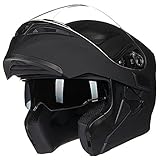
- High Resistance ABS Shell With Micrometrically Adjustable Strap
- Meets or Exceeds FMVSS-218 and DOT Safety Standards
- Helmet Liner / Cheek Pads are Lightweight, Soft and Easily Removable and Washable
- Sleek and Lightweight Design Reduces Wind Noise
- Modular Flip-Up Function Anti-Scratch, Anti-Fog and Wide View Clear Visor
Noise, ventilation, weight and comfort
These attributes are highly model- and rider-dependent. Head shape, motorcycle fairing, riding speed, windshield turbulence, clothing, visor seals, and ventilation design can change the result. The official material considered here does not establish a universal style-level winner. SHARP says it does not assess acoustic properties because it is unaware of a reliable, repeatable test that represents riding noise.
Compare manufacturer specifications where they are provided, then test the helmet in the riding position if possible. Never treat a listed weight as directly comparable unless the sizes, shell materials, visor, communication hardware, and measurement method are the same. A modular helmet may include additional hardware, but the only meaningful comparison is between the exact configurations you would wear.
Independent reader supportYour contribution helps us test, update, and keep practical guides available for everyone.Choose according to how you ride
Mostly highway and uninterrupted riding
If you rarely need to speak, eat, adjust eyewear, or perform tasks while stopped, a fixed chin bar may be the simpler arrangement. The benefit is not a guaranteed category-wide safety advantage; it is the absence of a flip-up operation and the ability to concentrate on fit, approval, visor and ventilation. Select a modular instead if its convenience solves a real problem without causing you to compromise fit or closed-position discipline.
Urban commuting and frequent stops
A modular helmet can make low-speed stops more convenient when its manual and local rules permit the raised position. You can communicate with a parking attendant or take a drink without removing the entire helmet. Before moving again, lower the guard and confirm that it is fully locked. Build that check into your routine just as you check the retention strap.
Adventure and dual-sport use
NHTSA notes that modular helmets are common among adventure and dual-sport riders. Their flexibility can be useful when a route alternates between traffic, navigation stops, and slower off-road sections. Terrain, dust, rain, and frequent operation can place additional demands on hinges and seals, so inspect the mechanism more often and follow the manufacturer’s cleaning instructions. The description of common use is not a recommendation for every rider or model.
Eyeglasses, hearing protection and communications
Try your normal glasses, earplugs, or communication system with the helmet. The temples must not create painful pressure, and a microphone or speaker must not displace the liner. SHARP tests helmets as sold, with original-equipment peripherals in place when supplied, but it does not test separately sold accessories fitted after purchase. Do not assume that a camera, intercom, or other add-on has been covered by the helmet’s original testing. Install only accessories permitted by the manufacturer and keep them clear of the retention system and impact-absorbing liner.
A practical buying sequence
- Confirm the jurisdiction. Identify the approval mark and label required where you will ride. For US use, verify the DOT certification label associated with FMVSS No. 218.
- List your real use case. Note highway percentage, stop frequency, weather, eyewear, communication equipment, and whether you genuinely need a raised guard.
- Shortlist by fit shape. Measure your head, then try several models in the correct size. Eliminate any helmet that moves during the shake test or creates intolerable pressure.
- For a modular, verify configuration. Read the manual and approval marking to determine when the chin bar is approved for riding and what the closed position requires.
- Check independent evidence. Look up the exact model in available SHARP results. Read the star rating and the separate latch score without turning either into a guaranteed crash outcome.
- Operate every control. Test the visor, vents, chin-bar release, latch indicator, strap, and any approved accessories while wearing the helmet.
- Compare specifications carefully. Use manufacturer weight and feature data only when sizes and equipment are comparable. Treat noise and comfort as personal tests, not style assumptions.
- Inspect the delivered helmet. Confirm the model, size, approval label, included parts, and undamaged hardware before removing tags or riding.
Use and maintenance mistakes that undermine either choice
- Riding with the modular guard raised: Do this only when the helmet’s approval, manual, and local law permit it. Otherwise, close and lock it before moving.
- Ignoring a partial latch: A guard that looks aligned is not necessarily locked. Use the model’s stated confirmation and stop riding if the mechanism is damaged or uncertain.
- Adding unapproved equipment: Separately sold cameras, intercoms, mounts, and adhesive accessories are not automatically covered by the helmet’s original test configuration.
- Replacing parts indiscriminately: Use manufacturer-specified shields, liners, cheek pads, screws, and lubricants. A mismatched part can affect fit, sealing, or latch operation.
- Cleaning with harsh chemicals: Follow the helmet maker’s cleaning directions for the shell, visor, seals, and moving hardware. Solvents can damage plastics and coatings.
- Continuing after impact or damage: A helmet can have hidden damage after a crash or substantial drop. Follow the manufacturer’s replacement guidance rather than relying on a visual inspection alone.
- Assuming the score follows every production run: Check the current model identification and listing. Do not transfer a result from an older or differently configured helmet.
Decision guide: which one should you choose?
| If your priority is… | Lean toward… | Still verify… |
|---|---|---|
| A fixed chin bar with no flip-up mechanism | Full-face | Exact fit, required approval, visor and ventilation |
| Frequent conversations or tasks while stopped | Modular | Closed-position approval, latch operation and model-specific latch evidence |
| Adventure or dual-sport flexibility | Either, with modular as a practical option | Local rules, configuration approval, dust and weather maintenance |
| Lowest possible noise or weight | Neither by category alone | Exact-model specifications and an in-person riding-position check |
| Strongest confidence from independent data | Either style with available model-specific testing | What the test measured, its limits, and whether the tested configuration matches yours |
The best answer is the helmet you can wear correctly for every ride. A full-face model is a sensible choice when you want a fixed chin bar and do not need a flip-up function. A modular model is sensible when its convenience is valuable and you are willing to verify its approval, maintain its mechanism, and close and lock the guard before riding. In both cases, fit and the required certification come before features.
Quick Recap
Product prices and availability are accurate as of the date/time indicated and are subject to change. Any price and availability information displayed on Amazon at the time of purchase will apply.
Free tools Windows power users keep installed
One-click scans. No signup required.




