Several well-known automakers trace their histories to aircraft manufacturing or aviation businesses—but they did not all follow the same path. Bristol added a car division after building aircraft; Saab diversified into cars after World War II and later separated the businesses; Mitsubishi’s wider industrial history includes both aircraft work and an early passenger-car program; and Subaru emerged through a postwar corporate succession rooted in Nakajima Aircraft. BMW has aviation-related origins, too, though its history does not establish that BMW itself began by building complete airplanes.
How aircraft companies and aviation groups entered carmaking
“Went from airplanes to cars” can describe several different corporate histories. Some firms moved into cars while still making aircraft; others began car production through a division, a diversified industrial group, or a successor company formed after restructuring. The distinction matters: an automaker’s roots in aviation do not necessarily mean the present-day company once built complete airplanes, or that it left aerospace behind.
| Company or lineage | Aviation connection | How carmaking began | Aviation today |
|---|---|---|---|
| Bristol | Predecessor founded as an aircraft company in 1910. | Car Division formed in 1945; first Bristol car, the 400, ran under its own power in 1946. | The cited heritage account describes its historical aircraft and car businesses; it does not establish a current aviation operation. |
| Saab | Started as a defence-industry company and made aircraft. | Moved into cars after World War II; automobile production separated from aviation in 1990. | Saab AB is not the continuing home of the former car operation. |
| Mitsubishi industrial lineage | The wider group included aircraft-fuselage production. | Model A passenger-car program began in the 1910s. | The cited histories cover the broader Mitsubishi group’s past, not a claim that today’s Mitsubishi Motors made every aircraft mentioned. |
| Nakajima Aircraft to Fuji Heavy Industries/Subaru | Corporate roots trace to the Aircraft Research Laboratory and Nakajima Aircraft. | Postwar restructuring led to Fuji Heavy Industries; the Subaru 360 appeared in 1958. | Subaru lists both automotive and aerospace activities. |
| BMW | Origins include an aircraft manufacturer and an aero-engine producer. | BMW entered automobile production in 1928. | The cited history establishes aviation-related origins, not that BMW itself began by producing complete airplanes. |
Bristol: aircraft manufacturing methods carried into cars
Sir George White founded the British and Colonial Aeroplane Company in 1910. According to Bristol’s heritage history, the company entered the Second World War among the leading aircraft manufacturers and formed its Car Division in 1945. Its first car, the Bristol 400, ran under its own power in September 1946 and was displayed at the Geneva motor show in March 1947. Bristol’s heritage history
Bristol describes a practical link between its aircraft and car work: engines were tested on aviation-style test beds, and aircraft-company methods informed the body of the 401. This is more specific than a general claim that the cars merely looked or felt like aircraft. The company’s own summary was: “Bristol did not lower its standards to build motor cars. It brought them.”
#1 Best Overall
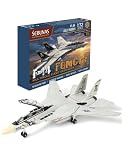
- Experience the legendary F-14 Tomcat through a highly detailed model designed for aviation collectors and hobby enthusiasts. The finished model becomes a striking desktop or showcase centerpiece.
- This 3D puzzle is designed for beginner-level assembly enthusiasts, offering an immersive hands-on building experience that helps cultivate patience, concentration, and mechanical problem-solving skills.
- This product is manufactured using high-quality, environmentally friendly plastic and employs an ultra-fine etching process to ensure durability, structural precision, and realistic aircraft details.
- Encourages understanding of aircraft engineering concepts while improving hand-eye coordination and spatial thinking through engaging mechanical assembly.
- Ideal gift for childs, engineers, collectors, model builders, and puzzle lovers for birthdays, Children’s Day, Christmas, or special hobby occasions.
Saab: postwar diversification, then a corporate split
Saab’s history describes the company as originating in the defence industry. Its account says the end of World War II and expected military-budget cuts prompted it to branch into civilian aircraft, applications, and cars. That makes the car program a postwar diversification rather than a simple conversion from aircraft production to automobiles. Saab’s corporate history
The aviation and motor-vehicle businesses separated in 1990. General Motors took over automobile production in the newly formed Saab Automobile AB, so the former carmaking operation should not be confused with today’s Saab AB. Saab’s history of the early 92 also says its designers drew on aircraft aerodynamics for the car’s sweeping lines and intended aerodynamic knowledge to aid acceleration. That is the company’s account of design intent, not an independently established performance comparison. Saab’s account of the early cars
Rank #2

- Revell Model Kit #85-5810, Skill Level 4, Contains 66-Parts, Recommended for ages 12 and up
- Accurate surface details
- Includes GTD-21 surveillance drone with cart
- Decals with authentic U.S. Air Force markings
- Molded in black and clear. Paint and glue required(not included).
Mitsubishi: aircraft work and an early passenger car in a wider industrial history
Mitsubishi’s company history recounts aircraft-fuselage production at its Nagoya Works, while its car history describes the Model A. The company says Model A production began in 1917 and calls it Japan’s first series-produced passenger car. A separate company-history milestone dates completion of Japan’s first mass-produced passenger car to November 1918. The official pages use different wording and dates; they should be preserved as distinct milestones rather than collapsed into one definitive date. Mitsubishi company history · Mitsubishi car history
This is a story about the broader Mitsubishi industrial lineage. The history does not mean that the present-day automaker Mitsubishi Motors itself made every aircraft associated with the group.
The Tool Desk
Outbyte PC Repair FREERepair Windows errors before they cause bigger problemsFix Now →Outbyte Driver Updater FREEScan for outdated or missing drivers - takes under a minuteDriver Scan →Rank #3

- MODEL AIRPLANE TOY – Build and explore a fun LEGO Technic Bush Plane toy with a spinning propeller, adjustable ailerons and 4-cylinder piston engine
- IMAGINATIVE PRETEND PLAY – Kids can play creatively as they swoop their LEGO plane and imagine endless conservation missions with their bush aircraft
- FUN FEATURES – This LEGO airplane toy comes with a cool zebra print design to reflect the role that bush planes play in wildlife conservation
- TOY AIRPLANE GIFT IDEA – This makes a great holiday or birthday gift idea for boys and girls ages 8 and up, while delivering big play value as young pilots build and explore their bush plane model
- YOUNG ENGINNERS IN THE MAKING – The LEGO Technic buildable toy vehicle sets feature realistic movement and mechanisms to introduce young LEGO builders to the universe of engineering
From Nakajima Aircraft through Fuji Heavy Industries to Subaru
Subaru traces its roots to an Aircraft Research Laboratory established in 1917, which later became Nakajima Aircraft. After World War II, Nakajima was reorganized as Fuji Sangyo. Further corporate restructuring led to the establishment of Fuji Heavy Industries in 1953; the Subaru 360, the first Subaru car, arrived in 1958. The Subaru name and emblem reflect the group’s consolidation history. Subaru’s 2023 anniversary release · Fuji Heavy Industries’ archival profile
Subaru is not simply a former aircraft maker that abandoned aviation. Its current corporate profile lists automotive and aerospace businesses, including airplane manufacture, sales, and repair. Subaru’s corporate profile
Rank #4

- QUICK SNAP-FIT ASSEMBLY — No glue, no mess: every precision-engineered piece clicks firmly into place so builders of all skill levels may complete their A-10 Thunderbolt II Warthog in one satisfying session without extra tools or adhesives.
- AUTHENTIC WARBIRD DETAIL — Faithfully recreates the iconic twin-engine, straight-wing attack jet with raised panel lines, movable control surfaces, and characteristic GAU-8 cannon nose for a display-ready replica straight out of the box.
- STEM-FRIENDLY BUILDING EXPERIENCE — The numbered part system and illustrated step-by-step guide introduce basic aerospace engineering concepts, supporting spatial reasoning and fine-motor development for builders ages 8 and up.
- DURABLE ABS CONSTRUCTION — High-impact ABS plastic parts resist warping and breakage, ensuring the finished model withstands shelf display, light handling, and proud show-and-tell moments for years to come.
- GREAT VALUE GIFT UNDER $25 — Thoughtfully packaged and priced at $21.99, this building set makes an ideal birthday, holiday, or any-occasion gift for aviation fans, military history enthusiasts, and hobbyist model builders alike.
BMW: aviation roots, with an important distinction
BMW’s official history traces the company’s origins to two aviation-related businesses: Flugmaschinenfabrik Gustav Otto, an aircraft manufacturer, and Rapp Motorenwerke, an aero-engine producer. BMW entered automobile production in 1928. This supports describing BMW as a company with aviation roots; it does not establish that BMW itself began by producing complete airplanes. BMW Group history
What these histories have in common—and where they differ
These examples connect aviation and automobiles, but in different ways. Bristol’s account documents aircraft manufacturing methods carried into its cars. Saab’s move into cars was part of postwar diversification and was followed by a corporate separation. Mitsubishi’s car and aircraft milestones belong to the history of a wider industrial group. Subaru’s connection runs through corporate succession and restructuring, while the present company continues to list aerospace alongside automotive work. BMW’s aviation connection comes through predecessor aircraft and aero-engine businesses, not proof that BMW itself began as a complete-aircraft manufacturer.
Best Value

- Revell Plastic Model Airplane Kit #85-5512 is skill level 4 and contains 147 parts. Recommended for ages 12 and up.
- 1:48 scale model, Length 14-1/4", Wingspan 16.75"
- Crew figures and weighted tires. Machine guns mounted in glass nose.
- Decals included to build one of two variants from the 345th Bomb Group, the Air Apaches.
- Molded in light gray and clear. Paint and glue not included.
These are representative examples, not an exhaustive worldwide roster of every company with aircraft and carmaking in its history.
Quick Recap
Product prices and availability are accurate as of the date/time indicated and are subject to change. Any price and availability information displayed on Amazon at the time of purchase will apply.




