There is no universal winner. The historical 2024 base-trim figures give the Chevrolet Camaro 1LT more horsepower, while the Ford Mustang EcoBoost Fastback uses less fuel. The Camaro’s listed starting MSRP was $1,020 lower, but that is a model-year comparison—not a current used-car price. Ford’s current 2025 Mustang specifications provide the clearest cargo and equipment data; the Camaro figures describe a used 2024 car. Choose the Camaro if a V6 and its driving character matter most and you find a well-documented example. Choose the Mustang if fuel economy, a newer purchase, and published fastback cargo data are higher priorities.
The sections below separate verified specifications from questions that require a matched test drive, local quotes, or an inspection of the actual Camaro you plan to buy.
As an Amazon Associate I earn from qualifying purchases.
What exactly is being compared?
This is not a same-year new-car comparison. It pairs a current-generation Mustang EcoBoost reference point with a used 2024 Camaro reference point:
Free tools Windows power users keep installed
One-click scans. No signup required.
- Ford Mustang: the 2024 EcoBoost Fastback figures listed by Cars.com and Car and Driver, plus Ford’s official 2025 fastback technical specifications for seating, passenger volume, trunk capacity, and listed driver-assistance equipment.
- Chevrolet Camaro: the 2024 Camaro 1LT figures in the Cars.com comparison. The available material does not include an equivalent official Chevrolet archive page or a Camaro cargo-volume specification.
That distinction affects every buying decision. A 2024 Camaro listing is a used-car transaction whose price depends on mileage, condition, accident history, location, options, and dealer or private-party pricing. A 2025 Mustang quote is a new-car transaction with different incentives, taxes, financing, and warranty timing. Do not read the historical MSRP table as a current market quote.
#1 Best Overall

- These highly detailed kits come with everything you need to build them including the screwdriver
- Opening parts, Rolling Wheels
- Easy assembly, Pre-painted metal body
- When finished the vehicles are fully functional
- Rolling die-cast replica
Source links: Cars.com’s 2024 comparison, Car and Driver’s 2024 Mustang specifications, and Ford’s 2025 Mustang technical specifications.
Key specifications at a glance
| Specification | 2024 Chevrolet Camaro 1LT | 2024 Ford Mustang EcoBoost Fastback |
|---|---|---|
| Historical starting MSRP | $30,900, Cars.com listed model-year figure | $31,920, Cars.com listed model-year figure |
| Engine | 3.6-liter V6 | 2.3-liter turbocharged inline-four |
| Horsepower | 335 hp | 315 hp |
| Torque | Not stated in the cited comparison | 350 lb-ft, Car and Driver specification |
| EPA city fuel economy | 18 mpg | 22 mpg |
| EPA highway fuel economy | 29 mpg | 33 mpg |
| EPA combined fuel economy | Not stated in the cited comparison | 26 mpg, Car and Driver estimate |
| Driven wheels | Rear-wheel drive | Rear-wheel drive |
| Seats | Four | Four |
| Basic warranty | Not stated in the cited material | 3 years or 36,000 miles for the 2024 configuration, Car and Driver specification |
The $1,020 difference is simply $31,920 minus $30,900. It does not include destination charges, taxes, financing, options, insurance, fuel, maintenance, or the price of a particular used Camaro.
Which car has more performance?
Horsepower favors the Camaro entry
In the listed base trims, the Camaro 1LT has 335 horsepower versus 315 horsepower for the Mustang EcoBoost Fastback. That is a 20-hp advantage on the specification sheet, and it comes from a larger naturally aspirated V6 rather than the Mustang’s turbocharged four-cylinder.
Horsepower is only one part of acceleration. Vehicle weight, gearing, transmission, launch technique, tires, fuel load, temperature, and the exact option package all affect the result. The cited material contains no matched 0-to-60-mph, quarter-mile, braking, skidpad, or lap-time test for these exact configurations.
The Mustang’s published torque figure needs context
Car and Driver lists 350 lb-ft for the 2024 Mustang EcoBoost Fastback. The available Camaro comparison does not state a Camaro torque figure, so a torque advantage cannot be established from the supplied numbers. Turbocharged engines can deliver strong low-speed response, but the way that response feels depends on transmission calibration and throttle mapping as well as the peak number.
Is the Camaro or Mustang faster?
The evidence does not answer that question. It would be inaccurate to declare either car faster from horsepower alone. If acceleration is a deciding factor, compare the exact cars you can buy: same transmission type where possible, similar tire condition, similar fuel load, and an independent test performed under comparable conditions. A used Camaro may have different tires, maintenance, or modifications than the car represented by a base-trim specification.
How to perform a useful performance test drive
- Record the identity of each car. Write down model year, trim, engine, transmission, tire brand and size, mileage, and any performance package. Do not compare a heavily optioned or modified car with a base specification.
- Check mechanical condition first. Look for warning lights, uneven tire wear, brake vibration, fluid leaks, and delayed or harsh transmission operation. A mechanical problem can make a healthy model seem slow or poor-handling.
- Use the same route. Include a cold start, stop-and-go traffic, a smooth straight road, a tight low-speed turn, and a highway merge where legal. Note throttle response, visibility, ride, steering effort, and stability rather than relying on a single burst of acceleration.
- Repeat a safe acceleration comparison. Use the same starting speed and road conditions, obey local laws, and avoid public-road racing. If you need measured results, use a professional test facility or published tests that identify exact trims and conditions.
- Evaluate the compromises. A car that feels exciting for five minutes may be tiring in traffic, difficult to place in a parking space, or harsh on rough pavement. Record those observations separately from outright speed.
Which gets better gas mileage?
The Mustang has the advantage in the listed city and highway ratings: 22 city and 33 highway mpg versus 18 city and 29 highway mpg for the Camaro 1LT. Car and Driver also lists an estimated 26 mpg combined for the 2024 Mustang EcoBoost Fastback. A combined figure for the Camaro is not stated in the cited comparison, so a complete apples-to-apples annual fuel calculation is not available from these figures alone.
Recommended Free Tools
Rank #2
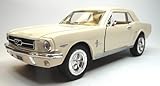
- Authentic 1:36 Scale: Meticulously crafted 1964 1/2 Ford Mustang model car with impressive 5-inch length.
- Realistic Details: Die-cast metal body with opening doors and eye-catching blue finish.
- Interactive Play: Engaging pull-back action for thrilling motion across smooth surfaces.
- Collectible Quality: Ideal for model car enthusiasts and collectors seeking miniature automotive replicas.
- Brand: KiNSMART, a trusted name in die-cast vehicle models and toys.
Actual consumption varies with traffic, weather, tire pressure, speed, idling, fuel blend, and driving style. Turbocharged engines can use substantially more fuel when driven hard, while a V6’s result depends heavily on urban traffic and how often the driver uses its power.
Calculate your own annual fuel cost
Use this formula with your annual mileage, the appropriate EPA combined rating, and the fuel price you actually pay:
Annual fuel cost = annual miles ÷ combined mpg × price per gallon.
For an illustration only, 12,000 miles at $3.50 per gallon with the Mustang’s cited 26-mpg combined estimate would be about 462 gallons, or approximately $1,615. That is not a forecast for every Mustang owner and cannot be used to calculate the Camaro without a comparable combined-mpg figure. Replace the assumptions with your own mileage, local price, and the EPA rating for the exact vehicle.
Windows Errors? Fix Them Before They Spread
Repair common Windows errors and clear accumulated junk for a smoother, more stable PC - no reinstall needed.Free scan · no reinstallCrashes, No Sound, or Screen Glitches?
Random freezes, missing sound and display glitches usually trace back to one bad driver. Find and replace yours safely.Free scan · under a minuteWhich is cheaper to buy and own?
Purchase price: historical MSRP is not today’s Camaro price
Cars.com lists a $30,900 starting MSRP for the 2024 Camaro 1LT and $31,920 for the 2024 Mustang EcoBoost Fastback. Those are historical model-year starting prices. They do not establish the current asking price of a used Camaro, nor do they show what a dealer will charge for a new or remaining Mustang inventory unit.
For a real quote, compare the vehicle’s selling price, destination charge, taxes, registration, dealer fees, financing rate, down payment, trade-in value, and optional equipment. A low sticker price can be offset by a higher interest rate or by expensive tires and brakes that are near replacement on a used car.
Ownership cost depends on your profile
No available evidence establishes a universal insurance, maintenance, depreciation, or reliability winner. Build a personalized estimate using:
Rank #3

- Limited Edition
- Diecast metal body and chassis
- 1/43 true-to-scale detail
- Made by GreenLight Collectibles
- Exact year, trim, engine, transmission, mileage, and condition.
- Out-the-door purchase price and financing terms.
- Insurance quotes for every driver, address, deductible, and coverage limit.
- Annual mileage and local gasoline prices.
- Scheduled maintenance, unscheduled repairs, tires, brakes, and alignment.
- Warranty coverage remaining and the cost of any service contract.
- How long you expect to keep the car and its expected resale value.
- Availability and pricing of qualified service shops and replacement parts near you.
Request insurance quotes using the vehicle identification number when possible. Insurers can rate two similar coupes differently because of claims data, driver age, location, coverage, and repair costs; a general statement that one model is always cheaper to insure would be unsupported.
Do these 3 things before closing this tab:
1Clear out junk files and repair common Windows errors2Fix the driver behind crashes, sound loss and screen glitches3Repair Windows errors before they cause bigger problemsWarranty timing matters
Car and Driver lists a 3-year/36,000-mile basic warranty for the 2024 Mustang EcoBoost Fastback configuration. Check the in-service date and mileage on any used Mustang before assigning value to remaining coverage. The cited material does not provide a Camaro warranty figure, so verify coverage directly from the vehicle’s paperwork and the manufacturer’s warranty terms.
Is the Camaro practical as a daily driver?
Both cars are four-seat coupes
The Camaro 1LT and Mustang EcoBoost Fastback are both listed with four seats. That makes them usable for occasional rear passengers, but seating count alone does not make either one a roomy family car. Rear-seat legroom, headroom, door opening, booster-seat placement, and the driver’s preferred position determine whether your family can use the back seat comfortably.
What is documented for Mustang cargo space?
Ford’s 2025 fastback technical specifications list 13.3 cubic feet of trunk volume and 82.8 cubic feet of passenger volume. Those figures describe the 2025 Mustang fastback specification and should not be presented as a Camaro measurement.
No equivalent Camaro trunk or passenger-volume figure is established in the available material. Therefore, there is no defensible cargo-space winner here. Measure the actual opening and bring the objects you carry regularly instead of judging by exterior appearance.
The Tool Desk
Outbyte PC Repair FREERepair Windows errors before they cause bigger problemsFix Now →Outbyte Driver Updater FREEScan for outdated or missing drivers - takes under a minuteDriver Scan →Test your real daily-use needs
- Bring your child seats. Install rear-facing and forward-facing seats in the positions you would use. Check front-seat travel, buckle access, top-tether routing, and whether the doors open wide enough for safe loading.
- Load your usual luggage. Try grocery bags, a stroller, work equipment, sports gear, or airline-size luggage. A trunk’s published volume does not reveal the shape of its opening or the height of its lift-over edge.
- Check sightlines. Sit in the driver’s seat, adjust mirrors, reverse into a space, and note blind spots. Coupe rooflines and high beltlines can feel very different from a sedan.
- Drive your normal route. Include speed bumps, narrow parking garages, highway traffic, and the roads you use in winter. Listen for rattles and judge ride comfort after at least 20 to 30 minutes rather than a short loop.
- Confirm access. Make sure the rear-seat release, trunk latch, fuel door, charging or phone-storage needs, and child-lock controls are convenient for your household.
What driver-assistance equipment does the Mustang list?
Ford’s 2025 technical specification lists standard Co-Pilot360 equipment including automatic emergency braking with pedestrian detection, blind-spot information with cross-traffic alert and braking, lane-keeping functions, a rear-view camera, automatic high beams, and rain-sensing wipers. These are manufacturer-listed features, not proof that the Mustang has a superior overall safety rating.
The available Camaro material does not provide an equivalent equipment list. Check the window sticker or vehicle identification number for the exact used Camaro, because safety features can vary by trim, package, and model year. During the test drive, confirm that cameras and sensors are clean, warning lights are absent, and every driver-assistance function can be switched on and off as expected.
Rank #4

- Crafted from durable materials such as 100% die - cast metal and premium rubber tires
- ur high - end casting method allows for feature rich details, such as an opening hood, doors , detailed interior, and trunk
- Scale is 1:24
- Collect them all
- Suitable for ages 8+
How to shop for a used 2024 Camaro
A used Camaro should be evaluated as an individual vehicle, not as an average example of the model. Use this inspection sequence before negotiating:
- Verify the identity. Match the VIN on the car, title, registration, service records, and listing. Confirm the 1LT trim, engine, transmission, drivetrain, and factory options.
- Review the history. Look for accident, flood, theft, rental, salvage, and inconsistent-mileage entries. A clean report does not replace a physical inspection.
- Inspect body and chassis. Check panel gaps, paint texture, glass dates, underbody damage, wheel bends, tire wear, and evidence of poor repairs. Pay special attention to low areas that can contact curbs or road debris.
- Check maintenance evidence. Ask for dated records for oil service, brake work, tires, alignments, recalls, and other repairs. If records are missing, budget for a baseline service rather than assuming it was completed.
- Drive it cold and warm. Confirm a quiet start, stable idle, predictable throttle, straight braking, smooth gear changes, and no overheating or warning messages. A seller who has already warmed the car may be hiding a cold-start symptom.
- Pay for an independent inspection. Use a shop that is not connected to the seller. Get a written estimate for immediate repairs and likely near-term maintenance before deciding what the car is worth.
- Reprice after inspection. Subtract documented repair costs from your maximum purchase price. Do not let the historical $30,900 MSRP anchor you to an unrealistic used-car value.
How to shop for a Mustang EcoBoost
For a new or nearly new Mustang, confirm the exact model year before comparing it with the used Camaro. The 2024 EcoBoost Fastback specification cited by Car and Driver is not automatically identical to every 2025 trim or package.
- Confirm engine, transmission, wheel and tire package, and any performance or appearance options.
- Obtain the out-the-door price in writing, including destination, documentation fees, taxes, registration, and financing conditions.
- Check the build sheet or window sticker for the driver-assistance equipment you expect.
- Read the warranty start date and mileage limits; the 3-year/36,000-mile basic figure cited above applies to the 2024 configuration.
- Drive the exact car you will buy and compare its ride, visibility, seat comfort, and throttle response with the Camaro you inspected.
A decision framework for your priorities
| Your priority | Evidence-based lean | What still needs verification |
|---|---|---|
| Highest listed horsepower | 2024 Camaro 1LT, with 335 hp versus 315 hp | Real acceleration depends on weight, transmission, tires, condition, and testing |
| Better listed fuel economy | 2024 Mustang EcoBoost, 22/33 mpg versus Camaro’s 18/29 mpg | Your combined use, traffic, fuel price, and driving style |
| Lower historical starting MSRP | 2024 Camaro 1LT by $1,020 | Current used asking price, fees, financing, and condition |
| Documented trunk volume | 2025 Mustang fastback, 13.3 cubic feet | No equivalent Camaro figure is established; test your own cargo |
| Published passenger-volume figure | 2025 Mustang fastback, 82.8 cubic feet | Actual rear-seat comfort and child-seat fit |
| Newer-car purchase | Mustang, if you buy a current 2025 example | Actual inventory, transaction price, and warranty start date |
| Potential value in a used purchase | Could be either, depending on the specific listing | VIN history, inspection, tires, brakes, insurance, and local market |
Which one should you buy?
Choose the Camaro when these conditions line up
The Camaro is the rational choice when you specifically want the V6 character, the inspected car has complete records and no major damage, and its total out-the-door cost remains attractive after insurance, financing, tires, and immediate maintenance. Treat the 335-hp figure as a specification advantage, not a guarantee that every Camaro will outrun every Mustang.
Choose the Mustang when these conditions matter more
The Mustang is the stronger fit when lower listed fuel consumption, a newer purchase, published fastback cargo data, and Ford’s listed driver-assistance equipment outweigh the Camaro’s V6 and historical price advantage. Confirm the exact year and trim, because the cited 2024 figures and Ford’s 2025 technical sheet are different model-year references.
Walk away from either car when the evidence is poor
Do not buy on horsepower, a low advertised price, or a short test drive if the seller cannot provide a VIN, history, maintenance records, or permission for an independent inspection. A sound, correctly priced example of either coupe is a better decision than a neglected car that appears cheaper on paper.
Bottom line
The 2024 Camaro 1LT wins the published horsepower comparison; the 2024 Mustang EcoBoost wins the listed city and highway fuel-economy comparison. The Camaro’s $30,900 historical starting MSRP does not tell you what a used example costs now, and the available evidence does not establish a universal winner for speed, insurance, reliability, maintenance, depreciation, or cargo capacity. Match exact trims and model years, inspect the individual car, obtain local insurance and financing quotes, and test the rear seat and trunk with the people and equipment you actually carry.
Quick wins for a faster PC:
Scan for outdated or missing drivers - takes under a minuteDriver Scan →Repair Windows errors before they cause bigger problemsFix Now →Fix the driver behind crashes, sound loss and screen glitchesFind Drivers →Quick Recap
Product prices and availability are accurate as of the date/time indicated and are subject to change. Any price and availability information displayed on Amazon at the time of purchase will apply.




