Recommended Free Tools
Ford is starting Ford Energy, a wholly owned subsidiary that plans to build U.S.-assembled, containerized battery-storage systems for utilities, data centers, and large businesses. The move repurposes part of Ford’s EV-battery manufacturing footprint for a new stationary-energy business, with first deliveries planned for late 2027.
Ford is moving beyond vehicle batteries with Ford Energy, a wholly owned U.S. subsidiary that plans to assemble containerized battery energy-storage systems for utilities, data centers, and large commercial and industrial customers. Ford says it is targeting at least 20 GWh of annual deployment, with first customer deliveries planned for late 2027.
As an Amazon Associate I earn from qualifying purchases.
This does not mean Ford will sell electricity, operate data centers, or offer a battery for home installation. Its role will be closer to that of an industrial equipment supplier: manufacturing large battery systems that can store electricity and release it when grid operators or infrastructure owners need it.
The Tool Desk
Outbyte Driver Updater FREEScan for outdated or missing drivers - takes under a minuteDriver Scan →Outbyte PC Repair FREEClear out junk files and repair common Windows errorsFree Scan →| Ford Energy detail | What Ford says |
|---|---|
| Business | Wholly owned Ford subsidiary focused on stationary battery storage |
| Primary customers | Utilities, data-center developers, and large commercial and industrial users |
| Product | Ford Energy DC Block, a standardized 20-foot containerized BESS |
| Battery chemistry | 512 Ah lithium iron phosphate, or LFP, prismatic cells |
| Rated energy | 5.45 MWh per stated DC Block configuration |
| Planned scale | At least 20 GWh of annual deployment |
| Timing | First customer deliveries planned for late 2027; EDF deliveries are expected to begin in 2028 |
Why Ford is turning EV-battery capacity toward stationary storage
Ford’s battery-storage strategy is part of a broader manufacturing restructuring, not a separate technology experiment unrelated to its electric-vehicle plans. In its December 15, 2025 restructuring announcement, Ford said it would repurpose existing U.S. battery-manufacturing capacity for stationary storage and invest roughly $2 billion over the following two years.
#1 Best Overall

- 56,800mAh Portable Charger – Multi-Day Power: Built for extended use, this high-capacity power bank keeps your devices charged for days. Compatible with iPhone 18/17/16/15/14/13 series, Samsung Galaxy S25/S24/S23, Google Pixel 9/8/7, Android phones, iPad, tablets, earbuds, and other USB devices. A practical Travel Essential for camping, road trips, outdoor work, power outages, and emergency backup. Not allowed on airplanes due to battery capacity.
- Triple Device Charging with USB-A & USB-C: This portable charger battery pack features 2 USB-A outputs and one two-way USB-C port, so you can charge up to 3 devices at once without waiting. The smart power bank automatically adjusts current output for stable, efficient charging and helps protect connected devices. Ideal for iPhone, Samsung, Android phones, iPad, tablets, and other USB-powered electronics during road trips, long commutes, business meetings, family outings, or power outages.
- 22.5W PD Fast Charging & 10+ Device Charges: This portable charger delivers fast, stable USB-C charging for iPhone 18/17/16/15, Samsung Galaxy S25/S24, Android phones, tablets, and more. The fast charging power bank charges iPhone 17 to about 60% in around 40 minutes, while the 56,800mAh battery pack powers iPhone 17 or Galaxy S25 10+ times, helping reduce battery anxiety during travel, camping, work, and emergencies.
- LED Display & Multi-Layer Safety Protection: The built-in LED digital display shows the remaining battery percentage clearly, so you can check your portable charger power level at a glance. This high-capacity power bank battery pack is designed with safeguards against overvoltage, overheating, short circuits, and overcurrent, helping deliver safe, stable charging for phones, tablets, earbuds, and other USB-powered devices during daily use, travel, and backup power needs.
- Heavy-Duty Backup Power for Outdoor Use: Built as a reliable external battery, this 56,800mAh portable charger power bank provides long-lasting backup power when outlets are not available. The high-capacity battery pack fits in backpacks, gear bags, or emergency kits, making it useful for road trips, hiking, camping, outdoor work, storms, and power outages. Works with your own USB charging cables for flexible everyday use.
The stated reason is strategic and financial: some battery-manufacturing capacity originally intended to support EV production has been underutilized, while demand for electricity infrastructure is growing. Stationary storage gives Ford another potential revenue stream for battery factories, engineering capabilities, and supply-chain relationships that were developed for electric vehicles.
The Kentucky battery complex was initially announced as a Ford-SK Innovation project intended to supply batteries for Ford and Lincoln electric vehicles. Ford now plans to use part of that industrial footprint for stationary energy storage. Ford’s sustainability materials describe wholly owned plants in Kentucky and Michigan as part of the Ford Energy manufacturing strategy, with the Kentucky site being converted to produce advanced battery energy-storage systems of more than 5 MWh.
What the Ford Energy DC Block is
Ford’s flagship system is the Ford Energy DC Block, a standardized battery-storage unit built into a conventional 20-foot shipping-container-sized enclosure. It is designed for infrastructure-scale projects rather than residential use.
The system uses 512 Ah lithium iron phosphate prismatic cells. LFP chemistry is commonly used in stationary storage because project designers often prioritize safety characteristics, operating life, cost, and predictable service over the highest possible energy density. Ford’s product materials also specify liquid-cooled thermal management and a battery-management system.
| DC Block specification | Published figure or description |
|---|---|
| Container format | Standard 20-foot container |
| Cell type | 512 Ah LFP prismatic cells |
| Rated energy | 5.45 MWh |
| Configurations | FE-250 for two-hour operation; FE-450 for four-hour operation |
| Operating voltage | 1,040 to 1,500 VDC |
| Maximum auxiliary power load | 37.5 kW |
| Approximate weight | 43.5 metric tons |
| Thermal management | Liquid-cooled |
| Safety and compliance items | UL 1973, UL 9540, UL 9540A, and NFPA 855 are listed as planned certifications or standards-related milestones |
Why the two-hour and four-hour ratings matter
Energy capacity and discharge duration are different specifications. A 5.45 MWh battery does not necessarily deliver the same power profile in every operating mode. If the same nominal energy is discharged over two hours rather than four, the two-hour configuration requires a higher discharge-power rating.
Ford identifies the FE-250 as the two-hour version and the FE-450 as the four-hour version, but the published material does not provide enough information to state a definitive maximum output figure for either configuration. Actual usable energy and power would also depend on factors such as operating reserves, temperature, efficiency, state-of-charge limits, and project controls. The safest comparison is therefore that the two versions are optimized for different duration requirements, not that the container will always deliver a simple mathematical 5.45 MWh divided by two or four.
How the battery can support data centers and the grid
A battery-storage system “powers the grid” by changing when electricity is available and how quickly a site can respond to grid conditions. The DC Block does not generate electricity like a power plant. It charges from the grid or another source, then discharges later.
Rank #2

- Huge Capacity 50000mAh Portable Charger - The 50000mAh power bank ultra-high massive capacity will keep your phone and other device running for many days!Without extra worry about low phone battery. Ideal for traveling, camping and hiking.
- Latest PD 22.5W High-Speed Charging - OHOVIV 50000mAh Portable phone charger adopts the latest Super Charger Protocol and Fast Charger Protocol with 22.5W output USB-C port.Support QC4.0 QC3.0 huge capacity power bank with fast charging, it only takes 30 minutes to charge your iPhone 14 from 0% to 55%.(NOTE: The 50000mAh PORTABLE CHARGER ARE NOT ALLOWED ON AIRPLANE!!)
- Power 3 Devices at Once - Cell phone external battery pack is equipped with 2 USB-A (22.5W output) ports, 1 USB-C (18W input/22W output) port and 1, and it can charge three devices at the same time. The portable power bank is universally compatible with all products via USB charging cable, including all iOS and Android smartphones, watch, bluetooth headsets and so on.
- LED Digital Display & Compact Design - OHOVIV 50000mAh Cell phone portable charger comes with smart LED digital display, accurately keep track of remaining juice, allowing you to easily operate your power.Our battery pack charger portable is 13.4*7*3.4cm(5.27*2.75*1.33in), and weigh 613g (21.6oz), which is easy to carry.
- Safe Powerful Phone Charger - OHOVIV 50000mAh portable charger power bank with premium Li-polymer battery, this portable battery charger can charge your devices multiple times.Battery bank adopt smart chips to prevent overcharge, overvoltage, overcurrent, and short circuit to ensure customer safety.
Ford identifies these potential applications:
- Frequency regulation: rapidly adjusting battery output to help balance supply and demand.
- Voltage support: helping maintain local electrical conditions within desired ranges.
- Energy arbitrage: charging when electricity is less expensive or more plentiful and discharging when it is more valuable.
- Peak-load shifting: reducing the amount of electricity drawn during a facility’s highest-demand periods.
- Demand response: changing consumption or discharge behavior in response to grid requests or pricing signals.
- Backup power: providing electricity during an interruption, subject to system design, interconnection, and the site’s required load.
- Microgrid integration: working with local generation and control equipment to support a site that can operate partly independently from the broader grid.
These are intended operating functions, not evidence that Ford has already deployed the DC Block in every listed application. A real project would need power-conversion equipment, controls, fire-safety systems, interconnection approval, site engineering, and an operating contract suited to the particular use case.
Why data centers are part of the target market
Data centers need highly reliable power and can create large, concentrated electricity loads. A battery system can potentially help a site manage peaks, provide short-duration backup, participate in demand-response programs, and coordinate with on-site generation or renewable power.
Ford is therefore entering the data-center power-infrastructure supply chain rather than directly “powering data centers.” The data-center owner, utility, developer, or engineering contractor would determine how the storage system is integrated and operated. Ford’s role is to supply the battery equipment.
The same logic applies to the wider grid. Storage can help smooth the timing mismatch between electricity production and consumption, including situations in which renewable generation is available before demand peaks. It can also provide fast responses that conventional generation may not provide as economically. The value depends on the project’s local electricity market, interconnection limits, control software, financing, and operating rules.
EDF power solutions provides Ford with a named commercial relationship
Ford Energy’s most significant publicly announced commercial relationship so far is EDF power solutions’ Ford Energy storage agreement. Announced May 18, 2026, the five-year framework gives EDF power solutions North America the ability to procure up to 4 GWh of Ford Energy DC Block systems annually, or up to 20 GWh over the full five-year term. Deliveries are expected to begin in 2028.
The agreement matters because it identifies a potential early customer and gives Ford a route into EDF’s growing portfolio of U.S. grid-scale storage projects. It also broadly matches Ford’s stated ambition to deploy at least 20 GWh annually.
However, the wording is important. This is a framework that permits procurement up to the stated volume. It should not be described as a guaranteed 20 GWh order, 20 GWh already delivered, or 20 GWh of revenue already recognized. The announcement does not by itself establish Ford Energy’s profitability, final production readiness, customer concentration, or ability to achieve its annual deployment target.
Quick wins for a faster PC:
Scan for outdated or missing drivers - takes under a minuteDriver Scan →Repair Windows errors before they cause bigger problemsFix Now →Where Ford Energy will build the systems
Ford says it intends to leverage its U.S. manufacturing footprint and assemble the systems domestically. The Kentucky operation is central to the plan, while Ford’s sustainability reporting also points to wholly owned facilities in Kentucky and Michigan.
Rank #3
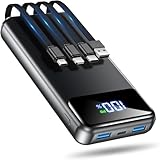
- Huge Capacity 50000mAh Power Bank:OHOVIV Portable charger ultra-high massive capacity provides 10 charges for iPhone 15, which make of new high-density polymer battery.Depending on battery size, most smartphones will get over 10 full charges. Portable power bank works and does not take on any extra room, suitable for camping, hiking, vacation, travel and other outdoors.
- Charge 6 Devices at Once: OHOVIV 50000mah Portable phone charger with 4 Built-in Cables(for iPhone, Type-C, Micro, USB-A) and 3 Charging ports (2 USB-A , 1 Type-C), you can charge up to 6 devices at once without sacrificing power for Ultimate Convenience.These portable charger power bank cables made of high quality materials,withstanding over 10,000 bends.
- 22.5W Super Fast Charging:The Cell phone portable charger boasts PD 22.5W output and QC4.0 quick charging technology, allowing it to charge your iPhone to 55% in just 30 minutes—3 times faster than a standard battery bank. USB-C two-way charging (IN&OUT) and LED digital display eliminate power anxiety, ensuring the best experience during your vacation
- Compact Design with Widely Compatibility:Easily slip it into your backpack, pocket, or bag and carry it anywhere! This lightweight external battery pack size is 5.82*2.83*1.18 inches and weighs just 1.07 lb.Compatible with nearly all electronics, power bank for iPhone 16/15/14/13/12 series, iPad series, for Samsung s24/s23/s22/s21/s20, Google Pixel and other Android, tablets,etc
- Safe and Secure Powerbank:Portable battery charger built in quality batteries and 10 multiple system protection to prevent overcharge, short circuit and and a series of potential dangers.Latest upgraded AI smart chip and NTC temperature control technology minimize real-time power loss, can reduce overheating risks by 97%, which are family picnic essentials.
Repurposing an existing battery plant could give Ford advantages in equipment, workforce, logistics, and supply-chain control compared with building an entirely new stationary-storage operation. Those advantages are part of Ford’s positioning, however, and should not be confused with independently verified production costs, reliability, or delivery performance.
Stationary batteries also have different engineering priorities from EV batteries. A vehicle pack must fit into a constrained package, minimize weight, withstand vibration, and support driving performance. A containerized grid battery can instead place more emphasis on thermal management, access for service, fire protection, predictable operating behavior, replacement logistics, and project-finance requirements. The DC Block’s large container form factor reflects that different design brief.
What remains uncertain
Launch and production timing
Late 2027 is Ford’s planned timing for first customer deliveries, and the EDF announcement points to 2028 for deliveries under that framework. Factory conversion, certification, customer engineering, interconnection, and project schedules can all affect when systems actually enter service.
Certifications
Ford’s product sheet lists UL 1973, UL 9540, UL 9540A, and NFPA 855-related requirements as planned certifications or milestones. They should not be presented as completed approvals. The status of those items will matter to permitting, insurance, procurement, and project financing.
Field performance and economics
Ford’s materials emphasize manufacturing scale, domestic assembly, supply-chain control, long-term service, reliability, bankability, and performance over a potentially long service life. Those are company claims and product-positioning statements. The researched materials do not independently validate lifetime degradation, warranty economics, field reliability, round-trip efficiency, operating costs, or financing performance.
Actual customer volume
The EDF framework creates a credible commercial reference point, but the maximum volume is optional rather than automatically committed. Ford will need to convert plans and framework capacity into completed systems, operating projects, and repeat orders before the business can be judged on execution.
Independent reader supportYour contribution helps us test, update, and keep practical guides available for everyone.What Ford Energy means for Ford’s EV strategy
Ford is not abandoning batteries. It is trying to use battery-manufacturing assets across more than one market. If EV demand, product mix, or factory utilization changes, stationary storage could give Ford another outlet for cells, packs, manufacturing labor, and plant capacity.
That diversification could reduce Ford’s dependence on passenger EV volumes to justify every battery investment. It also introduces a different competitive environment, where utilities and developers evaluate safety documentation, warranty terms, degradation assumptions, service support, project delivery, and total cost over many years.
Rank #4

- 87W Power to Share: Distribute 87W across three devices, with a single device receiving up to 65W, to rapidly charge iPhones, Samsung phones. Quickly charge a 14" MacBook Pro to 50% in under 40 minutes.
- Speedy Cable Charging: Utilize the built-in cable to elevate your iPhone 15 Pro to 58% or a MacBook Air to 52% in 30 minutes. You can also fully recharge this power bank in 1.5 hours with a 65W charger.
- 20,000mAh for Extended Use: Eliminate concerns about battery depletion with a 20,000mAh power bank that ensures consistent, reliable charging for all your devices, also approved for airline travel.
- Lasts Longer, Charges Faster: The integrated USB-C cable is designed to endure, withstanding over 10,000 bends for dependable charging and convenient storage.
- What You Get: Anker Power Bank (20K, 87W, Built-In USB-C Cable), 6.2 × 2.9 × 1.0 in (15.5 oz), welcome guide, 18-month warranty, and friendly customer service.
For Ford, the opportunity is substantial but execution-heavy. The company must complete the factory conversion, secure the necessary certifications, meet its late-2027 target, establish service and warranty economics, and demonstrate that its systems perform reliably in the field. Until those steps occur, Ford Energy is a significant announced strategy—not yet a proven large-scale storage business.
Frequently Asked Questions
Can consumers buy the Ford Energy DC Block?
No. Ford Energy is aimed at infrastructure-scale customers such as utilities, data-center developers, and large commercial and industrial companies. Ford has not announced a retail home-battery product, household installation program, or consumer pricing.
Do these 3 things before closing this tab:
1Repair Windows errors before they cause bigger problems2Scan for outdated or missing drivers - takes under a minute3Clear out junk files and repair common Windows errorsWhen will Ford Energy batteries be available?
Ford says first customer deliveries are planned for late 2027. The separate EDF power solutions framework says deliveries under that relationship are expected to begin in 2028. Both dates are forward-looking plans, not completed shipments.
How much energy can one Ford Energy DC Block store?
Ford lists a rated energy figure of 5.45 MWh for the DC Block. It identifies a two-hour FE-250 configuration and a four-hour FE-450 configuration. The exact maximum power output for each version should not be inferred without additional published technical data.
Will Ford directly power data centers?
Not directly. Ford will supply battery-storage equipment to infrastructure customers. Those customers and their engineering partners will integrate the systems with the grid, on-site generation, controls, and facility loads. The systems may support data-center power reliability and peak management, but Ford is not becoming a data-center operator or electricity retailer.
What can Ford’s grid-scale battery systems do?
Ford says the DC Block may support frequency regulation, voltage support, energy arbitrage, peak-load shifting, demand response, backup power, and microgrid integration. These are listed intended applications, not proof that the product has already been deployed in every use case.
Free tools Windows power users keep installed
One-click scans. No signup required.
The Bottom Line
Ford Energy is a planned industrial battery-storage business built around the 5.45 MWh Ford Energy DC Block. Ford intends to repurpose U.S. EV-battery capacity, invest roughly $2 billion, and target at least 20 GWh of annual deployment for utilities, data centers, and large businesses. The EDF framework is an important potential customer relationship, but it is not a guaranteed full-volume order. The technology, certifications, production schedule, and long-term economics still need to be demonstrated.
Quick Recap
Product prices and availability are accurate as of the date/time indicated and are subject to change. Any price and availability information displayed on Amazon at the time of purchase will apply.




