Do these 3 things before closing this tab:
1Scan for outdated or missing drivers - takes under a minute2Clear out junk files and repair common Windows errors3Fix the driver behind crashes, sound loss and screen glitches“Every major motorcycle helmet brand ranked worst to best in NHTSA compliance testing” is not a defensible official leaderboard: NHTSA publishes selected model-level tests, recalls, and investigations rather than a complete brand census. In the reviewed records, BILT has the strongest concentration of documented recent noncompliance; River Road’s U-6 follows, while NexL is a historical, qualified case.
NHTSA’s public evidence supports a ranking of documented outcomes for identified models and production populations, not a claim that one entire brand is universally safer or less safe. NHTSA’s public compliance database is selected and report-oriented, so every “best” conclusion must be treated cautiously.
As an Amazon Associate I earn from qualifying purchases.
Key takeaways
- FMVSS No. 218 is the U.S. federal minimum performance standard for on-road motorcycle helmets, covering impact attenuation, penetration resistance, retention systems, coverage, vision, projections, contour, and certification labeling.
- NHTSA does not publish a complete, normalized safety leaderboard for every motorcycle-helmet brand; NHTSA uses manufacturer self-certification and selected marketplace compliance testing.
- BILT has the strongest concentration of documented recent negative outcomes in the reviewed records, involving three specified models and potentially involved quantities of 1,374, 14,338, and 317 units.
- River Road’s Grateful Dead U-6 finding applied to certain small and medium helmets made in December 2012, while NexL’s negative result is a historical case complicated by test-procedure ambiguities.
- A brand with no documented failure in the reviewed material is unranked, not proven safest, because the available NHTSA evidence does not provide a complete test count or brand-level denominator.
What motorcycle helmet brands fail DOT testing?
The reviewed NHTSA-related records document noncompliance for specified BILT models, certain River Road Grateful Dead U-6 helmets, and historical NexL helmets; the records do not establish that every helmet sold by any of those brands failed DOT testing.
The ordering below is a provisional ranking of documented negative compliance outcomes, not a ranking of crash protection, product quality, or brand-wide failure rates. The ordering gives the highest position to the brand with the strongest concentration of recent, clearly documented model-level noncompliance.
#1 Best Overall
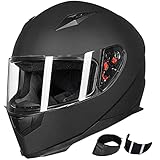
- 2 Visors Included: Clear + Smoked and 1 Neck Scarf for Winter Use
- Streamlined Aerodynamic Design Reduces Wind Noise and Drag
- Advanced and Lightweight Durable ABS Shell
- Quick Release Clasp and Strap and Removable Inner Lining Pads
- Meets or Exceeds FMVSS-218 and DOT Safety Standards
| Provisional position | Brand or model | Evidence and date | Documented issue | Population or disposition | What the evidence does not prove |
|---|---|---|---|---|---|
| 1 | BILT Amped Evo Rapid Adult | NHTSA Part 573 report 22E-013, 2022 | Penetration-test and second-impact dwell-time failures | 1,374 potentially involved units listed in the report | Not a BILT-wide failure rate or finding about every size and model |
| 1 | BILT Amped Evo Youth | NHTSA Part 573 report 22E-013, 2022 | Penetration-test and second-impact dwell-time failures | 14,338 potentially involved units listed in the report | Not a denominator for all BILT helmets sold |
| 1 | BILT Vertex Stripes | NHTSA Part 573 report 23E-004, 2023 | Penetration-test, second-impact dwell-time, and retention failures | 317 potentially involved units listed in the report | Not evidence that every BILT helmet has the same defect |
| 2 | River Road Grateful Dead U-6 | 2014 NHTSA recall notice | Excessive acceleration during the low-temperature helmet impact test’s second impact | Certain small and medium helmets manufactured in December 2012; replacement helmets were offered | Not a ranking of the entire River Road brand |
| 3 | NexL Sports Products | NHTSA historical rulemaking material, fiscal years 2002–2003 | Impact attenuation, penetration, and retention requirements were reported as failed | NHTSA did not pursue enforcement because of ambiguities involving impact velocity and retention-test load application | Not a clean modern brand score or directly comparable current result |
| Unranked | Arai, Bell, HJC, Shoei, AGV, Shark, LS2, Scorpion, and other major brands | No comparable failure located in the reviewed official material | No documented failure in this review | Test count, model coverage, production-year coverage, and denominator are not established | Not proof of passing all NHTSA testing or being safest |
1. BILT: the strongest documented recent negative record
Among brands with clearly documented recent NHTSA-filed helmet noncompliance in the reviewed sources, BILT ranks worst because multiple specified models and potentially involved product populations appear in reports from 2022 and 2023.
The 2022 report for the BILT Amped Evo Rapid Adult identified penetration-test and second-impact dwell-time failures and listed 1,374 potentially involved units. A separate 2022 report for the BILT Amped Evo Youth identified the same failure categories and listed 14,338 potentially involved units. The 2023 report for the BILT Vertex Stripes identified penetration-test, second-impact dwell-time, and retention failures and listed 317 potentially involved units. The linked reports identify affected product populations, not a complete denominator for all BILT helmets sold.
BILT’s position is therefore a documented-outcome ranking, not a statement that every BILT helmet is defective. A buyer should match the exact model, size, production information, and recall instructions before drawing a conclusion about a particular helmet.
2. River Road Grateful Dead U-6: a narrow but documented recall
River Road’s Grateful Dead U-6 finding applies to certain small and medium helmets manufactured in December 2012. The 2014 recall notice stated that the helmets did not conform to FMVSS No. 218 impact-attenuation requirements because the helmets experienced excessive acceleration during the second impact of the low-temperature impact test.
The recall notice offered replacement helmets. The narrow model, size, and production-date scope makes the finding meaningful for the identified U-6 population but insufficient for ranking every River Road helmet or comparing River Road’s overall failure rate with another brand.
3. NexL Sports Products: serious historical findings with a procedural qualification
NHTSA historical rulemaking material states that NexL helmets failed impact attenuation, penetration, and retention requirements during compliance testing in fiscal years 2002–2003. The same material says NHTSA did not pursue enforcement because of ambiguities involving impact velocity and the rate of load application in the retention test.
NexL belongs near the bottom of a documented historical-outcome list because several FMVSS-related performance areas were reported as failures. The age of the testing and the unresolved procedural qualification prevent the NexL result from functioning as a clean modern brand score.
Rank #2

- 【DOT Certified & High-Impact Protection】 This full face motorcycle helmet meets or exceeds DOT FMVSS-218 standards, ensuring professional-grade safety. Built with a rugged ABS shell and energy-absorbing EPS, these motorcycle helmets dot approved provide ultimate defense for street bikes, cruisers, and sport bikes
- 【Optimized Airflow for All-Weather Riding】 Experience superior ventilation with 4 strategically placed air intakes and exhaust vents. This full face helmet design minimizes wind resistance and fogging, keeping you cool during summer rides and providing a reliable full face helmet adult option for rainy or cold weather
- 【Quick-Release Dual Visor System】 Adapt to any light condition with ease. Our full face helmet motorcycle features a tool-free quick-release system. Each order includes a pre-installed tinted shield plus a bonus clear visor, making these full face motorcycle helmets for men and women versatile for both bright days and night riding
- 【Washable Lining & Comfort Fit】 Maintain freshness on every journey with our fully removable and machine-washable interior. The moisture-wicking sponge padding makes these motorcycle helmets for adults incredibly comfortable for long-distance trips, ensuring a snug fit for these full face motorcycle helmets dot certified
- 【Complete Bundle & Perfect Sizing】 We include a premium carrying bag for easy storage and scratch protection. Whether you are searching for motorcycle helmets for women or men, TRIANGLE offers 4 sizes (S-XL) to ensure a secure fit. Please measure your head circumference to find the perfect full face motorcycle helmet for women or men
Why are most major helmet brands unranked?
Most major brands are unranked because the reviewed NHTSA material does not provide the complete model count, test count, production-year coverage, denominator, and final disposition needed for a fair brand-level comparison.
NHTSA’s compliance system is report-oriented and selective. NHTSA tests helmets selected from the marketplace rather than testing every model from every manufacturer. A no-failure result can mean that NHTSA did not test that brand, tested a different model, tested in a different year, or did not publish a comparable report.
NHTSA’s consumer guidance describes the selection process this way:
“While our selection is typically random, we do take into account feedback and complaints from consumers in determining which helmets to test each year.” — National Highway Traffic Safety Administration, Choose the Right Motorcycle Helmet
Special offer. See more information about Outbyte and uninstall instructions. Please review EULA and Privacy policy.
That selection process is useful for identifying documented problems, recalls, and compliance concerns. The selection process does not create the consistent sample needed to declare one brand safest because another brand has no published failure in the reviewed records.
How was the provisional ranking built?
The provisional ranking compares the strength and scope of documented negative evidence, not a calculated safety score.
- Evidence type: A formal compliance-test report, safety recall report, investigation, or rulemaking record carries more weight than an unsupported online claim.
- Exact product identity: The comparison keeps the brand, model, size, and production date separate wherever the source supplies those details.
- Failure category: Impact attenuation, penetration, retention, labeling, and other FMVSS requirements are recorded separately rather than combined into a vague “failed” label.
- Population and denominator: A potentially involved quantity is not treated as the number tested, the number that failed, or a brand-wide failure rate.
- Final status: A confirmed noncompliance finding, recall, corrective action, and unresolved procedural dispute are identified separately.
- Testing vintage and standard version: Older findings are not silently treated as directly comparable with newer testing.
- Helmet configuration: Half, open-face, full-face, and modular helmets are recognized as different configurations in NHTSA’s research sample.
The framework prevents two common errors: turning one recalled model into a verdict on an entire brand and turning missing evidence into a “best” ranking.
Rank #3
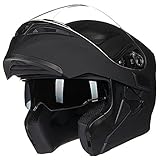
- High Resistance ABS Shell With Micrometrically Adjustable Strap
- Meets or Exceeds FMVSS-218 and DOT Safety Standards
- Helmet Liner / Cheek Pads are Lightweight, Soft and Easily Removable and Washable
- Sleek and Lightweight Design Reduces Wind Noise
- Modular Flip-Up Function Anti-Scratch, Anti-Fog and Wide View Clear Visor
What does NHTSA actually test under FMVSS No. 218?
FMVSS No. 218 tests whether a motorcycle helmet meets specified federal minimum requirements for impact attenuation, penetration resistance, retention-system performance, physical coverage and visibility, construction features, and certification labeling. The NHTSA and Federal Register material on FMVSS No. 218 describes the standard and its requirements.
Free tools Windows power users keep installed
One-click scans. No signup required.
| Performance area | What the requirement addresses | How to interpret a failure |
|---|---|---|
| Impact attenuation | Whether the helmet limits acceleration transmitted to the test headform during specified impacts | A model or population failed a defined impact requirement; the result is not automatically a brand-wide score |
| Penetration resistance | Whether the striker penetrates far enough to contact the headform | A penetration failure identifies a serious requirement problem for the tested or affected population |
| Retention system | Whether the chin strap and retention system remain attached and within the applicable displacement limit under load | A retention failure concerns the helmet’s ability to stay secured during the specified test |
| Coverage and peripheral vision | Whether the helmet covers the required areas and preserves the required field of vision | A helmet can have a labeling or coverage issue without that result being an impact-test failure |
| Projections and continuous contour | Whether construction features meet physical design requirements | The issue belongs to a separate FMVSS requirement and should not be summarized as a generic crash score |
| Certification labeling | Whether required certification information is located and presented correctly | A label-location finding does not prove that the helmet failed impact attenuation or retention |
What did NHTSA’s 2019 helmet research program test?
According to NHTSA’s 2019 motorcycle-helmet testing research program, NHTSA examined 49 helmet models: 13 half helmets, 15 open-face helmets, 12 full-face helmets, and 9 modular helmets. The 49-model sample was a research program, not a census of all motorcycle helmets and not a complete brand leaderboard.
The 2019 program also examined ISO-headform impact attenuation, dynamic roll-off stability, face-shield penetration, and chin-bar impact attenuation. Additional research tests should not be confused with a complete FMVSS No. 218 compliance ranking of every brand.
Does a DOT sticker mean NHTSA approved the helmet?
No. A DOT mark means the manufacturer certifies that the helmet complies with the applicable standard; the DOT mark is not an NHTSA pre-approval or a guarantee that NHTSA has individually tested that exact helmet.
“NHTSA does not approve helmets, or any other motor vehicle equipment, instead relying on a self-certification process.” — National Highway Traffic Safety Administration, consumer motorcycle-helmet guidance
The Tool Desk
Outbyte Driver Updater FREEScan for outdated or missing drivers - takes under a minuteDriver Scan →Outbyte PC Repair FREERepair Windows errors before they cause bigger problemsFix Now →Special offer. See more information about Outbyte and uninstall instructions. Please review EULA and Privacy policy.
Under the self-certification system, manufacturers certify their helmets and NHTSA conducts selected marketplace testing, investigations, and recalls when appropriate. A DOT label is therefore an important compliance signal, but the label should not be described as NHTSA approval.
NHTSA’s consumer guidance says a compliant helmet sold in the United States should identify the manufacturer or brand, model designation, DOT, FMVSS No. 218, and the word “CERTIFIED” on the certification label. Compare the physical helmet’s label with the product listing rather than relying only on a marketplace title, seller description, or stock photograph.
Rank #4

- Unmatched Protection & Durability:Built Tough for Extreme Adventures, Our Helmet Exceeds Expectations by Meeting FMVSS-218 and DOT Safety Standards. Its Robust Construction Safeguards Ensuring Ultimate Security as You Conquer the Toughest Terrains
- Convenient Flip-Flop Mechanism: Easy Switching Between Full-Coverage Helmet and Open Mode, This Modular Motorcycle Helmet Is Perfect for City Riding and Long-Distance Touring
- Stay Cool and Comfortable with Strategically Placed Vents That Ensure Maximum Airflow and Reduce Heat and Moisture Buildup During the Ride
- Comfortable Interior Lining: Enjoy the Cozy Plush Lining That Provides Long-Lasting Comfort Even on Long Rides
- The Modular Design Makes It Suitable for Snowmobiles, Dirt Bikes, Scooters, Bike Riding and More. With Its Innovative Features, It Is Sure to Be an Ideal Choice for Riders Looking for a Stylish, Comfortable and Safe Helmet!
| Label information to check | Why the information matters |
|---|---|
| Manufacturer or brand | Connects the certification statement to the responsible brand |
| Exact model designation | Allows the buyer to compare the helmet with a model-specific NHTSA report or recall |
| DOT | Identifies the manufacturer’s claimed U.S. certification |
| FMVSS No. 218 | Identifies the federal motorcycle-helmet standard |
| CERTIFIED | Forms part of the certification information NHTSA says should appear on the label |
How do I check my helmet’s FMVSS 218 compliance?
Check the exact helmet against NHTSA’s public compliance records and recall material, then interpret the result at the model-and-production-population level.
- Record the identifying information. Write down the manufacturer or brand, exact model designation, size, and production date or other date information shown on the helmet and packaging.
- Inspect the certification label. Confirm that the physical label identifies the brand or manufacturer, model, DOT, FMVSS No. 218, and “CERTIFIED,” as described in NHTSA’s helmet-label guidance.
- Search NHTSA’s database. Use the NHTSA Compliance Test Report Search with the brand and model terms. Search variations of the model name when the database or product label uses different spacing or punctuation.
- Match the product precisely. Confirm that the report concerns the same model, size range, production period, and helmet configuration. A report about a youth model does not automatically apply to an adult model, and a report about one production population does not automatically apply to every later helmet.
- Read the failure and disposition. Identify whether the record describes a test issue, confirmed noncompliance, recall, corrective action, or a procedurally unresolved matter. Follow the applicable recall notice rather than assuming that a different model is affected.
- Interpret no result cautiously. No matching NHTSA record means that no comparable failure was located in the searched material; no result does not prove that NHTSA tested and passed the helmet.
NHTSA’s database can help answer “Has NHTSA tested my helmet?” only when the search is matched to the exact product identity. NHTSA’s public material does not establish a complete market-wide test census or a brand-level failure denominator.
What is the safest full-face motorcycle helmet?
NHTSA’s reviewed evidence does not identify one safest full-face motorcycle helmet brand. NHTSA’s 2019 research included 12 full-face models, but the 12-model sample cannot establish the safest full-face brand across the market.
A more defensible buying decision starts with the exact model rather than a universal brand ranking. Check the physical certification label, search the model in NHTSA’s compliance and recall records, verify that the product is not one of the specified recalled populations, and choose a helmet that fits securely according to the manufacturer’s instructions.
When shopping for a DOT FMVSS 218 motorcycle helmet, treat a marketplace listing as a place to compare products, not as proof that Amazon independently verified the listing or that NHTSA selected the product. Verify the manufacturer or brand, exact model designation, and certification information on the physical helmet before relying on the purchase.
DOT and another national or international helmet standard should not be treated as interchangeable labels. A DOT helmet does not automatically have the same protection profile as a helmet tested under every other standard, and the reviewed NHTSA material does not provide a cross-standard brand ranking.
What’s actually slowing this PC down?
Pick the symptom - the matching free tool is one click away.
Which motorcycle helmets have been recalled in the reviewed records?
The reviewed records identify three BILT model populations and a limited River Road Grateful Dead U-6 population. The records do not support the claim that every helmet from a recalled brand is unsafe.
| Recall or report | Specified product | Reported problem | Scope to use when checking a helmet |
|---|---|---|---|
| 22E-013, 2022 | BILT Amped Evo Rapid Adult | Penetration-test and second-impact dwell-time failures | Match the exact adult model and affected product population |
| 22E-013, 2022 | BILT Amped Evo Youth | Penetration-test and second-impact dwell-time failures | Match the exact youth model and affected product population |
| 23E-004, 2023 | BILT Vertex Stripes | Penetration-test, second-impact dwell-time, and retention failures | Match the exact Vertex Stripes model and affected product population |
| 2014 recall notice | River Road Grateful Dead U-6, certain small and medium helmets made in December 2012 | Excessive acceleration in the second impact of the low-temperature impact test | Match model, size, and December 2012 production scope |
NexL is included in the provisional ranking because NHTSA historical rulemaking material reported failures in impact attenuation, penetration, and retention during fiscal years 2002–2003. NexL is not listed as a current recall in the same way as the model-specific BILT and River Road records summarized above.
Best Value
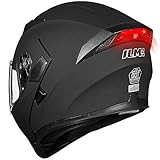
- High Resistance ABS Shell With Micrometrically Adjustable Strap
- Meets or Exceeds FMVSS-218 and DOT Safety Standards
- Helmet Liner / Cheek Pads are Lightweight, Soft and Easily Removable and Washable
- Sleek and Lightweight Design Reduces Wind Noise
- Modular Flip-Up Function Anti-Scratch, Anti-Fog and Wide View Clear Visor
What do NHTSA’s helmet statistics actually show?
NHTSA statistics provide useful context, but the statistics do not create a brand leaderboard.
- According to NHTSA’s 2015 rulemaking document, 14 percent of helmets tested during fiscal years 2000–2003 failed a certification-label location requirement. The 14 percent figure concerns labeling, not the core impact or retention tests.
- According to NHTSA’s 2007 novelty-helmet performance note, seven tested novelty helmets produced acceleration results ranging from 636g to 992g in the cited impact comparisons. The 636g-to-992g range describes those novelty helmets and must not be generalized to certified helmets or converted into a brand statistic.
- According to NHTSA’s 2024 report on motorcycle helmet use in 2023, DOT-compliant motorcycle-helmet use was estimated at 73.8 percent in 2023. NHTSA described 73.8 percent as the highest recorded estimate in that series and said the 2023 estimate was not statistically different from 66.5 percent in 2022.
These figures answer different questions. Label-location results concern certification markings, novelty-helmet acceleration results concern a specific research sample, and helmet-use estimates concern rider behavior. None of the figures is a brand-wide failure rate.
Recommended Free Tools
What should you conclude from the ranking?
The strongest supported conclusion is narrow: BILT has the worst documented position in this review because three specified models appear in recent NHTSA-filed noncompliance reports; River Road’s Grateful Dead U-6 is next because of a limited 2012 production-population recall; and NexL is a historical, procedurally qualified case.
The evidence does not identify Arai, Bell, HJC, Shoei, AGV, Shark, LS2, Scorpion, or any other unlisted major brand as safest. The absence of a reviewed failure is not the same as a passed test, and a documented failure involving one model is not proof that every helmet from that brand fails FMVSS No. 218.
Frequently Asked Questions
Does a DOT sticker mean NHTSA approved the helmet?
No. NHTSA does not approve helmets before sale. Manufacturers certify their own helmets under the self-certification system, while NHTSA selects helmets from the marketplace for compliance testing and may investigate or recall noncompliant products.
What motorcycle helmets have been recalled?
The reviewed records identify certain BILT Amped Evo Rapid Adult, BILT Amped Evo Youth, BILT Vertex Stripes, and River Road Grateful Dead U-6 populations. The BILT reports and River Road notice are model- and population-specific, so a buyer must match the exact model, size, and production information.
Quick wins for a faster PC:
Scan for outdated or missing drivers - takes under a minuteDriver Scan →Repair Windows errors before they cause bigger problemsFix Now →Fix the driver behind crashes, sound loss and screen glitchesFind Drivers →What is the safest full-face motorcycle helmet?
NHTSA’s reviewed evidence does not identify one safest full-face motorcycle-helmet brand. NHTSA’s 2019 research included 12 full-face models, but that sample was not a market census or a brand-level safety ranking.
Has NHTSA tested my helmet?
Search NHTSA’s Compliance Test Report Search using the helmet’s manufacturer or brand and exact model designation. Match the search result to the helmet’s size, production information, and configuration; no matching result means only that no comparable record was located, not that NHTSA tested and passed the helmet.
The Bottom Line
Bottom line: NHTSA does not provide a complete worst-to-best ranking of every major motorcycle-helmet brand. Use the provisional order only as a record of documented negative outcomes: BILT first, River Road Grateful Dead U-6 second, and NexL third. For any helmet, verify the exact model, size, production information, physical DOT/FMVSS No. 218 label, NHTSA record, and recall disposition. Treat unranked brands as unranked—not automatically safest.
Quick Recap
Product prices and availability are accurate as of the date/time indicated and are subject to change. Any price and availability information displayed on Amazon at the time of purchase will apply.




