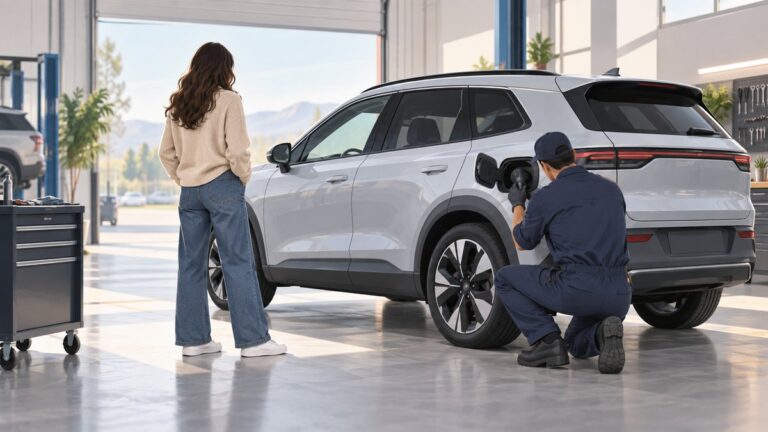
Choose a battery-electric vehicle (BEV) if you can charge reliably at home or work, its real-world range suits your regular routes, and the numbers work for your budget. Choose a conventional hybrid (HEV) if you want better fuel efficiency without plugging in. A plug-in hybrid (PHEV) is a middle option: it can handle some driving on electricity, then use gasoline when its electric range runs out. The best fit depends on your charging access, driving pattern, and the specific vehicles you are comparing.
What’s the difference between an EV, a hybrid, and a plug-in hybrid?
In this comparison, “EV” means a battery-electric vehicle, or BEV. A BEV runs on electricity stored in a battery and has no gasoline engine. A conventional hybrid, or HEV, combines an engine and electric motor but does not plug in: its battery gets energy from the engine and regenerative braking, and you refuel it at gas stations. A plug-in hybrid, or PHEV, has both a plug-in battery and a gasoline engine. It can drive on electricity for some trips and use gasoline when that electric range is depleted. The U.S. Energy Information Administration explains these powertrains in its transportation overview.
Which powertrain fits your driving and charging access?
A BEV suits predictable driving and dependable charging
A BEV can be convenient for everyday use if you can reliably charge where the car is parked and its range covers your routine trips. Home charging can turn “refueling” into time spent parked. The EIA says about 75% of EV owners charge at home, but that national figure does not mean a particular driver has access to a usable outlet or charger.
Public charging can work for drivers without home charging, but it makes the decision more dependent on nearby station locations, connector compatibility, availability, charging speed, and price. A public stop also takes longer than a typical 5–10-minute gasoline stop, according to the EPA’s guide to electric and plug-in hybrid vehicles.
The Tool Desk
Outbyte Driver Updater FREEScan for outdated or missing drivers - takes under a minuteDriver Scan →Outbyte PC Repair FREERepair Windows errors before they cause bigger problemsFix Now →#1 Best Overall

- Never Let a Dead Battery Ruin Your Drive. The LISEN 4 in 1 Retractable Car Charger delivers reliable power for your entire journey. Compatible with standard 12V cigarette lighter sockets, it keeps phones, tablets, and devices charged during daily commutes, road trips, and long drives — the perfect practical gift for dads, truck drivers, and anyone who lives on the road.
- Daily Driver Essential: Always Ready When You Need It. Featuring two retractable cables ( USB C & Old iPhone Charging Cable ) that extend up to 31.5 inches and dual USB ports, this charger solves cable clutter while charging up to 4 devices simultaneously. Ideal for busy fathers, commuters, and families who want a tidy car and never worry about low battery again.
- Deliver full-speed PD fast charging for iPhone 18 Pro Max & iPhone 18 Pro Max & iPhone 18 Pro right inside your car. The built-in 45W PD USB-C port hits the peak charging speed for these latest iPhone models, juicing up your phone to 50% power in just 15 minutes while you drive.(Note: Maximum 45W PD output is available under 24V vehicle power supply. When used with standard 12V car sockets, the peak output is limited to 36W.)
- Standard 12V Power Solution: Designed as a dedicated USB power supply for charging devices. Note: Does NOT support CarPlay, Bluetooth, or data transfer. Compatible with most phones, tablets, and small electronics. This retractable charger is a core car organization tool, keeping your vehicle tidy. Not compatible with Micro-USB devices.
- Clutter-Free Tech Organization: Featuring dual USB ports and retractable cables, the LISEN 4 in 1 charger provides a clean car storage solution. Perfect for truck enthusiasts or as a thoughtful gift for drivers, it supports fast USB-C charging for devices like the iPhone 18Pro & iPhone 18 ProMax. Keep your vehicle organized while ensuring efficient power delivery for all your tech on the road.
An HEV keeps gasoline refueling simple
A conventional hybrid is worth considering if you have limited access to charging or do not want to build charging into your routine. You continue to fill up at gas stations; the car manages its battery through the engine and regenerative braking. Compare the fuel economy and purchase price of the particular HEV with the alternatives rather than assuming a hybrid is automatically cheaper to own.
A PHEV bridges electric trips and gasoline flexibility
A PHEV can be a good fit if you can plug in often enough to use its electric range for regular short trips, while still valuing gasoline for longer journeys. The EIA gives a broad typical electric-only range of about 8–45 miles for PHEVs; the range of a specific vehicle may differ. PHEV designs also vary: some rely mostly on electricity until the battery charge is low, while others blend gasoline and electricity. Check the model’s electric range and its separate electric and gasoline economy figures with the EPA’s vehicle guidance.
Rank #2

- High Quality Material: The coaster is made of environmentally friendly silicone, safe, non-toxic and odorless. Soft with toughness, easily embedded in the cup holder. Very durable, wear-resistant, long service life. High temperature resistance, can withstand 100 ℃ high temperature water cups.
- Wide Compatibility: The coaster has a diameter of 3.15 inches and a height of 1.18 inches, which is widely used in most vehicles, such as SUV, sedan, MPV, etc., as long as the size fits your car cup holder.
- Protection Function: Our car cup holder coaster has a carry handle design and a stand-up ring edge on its edge to effectively prevent food crumbs, drinks and water from leaking out and preventing the car cup holder from getting dirty.Meanwhile,Thickened design effectively prevents the cup holder from being scratched by the cup when driving on bumpy roads and eliminates the annoying thumping sound, making your journey more enjoyable.
- Easy to Use and Clean: With embedded installation, you just need to put it flat on the car cupholder. It is also very quick to remove, there is a small bump on the coaster, pinch it and you can easily remove the coaster. It is very easy to clean, rinse with water or wipe with a wet towel (be careful not to clean with sharp tools).
- 100% Satisfaction: Our products have quality assurance, if you have questions or are not satisfied after receiving the product, don't worry, please contact us as soon as possible, we provide after-sales service.
Is an EV worth it if you can’t charge at home?
It may be, but first establish a practical charging routine. Consider whether reliable workplace or public charging is available near places you already go, whether the stations work with the vehicle, and how often you would need to charge. If public charging is sparse, inconvenient, costly, or unreliable for your routine, an HEV avoids that dependency. A PHEV still needs plugging in to deliver its electric-driving benefit; without regular charging, its gasoline engine may do more of the work.
If you can charge at home, Level 1 uses a standard 120-volt outlet, while Level 2 typically uses a dedicated 240-volt setup. EIA’s broad estimates are 2–5 miles of range added per hour with Level 1 and 10–20 miles per hour with Level 2. DC fast charging can bring a battery to 80% in roughly 20 minutes to an hour. These are generalized figures, not promises: actual charging depends on the vehicle, charger, battery state, and conditions. Check the model’s charging limits and your expected parked time to see whether Level 1 is enough.
Do these 3 things before closing this tab:
1Fix the driver behind crashes, sound loss and screen glitches2Clear out junk files and repair common Windows errors3Scan for outdated or missing drivers - takes under a minuteRank #3

- ✅【Designed for Magsafe】 - The most fashionable iphone car mount in 2026 Magsafe is designed for iPhone 18 Pro Max/17/16/15/14/13/12 Pro Max Mini and official Magsafe cases and other magnetic phone cases and can be fixed directly to these phones without the need to affix metal plates. All Android Phones Will Work: Metal rings are provided; they fit cases and other phones without magsafe. Based on Unique Grandmaster Design (Protected by US Design Patent No. US D1,112,194 S)
- ✅【STRONG MAGNETIC MagSafe Car Mount】 - This powerful magnetic phone holder can create a powerful attraction that firmly supports your device while allowing you to drive without distraction. it easily and securely holds your phone through bumps, sharp turns or even sudden stops, no worrying of dropping your phone.
- ✅【SUPER STICK FORCE】 - VHB Dash Mounted Holders adhesive provides strong stick force between the dashboard and the car phone holder, which can firmly stick to any plane in the car, fix your device, adapt to a variety of road conditions such as sudden braking, speed bump, and rugged mountain road.
- ✅【SAFE DRIVING VIEW】 - Mini-size, not taking up space, it is placed in the dashboard without blocking the view at all, and does not need to look down at the device to ensure your safe driving. Cell Phone Car Mount is suitable for most cars, pickups, SUV, taxi; It is the best assistant for Uber and Lyft drivers
- ✅【360° FREE ROTATION】 - With an adjustable swivel ball joint, you can rotate your smartphone or device at your own will, providing the best viewing angle. Quickly pick and place with one hand, free your hands and make calls and GPS navigation more convenient
Check the home electrical setup before buying a charger
For drivers with a suitable parking space and compatible plug-in vehicle, a Level 2 home charger may make regular charging faster. Before choosing equipment, check the vehicle’s connector and maximum charging rate, and have the home’s electrical capacity assessed where needed. The EPA notes that a 40-amp Level 2 charger requires a dedicated 50-amp circuit under the NEC sizing guidance it describes; that example is not a recommendation for every home. A vehicle limited to 30 amps will not charge faster on an 80-amp unit. Consider ENERGY STAR certified equipment and check current utility or local incentives. The EPA’s EV guidance covers charging considerations.
Will the range work for your commute and road trips?
Compare the exact model’s EPA range with your usual distance, highway driving, seasonal weather, and charging opportunities. EIA reports a broad range of about 114–450 miles for new BEVs, but this is not a promise for a particular vehicle or a guarantee of current model-year availability. EPA ratings are useful for comparing vehicles, not guarantees of what a driver will achieve: cold weather, cabin heating or air conditioning, and high-speed driving can reduce BEV range. Extreme temperatures can also increase energy needs for propulsion, heating, and cooling.
Rank #4

- Buyer's Guide: The seat guard for car seat between seat & console measures 15.75*2.7*1.53", suitable for gaps of 1.43-1.53" in width, please double-check carefully the distance between your seat and the center console before placing an order
- Storage and Filling in One: Differ from traditional single-function gap fillers, gap filler for car incorporates storage function, offers you the convenience of storing phones and various other items, so that you can access them at any time while driving
- Avoid Items Slipping: With the bumps and vibrations of the car, phones, keys may fall into the seat crevices, which is difficult to pick up, and distracts the driver's attention. Car gap seat filler fills gaps seamlessly to create an effective barrier
- Easy to Install: Car side seat gap filler is easy to install, simply insert it into the gap between the seat and the center console, gap seat filler for car can fit tightly without affecting the normal adjustment of the seat and the use of the seat belt
- Premium Material: Crafted from premium EVA material, our car seat side gap filler boasts a combination of wear-resistant, softness&durability. Maintenance is effortless, simply rinse and wipe to quickly clean the dust and debris in corners and crevices
For a commute, consider how much range you need between reliable charging opportunities, not just the daily mileage if you can charge overnight. For a road trip, ask whether compatible, functioning stations are available along the route and whether you have time for charging stops. The key question is whether the route and charging plan work—not simply whether the advertised range seems large enough. The EIA’s transportation overview explains charging and range basics; the EPA outlines factors affecting range in its EV and PHEV guide.
Independent reader supportYour contribution helps us test, update, and keep practical guides available for everyone.How to compare the cost of an EV, hybrid, and PHEV
There is no reliable universal cost winner. Compare the exact vehicles and trims with local prices and your expected use. Separate what you pay to buy the car from recurring ownership costs; a lower fuel bill does not by itself prove that a vehicle will cost less overall.
Best Value

- 🔰 UPGRADED SIDE STORAGE DESIGN - Our console cover is thinner than the old one, universal for all seasons. There is an 8.66*5.12 inch storage pocket design on each left and right side, expanding the storage space, convenient and practical. Meet the storage needs of the main passenger seat, you can store your cell phone, keys, tissues, ID and some other small daily items.
- 🔰 PREMIUM MICROFIBER LEATHER MATERIAL - This car center console cover is made of quality microfiber leather material, soft and skin-friendly touch. Exquisite and fashionable diamond shaped stitching, every detail is in place. Inside the car center console cover is made of thickened memory foam, even after squeezing, it can slowly recover to its original shape.
- 🔰 RELIEVE DRIVING FATIGUE - The arm rest cover for car adopts ergonomic design, giving just the right amount of arm support, effectively dispersing elbow pressure and relieving driving fatigue. Protect your car's center console from getting dirty or scratched. Especially suitable for long time driving or long distance traveling, bringing you a new experience of relaxation and comfort!
- 🔰 NON-DESTRUCTIVE INSTALLATION - This car console cover is designed with an elastic band for a firm fit and not easy to shake. And the back side is full of protruding dots, which can effectively avoid the armrest cover from slipping and shifting. All you need to do is to open the center console cover, put the elastic band directly into the cover and then close it.
- 🔰 BUYER'S GUIDE - You will receive a car armrest storage box with the size of 12.13*7.80 inch, please measure the size of your car's armrest storage box before you buy. We have prepared five simple and beautiful colors for you, you can choose according to your own preferences. Suitable for most of the vehicles on the market, such as car, truck, SUV, RV, van, etc.
- Compare acquisition costs. Use the purchase price and financing terms for the actual trims you are considering. Check current state, local, utility, or other incentives rather than assuming you qualify for a particular one.
- Estimate annual energy costs. Use your expected annual miles, local gasoline price, home electricity rate and charging schedule, and the share of charging you expect to do publicly. Compare each vehicle’s relevant fuel-economy or electric-efficiency figures.
- Include ownership factors. Account for maintenance and any home charging equipment or installation that applies to your situation.
- Use a vehicle-specific comparison. The Alternative Fuels Data Center links to a vehicle cost calculator and incentive information. FuelEconomy.gov can compare individual vehicles using personalized assumptions. The U.S. Department of Energy also explains its incremental purchase-cost methodology.
AFDC’s sample comparison lists 2023 Kia Niro figures of 53 mpg for the hybrid, 48/108 MPGe and 34 miles of electric range for the PHEV, and 113 MPGe and 253 miles of range for the electric model. It lists the 2023 Chevrolet Bolt at 120 MPGe and 259 miles of range. These are examples for 2023 vehicles, not current pricing or a statement of present model availability. Use them as illustrations, not substitutes for checking the vehicles you can actually buy.
The EPA estimates that switching one main household car to an EV could save about $500–$1,000 per year in fuel in its household cost example. That estimate uses historical fuel and electricity prices and assumes residential charging; it also supposes another household vehicle or a rental can cover trips beyond the EV’s range. It is not a guaranteed current saving.
AAA’s 2026 dynamometer study used price inputs updated March 27, 2026: $3.978 per gallon for retail fuel, $0.1745 per kWh for residential electricity, and $0.418 per kWh for commercial charging. These are inputs to that study, not universal current prices. At 20°F, 75°F, and 95°F, AAA found cost increases at temperature extremes for the vehicles it evaluated. For example, its Tesla Model Y result at 20°F rose by $43.57 per 1,000 miles with residential charging and $104.36 per 1,000 miles with commercial charging compared with its 75°F baseline. Those results apply to the tested model, cycle, and study inputs—not to every EV. See the AAA report.
Which option produces fewer emissions?
A BEV produces no tailpipe emissions while driving, but electricity generation contributes to the emissions associated with charging. The EPA says total driving emissions for EVs are typically lower than for gasoline cars, particularly where electricity comes from renewable sources; the result depends on location and grid mix. A PHEV produces tailpipe emissions when it runs on gasoline. These are driving-emissions comparisons, not full lifecycle analyses. Use the EPA’s location-sensitive emissions calculator for a comparison suited to your area.
Quick wins for a faster PC:
Fix the driver behind crashes, sound loss and screen glitchesFind Drivers →Clear out junk files and repair common Windows errorsFree Scan →Quick Recap
A practical decision checklist
- Choose a BEV for closer consideration if you have dependable home or workplace charging, the specific model’s range suits your regular and occasional trips, and a local cost comparison is favorable.
- Choose an HEV for closer consideration if charging access is unreliable or you want electrified driving while keeping gasoline refueling as your routine.
- Choose a PHEV for closer consideration if you can charge regularly, your recurring shorter trips fit the vehicle’s electric range, and you want a gasoline option for longer trips.
- Before committing to a plug-in vehicle, verify charging access, route coverage, vehicle and charger compatibility, home electrical capacity if installing equipment, and local costs and incentives.
Product prices and availability are accurate as of the date/time indicated and are subject to change. Any price and availability information displayed on Amazon at the time of purchase will apply.