A comfortable EV charging stop is more than a compatible plug: it should fit your route and schedule, have a charger that works with your vehicle, and offer a safe, clear place to wait. Before pulling in, check current availability, charging speed, fees, accessibility, and which amenities are actually confirmed. The checklist below is for choosing public stops; home charger decisions are separate.
What to check before choosing a charging stop
Use current station listings and the operator’s information to compare practical details. A listing can help you plan, but amenities and availability may change; confirm on arrival and follow posted terms.
- Route and detour: Choose a location that fits your route and timing, rather than adding a detour that undermines the stop’s convenience.
- Vehicle compatibility: Check that the connector works with your vehicle and that the charger’s speed suits what your vehicle can accept.
- Availability: Look for a currently available charger and have another option in mind if the listing changes or the unit is out of service.
- Expected dwell time: Consider whether the charging speed makes sense for how long you can stay. A slower charger may suit a longer break; a short stop calls for a speed appropriate to your vehicle and schedule.
- Fees and terms: Read the station’s current pricing and signage, including any idle-fee rules that may apply after charging ends.
- Cable requirements: Some AC charging locations may require you to bring your own cable. Confirm before you arrive.
Australian government consumer guidance recommends checking speed, location, availability, compatibility, cable needs at AC sites, and possible idle fees when planning public charging. Connectors, payment arrangements, and fees vary by location, so check the local station details rather than assuming they are uniform: Australian Government: charging an electric vehicle.
How to judge comfort and amenities
Think about what you will do while the vehicle charges. The Joint Office of Energy and Transportation’s October 2023 site-selection checklist names public restrooms, drinking fountains, and Wi-Fi hot spots as examples for planners to consider. These are possibilities to verify, not amenities guaranteed at every charging location. Check the live listing or contact the site if a particular amenity matters to your stop: Joint Office resources.
The Tool Desk
Outbyte PC Repair FREERepair Windows errors before they cause bigger problemsFix Now →Outbyte Driver Updater FREEFix the driver behind crashes, sound loss and screen glitchesFind Drivers →#1 Best Overall

- Flex Level 1 EV Charger - The EVDANCE Level 1 electric car charger is compatible with J1772 electric vehicles and plug-in hybrid vehicles (North American Standard). *Tesla requires a SAE J1772 adapter.
- Convenient to Use - This charger has both NEMA 6-20 plug for 16A 240V charging (3.68kW, 10-12 mi/h) and a NEMA 6-20 to 5-15 plug adapter for 12A 120V charging (1.44kW, 2-5 mi/h). The included bag makes it easier to carry on the go. It also has a 25ft cable length, you can use it flexibly from anywhere in the garage or driveway.
- Check Your Outlet Type -This charger works with standard 120V NEMA 5-15/5-20 outlets (2-5 mph charging speed) and 240V NEMA 6-20 outlets (10-12 mph) . It's not compatible with NEMA 6-15/10-30/14-30/14-50/6-50 outlets – you'll need a NEMA 14-50/14-30/10-30/6-50 to 6-20 adapter (sold separately) to connect.
- Compatible EV Models -This EV charger works with most major electric vehicles, including Ford, Chevrolet, Hyundai, Audi, Nissan Ariya, Rivian R1S, Kia, and others. However, it's not compatible with Mini Cooper Electric Hardtop,Toyota Prus Prime/Z4X/RAV4Prime, Porsche Taycan Base/4S/Turbo/Turbo S or Tesla models (Tesla requires a J1772 to Tesla Adapter, sold separately). For a full list of compatible models, check out the Full Compatibility List on our product page.
- Indication Displays - LED display that can tell you the status as well as indicate errors while charging your electric vehicle.
- Confirm restroom access, drinking water, food, shelter, or Wi-Fi from current site information; do not infer availability from a station’s presence.
- Consider whether the waiting area suits the length and timing of your stop, including weather and whether you can remain somewhere comfortable nearby.
- Check that instructions, payment information, and any operator contact details are easy to find before you need them.
The Joint Office’s June 2024 help sheet discusses physical safety and security design elements and general practices relevant to customer safety and comfort at charging sites. It does not establish a universal station rating, so use visible conditions and available site information to make your own assessment: Joint Office resources.
What to look for in safety, visibility, and accessibility
Before connecting, take a moment to assess the immediate area. Look for adequate lighting and visibility, equipment that appears intact, and clear instructions. Avoid using visibly damaged equipment; report damage to the operator.
Rank #2

- Road-Trip Ready & Apartment-Friendly: Comes with a 20ft heavy-duty cable that easily spans a standard parking space, plus a NEMA 5-15 adapter for plug and play convenience. Whether you're charging at home or hitting the highway, this portable EV Charger is your ultimate travel companion for weekend getaways and camping trips
- Delay Timer & Adjustable Current: Use the built-in timer to delay your start by 1-12 hours and easily harvest off-peak energy savings. Then pick from 6/8/10/12/16A (Level 2) to match your garage grid. It automatically locks in your favorite setting and never forces you to re-adjust. No complicated apps or Wi-Fi needed, just straightforward, reliable control
- Tactile Buttons & LED Screen: No glitchy smartphone apps or finicky touchscreens that lag, freeze, and misfire in winter. Our EV charger is engineered with a high-definition LED display that tracks critical real-time data, including live voltage and current. Tactile buttons deliver direct, satisfying click feedback that remains highly responsive even when wearing heavy winter gloves or operating in torrential downpours—conditions where standard touchscreens completely fail
- ETL Certified Safety & IP65 All-Weather Shield: ETL certified to meet US safety standards for charging. Engineered with a certified IP65 dust-and-waterproof enclosure and a heavy-duty TPE cable that operates reliably across a wide -22°F to 130°F range. An intelligent multi-protection defense system (GFCI, over-voltage, over-current, surge, short-circuit, and over-temp) keeps a 24/7 watch for 100% safe, unattended overnight charging in any weather
- J1772 Compatible + Dual-Level Charging: Works with all J1772 EVs (Tesla requires a separate J1772 adapter). Level 2: built-in NEMA 6-20 plug. Level 1: included NEMA 5-15 adapter fits any standard outlet. Please confirm your outlet is NEMA 6-20 or 5-15 before purchase
- Visibility: Prefer a spot where the charger and nearby surroundings are easy to see, especially if you will be there after dark.
- Equipment condition: Check the connector and cable for visible damage and the unit for obvious faults. If something looks unsafe or damaged, use another charger and notify the operator.
- Clear information: Make sure you can identify the charging instructions, status indicators, and relevant fees or time limits.
- Accessible layout: Notice whether the parking space, charger, cable, socket, and information can be reached and used comfortably by the people travelling with you.
UK Office for Zero Emission Vehicles design guidance published 25 March 2022 treats the height and location of the chargepoint, cable, socket, and information as accessibility considerations, including for wheelchair users. This is UK design guidance, not a statement of legal requirements in other countries: UK accessible electric vehicle charging guidance.
What to do when you arrive and finish charging
- Check the site rules: Read posted instructions and terms before starting, including any cable, payment, parking, or idle-fee requirements.
- Connect and verify: Follow the vehicle or charger instructions, then check the vehicle’s or charger’s indicators to confirm charging has begun.
- Stay aware of the session: Keep track of charging progress and any time limit or fee rule shown at the site.
- Leave the equipment ready: When charging is complete, disconnect the cable, return it as the site instructs, and move your vehicle so the charger is available to the next driver.
- Report problems: Leave the charger as you found it and notify the operator if you encounter damage or a fault.
These practical steps reflect Australian government consumer guidance; the exact procedure depends on the vehicle, charger, and local site rules: Australian Government: charging an electric vehicle.
What’s actually slowing this PC down?
Pick the symptom - the matching free tool is one click away.
Rank #3

- LEVEL 1 CHARGING - The Lectron Level 1 Charger lets you quickly charge your EV with a standard 120V outlet; You get 15 amps and 1.65 kW of power for the standard full-charge time for your car, at home or at wor
- CONVENIENT OVERNIGHT CHARGING - The Lectron 15 Amp EV Charger is a more affordable and faster charging option compared to other Level 2 EV chargers, delivering an extra 40-50 miles of overnight charge at home — without breaking the bank
- J1772 COMPATIBILITY - This J1772 charger is compatible with all electric vehicles that use the J1772 standard, including BMW, Ford, Honda, Hyundai, Kia, Porsche, Nissan, and Chevy
- SAFE AND RELIABLE - FCC and ETL certified (UL2594 standard) for safety with overvoltage, overcurrent, and short circuit protection; Energy Star certified for efficiency; IP65 rated for dust and water resistance
- PORTABLE CONVENIENCE - Whether you're on a road trip or visiting a friend, you can easily plug in your EV and charge with our portable EV charger. Please refer to the included User Manual for complete operating instructions and compatibility requirements
Keep home charger choices separate
If you are also considering a home charger, do not use public-stop comfort criteria as a substitute for installation planning. The US EPA says home chargers range from basic units to models with features such as current adjustment, load sharing, energy tracking, schedules, and access control. Its guidance recommends a laboratory-safety-certified charger, checking cable length and outdoor weather rating where relevant, and consulting an electrician for a new charging circuit; an electrical load calculation may be needed. Have electrical work handled by a qualified professional under local requirements: US EPA: electric vehicle charging at home.
Quick Recap
Best Value

- [LEVEL 1 & 2 CHARGING FOR HOME, BACKUP & TRAVEL] One charger for everyday home charging, road trips, and backup use. This Level 1/2 EV charger supports both 110/120V and 240V power: use the included NEMA 5-15 adapter as a 120V electric car charger, or connect the NEMA 6-20 plug to 240V power for Level 2 charging up to 16A / 3.68kW. Whether kept in your garage or carried in the vehicle, this portable EV charger gives you more charging options when a dedicated charging station is not available.
- [8-16A ADJUSTABLE CURRENT & 1-12H DELAY CHARGING] Unlike fixed-current chargers, YLITES lets you choose 8A, 10A, 12A, or 16A to better match different outlets and charging environments. When connected to a NEMA 5-15 household outlet, current is automatically limited to 12A for appropriate circuit use. The 1–12 hour delay timer lets you schedule charging to start later, making overnight and off-peak charging more convenient. Flexible current control makes it especially practical for garages, older homes, apartments, and travel charging.
- [SAE J1772 COMPATIBILITY, SMOOTH CONNECTION & 25FT TOTAL LENGTH] Compatible with electric vehicles and plug-in hybrids equipped with an SAE J1772 charging inlet, including vehicles from GM, Nissan, Audi, Kia, Honda, BMW, Hyundai, and more. The J1772 connector is designed for smooth insertion and easy release, making everyday charging simple and convenient. With a 25FT total length, this portable EV charger offers flexible reach for garages, driveways, parking spaces, travel, and emergency backup charging. Tesla/NACS vehicles require a J1772-to-NACS adapter, sold separately.
- [SMART TFT DISPLAY & ACTIVE TEMPERATURE PROTECTION] The enhanced TFT color display provides clear real-time charging information, including voltage, current, power, charging status, and temperature. The YLITES temperature management system continuously monitors the plug-outlet connection point and can intelligently reduce current when necessary to help reduce overheating risk. Over-voltage, over-current, leakage, grounding, and insulation protection provide additional safeguards for more reliable daily charging, whether charging on 110/120V Level 1 power or 240V Level 2 power.
- [BUILT FOR SAFE & RELIABLE EVERYDAY CHARGING] Designed for repeated home and on-the-road use, the charger features an IP66 water-resistant enclosure, fire-resistant materials, and multi-layer electrical protection. It is designed to operate in temperatures from −22°F to 122°F, supporting charging in garages, driveways, and changing outdoor conditions. Combining dual-voltage flexibility, a long cable, portable construction, and multiple safety protections, this EV portable charger works as a dependable everyday charger or a convenient backup charging solution.
Rank #4
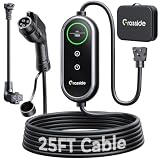
- Universal J1772 Compatibility: Designed with a standard J1772 connector, this J1772 charger works with most J1772 electric vehicles and PHEVs, including BMW, Mercedes-Benz, Hyundai, Kia, Nissan, Rivian, Ford, Chevy, Volkswagen, Toyota and more. Note: Tesla vehicles require a J1772 to Tesla adapter (not included)
- Flexible Outlet Compatibility: This portable EV charger comes with a NEMA 6-20 plug and a NEMA 5-15/5-20 to 6-20 adapter. Supports Level 1 (8–12A) and Level 2 (16A). Max 12A (1.44kW) on 120V NEMA 5-15/5-20 outlets, and full 16A (3.84kW) with a 240V NEMA 6-20 outlet. One charger is designed to cover home, garage, and travel charging needs with reliable performance
- Adjustable Smart Charging Control: Customize charging safely with adjustable current settings (8A/10A/12A/16A) to match different circuits. The 0–12 hour delay timer helps schedule overnight charging during lower electricity rates. Integrated LCD display shows real-time voltage, current, power, and charging status for clear monitoring without apps. Note: Press 'A' or 'T' for 3s to set and confirm.
- Home Charging & Travel Backup: For daily home use while remaining fully portable for travel. This level 1 ev charger includes a durable 25FT ev charging cord, providing flexible reach for garage or driveway charging. Charge overnight to take advantage of lower utility rates—potentially saving up to $500 annually on electricity costs. The included carrying case makes storage easy and keeps a dependable backup charger available in your trunk for road trips or visiting friends
- Engineered For Safety & Durability: Built for dependable daily use, this electric car charger features an IP65 waterproof rating for all weather operation. Equipped with a UL-listed cable, fully rubberized connector, and advanced protection against overcurrent, overheating, and electrical faults. Designed to ensure safe, stable, and long-term charging performance in demanding environments
Product prices and availability are accurate as of the date/time indicated and are subject to change. Any price and availability information displayed on Amazon at the time of purchase will apply.