Short answer: A battery cell is the electrochemical unit that stores and releases energy. A battery pack, also called the traction battery, is the complete vehicle-level assembly: connected cells plus the hardware and software that manage operation, temperature and delivery of power to the electric motor. Cells do the energy conversion; the pack makes many cells usable, controllable and safer in a car.
What is the difference between an EV battery cell and a battery pack?
The terms describe different system boundaries. One cell contains the electrochemical materials and electrolyte that store energy during charging and release it during discharge. The pack is an integrated assembly installed in the vehicle. It combines an array of physically connected cells with battery-management hardware and software, then supplies the motor with electrical energy.




As an Amazon Associate I earn from qualifying purchases.
The National Highway Traffic Safety Administration (NHTSA) defines a battery pack as a traction battery that stores energy and supplies power and energy to the electric motor. Its definition explicitly includes both the connected cells and the management hardware and software: NHTSA, Electric and Hybrid Vehicles: Battery, Charging & Safety.
PC Slower Than It Used to Be?
A free scan shows the junk files, broken settings and background clutter dragging Windows down - then fixes them in one click.Free scan · Windows 10 & 11Crashes, No Sound, or Screen Glitches?
Random freezes, missing sound and display glitches usually trace back to one bad driver. Find and replace yours safely.Free scan · under a minute| Comparison | Battery cell | Battery pack (traction battery) |
|---|---|---|
| What it is | One electrochemical energy-producing unit | The vehicle’s integrated energy-storage system |
| Primary job | Convert electrical energy to chemical potential while charging, then convert that stored potential back to electricity while discharging | Store energy, deliver it to the motor and manage the conditions under which the cells operate |
| What it contains | Electrodes, electrolyte and the other materials that enable the cell reaction | Physically connected cells, management electronics, software and temperature-control equipment as specified by the vehicle design |
| Scale | A single unit | Many cells; EPA says an EV pack can contain hundreds or even thousands, depending on the design |
| Architecture | The basic building block | Often cells are grouped into modules and modules into a pack, but module boundaries and layouts vary |
| Service boundary | Not automatically an owner-serviceable part | A high-voltage vehicle system requiring manufacturer procedures and qualified technicians |
The practical distinction is therefore not simply “small battery versus big battery.” It is function and system boundary: the cell performs the chemistry, while the pack coordinates many cells and the supporting systems needed in a moving, charging vehicle.
#1 Best Overall
What does a battery cell do?
The cell stores energy electrochemically
During charging, electrical energy drives a chemical change inside the cell, increasing its stored chemical potential. During discharge, the reaction runs in the opposite direction and produces electrical energy. The U.S. Department of Energy explains that ions move through the electrolyte inside the cell while electrons travel through an external circuit: DOE Explains… Batteries.
That separation of ion and electron movement is what makes a cell useful as an electrical source. The electrolyte permits ion transport inside the cell, while the external circuit provides the path for electrons. In an electric car, the external circuit ultimately connects the traction battery’s output with the vehicle’s power electronics and motor.
One cell has limited voltage and energy
A single cell can provide only a portion of the voltage and energy required by a vehicle. Designers connect cells electrically and mechanically so the complete assembly can meet the car’s demands. The exact connection pattern, physical shape, cooling arrangement and electrical ratings are manufacturer-specific; there is no universal EV cell layout.
A cell is not the same thing as a replaceable household battery
Although the word “cell” also appears on consumer battery packaging, an automotive cell operates as part of a high-voltage system. Its terminals, enclosure, insulation, sensors and cooling interfaces are selected for the pack architecture. Removing or probing one without the correct isolation procedure can expose a person to hazardous voltage and can damage neighboring components.
How cells become a vehicle battery pack
Cells are connected into a larger assembly
Manufacturers connect numerous cells so their combined voltage, current capability and energy capacity suit a particular vehicle. The cells are held in a structure and connected to the pack’s electrical and control systems. EPA notes that electric-vehicle packs may contain “hundreds or even thousands of cells,” but that statement describes a range of possible designs, not a cell count for every car: U.S. EPA, Lithium-Ion Battery Recycling.
Modules are common, but not mandatory
A frequently used teaching diagram is:
cell → module → pack
In many designs, a module is a group of cells that can be assembled, monitored or supported as a subunit. EPA describes cells grouped into modules and modules grouped into packs, while also emphasizing that pack designs vary. Some newer architectures reduce or change the role of conventional modules. For that reason, “module” should be understood as a common, architecture-dependent layer rather than a universal part every EV must have.
The pack includes more than cells
NHTSA’s definition includes battery-management hardware and software in the pack. Depending on the vehicle, the integrated assembly also has electrical interconnections, enclosures, sensors, isolation features and temperature-control components. The exact implementation is manufacturer-specific, so a diagram from one model cannot be used to infer the internal layout of another.
What’s actually slowing this PC down?
Pick the symptom - the matching free tool is one click away.
What does the battery pack do in an electric car?
Supplies energy for propulsion
The pack is the source of traction energy. When the driver requests acceleration, the vehicle draws electrical energy from the connected cells through the pack’s controlled output and sends it to the systems that drive the electric motor. During regenerative braking, energy can flow back toward the pack, where the cells accept it as charging energy if operating conditions permit.
Controls how the cells operate
Battery-management hardware and software supervise pack operation. They coordinate the connected cells as one system and apply the vehicle maker’s operating limits. The precise sensors, algorithms, communication paths and protective thresholds differ by manufacturer and model, so there is no single universal battery-management design to memorize.
Maintains a usable temperature range
Temperature control is a pack-level responsibility. NHTSA warns that temperature extremes can affect performance and shorten battery life. Thermal-management equipment helps keep the battery within appropriate operating conditions, but it consumes some energy that could otherwise help move the vehicle: NHTSA, Electric and Hybrid Vehicles: Battery, Charging & Safety.
This is why a car can have a large amount of stored energy yet temporarily limit charging or power when the battery is too hot or too cold. Such behavior is a system-protection response, not evidence that one cell has become a separate kind of battery.
What happens during charging and driving?
The cell performs the chemistry in both directions; the pack controls the conditions and routes the energy. The sequence below describes the general flow without assuming a particular vehicle’s module arrangement.
Rank #3
- Charging equipment supplies electrical energy. A conductive or wireless charging system, depending on the vehicle, presents electrical power to the car’s charging and battery systems.
- The pack’s management system supervises the session. Pack hardware and software monitor operating conditions and apply the vehicle’s control strategy. The details vary by model.
- Cells convert electrical energy into chemical potential. Ions move through the electrolyte inside each cell while electrons move through the external electrical path, as described by DOE.
- The connected cells accumulate energy as a pack. The pack combines the cells’ electrical output and keeps the assembly within its designed operating limits.
- During driving, the process reverses. Stored chemical potential becomes electrical energy. Electrons move through the external circuit to the vehicle’s propulsion system, and the motor converts that electrical input into motion.
- During regenerative braking, energy may return. The vehicle can send recovered electrical energy back toward the pack, subject to the pack’s temperature, charge and control limits.
The cell-level reaction and the pack-level controls are therefore complementary. Describing only the chemistry misses the system that makes propulsion possible; describing only the pack hides the unit that actually stores and releases energy.
Why temperature management matters
Temperature affects performance
Cells do not operate identically at every temperature. NHTSA states that temperature extremes can affect battery performance. A pack therefore includes a strategy for controlling or responding to temperature, which may include sensors, heat-transfer hardware and software limits. The specific hardware is not the same across all vehicles.
Temperature affects service life
NHTSA also notes that temperature extremes can shorten battery life. Thermal management is intended to keep conditions more suitable for operation, but it is not free: the system uses some stored energy. That energy trade-off explains why maintaining the battery at an appropriate temperature can reduce available driving energy in some conditions while protecting long-term operation.
Recommended Free Tools
Thermal control is not a separate battery
Cooling or heating equipment supports the pack; it does not replace the cells’ electrochemical function. If a temperature-control component fails, the vehicle may reduce charging or propulsion power even though the cells still contain chemical energy. The resulting warning is a pack-system issue rather than proof that every cell has failed.
Can a bad cell be replaced without replacing the pack?
There is no universal answer. Whether a manufacturer permits cell-, module- or pack-level service depends on the vehicle’s architecture, diagnostic procedures, parts availability and safety requirements. Some designs provide a distinct module layer; others integrate cells more tightly. The existence of a module in a diagram does not guarantee that an owner or independent shop can replace it.
For drivers, the important distinction is between identifying a fault and repairing it. A diagnostic system may report a problem associated with a cell group, module, sensor, management component or thermal system. Interpreting that message requires model-specific service information. It should not be treated as permission to open a high-voltage enclosure.
Rank #4
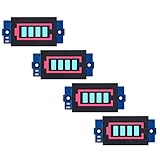
- The 2S battery capacity indicator module can be used to display lithium battery, lead acid battery, and Ni-MH battery.
- Clear and bright display, outline red, display block Blue. The different electricity quantity will illuminate corresponding blocks electricity quantity.
- How to use it: Connect the positive and negative terminals of the display board to the positive and negative terminals of the battery under test. The digital tube displays the real-time battery power.Note : after connecting a few series of lithium batteries in series, it is necessary to connect t-i-n to the corresponding pads.For example if a 2S battery is measured (two 3.7V lithium batteries are connected in series), a short circuit on the pad corresponding to S2 of the board is required.
- Widely applications: Can be widely applied to portable mobile equipment, electro mobile, balance car, cleaning machine, measuring equipment etc. battery capacity indicator.
- Note: The electricity quantity parameter is a reference value, there will be about 2% error range; This model is not waterproof, the electronic components should be used in a dry environment; The number of corresponding battery strings and use them within the corresponding voltage range. Do not exceed a voltage of 4.3*N at most.(for example, if the t-i-n on the pad of S3 is selected, the maximum voltage detected by the module should not exceed 4.3*3=12.9 V).
- Read the vehicle’s warning message and owner documentation.
- Record when the warning appeared, including charging conditions and outside temperature.
- Arrange diagnosis through the manufacturer or a technician trained for that vehicle’s high-voltage system.
- Do not disconnect, puncture, bridge or open pack components based on a generic online diagram.
A cell-level repair can involve high voltage, stored energy, chemical hazards and requalification of the entire assembly. The safe service boundary is set by the vehicle maker, not by the vocabulary of cell, module or pack.
Battery-pack safety after flooding or physical damage
High-voltage packs require special caution after a crash, flood or other damage. NHTSA warns that a flood-exposed battery system may present high-voltage shock and fire hazards. If damage is suspected, contact a dealer and/or emergency services rather than attempting to inspect or repair the pack yourself: NHTSA, Electric and Hybrid Vehicles: Battery, Charging & Safety.
What an owner should do
- Move away from the suspected damaged vehicle when it is safe to do so. Do not touch exposed orange cables, the battery enclosure or liquid near the vehicle.
- Do not charge or operate the vehicle if damage is suspected. Follow emergency personnel and vehicle-maker guidance.
- Contact qualified help. Use the dealer, an appropriately trained recovery provider or emergency services as circumstances require.
- Tell responders that the vehicle is electric or hybrid. This helps them apply the correct high-voltage and fire-safety procedures.
These precautions apply even when the car appears switched off. A pack stores energy independently of whether the ignition is active, and flood damage can create hazards that are not visible from outside.
Independent reader supportYour contribution helps us test, update, and keep practical guides available for everyone.Common misconceptions about cells, modules and packs
“The pack is just one giant cell.”
No. A pack combines many connected cells and the systems that manage them. Calling it a large cell erases the management, thermal and safety functions that distinguish a vehicle pack from an individual electrochemical unit.
“Every EV has the same number of cells and modules.”
No. EPA’s hundreds-or-thousands description is a qualitative scale, not a universal specification. Cell count, module count, physical arrangement and service strategy vary by vehicle design.
Quick wins for a faster PC:
Clear out junk files and repair common Windows errorsFree Scan →Scan for outdated or missing drivers - takes under a minuteDriver Scan →Repair Windows errors before they cause bigger problemsFix Now →“Every pack must contain modules.”
No. Modules are common in many architectures, but they are not a mandatory layer. Use “often” or “in many designs” when describing the cell-to-module-to-pack hierarchy.
“A battery-management system stores the energy.”
The cells store energy electrochemically. Management hardware and software supervise operation, coordinate the connected cells and help enforce operating conditions; they are essential to the pack but are not the energy-storage medium themselves.
“A warning light identifies one failed cell.”
Usually, a vehicle warning indicates that the pack system has detected an out-of-range condition. The cause could involve a cell group, module, sensor, management component, temperature condition or another part of the system. A model-specific diagnostic process is needed to identify it.
How to read EV battery specifications
Vehicle specifications normally describe the pack, not an individual cell. When a brochure lists usable or total energy, charging behavior or traction-battery placement, those figures refer to the integrated vehicle system and its control strategy. They should not be divided by an assumed cell count to estimate what one cell does.
If a technical document lists a module or cell count, treat it as a design detail for that exact model, revision and market. It does not establish a standard for all electric cars. The same caution applies to service manuals: a procedure for one pack architecture cannot be safely generalized to another.
| If you are asking… | The relevant level is… | Why |
|---|---|---|
| Where is energy converted and stored? | Cell | The electrochemical reaction occurs in the cell’s materials and electrolyte. |
| What sends energy to the motor? | Pack | The connected-cell assembly supplies the vehicle’s propulsion system. |
| What keeps operation within limits? | Pack management system | Hardware and software supervise the connected cells. |
| What responds to temperature extremes? | Pack thermal-management and control systems | Temperature affects performance and life, and control may consume energy. |
| What should be handled after flood damage? | The complete high-voltage pack system | NHTSA warns of shock and fire hazards and advises qualified assistance. |
The practical takeaway for an EV owner
Think of the cell as the energy-converting building block and the pack as the engineered power plant installed in the car. The pack’s value is not merely the sum of its cells: it also includes the connections, management electronics, software and temperature-control functions that allow those cells to propel a vehicle.
That distinction helps explain vehicle behavior. A charging limit can be a pack-management or temperature response; a diagnostic code may identify a system condition rather than a single replaceable cell; and a damaged or flooded pack must be treated as a high-voltage safety hazard. For specifications, diagnosis and repair, use information for the exact vehicle and qualified technicians rather than assuming that every EV follows the same cell-module-pack layout.
Quick Recap
Product prices and availability are accurate as of the date/time indicated and are subject to change. Any price and availability information displayed on Amazon at the time of purchase will apply.
Free tools Windows power users keep installed
One-click scans. No signup required.




