Businesses including IKEA, EDF, Geopost and DFDS are urging the European Commission to keep the EU’s heavy-duty vehicle CO₂ standards ambitious and not bring their planned 2027 review forward. In a letter coordinated through Climate Group’s EV100 and published on October 1, 2026, they argue that stable rules support investment in electric fleets and the charging infrastructure those fleets need. Their request concerns the standards’ ambition and review timing—not the separate, targeted change to some manufacturers’ credit calculations adopted earlier in 2026.
What are fleet operators asking the Commission to do?
The EV100-coordinated letter asks the Commission to uphold the standards’ original ambition and avoid advancing the planned 2027 review. Climate Group says it was addressed to Commission President Ursula von der Leyen, Executive Vice-Presidents Teresa Ribera and Stéphane Séjourné, and commissioners responsible for transport, climate and energy. Transport & Environment published the letter on October 1, 2026.
The signatories include companies and organisations from across transport and energy, among them IKEA, EDF, Geopost and DFDS. They say that reopening or weakening the rules could unsettle expectations for businesses investing in electric trucks and related infrastructure. These are the signatories’ arguments; the letter does not establish how all European fleet operators view the policy.
What do the EU’s truck CO₂ standards cover?
Vehicles and emissions context
The European Commission defines heavy-duty vehicles (HDVs) as lorries with a technically permissible maximum laden mass above 3.5 tonnes, buses and coaches. The Commission’s policy overview, accessed October 3, 2026, says HDVs account for more than a quarter of greenhouse-gas emissions from EU road transport and over 6% of the EU’s total greenhouse-gas emissions.
Recommended Free Tools
#1 Best Overall

- 🚛 39.6" MASSIVE SHOWSTOPPER & ULTIMATE GIFT: Stop settling for tiny, underwhelming toys. Measuring an incredible 39.6 inches(truck + trailer) long with the tailgate extended, this giant RC semi-truck guarantees a jaw-dropping unboxing experience. Fully compliant with US safety standards, it’s the perfect birthday or holiday gift that will make any 6-12 year old truck enthusiast's dream come true(Overall Size: 39.6" L × 5.0" W × 6.8" H)
- 🎮 PRO-LEVEL 16-CHANNEL 2.4GHz CONTROL: Experience true-to-life operation without signal interference. Using the 2.4GHz remote, kids can precisely steer, switch between fast/slow modes, drive the cab solo, and trigger authentic engine sounds, the working horn, LED headlights, and the signature dual water-vapor exhaust smoke—delivering a fully immersive driving experience
- 🔋 UPGRADED 60-MIN PLAYTIME & USB-C CHARGING: Say goodbye to constant recharging tears! This heavy-duty transport hauler includes TWO upgraded 3.7V/1000mAh rechargeable batteries for the truck, delivering up to 60 minutes of combined uninterrupted hauling. The modern, safer USB-C charging port completely eliminates the frustration of broken charging pins found on older RC models
- 💪 HEAVY-DUTY HAULING & 17-LB PAYLOAD: Built for serious backyard construction sites. The robust 4WD chassis and extra-long flatbed can securely transport up to 17 lbs of smaller cars, building blocks, or construction vehicle toys. Boasting a massive 100–160 ft control range, it effortlessly conquers driveways, carpets, and parks for versatile indoor and outdoor play
- 🔥 AUTHENTIC MECHANICS & HANDS-ON LEARNING: Spark their engineering curiosity! Features include a manually opening hood, dual smoke nozzles, an adjustable tailgate, and extendable lifting outriggers. (Pro Tip: A gentle mechanical clicking sound when adjusting the outriggers is normal and ensures secure locking!) This interactive design naturally develops hand-eye coordination through immersive play
Targets in the Commission’s expanded framework
The Commission’s current overview lists reductions of 45% by 2030, 65% by 2035 and 90% by 2040 for the relevant expanded HDV framework. These figures are not measured against one universal baseline for every vehicle class:
| Vehicle scope | Reference period stated by the Commission |
|---|---|
| Vehicles covered by the earlier standards | 2019 |
| Newly regulated lorries above 7.5 tonnes and special-axle heavy lorries | 2021 |
| Coaches, trailers and medium lorries from 5 to 7.5 tonnes | 2025 |
The Council of the EU’s March 2026 summary describes the standards as reductions of 15% from 2025, 43% from 2030 and 90% in 2040. Those are the Council release’s summary figures; they should not be treated as interchangeable with the Commission’s expanded-framework figures without accounting for differences in vehicle scope and reference periods.
Rank #2
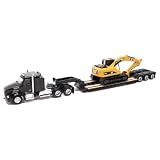
- Diecast Masters | 1:87 Scale Kenworth T880s SBFS 40in-Sleeper Tandem Tractor with Lowboy Trailer and Cat 320D L Hydraulic Excavator | Model 84420
Separate city-bus requirements
The Commission says the amended 2024 regulation requires 90% of new city buses to be zero-emission by 2030 and all new city buses to meet the zero-emission requirement from 2035. These requirements are distinct from the percentage CO₂-reduction targets for the wider HDV framework.
What changed in the 2026 truck-emissions rules?
On March 30, 2026, the Council formally adopted a targeted amendment to how certain manufacturers can accumulate credits before 2030. For covered heavy lorries over 16 tonnes and certain bus categories over 7.5 tonnes, manufacturers can earn credits in 2025–29 when emissions are below their own annual targets, rather than having to beat a stricter linear trajectory. The change does not apply to urban buses.
What’s actually slowing this PC down?
Pick the symptom - the matching free tool is one click away.
Rank #3

- Diecast Masters | 1:87 Scale Peterbilt Model 579 UltraLoft Tandem Tractor with Lowboy Trailer and Cat D5M Dozer | Model 84419
The Council says the amendment does not alter the long-term reduction targets. It changes a route to compliance for specified manufacturers and vehicle categories; it is not itself a decision to lower the standards or move the planned 2027 review. The Commission’s overview also describes additional 2030 compliance flexibility proposed in the 2025 Automotive Package. That proposal and the Council-adopted credit amendment are specific compliance measures, separate from the broader dispute over whether the standards should be weakened or reviewed early.
Why do fleet and business signatories oppose an earlier review?
The letter’s central case is that predictable standards help companies plan investments in zero-emission fleets and give infrastructure providers confidence to build for future demand. The signatories also ask the EU to pair the standards with revision of the Alternative Fuels Infrastructure Regulation (AFIR) and the European Grids Package, arguing that high-power charging and grid capacity are essential to deployment.
Rank #4
- Expertly Designed.
- True to Life Detail.
- Made from Quality Parts.
- Ships from USA.
- Brand New Item.
Climate Group’s announcement presents electric fleets as a way for businesses to reduce exposure to fuel-price spikes and links stable ambition to energy security, climate commitments and Europe’s industrial transition. These are claims made by the signatories, not a settled finding about costs or the pace of demand across all fleets. IKEA, DFDS, EDF and ChargeUp Europe representatives likewise frame predictable policy as important to investment by operators and companies across the charging value chain.
Independent reader supportYour contribution helps us test, update, and keep practical guides available for everyone.Why does ACEA argue for bringing the review forward?
In a May 27, 2026 statement, the European Automobile Manufacturers’ Association (ACEA) and its signatories argued that deployment is being held back by practical and commercial constraints. ACEA cited slow public and depot charging rollout, insufficient hydrogen-refuelling infrastructure and weak business cases for some operators. It called for an earlier review, binding infrastructure milestones, incentives to narrow total-cost-of-ownership gaps and an industrial strategy.
The Tool Desk
Outbyte PC Repair FREEClear out junk files and repair common Windows errorsFree Scan →Outbyte Driver Updater FREEScan for outdated or missing drivers - takes under a minuteDriver Scan →Best Value

- Realistic Diecast Semi Truck Design: This small container truck model features craftsmanship and detailed construction, capturing the retro and rustic look of a classic transport truck, making it an ideal car model decoration for collectors and vintage enthusiasts
- Toy Semi Truck Model Material: Crafted with a sturdy alloy truck front end and a sturdy ABS container, this semi truck toy model ensures safety and longevity. Featuring moving parts like a turning head, it provides a premium feel and durability for collect, play, and display
- Compact Size and DIY Paintable: Measuring about 7.5 inches in length, this desktop truck decoration fits conveniently in various spaces like living rooms, bedrooms, studies, or offices. The smooth paint finish allows for DIY painting or stickers, enabling to create unique DIY paint semi truck
- Versatile Decorative Use: This craft mini container truck model is designed to be stable safely on flat surfaces, whether on desktops or shelves. It serves as a creative adornment that complements a range of interior styles, enhancing the aesthetic of your home or workspace with its nostalgic charm
- Easy Placement: This container truck model features a detachable design, facilitating easy assembly and disassembly, simulating real-world transportation scenarios. This cargo truck is the perfect gift for boys and girls, as well as family and friends, for birthdays, holidays, or as a retro collectible
ACEA’s position puts greater emphasis on whether infrastructure, operating economics and market conditions are ready to support the current pathway. Its concerns about competitiveness, production capacity, innovation and industrial employment should be understood as the organisation’s case for revisiting the rules, not as independent proof that the targets are unachievable.
Where do the two sides disagree?
| Issue | EV100-coordinated business signatories | ACEA and its signatories |
|---|---|---|
| Review timing | Keep the planned 2027 review; do not bring it forward, because predictable ambition supports investment. | Advance the review to assess whether the standards’ ambition matches market conditions. |
| Infrastructure | Accelerate high-power charging and address grid bottlenecks through AFIR and the European Grids Package. | Set binding milestones for public and depot charging and hydrogen refuelling infrastructure. |
| Economics | The signatories say policy certainty supports investment and electric fleets can reduce exposure to fuel-price spikes. | ACEA says some operators lack a robust business case and calls for incentives to address total-cost-of-ownership gaps. |
| Industrial outcomes | The letter links stable ambition with investment, energy security, climate commitments and industrial transformation. | ACEA stresses competitiveness, production capacity, innovation and industrial employment. |
The disagreement is therefore not simply about whether zero-emission vehicles should expand. It is about whether holding the existing policy course provides the certainty needed to build fleets and infrastructure, or whether the timetable should be reconsidered in light of deployment constraints and operators’ economics. The public statements establish the positions of the participating organisations, not a consensus among all businesses or an independent verdict on the effects of either policy choice.
Quick Recap
Product prices and availability are accurate as of the date/time indicated and are subject to change. Any price and availability information displayed on Amazon at the time of purchase will apply.