What’s actually slowing this PC down?
Pick the symptom - the matching free tool is one click away.
Electric reach stackers can cost less to run and produce far fewer operational emissions, but diesel still has a lower purchase price and simpler refuelling. The right choice depends on your container weights, annual movements, shift pattern, electricity and diesel prices, charging window, grid capacity, maintenance support, battery-replacement exposure and resale assumptions. A five-year model from Kalmar shows electric ahead in two European scenarios, while California’s draft cost assessment shows a much higher electric capital cost. Neither result is universal.
The fairest comparison uses equivalent capacity and configuration, the same duty cycle, local delivered energy prices and every infrastructure cost. The evidence below includes a New Zealand operating case, manufacturer modelling, a draft California assessment and U.S. port guidance; each is identified so you can judge how much weight to give it.
As an Amazon Associate I earn from qualifying purchases.
What the evidence says at a glance
| Question | Evidence | How to interpret it |
|---|---|---|
| Which costs less to buy? | California Air Resources Board’s draft 2025 CHE Technology Assessment lists battery-electric reach-stackers at $1.7 million–$2.3 million and diesel machines at $830,000–$860,000 in 2024 dollars. It also lists $25,000 per charger and $30,000–$200,000 for battery replacement. | These are provisional draft figures, not a final price list. Electric capital cost is materially higher in this assessment. |
| Which has lower modeled five-year TCO? | Kalmar’s November 2025 investor presentation models electric at 24% below diesel in Norway and 16% below diesel in France. | The scenarios include resale value but exclude chargers and infrastructure, so a site-specific model can produce a different result. |
| What operating savings have been reported? | EECA says Reliance Transport’s electric SANY SRSC45E delivered 80% lower energy costs and 65% lower maintenance costs than its previous diesel reach stacker. | This is one site’s comparison, not a universal percentage. |
| Can an electric machine cover a full shift? | The Reliance machine has a 269 kWh battery, handles up to 45 tonnes, lifts just over 15 metres and regularly completes eight-hour shifts. The depot reports peak activity of about 100 container movements per day. | Electric operation is technically viable for a demanding schedule when the machine, charging plan and grid are sized for it. |
| What emissions reduction is documented? | EECA reports 90% lower yearly emissions for the electric machine than the site’s former diesel machine. | The page does not provide a full lifecycle method. Grid mix, operating hours and the diesel baseline must be stated before applying the result elsewhere. |
Sources: EECA, Kalmar November 2025 presentation and the CARB draft 2025 assessment.
Recommended Free Tools
Purchase price and total cost of ownership are different decisions
Electric starts with a higher capital bill
The CARB draft assessment’s 2024-dollar range is $1.7 million–$2.3 million for a battery-electric reach stacker versus $830,000–$860,000 for diesel. Its table separately lists $25,000 for each charger and $30,000–$200,000 for battery replacement. Because the document is marked DRAFT 2025 CHE Technology Assessment, treat the numbers as provisional and verify current quotations, warranty terms and regional taxes before approving a purchase.
#1 Best Overall

- Empower Your Workforce with Unmatched Strength: The TYPHON Vigor 1.5 electric forklift sets a new standard in lifting, boasting a formidable weight of 5300 lbs and a remarkable capacity to elevate loads up to 1.5 tons. This powerhouse ensures your team can handle double the load with ease, compared to standard forklifts, transforming how you move materials in your workspace.
- Elevate Efficiency in Every Lift: Designed for versatility, our industrial forklift achieves a lifting height of 4500mm across three stages, complemented by a 1400mm free lift capability, perfect for navigating spaces with restricted height. Its precision handling and 1580mm wheelbase ensure stability and safety, even during the most challenging lifts.
- Navigate with Unparalleled Agility: Experience the freedom of movement with this forklift truck featuring a compact turning radius of just 2210mm and advanced lateral movement capabilities. This agility allows for seamless navigation through tight warehouse aisles, making every turn and placement effortless and efficient.
- Sustain Your Operations with Smart Power: Leverage the latest in energy efficiency with our electric fork lifter's 60V/260Ah lithium battery, offering an intelligent charging solution that adapts to any 110V outlet. With a charge time of just six-eight hours (for up to a full ten hours of operational capability), your productivity will soar without interruption.
- Achieve Operational Excellence with Every Move: The TYPHON Vigor 1.5 heavy-duty lifting equipment is not just about power; it's also about control. Equipped with hydraulic steering for precise maneuvering and solid tires for unrivaled stability, this compact electric forklift is engineered to elevate your operational standards, ensuring every task is executed with precision and confidence.
A purchase-price comparison also needs to define what is included: spreader and attachments, telematics, tyres, delivery, commissioning, operator training, charging hardware, transformer or switchgear upgrades and any civil works. A diesel quote that excludes site fuel storage or an electric quote that excludes its connection upgrade can make either option look artificially cheap.
Energy costs can reverse the five-year result
Kalmar’s November 2025 investor presentation compares same-size machines with basic configurations, the same drive cycle and the same energy consumption. In its Norway scenario, electric TCO is shown 24% below diesel over five years. The assumptions are diesel at €1.83 per litre, electricity at €0.09 per kWh, expected EU ETS2 diesel surcharges from 2027 and a resale value; charger and infrastructure costs are excluded.
Its France example shows electric 16% below diesel over five years, using diesel at €1.70 per litre, electricity at €0.16 per kWh, 3,000 running hours per year and a resale value. Again, charging and infrastructure are excluded. These are manufacturer scenarios, not independent guarantees, and the result is sensitive to tariffs, utilization, carbon pricing and residual value.
Quick wins for a faster PC:
Scan for outdated or missing drivers - takes under a minuteDriver Scan →Repair Windows errors before they cause bigger problemsFix Now →A draft cost table is not an equal-utilization test
CARB’s draft table estimates annual energy costs of $31,000 for electric and $29,600 for diesel under its stated assumptions. The rows use different annual operating hours and assumed energy prices, so they are not a controlled comparison of identical utilization. Use them as inputs to question your own assumptions, not as a forecast of your fuel bill.
One real deployment shows the operating upside
EECA reports that Reliance Transport’s electric reach stacker cut energy costs by 80% and maintenance costs by 65% compared with the company’s previous diesel machine. The case-study page does not state a publication year. Its figures reflect that depot’s duty cycle, energy tariff, maintenance practice and baseline machine; they should not be generalized without matching those conditions.
Rank #2
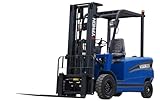
- Empower Your Workforce with Unmatched Strength: The TYPHON Vigor 2.5 electric forklift sets a new standard in lifting, boasting a formidable weight of 6613 lbs and a remarkable capacity to elevate loads up to 2.5 tons. This powerhouse ensures your team can handle double the load with ease, compared to standard forklifts, transforming how you move materials in your workspace.
- Elevate Efficiency in Every Lift: Designed for versatility, our industrial forklift achieves a lifting height of 4500mm across three stages, complemented by a 1400mm free lift capability, perfect for navigating spaces with restricted height. Its precision handling and 1820mm wheelbase ensure stability and safety, even during the most challenging lifts.
- Navigate with Unparalleled Agility: Experience the freedom of movement with this forklift truck featuring a compact turning radius of just 2350mm and advanced lateral movement capabilities. This agility allows for seamless navigation through tight warehouse aisles, making every turn and placement effortless and efficient.
- Sustain Your Operations with Smart Power: Leverage the latest in energy efficiency with our electric fork lifter's 60V/250Ah battery, offering an intelligent charging solution that adapts to any 110V outlet. With a charge time of just six hours for up to ten hours of operational capability, your productivity will soar without interruption.
- Achieve Operational Excellence with Every Move: The TYPHON Vigor 2.5 heavy-duty lifting equipment is not just about power; it's also about control. Equipped with hydraulic steering for precise maneuvering and solid tires for unrivaled stability, this compact electric forklift is engineered to elevate your operational standards, ensuring every task is executed with precision and confidence.
Reliance General Manager Mark Darrah is quoted by EECA saying, “This reach stacker is producing significant savings in operating costs and maintenance costs. Emission reduction equals cost reduction, and in a competitive industry we need to deliver.” That statement describes the company’s experience, not an independently controlled trial.
Build a site-specific TCO model
Model each machine over the same ownership period, usually five to ten years, and show cash costs separately from non-cash assumptions such as resale value. Use delivered prices rather than headline tariffs.
The Tool Desk
Outbyte PC Repair FREERepair Windows errors before they cause bigger problemsFix Now →Outbyte Driver Updater FREEFix the driver behind crashes, sound loss and screen glitchesFind Drivers →- Define the work. Record annual running hours, container moves, average and maximum loads, lift heights, travel distance, idle time, temperature and the number of shifts. Include seasonal peaks rather than using a quiet-month average.
- Match the machines. Compare the same rated capacity, reach, lift height, spreader configuration, tyre specification, automation and safety equipment. A lower-capacity electric machine is not a fair substitute for a diesel model.
- Measure energy use. Obtain manufacturer consumption data for your duty cycle and validate it with a monitored trial where possible. For diesel, include fuel burned during idle and warm-up; for electric, include charging losses, demand charges and auxiliary loads.
- Enter local prices. Use your delivered diesel price per litre, electricity price per kWh, time-of-use periods, demand charges, taxes and any verified incentive. Run low, central and high price cases because energy markets change.
- Price the electrical work. Include chargers, cabling, switchgear, transformer capacity, trenching, permits, engineering, utility connection fees, backup generation and future fleet expansion. Kalmar’s published scenarios omit these items.
- Cost maintenance and downtime. Include scheduled services, inspections, tyres, hydraulic components, traction motors, software support, technician training, spare parts and the cost of taking a machine out of service. The Reliance case reports lower maintenance, but the percentage is site-specific.
- Model the battery. State battery warranty, guaranteed retained capacity, replacement trigger, replacement price, lead time, recycling and whether a spare battery is needed. CARB’s draft range of $30,000–$200,000 demonstrates why this line cannot be ignored.
- Use realistic availability. Cost lost moves when charging, maintenance or a fault removes the machine from service. Include a rental or backup-machine allowance if your terminal cannot tolerate a gap.
- Include residual value and financing. Kalmar includes resale value in its scenarios. Use a conservative value for electric equipment if your local used-equipment market is immature, and compare financing rates and taxes on the same basis.
- Report the break-even point. Show the purchase-price premium, annual operating saving and years required to recover infrastructure and battery costs. Also show the result if utilization falls, electricity rises or a battery replacement occurs earlier than planned.
Can electric reach stackers match diesel performance?
What manufacturers claim
Hyster says current lithium-ion and hydrogen fuel-cell systems can deliver diesel-like performance for demanding terminal operations. Its guidance says selection should begin with runtime, fleet size, local electricity or hydrogen availability and sustainability requirements. This is manufacturer guidance, not an independent comparative test: Hyster’s electric container-handler FAQ.
The Reliance shift example
The Reliance Transport case supplies concrete operating details. Its SANY SRSC45E uses a 269 kWh battery, handles loads up to 45 tonnes and reaches just over 15 metres. The machine regularly completes eight-hour shifts, consumes about 33 kWh per hour according to the case study and performs the majority of container movements at the Wiri depot. Peak activity is around 100 movements per day.
Reliance charges with a 40 kW charger overnight and sometimes tops up during staff breaks. Dividing 269 kWh by 40 kW gives about 6.7 hours under ideal conditions; real charging takes longer because of charging losses and the taper near full charge. The example therefore supports an overnight strategy, not an assumption that every eight-hour operation can charge in one short break.
Rank #3
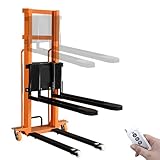
- IMPORTANT MATTERS BEFORE SHIPMENT:Because the product is a big item,we need you to tell us:1.Your address is commercial or residential? 2.ls the address on Amazon the correct delivery address? 3.Please provide us with the correct contact information.
- SCOPE OF WORK:Our electric pallet stacker have a maximum lifting capacity of 1300lbs Maximum lift height is 63” Minimum working height is 3.2”
- ROUTINE MAINTENANCE:If the pallet stacker is not used for a long period of time, charge it at least once a month to avoid over-discharging, which may affect the performance and life of the battery.
- SCOPE OF APPLICATION:The pallet lift can be used for a variety of pallets, making it a great choice for pulling drivers!
- PLEASE NOTE:The cargo forks are motorized lift type, but the mobile forklift itself still needs to be operated manually.
Questions to ask about your duty cycle
- How many productive hours occur between guaranteed charging windows?
- Does the machine spend long periods at maximum load, maximum lift or high travel speed?
- Can breaks be scheduled for opportunity charging without reducing moves?
- What ambient temperatures and weather conditions apply?
- How many reach stackers will charge simultaneously at shift change?
- What performance is guaranteed at the end of the battery warranty, not just when new?
Ask suppliers for measured energy use, continuous-duty runtime, charging curves, cold- and hot-weather limits, guaranteed availability and service response times. Compare the same test conditions for diesel and electric machines.
PC Slower Than It Used to Be?
A free scan shows the junk files, broken settings and background clutter dragging Windows down - then fixes them in one click.Free scan · Windows 10 & 11Outdated Drivers Are Slowing You Down
One free scan finds every outdated or missing driver and matches the right update for your exact hardware.Free scan · exact hardware matchCharging is an operating system, not an accessory
Check grid capacity before ordering machines
Hyster warns that charging demand depends on fleet size and the local grid, and recommends evaluating charging strategies and consulting the utility. Determine available capacity, connection lead time, transformer rating, protection requirements, cable routes, charger locations, flood or collision exposure and room for additional machines. A site that can power one charger may not support a full fleet charging at once.
Choose between dedicated and opportunity charging
Dedicated charging removes a machine from service while it charges, making overnight charging predictable but requiring enough battery capacity and spare equipment. Opportunity charging uses planned breaks or shift changes; it can reduce the required battery size but needs disciplined scheduling and charger access. Hyster’s earlier guidance notes that opportunity charging can affect productivity if it is not planned around the operation: Hyster’s reach-stacker charging guidance.
For a multi-machine fleet, model staggered charging, demand peaks, queueing and a failed charger. Consider energy-management software, lower-power overnight charging, a second connection or on-site generation only after calculating its cost and reliability. Do not assume a generic automotive charger will be compatible with a heavy industrial reach stacker; charger voltage, connector, communications and safety interlocks are machine-specific.
Independent reader supportYour contribution helps us test, update, and keep practical guides available for everyone.Emissions: large potential benefit, but define the boundary
What the New Zealand case reports
EECA reports 90% lower yearly emissions for Reliance’s electric reach stacker than for its previous diesel machine. The case does not publish a full lifecycle method. It does not establish whether the percentage covers tailpipe emissions, operational electricity emissions, battery manufacture, infrastructure or end-of-life treatment.
Rank #4

- High Lift Height & Load Capacity: Full electric pallet stacker with 118 In lift height and 3300 Lb load capacity for pallet lifting, transport, and stacking in warehouses, factories, stockrooms, and distribution centers.
- Efficient Electric Drive System: Electric forklift with battery-powered drive system and high-efficiency motor provides smooth lifting, stable travel, and reliable performance for daily material handling tasks.
- Comfortable Stand-On Operation: Designed with ergonomic control handle, spacious stand-on platform, and clear visibility for simple operation during warehouse loading, unloading, and pallet movement.
- Compact Warehouse Maneuverability: Warehouse stacker with compact turning radius and electronic brake allows smooth movement through aisles, loading areas, and indoor material handling spaces.
- Open-Bottom Pallet Compatibility: This pallet lift is designed for open-bottom pallets only. Not suitable for closed-bottom pallets or pallets with bottom boards blocking the fixed straddle legs.
For a defensible comparison, state the diesel model and hours, electricity supply mix, charging losses, annual moves and whether upstream fuel and battery emissions are included. A low-carbon grid will generally improve the operational result; a carbon-intensive grid reduces it. The percentage from one depot must not be presented as a universal lifecycle factor.
Compare against newer diesel, not only an old machine
The U.S. Environmental Protection Agency says ports can reduce pollution by replacing older container-handling equipment with all-electric versions or Tier 4 diesel equipment. It recommends considering equipment age and annual use and prioritizing the oldest, heavily operated machines. The practical procurement choice may therefore be a new electric machine, a new Tier 4 diesel machine or an upgrade/replacement plan for an aging fleet, depending on local air-quality priorities and operating economics: EPA cargo-handling equipment best practices.
Maintenance, reliability and residual value
The Reliance case’s 65% maintenance-cost reduction is a useful signal that electric drivetrains can remove engine-related service work, but it is not a guaranteed ratio. Electric machines still require inspections, tyres, hydraulics, brakes, cooling systems, spreaders, software and high-voltage safety procedures. Ask who is trained and authorized to work on the battery and power electronics, how quickly parts arrive and what happens after a fault-code lockout.
Battery degradation is both a cost and an availability issue. Require a written capacity warranty, diagnostic access, replacement lead time and a plan for temporary equipment. Obtain residual-value assumptions from local dealers rather than importing a European estimate into another market. Resale value can materially change the TCO ranking because Kalmar’s scenarios include it while the CARB draft capital table does not present a complete ownership model.
Use this comparison checklist in a procurement tender
| Category | Information to require from every bidder |
|---|---|
| Capacity and configuration | Rated load, reach, lift height, spreader type, attachments, tyre specification and safety systems. |
| Productivity | Moves per hour, cycle assumptions, travel speed, lift speed and performance at maximum load. |
| Energy | Consumption per operating hour or move, test conditions, charging losses and auxiliary loads. |
| Runtime | Guaranteed runtime for your duty cycle, end-of-warranty capacity and temperature limits. |
| Charging | Power rating, charge time, connector, communications, installation requirements and fault recovery. |
| Site work | Transformer, switchgear, cabling, civil works, permits, utility fees and expansion capacity. |
| Maintenance | Service intervals, labour hours, parts, high-voltage training, response time and uptime guarantee. |
| Battery | Warranty, degradation limits, replacement trigger, price, lead time, recycling and safety plan. |
| Financial model | Purchase price, financing, taxes, incentives, energy prices, utilization, residual value and sensitivity cases. |
| Emissions | Tailpipe and electricity assumptions, grid factor, fuel pathway and whether manufacturing is included. |
When an electric reach stacker is likely to fit
Favour electric when
- The machine runs enough hours for energy and maintenance savings to recover the capital premium.
- You have predictable overnight or break-time charging windows and confirmed grid capacity.
- Local electricity is competitively priced and relatively low-carbon.
- Noise, local air quality or corporate emissions targets have operational value.
- You can support high-voltage maintenance, software diagnostics and battery contingency planning.
- Your duty cycle resembles the Reliance example: full shifts with a planned overnight charge and occasional top-up.
Favour diesel, or stage the transition, when
- Utilization is low or irregular, so the energy saving cannot recover the purchase premium.
- The site lacks connection capacity or a reliable charging window and upgrades would be excessive.
- Operations require continuous peak-duty work with no practical opportunity to charge.
- Local electricity is expensive, heavily demand-charged or carbon-intensive.
- Specialist service support and battery replacement logistics are unavailable.
- A newer Tier 4 diesel replacement delivers the required emissions improvement at lower risk.
A practical pilot before fleet replacement
- Select one representative machine and one representative operating area, not an easy demonstration route.
- Record baseline diesel fuel, hours, moves, idle time, maintenance events, downtime and emissions methodology for several comparable weeks.
- Install temporary energy metering and log electric kWh, charge duration, state of charge, moves, loads, weather and downtime.
- Run the electric machine through the busiest shift pattern, including peak loads and normal breaks.
- Test a charger fault, a missed charging window and a low-state-of-charge recovery plan.
- Compare cost per move, availability, productivity, maintenance hours, operator acceptance and local air-quality outcomes.
- Recalculate TCO with actual site energy data, infrastructure quotations and a conservative battery and residual-value case.
- Scale only if the pilot meets written productivity, uptime, safety and financial thresholds.
Bottom line
Electric reach stackers can deliver lower energy and maintenance costs and substantially lower operational emissions, and modeled five-year TCO can beat diesel where electricity, utilization and charging conditions are favourable. Diesel remains cheaper to buy in the CARB draft assessment and is easier to refuel without electrical construction. Treat the Reliance savings and emissions figures as a valuable real-world example, not a promise; treat Kalmar’s percentages as scenario outputs that exclude infrastructure; and treat CARB’s prices as draft. The procurement decision should rest on a matched duty-cycle model that includes chargers, grid upgrades, battery replacement, downtime, residual value and the emissions boundary your organization actually reports.
Quick Recap
Product prices and availability are accurate as of the date/time indicated and are subject to change. Any price and availability information displayed on Amazon at the time of purchase will apply.




