Dom Toretto’s defining Dodge Charger is the black 1970 Charger R/T from The Fast and the Furious (2001). It carries his family history and became the visual shorthand for the character. The F9 mid-engine Charger is the most credible challenger because its unusual layout and Hellcat-based powertrain turn the familiar muscle car into something radically new. This ranking weighs narrative importance, recognizability, visual distinctiveness, and how much each build changes the action or Dom’s story.
Every major Dom Toretto Charger at a glance
| Rank | Charger | Film or appearance | Reported identity | Why it matters | Evidence confidence |
|---|---|---|---|---|---|
| 1 | Original black Charger R/T | The Fast and the Furious (2001) | Presented publicly as a 1970 Dodge Charger R/T; the screen car reportedly used a 1969 base with 1968 and 1970 parts | Dom’s family legacy, signature image and emotional climax | High for the on-screen identity; mixed for the exact donor build |
| 2 | F9 mid-engine Charger | F9 (2021) | Black 1968 Charger body with a Dodge Hellcat motor moved to an unusual mid-engine location | Most radical engineering and strongest action reinvention | High for production descriptions |
| 3 | “1327” rebuilt Charger | F9 (2021) | Rebuilt version of the original car, identified by the number 1327 | Turns the first film’s wrecked icon into a family-heirloom continuation | High for its presence in the F9 garage |
| 4 | Off-road Charger | Furious 7 (2015) | Recurring Charger converted with raised suspension and larger tires | Shows the car performing a rally-style, rough-terrain role | Moderate; transformation details come from Dodge Mexico |
| 5 | Charger Maximus | Furious 7 (2015) | Silver Charger with Italian-leather interior and a V8 described as using two superchargers | The most flamboyant, specification-focused version | Moderate; performance figures are brand-editorial claims |
| 6 | 1970 Charger Tantrum | F9 (2021) | 1970 Charger listed among Dom’s collection | Adds another period-correct-looking muscle car to the garage mythology | High for the production guide’s identification; low on detailed screen use |
| 7 | 2020 Charger SRT Hellcat wide-body | F9 (2021) | Wide-body 2020 Charger SRT Hellcat | Connects Dom’s vintage collection to a modern production-based performance sedan | High for the production guide’s identification; limited narrative emphasis |
The list treats separately named cars as separate entries. In particular, the rebuilt 1327 car is not the same vehicle as the F9 mid-engine Charger, even though both appear in Dom’s garage-era story.

As an Amazon Associate I earn from qualifying purchases.
1. The original black 1970 Dodge Charger R/T
The first-film Charger wins because every later version borrows its meaning. Universal’s own retrospective identifies Dom’s signature car as a black 1970 Dodge Charger R/T from the 2001 original (Universal Parks). In the story, Dom’s father helped build it, so the car represents an inheritance rather than a disposable race machine. Dom’s confidence, his fear of losing control and his loyalty to family all converge around this one body shape.
Its importance is also structural. The film withholds the Charger as a near-mythical object before unleashing it in the final race. The resulting crash makes the car—and Dom’s vulnerability—part of the franchise’s founding memory. The black paint, high nose, exposed mechanical attitude and unmistakable R/T profile became more recognizable than any specification sheet.
#1 Best Overall

- Crafted from durable materials such as 100% die - cast metal and premium rubber tires
- Our high - end casting method allows for feature rich details, such as an opening hood, doors , detailed interior, and trunk
- Scale is 1:24
- Collect them all
- Ages 8+
Why “1970” is accurate and still incomplete
“What year is Dom’s Charger?” has two defensible answers. The in-universe and publicity identity is a 1970 R/T. Charlotte Motor Speedway’s 2021 account, however, says the featured screen car used a 1969 base fitted with parts from 1968 and 1970 models (Charlotte Motor Speedway). That is why a clean factory-year answer can be misleading: movie cars are often composites assembled for appearance, durability and stunt work.
The same release relays Road & Track’s report that five Chargers were built for filming and three served as stunt cars. That count belongs to the publication Charlotte cites, not an independently verified production registry. It nevertheless explains why photographs or auction descriptions can show details that do not match one another.
2. The F9 mid-engine Charger
If the original is the emotional champion, the mid-engine Charger is the engineering spectacle. The F9 production information places it in the Edinburgh and Tbilisi sequences and describes a build combining a Dodge Hellcat motor, an unusual engine location, and old and new technology (Universal Pictures’ F9 production information). Moving the engine behind the cabin changes the car’s proportions, weight distribution and visual logic while preserving the long, aggressive Charger silhouette.
PC Slower Than It Used to Be?
A free scan shows the junk files, broken settings and background clutter dragging Windows down - then fixes them in one click.Free scan · Windows 10 & 11Outdated Drivers Are Slowing You Down
One free scan finds every outdated or missing driver and matches the right update for your exact hardware.Free scan · exact hardware matchPicture-vehicle coordinator Dennis McCarthy called it, “This Charger is now my all-time favorite Fast & Furious car.” His explanation is useful because it identifies the design goal: the team wanted something over-the-top and distinct, not a routine restoration of the 2001 car. The result looks familiar at a glance but behaves like a purpose-built stunt machine in the film’s large-scale set pieces.
Rank #2

- Movie Replica – Relive the action-packed scenes of The Fast and the Furious with Dom’s iconic 1970 Dodge Charger, crafted in stunning 1:24 scale.
- Durable Diecast Construction – Made from high-quality diecast metal for long-lasting durability and a premium feel.
- Realistic Features – Includes opening doors, detailed interior, and a meticulously recreated engine for a lifelike touch.
- Non-Articulated Dom Figure Included – Comes with an authentic Dom Toretto figure to complete the ultimate Fast & Furious collector’s display.
- Jada Toys – Known for delivering high-quality, expertly crafted collectibles designed to bring movie magic into your home.
This Charger ranks second rather than first because novelty cannot replace the original’s character history. It is the best choice for readers who value fabrication, layout and action innovation; it is not the car that established Dom’s identity.
3. The rebuilt “1327 Charger”
F9’s production guide lists a rebuilt original Charger, marked “1327,” in the garage at Dom’s new Toretto home. The number and restoration are significant: this is continuity made physical. Instead of treating the first film’s wreck as a permanent endpoint, the later story gives the family a recovered object that can be maintained, displayed and remembered.
Unlike the mid-engine car, the 1327 build’s appeal is restraint. Its value comes from being recognizably connected to the first Charger, not from a new suspension trick or headline horsepower claim. It functions as a piece of domestic history in the garage, showing that Dom’s collection is also an archive of family events.
The Tool Desk
Outbyte Driver Updater FREEFix the driver behind crashes, sound loss and screen glitchesFind Drivers →Outbyte PC Repair FREEClear out junk files and repair common Windows errorsFree Scan →4. The Furious 7 off-road Charger
Dodge Mexico describes one Furious 7 Charger as an off-road conversion with raised suspension and larger tires (Dodge Mexico). Those changes matter because they alter what the recurring muscle car is for. The standard Charger suggests drag racing, street intimidation and straight-line force; the lifted version is prepared for broken ground, jumps and pursuit routes where a low classic muscle car would be impractical.
Rank #3
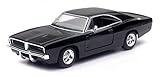
- 1969 Dodge Charger R/T Black 1/25 Diecast Model Car by New Ray 71893 B
- Color: Port Pullover 2/Powder Blue
Visually, the extra ride height and tire volume make the car immediately legible as a film build rather than a concours restoration. Narratively, it demonstrates the series’ willingness to adapt Dom’s signature object to whatever terrain the next mission requires. It ranks above Maximus because the transformation has a clear action purpose, not just an extreme specification.
5. The silver Charger Maximus
Maximus is the most theatrical of the Furious 7 variants. Dodge Mexico describes a silver body, an Italian-leather interior and a V8 with two superchargers. The same brand account states a 2,250-horsepower figure for Maximus and 900 horsepower for the Charger R/T in its film-car narrative. Those numbers should be read as manufacturer editorial claims tied to the movie, not as independent road-test results or certification data.
The silver finish separates Maximus from Dom’s usual black-and-steel visual language, while the interior description gives it a grand-touring character rather than a stripped stunt-car feel. It is memorable precisely because it pushes the Charger toward fantasy. Readers who rank by outrageous specifications could place it second, but a narrative-first rubric leaves it below the cars that carry Dom’s personal history or materially change an action sequence.
Quick wins for a faster PC:
Clear out junk files and repair common Windows errorsFree Scan →Scan for outdated or missing drivers - takes under a minuteDriver Scan →Repair Windows errors before they cause bigger problemsFix Now →6. The 1970 Charger Tantrum
The F9 production information names a 1970 Charger Tantrum among the cars in Dom’s collection. The guide does not provide the same extensive sequence-by-sequence explanation given for the mid-engine build, so its ranking rests on what the name and year add to the garage: another period Charger that reinforces Dom’s taste for classic American muscle.
Rank #4

- GENUINE: Authentically licensed by Universal and Dodge
- ICONIC BRANDING: Attention to detail and expert styling enhances this 2021 Dodge Charger vehicle
- ENHANCEMENTS: Highly detailed sculpt, premium paint detail and custom logos
- HIT THE ROAD: Opening doors, premium rubber tires
- Ages 8+
Tantrum is valuable as world-building. The garage is not limited to one sacred black car; it contains variations on a theme, suggesting restoration knowledge, resources and a family culture built around machines. Its lower rank reflects limited documented action or character function, not a claim that the car is less interesting to enthusiasts.
7. The wide-body 2020 Charger SRT Hellcat
The same production guide identifies a wide-body 2020 Charger SRT Hellcat used in the Central American jungle sequence. It is the clearest bridge between Dom’s classic collection and a modern, factory-developed performance sedan. The wide-body stance gives it visual authority without pretending it is an untouched 1970 car.
Its placement at number seven is about screen emphasis. The guide establishes the model and setting, but the car does not receive the emotional framing of the original, the fabrication spotlight of the mid-engine Charger or the transformation story of the off-road build. For a reader assembling a timeline of Dom’s garage, however, it is essential: it proves that the collection extends into contemporary Chargers.
Do these 3 things before closing this tab:
1Repair Windows errors before they cause bigger problems2Scan for outdated or missing drivers - takes under a minute3Clear out junk files and repair common Windows errorsWhy the Charger’s “horsepower” numbers need labels
Movie-car coverage often repeats very large outputs without explaining what was measured. Dodge Mexico’s 900-horsepower and 2,250-horsepower figures belong to its 2020 account of the film cars, so they should not be compared directly with a production-car brochure or a dynamometer test. Likewise, a stunt car may use a reinforced chassis, a different engine, a replacement transmission or a temporary setup that never appears in a showroom model.
Best Value
The distinction is especially important for the F9 mid-engine Charger. The production information confirms the Hellcat-based concept and unusual engine position, but it does not provide a standardized acceleration, top-speed or lap-time test. The useful fact is the engineering direction, not an invented performance ranking.
How to answer the three questions readers ask most
Which Dodge Charger does Dom drive?
Most often, the answer means the black 1970 Charger R/T from the 2001 film. Across later movies, Dom drives or keeps multiple Chargers, including the F9 mid-engine car, the rebuilt 1327 car, the off-road conversion, Maximus, Tantrum and the 2020 wide-body SRT Hellcat.
What year is Dom Toretto’s Charger?
Its on-screen identity is a 1970 Dodge Charger R/T. The principal screen car’s reported construction used a 1969 base with parts from 1968 and 1970 cars, so “1970” describes the character’s model identity rather than every piece of the stunt fleet.
Which Charger is the best?
For story and recognition, choose the original black R/T. For inventive engineering and action spectacle, choose the F9 mid-engine Charger. Those answers use different criteria; neither changes the other car’s place in the franchise.
Two official extensions of Dom’s Charger legacy
A buildable 1:13-scale model
The LEGO Group and Universal announced a Technic Dom’s Dodge Charger set in 2020 with 1,077 pieces at 1:13 scale for ages 10 and up (LEGO Group announcement). That product is a physical model of the 1970 Charger R/T, not a source for the film cars’ mechanical specifications. Availability, price and current retail stock are not established here, so treat the announcement as a historical reference rather than a buying recommendation.
The Hollywood Drift attraction vehicle
A 2026 Universal Studios Hollywood release describes a Charger-inspired ride vehicle for Fast & Furious: Hollywood Drift as a 900-horsepower 1970 Charger and gives the coaster’s announced maximum speed as 72 mph over 4,100 feet (Universal Studios Hollywood). Those figures describe the themed attraction and its ride vehicle, not a film-used Charger or a production road car. The release is dated 2026, so park availability and operating details can change.
Bottom line: which build belongs at the top?
The black 1970 Charger R/T remains number one because it does four jobs at once: it is instantly recognizable, central to Dom’s family story, visually distinctive and responsible for one of the franchise’s defining action moments. The F9 mid-engine Charger is the essential runner-up for readers who prize audacious fabrication. The other versions matter because they show how filmmakers repeatedly re-purpose one iconic shape—as heirloom, off-road machine, silver fantasy build, garage collection piece and modern performance car—without erasing the original’s place at the center.
Free tools Windows power users keep installed
One-click scans. No signup required.
Quick Recap
Product prices and availability are accurate as of the date/time indicated and are subject to change. Any price and availability information displayed on Amazon at the time of purchase will apply.




