Not directly. Kenworth’s primary result is an up to 136% improvement in freight efficiency versus its 2009 Kenworth T660, not a published 50% reduction in fuel bills. Freight efficiency measures ton-miles per gallon, so converting that result into a fuel-cost percentage would require assumptions about fuel prices, payload, routes and duty cycles that have not been published.
What Kenworth actually demonstrated
Kenworth describes SuperTruck 2 as a Class 8 diesel-hybrid technology demonstrator developed with the U.S. Department of Energy (DOE). In 2024, Kenworth said the truck achieved an up to 136% freight-efficiency improvement over the 2009 Kenworth T660.
As an Amazon Associate I earn from qualifying purchases.
Freight efficiency is calculated in ton-miles per gallon: how much freight can be moved over a distance for each gallon of diesel. It is not the same as a fleet’s fuel bill. A truck’s invoice depends on diesel prices, payload, speed, terrain, weather, traffic, route length, idling and operating practices.
Recommended Free Tools
How to read the 136% figure
A 136% improvement means the tested freight-efficiency result was more than twice the T660 baseline on the stated comparison. It does not mean every operator would spend 136% less on fuel, or that a production tractor would deliver the same result in every duty cycle.
#1 Best Overall

- SCALE MODEL: Precision-crafted 1:68 scale die-cast metal replica of the Kenworth T700 Container Truck in pristine finish
- INTERACTIVE FEATURES: Features openable doors, detachable trailer with functioning trailer doors, and engaging pullback action mechanism
- CONSTRUCTION: Built with die-cast metal body, durable plastic components, and realistic rubber tires for enhanced play value
- DIMENSIONS: Detailed miniature truck designed to match the proportions of the real Kenworth T700 semi-truck and container trailer
- DESIGN DETAILS: Authentic recreation including detailed cab interior, chrome-look accents, and accurate truck and trailer proportions
What the DOE reported across the program
| Measure | Reported result | Qualification |
|---|---|---|
| Kenworth freight efficiency | Up to 136% better | Kenworth Truck Company, 2024; compared with its 2009 T660 |
| Freight efficiency across SuperTruck 2 teams | More than 100% improvement | U.S. Department of Energy, 2024; reported for all participating teams |
| Diesel fuel economy | Some demonstrations exceeded 16 mpg | DOE, 2024; the summary does not state that every truck achieved this result or define one universal duty cycle |
| Engine brake thermal efficiency | More than 52% | DOE, 2024; three teams demonstrated pathways to 55% |
The DOE’s cross-team summary supports a major efficiency advance, but it still does not establish a universal fuel-bill reduction for fleets. The 16-mpg figure applies to some demonstrations, while the freight-efficiency percentages incorporate payload and therefore cannot be treated as ordinary unloaded or lightly loaded mpg.
How SuperTruck 2 improved efficiency
The demonstrator attacked fuel consumption from several directions instead of relying on one larger engine or a single hybrid component.
Diesel power and a mild-hybrid electrical system
Kenworth specified a PACCAR MX-11 engine rated at 440 horsepower, paired with a PACCAR TX-12 automated transmission. A 48-volt electric generator and mild-hybrid system recover and supply electrical energy without turning the truck into a full battery-electric tractor.
Crashes, No Sound, or Screen Glitches?
Random freezes, missing sound and display glitches usually trace back to one bad driver. Find and replace yours safely.Free scan · under a minutePC Slower Than It Used to Be?
A free scan shows the junk files, broken settings and background clutter dragging Windows down - then fixes them in one click.Free scan · Windows 10 & 11Rank #2

- Kenworth Aerodyne Cabover
Next-generation lithium-ion batteries are recharged through regenerative braking. That recovered energy can support electrical loads and reduce the mechanical work demanded from the engine.
Electrified accessories
SuperTruck 2 uses electric fans, steering, coolant pumps and HVAC pumps. This matters because accessories consume power even when the truck is not producing useful wheel torque. Kenworth says the engine fan alone can draw up to 80 horsepower; reducing unnecessary fan operation can therefore cut a substantial parasitic load.
Engine-off hoteling
An overnight engine-off hoteling solution provides cabin functions without leaving the diesel engine running for rest-period comfort. Avoiding extended idling can improve real-world fuel use, although the benefit depends on climate, hoteling duration and how a fleet operates.
Rank #3

- AMT Kenworth Model Kit
Waste heat and aftertreatment work
The project included waste-heat recovery and aftertreatment development. These efforts target energy that normally leaves through the exhaust and the efficiency penalties associated with emissions control. DOE’s reported brake thermal-efficiency results indicate that the SuperTruck 2 teams pushed the engine itself beyond conventional heavy-duty benchmarks.
Quick wins for a faster PC:
Fix the driver behind crashes, sound loss and screen glitchesFind Drivers →Repair Windows errors before they cause bigger problemsFix Now →Aerodynamic improvements
SuperTruck 2 also uses an extensive aerodynamic package. Lower aerodynamic drag is especially valuable at highway speed, where air resistance is a dominant part of a tractor-trailer’s energy demand. The exact benefit varies with speed, trailer configuration, crosswinds and road conditions.
Why “50% lower fuel bills” is an unsafe shorthand
The headline claim confuses an engineering comparison with an operating-cost promise. Even if a truck moves the same payload with fewer gallons, the owner’s bill changes with the price paid for each gallon and with how the truck is loaded and driven.
Rank #4
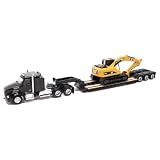
- Diecast Masters | 1:87 Scale Kenworth T880s SBFS 40in-Sleeper Tandem Tractor with Lowboy Trailer and Cat 320D L Hydraulic Excavator | Model 84420
- Payload: ton-miles-per-gallon rewards moving more freight, so two mpg results are not comparable unless payload is also comparable.
- Duty cycle: highway cruising, regional delivery, grades, stop-and-go work and idling stress the powertrain differently.
- Baseline: Kenworth’s headline compares with a 2009 T660, not necessarily with a current production tractor configured for a particular fleet.
- Operating conditions: weather, terrain, traffic, tire pressure, trailer aerodynamics and driver behavior can materially alter consumption.
- Cost inputs: a fuel-cost percentage requires a defined diesel price and a specified time period.
For a fleet business case, compare gallons per route or ton-miles per gallon under the same payload and duty cycle, then apply the fleet’s actual fuel price. Add maintenance, battery and electrical-system costs before calculating total cost of ownership.
How SuperTruck 2 compares with a conventional tractor
| Comparison area | SuperTruck 2 | What a fair conventional-tractor comparison requires |
|---|---|---|
| Powertrain | 440-hp PACCAR MX-11, TX-12 automated transmission, 48-volt mild hybrid | Same payload, route, speed profile and emissions configuration |
| Energy recovery | Regenerative braking with lithium-ion batteries | Whether the reference truck has any hybrid or regenerative system |
| Accessories | Electrified fan, steering, coolant and HVAC pumps | Accessory loads and control strategy on the reference tractor |
| Hotel load | Engine-off overnight hoteling solution | Idling policy and auxiliary-power equipment |
| Aerodynamics | Extensive next-generation aerodynamic improvements | Matched tractor, trailer, fairings and operating speed |
| Efficiency metric | Up to 136% freight-efficiency improvement versus 2009 T660 | Identical test method and duty cycle |
| Commercial status | Research demonstrator | Retail production availability and support terms |
Is the Kenworth SuperTruck 2 for sale?
Available documentation identifies SuperTruck 2 as a research demonstrator, not a regular Kenworth production model offered through dealers. There is no basis to assume that a truck with this exact specification, its complete aerodynamic package or its full hybrid and hoteling system can be ordered by the public.
Some technologies may influence future PACCAR or Kenworth products, but a fleet should verify production specifications, emissions certification, warranty coverage, serviceability and delivery dates with Kenworth before treating any feature as commercially available.
Best Value

- 1/50 Scale Model Truck: The model truck is a 1/50 scale diecast truck replica of the popular Kenworth W900 semi-truck used for long-haul transportation; Size: 34.9× 4.8× 7.5 cm (13.74 × 1.89 × 2.95 Inc),Product Weight: 540g
- Collectible: The Kenworth W900 diecast truck with container trailer is a collectible item that is perfect for truck enthusiasts or for anyone who loves to collect scale model vehicles
- High Quality: The semi truck body is made of die-cast alloy metal truck, tires and simulated details on the bottom are made of plastic
- Exquisitely Paintwork: The exquisite contrasting colors add a touch of sophistication to the antique car model series, The parts of the semi-trailer truck model have printed coatings to ensure a high degree of reproduction of the transport truck model toy
- Great Gift Toys: This figure makes a great collectible gift for adults and children; This is a car collection model that can be used as a Children's Day gift for model toy lovers
Why the project matters beyond one truck
DOE says trucks haul about 80% of U.S. goods and consume roughly 28 billion gallons of fuel annually, representing approximately 22% of transportation energy use (DOE, 2016). That scale explains the value of demonstrating efficiency gains in a Class 8 tractor: even incremental improvements can matter across long-haul fleets.
The program also shows why heavy-truck efficiency is a systems problem. Engine thermal efficiency, accessory loads, regenerative braking, hoteling, aftertreatment and aerodynamics must work together. A single component’s laboratory result cannot predict a fleet’s complete fuel bill.
What to ask before applying the results to a fleet
- What payload and trailer configuration were used for the comparison?
- Was the result reported as mpg, ton-miles per gallon or another test metric?
- Which baseline tractor, engine calibration and emissions configuration were used?
- How much of the route was highway, grade, urban or idling operation?
- Are the hybrid, accessory, hoteling and aerodynamic systems certified and supported for production use?
- What are the purchase, maintenance, battery-replacement and downtime costs?
The Bottom Line
Kenworth SuperTruck 2 delivered a documented up to 136% freight-efficiency improvement over a 2009 T660, and DOE reported more than 100% improvement for every SuperTruck 2 team, with some demonstrations above 16 diesel mpg. Those are significant technology-demonstration results, but they do not prove that owners cut fuel bills in half.
Do these 3 things before closing this tab:
1Repair Windows errors before they cause bigger problems2Fix the driver behind crashes, sound loss and screen glitches3Clear out junk files and repair common Windows errorsQuick Recap
Product prices and availability are accurate as of the date/time indicated and are subject to change. Any price and availability information displayed on Amazon at the time of purchase will apply.




