Possibly—but methanol-fueled cars would not be emissionless. Their climate impact depends chiefly on how the methanol is made, how it powers the vehicle, and which lifecycle emissions are counted. Methanol made from fossil fuels can carry substantial production emissions; a low-carbon route may reduce them, but results from particular studies are not universal guarantees.
What does “methanol-fueled car” mean?
The phrase covers different powertrains, not one standard type of car. Methanol can be burned in an internal-combustion engine, used directly in a direct methanol fuel cell, or converted into hydrogen that then feeds a hydrogen fuel cell. Those pathways have different equipment and emissions profiles.
Combustion engine
A combustion car burns methanol to produce power. It has tailpipe emissions; the available lifecycle figures discussed below do not establish an emissions reduction for this type of methanol car.
Direct methanol fuel cell
A direct methanol fuel cell (DMFC) uses methanol, usually mixed with water, at the cell’s anode. The U.S. Department of Energy says DMFCs are often used in portable applications such as phones and laptops. That does not establish that consumer passenger cars using them are commercially available.
PC Slower Than It Used to Be?
A free scan shows the junk files, broken settings and background clutter dragging Windows down - then fixes them in one click.Free scan · Windows 10 & 11Crashes, No Sound, or Screen Glitches?
Random freezes, missing sound and display glitches usually trace back to one bad driver. Find and replace yours safely.Free scan · under a minute#1 Best Overall

- Product Name: Model Car Methanol Engine Tank
- Material: Stainless Steel
- Capacity: 250ML
- Product Size: 100x50x50MM
Methanol converted to hydrogen
In this pathway, methanol is reformed into hydrogen, which powers a hydrogen fuel cell. The DOE’s historical analysis considered methanol converted to hydrogen at a refueling site as well as direct methanol fuel cells. Methanol is a liquid and can be easier to transport and supply than hydrogen gas, according to the DOE, but that logistical advantage does not determine whether the fuel is low-carbon. DOE: Direct Methanol Fuel Cells
Why “emissionless” is too strong
A vehicle can have low or no emissions at the point of use and still be responsible for emissions from making and delivering its fuel. A well-to-wheel assessment covers fuel production, processing, distribution, and use. A cradle-to-grave assessment also includes vehicle production and end of life. The boundary matters when comparing claims. U.S. Department of Energy: Emissions from Electric Vehicles
For methanol, the production route is especially important. Methanol can be made from fossil natural gas or coal, or through routes using biomass or captured CO2. The feedstock alone is not enough to establish the result: the energy and processes used to convert it matter too. A car using methanol therefore cannot be called clean or emissionless without specifying both its powertrain and the fuel’s source.
What the lifecycle studies actually found
Two reported figures illustrate why the conditions behind a result matter. They use different pathways, models, boundaries, and comparison settings, so they should not be read as directly comparable estimates.
What’s actually slowing this PC down?
Pick the symptom - the matching free tool is one click away.
Rank #3
- Product Name: Model Car Methanol Engine Tank
- Material: Stainless Steel
- Capacity: 250ML
| Evidence | What was compared | Reported result and limits |
|---|---|---|
| U.S. Department of Energy program record, January 8, 2016 | Natural-gas-to-methanol pathways—methanol reformed to hydrogen for a fuel-cell vehicle, and methanol used in a direct methanol fuel-cell vehicle—against a model-year-2010 midsize gasoline car rated at 25 mpg. | Estimated 30–35% lower well-to-wheels greenhouse-gas emissions for the named pathways. The record used a modified 2014 GREET model; this is a historical modeled estimate, not a finding for methanol combustion cars or today’s renewable methanol. DOE program record |
| Applied Energy study, 2024 | A modeled CO2-to-methanol vehicle and a gasoline vehicle in the study’s China context. | The abstract reports 24% lower lifecycle CO2 for the modeled CO2-to-methanol vehicle. It also reports significant lifecycle impacts for conventional coal-to-methanol vehicles due to the production process. This is scenario-specific, not a universal real-world guarantee. Applied Energy study abstract |
The DOE estimate is not an estimate for a CO2-derived fuel, and the 2024 study’s percentage should not be applied to all methanol cars. For any comparison, check the feedstock and production energy, vehicle pathway, geography, date, gasoline or other baseline, and lifecycle boundary.
What would make methanol a lower-carbon option?
- A lower-carbon production route: Fuel made using captured CO2 or biomass may have a different lifecycle profile from fuel made from coal or natural gas. The label “green methanol” alone does not supply a quantified emissions result.
- Energy used in production: Converting feedstocks into methanol requires energy. Its source and the production process affect the fuel’s lifecycle footprint.
- A clearly identified vehicle and boundary: A result for a hydrogen fuel-cell car using reformed methanol does not automatically apply to a DMFC or a combustion engine. Tailpipe, well-to-wheel, and cradle-to-grave results answer different questions.
- A relevant comparison: A percentage reduction is meaningful only alongside its baseline, geography, assumptions, and study date.
Are methanol passenger cars available today?
The sources cited here establish that methanol fuel-cell pathways have been analyzed and that DMFCs are used in portable applications. They do not establish current passenger-car models, country-level deployment, refueling-network availability, or suitable conversion kits. Those details should be checked for a particular country and vehicle rather than inferred from modeled lifecycle benefits.
Quick Recap
Best Value
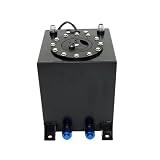
- 0-90 Ohm Fuel Sender
- Quick Release Fuel Cap
- Tank measures 8" (L) x 8.25" (W) x 10" (H)
- Fuel Tank and Cap made with high grade aluminum for extra protection
- Not for use with alcohol, methanol, water Inspect foam for deterioration regularly. Inlet and Outlet Diameter 10 AN
Rank #4

- Color: Black fuel tank
- Material: Metal
- Recommend Age: 12+y
- Tool Supplies: Painted
Product prices and availability are accurate as of the date/time indicated and are subject to change. Any price and availability information displayed on Amazon at the time of purchase will apply.




