The Tool Desk
Outbyte Driver Updater FREEScan for outdated or missing drivers - takes under a minuteDriver Scan →Outbyte PC Repair FREEClear out junk files and repair common Windows errorsFree Scan →Colored lines on a new tire and the raised bars molded into its grooves are different things. Paint-like colored stripes are temporary factory identification or compound markings; they do not measure tread depth. Tread-wear indicators are permanent rubber bridges at the bottoms of the main grooves. When the surrounding tread becomes level with those bridges, about 2/32 inch (1.6 mm) remains and the tire should be replaced.
The short answer: stripes are markings, bars are safety indicators
A thin red, blue, yellow, green, or other colored line running around the tread is usually applied during tire manufacturing to identify a production batch, compound, position, or handling characteristic. The line sits on the tread surface and normally fades or wears away as the tire is driven. Manufacturers do not publish one universal color code, so the color cannot reliably tell you a tire’s age, condition, intended position, or remaining tread.
As an Amazon Associate I earn from qualifying purchases.
Tread-wear indicators, also called wear bars or tread-depth indicators, are raised sections of rubber molded into the bottom of the tire’s main grooves. They are part of the tread design, not paint. As the tread blocks wear, the bars become easier to see. Once a bar is flush with the adjacent tread surface, the tire has reached the minimum commonly specified tread depth of 2/32 inch (1.6 mm).
Do these 3 things before closing this tab:
1Fix the driver behind crashes, sound loss and screen glitches2Clear out junk files and repair common Windows errors3Scan for outdated or missing drivers - takes under a minuteThe National Highway Traffic Safety Administration (NHTSA) says tires should be replaced when tread is worn to 2/32 inch. The National Institute of Standards and Technology (NIST) defines the molded indicator bands as 2/32 inch above the bottom of the main grooves. Michelin describes the practical visual test this way: when tread is level with the wear indicator, the tire has reached its minimum tread-depth level.
#1 Best Overall

- 1.Accurate and Efficient: Different colors on the bar represents different scopes, the red range on bar: 0 - 3/ 32; Yellow range on bar: 3/ 32 - 6/ 32; Green range on bar: 6/ 32 - 32/ 32, allowing you easy and fast to read and calibrated
- 2.Reusable:Tire tread gauge is made of sturdy material, reusable and long lasting, which is an efficient tool to moenitor tire tread levels, make driving safer
- 3.Convenient:Tire tread Depth gauge measures approx 3.35 x 1.06 inch, small size, also features a pocket clip for easy carrying, you can clip it on your pocket, ideal for quick and convenient getting and using
- 4.Simple to use :Place the black flat edge of the tire tread gauge on both sides of the tire tread, press down the color bar until it reaches the bottom of the tread groove, and read the depth measurement on the indicator bar.
- 5.Easy to read: There are 3 different color codes of areas on the bar that add simplicity and convenience, which show you a clear result of your tyre condition, really easy to read, giving you a fast and accurate measurement to tread depth, smart, high efficiency
How to tell the two markings apart
| Clue | Colored tread stripe | Tread-wear indicator |
|---|---|---|
| Location | On the outer surface of the tread, often running circumferentially around the tire | Across the bottom of the main tread grooves |
| Construction | Applied surface marking associated with factory identification or compound handling | Molded rubber bridge that is part of the tire |
| Persistence | Usually disappears with normal driving and abrasion | Remains in the groove and becomes prominent as tread wears |
| Measurement value | None; color and visibility do not indicate remaining tread depth | Yes; a flush bar corresponds to approximately 2/32 inch (1.6 mm) remaining tread |
| What to do | Ignore its disappearance when assessing safety | Arrange replacement when the surrounding tread reaches the bar |
A stripe is normally a narrow, paint-like line that can be rubbed, scuffed, or worn off. A wear bar looks like a solid rectangular ridge crossing a groove. It has the same rubber appearance as the tire and is located down inside the channel rather than painted on top of a tread block.
Why new tires have colored lines
Tire plants handle large numbers of similar-looking products. Surface stripes can help workers identify a compound, size family, construction, mold setup, or intended production position while a tire moves through manufacturing, inspection, storage, and installation. The exact purpose differs by manufacturer and factory, and there is no authoritative industry-wide chart that lets a driver decode every color.
Because the line is a manufacturing aid rather than a service measurement, it can disappear soon after installation. Road abrasion, cornering, braking, and normal contact with the pavement remove the exposed marking. A stripe that fades does not prove that a tire is worn out, and a stripe that remains does not prove that the tire is new, safe, or unused.
Crashes, No Sound, or Screen Glitches?
Random freezes, missing sound and display glitches usually trace back to one bad driver. Find and replace yours safely.Free scan · under a minuteWindows Errors? Fix Them Before They Spread
Repair common Windows errors and clear accumulated junk for a smoother, more stable PC - no reinstall needed.Free scan · no reinstallDo stripes mean a tire is used?
No. A colored line is not evidence that a tire has been driven, retreaded, or previously mounted. It is also not proof that a tire is new: markings can vary in visibility, and some tires may have no obvious stripe. Determine serviceability from tread depth, damage, age information, and wear pattern instead.
Rank #2

- Accurate and precise tire tread depth readings in 1/32 inch increments (1/128 inch resolution)
- Durable dial type gauge with easy-to-read 32nds scale (max. tread depth 14/32 inch)
- Color coded scale shows true tire health - safe range (green), showing wear (yellow), or needs replacement (red)
- Calibrated to meet or exceed industry standards for precise accuracy of tire tread depth (+/- 0.25%)
- Rugged, convenient, and compact design for easy storage with included leather pouch
What tread-wear indicators look like
Look into the large, longitudinal grooves that separate the main tread ribs. At several points around each groove, you should find a small rubber bridge spanning from one side of the groove to the other. These bridges are lower than a new tread block, so they may be hard to notice on a fresh tire. A flashlight and a clean tread surface make them easier to locate.
As the tread wears, the groove becomes shallower while the bridge stays at its molded height. The bridge then appears as a solid band across the groove. When the adjacent tread is level with the band, there is approximately 2/32 inch (1.6 mm) of tread left at that location. NHTSA’s technical procedure describes worn indicators as solid bands across the tread surface at a remaining depth of 1.6 mm plus or minus 0.38 mm.
Sidewall marks help you find the bars
Many tires have a small triangle, the letters “TWI,” or another molded symbol on the sidewall. The mark points toward a wear bar in the nearby groove. It is only a locator. The sidewall symbol itself is not the 2/32-inch threshold and should not be interpreted as a separate wear measurement.
How to inspect tire tread correctly
Inspect more than the place where a colored line happens to be. Tread can wear unevenly from alignment problems, incorrect inflation, suspension faults, overloading, or driving conditions. NHTSA recommends checking tires at least monthly and before long trips.
Rank #3

- 1. Accurately measures tire tread depth gauge, Calibrated from 0 to 1 inch in 1/32 inch
- 2. Color coded tire tread depth gauge clearly indicates the tire different phase by colors
- 3. Tire tread depth gauge of Red range on bar: 0-3/32; Yellow Range on bar: 3/32 - 6/32; 5. Green Range on bar: 6/32-32/32
- 4. Comes with a pocket clip, easy to carry a tire tread depth gauge
- 5. Tire tread depth gauge reads in 32nds Suitable for trucks, motorcycles, automobiles and any passenger vehicle
- Park safely. Stop on level ground, select the parking brake, and turn the steering wheel as needed to see the front tires. If you must raise a vehicle, use the manufacturer’s approved lifting points and support it with stands; never rely on a jack alone.
- Clean and illuminate the tread. Remove stones and mud from the main grooves. Use a flashlight so a dark groove does not hide a bar, crack, or exposed cord.
- Find the wear bars. Follow each major groove around the tire and locate multiple bridges. Use the sidewall triangle or “TWI” mark if present.
- Compare the bridge with the surrounding tread. If any wear bar is flush with the adjacent tread, treat that tire as having reached the replacement threshold. Do not wait for every groove or every block to be level.
- Check several points around the circumference. Measure or visually compare the inner, center, and outer portions of the tread. One area can be legal-looking while another is already worn out.
- Inspect both sides of every tire. The inside shoulder is easy to miss, especially on vehicles with alignment or suspension problems. Turn the steering wheel or have a shop inspect the inner side if it cannot be seen safely.
- Look for non-tread hazards. Cracks, cuts, bulges, punctures, exposed cords, separation, and severe uneven wear can require immediate service even when the tread is above 2/32 inch.
Using a tread-depth gauge
A tread-depth gauge gives a numeric reading in 32nds of an inch or millimeters and is more dependable than judging a stripe’s color or disappearance. A basic gauge is inexpensive and can be kept in the vehicle or toolbox.
- Set the gauge’s measuring foot on the tread block and place the probe in the groove, not on top of a wear bar.
- Take readings in the major grooves at the center and both shoulders of the tread.
- Repeat at several points around the tire, including areas that look different or show shoulder wear.
- Record the smallest reading for each tire. Compare the result with the 2/32-inch (1.6 mm) replacement threshold and with the vehicle or tire maker’s instructions.
- If readings vary substantially across the tread, have alignment, inflation, suspension, and wheel-balance conditions checked. Uneven wear can reduce wet-weather performance before the lowest point reaches the legal minimum.
Do not place the probe on a molded wear bar, because that produces a misleadingly shallow reading. Likewise, do not measure only the groove beside a colored stripe; the stripe has no measurement function.
What the 2/32-inch rule means
The 2/32-inch (1.6 mm) figure is the replacement point identified in current NHTSA TireWise guidance. It is also the height used for molded indicator bands in NIST’s glossary. At that point, the tire has very little tread depth available to evacuate water, and the visible wear bar provides a clear warning that service life is finished.
What’s actually slowing this PC down?
Pick the symptom - the matching free tool is one click away.
The number is not a promise that a tire performs equally well until the instant it reaches the bar. Wet grip, snow traction, ride, noise, and resistance to hydroplaning can decline progressively as tread wears. A driver may reasonably replace earlier when local regulations, the vehicle maker, a tire maker, fleet policy, climate, or personal risk tolerance calls for more remaining tread.
Rank #4
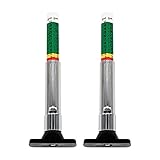
- Accurate measures tire tread depth gauge tool
- Calibrated from 0 to 1 inch in 1/ 32 inch
- Red range on bar: 0-3/32; Yellow Range on bar: 3/32 - 6/32; 5. Green Range on bar: 6/32-32/32
- Pocket-sized gauge, easy handy
- 2 pack
Legal limits can differ by jurisdiction and vehicle category. Confirm the rule that applies where the vehicle is registered and operated; do not assume that the NHTSA guidance is the legal standard in every country or state.
Damage that overrides a tread-depth reading
A tire can have more than 2/32 inch of tread and still be unsafe. Stop using the tire and obtain professional advice promptly when you find:
- Sidewall bulges, blisters, or deformation, which can indicate internal structural damage.
- Deep cuts, punctures in an unrepaired area, or objects that have penetrated the casing.
- Visible cords, belts, or fabric.
- Cracks in the sidewall or between tread blocks, including weather-checking that is spreading.
- Tread separation, lifted rubber, or a repeating thumping sensation.
- Severe cupping, one-sided shoulder wear, scalloping, or other patterns that suggest a mechanical or inflation problem.
Do not attempt to solve structural damage by adding air or by comparing the tire with a colored stripe. A qualified tire technician can determine whether a repair is permitted and whether the underlying wheel, alignment, or suspension needs attention.
Recommended Free Tools
Common misunderstandings about colored stripes
“The stripe is a wear warning.”
It is not. Wear warnings are the molded bridges in the grooves. A stripe may be gone while the tire is nearly new, or remain visible while the tire has serious damage or inadequate tread.
Best Value

- 1. Accurately measures tire tread depth gauge tool, Calibrated from 0 to 1 inch in 1/32 inch
- 2. Color coded tire tread depth gauge tool clearly indicates the tire different phase by colors
- 3. Tire tread depth gauge of Red range on bar: 0-3/32; Yellow Range on bar: 3/32 - 6/32; 5. Green Range on bar: 6/32-32/32
- 4. Comes with a pocket clip, easy to carry a tire tread depth gauge tool
- 5. Tire tread depth gauge tool reads in 32nds Suitable for trucks, motorcycles, automobiles and any passenger vehicle
“Different colors tell me which tire goes on each corner.”
There is no universal color standard supporting that conclusion. Use the vehicle’s tire-size, load, speed, rotation, and installation instructions instead.
“A stripe that has not worn off proves the tire has low mileage.”
Visibility depends on the marking, the tire compound, road surface, driving style, and how much of the tread has contacted the road. It is not a mileage gauge.
“The sidewall triangle is the wear limit.”
The triangle or “TWI” lettering is a locator for the bar. Judge the limit at the bar itself, where the adjacent tread becomes level with it.
When to replace one tire or a set
Replace a tire when a wear bar is flush with the tread, when a tread-depth measurement reaches 2/32 inch (1.6 mm), or when damage makes the tire unsafe. If only one tire is damaged, the correct replacement strategy depends on the vehicle’s drivetrain, tire-size requirements, remaining tread on the other tires, and the tire manufacturer’s guidance.
Replacing tires in pairs on the same axle is often considered to keep handling balanced, but the vehicle and tire maker’s instructions take priority. All-wheel-drive vehicles can have strict circumference or tread-depth matching requirements. A tire shop should measure every tire and explain whether a single replacement, axle pair, or complete set is appropriate.
Practical monthly checklist
- Check pressure with a reliable gauge when the tires are cold, following the pressure on the vehicle’s door-jamb label or owner’s manual rather than the maximum molded on the sidewall.
- Walk around the vehicle and look for bulges, cuts, cracks, punctures, and objects lodged in grooves.
- Inspect several main grooves for molded wear bars and compare the inner, center, and outer tread.
- Use a tread-depth gauge at multiple points and record the lowest reading.
- Look for uneven wear that could indicate alignment, inflation, wheel, or suspension faults.
- Arrange professional inspection if a bar is flush, a reading is at 2/32 inch (1.6 mm), damage is visible, or the pattern changes suddenly.
Bottom line for drivers
Colored tread stripes are temporary factory markings with no standardized safety meaning. Tread-wear indicators are molded rubber bridges in the groove bottoms and provide the visual replacement signal. Ignore the stripe when judging tire condition: inspect the bars, measure several locations with a tread-depth gauge, and replace at the 2/32-inch (1.6 mm) threshold or sooner if damage, age, uneven wear, climate, or local requirements call for it.
Quick Recap
Product prices and availability are accurate as of the date/time indicated and are subject to change. Any price and availability information displayed on Amazon at the time of purchase will apply.




