Quick wins for a faster PC:
Repair Windows errors before they cause bigger problemsFix Now →Fix the driver behind crashes, sound loss and screen glitchesFind Drivers →Chrysler’s turbine car was a real, drivable research vehicle—not a styling mock-up—but it never became a production model. The company built five prototypes and 50 cars for a consumer evaluation program, which put turbine power in drivers’ hands while Chrysler studied service needs and market reaction. The test showed that a turbine car could operate on public roads; it did not show that the engine was ready to be built, certified, and sold at a competitive scale.
What Chrysler built—and why
The full program comprised 55 cars: five prototypes and a 50-car evaluation fleet. The National Museum of Transportation says the bodies were handmade by Ghia in Italy and shipped to the United States for engine installation. Its collection identifies its own car as a 1963 example.
Chrysler’s 1962 announcement spoke of a planned limited run of 50 to 75 cars for selected customers, conditional on evaluating consumer reaction and manufacturing feasibility. What followed was not a retail launch. The 50 similar cars were used in a no-charge research program intended to gather driver experience, service information, and reactions to turbine power.
Chrysler’s 1966 history says 203 motorists received cars on a rotating basis. The user periods ran from October 29, 1963, to October 28, 1965; the last user completed a three-month period on January 28, 1966. That scale made the program a substantial public-use experiment, but it does not establish that participants represented every American driver or shared one opinion.
#1 Best Overall

- Modern American Luxury Muscle – Build the premium 2005 Chrysler 300C with this detailed 1:25 scale kit—perfect for experienced modelers.
- Authentic 5.7L V8 HEMI Engine – Features a fully detailed engine and realistic 9-spoke wheels for an accurate recreation of the iconic sedan.
- Interior & Exterior Details – Includes detailed interior components, chrome-plated parts, clear and transparent red pieces, and vinyl tires.
- All-New Decal Sheet – Customize your build with a fresh set of water-slide decals, designed just for this kit.
- Display-Worthy Build – Finished model measures 8 inches long; comes in classic AMT packaging with 109 parts to bring it to life.
How the turbine engine worked
The car used a regenerative gas turbine. A compressor fed air into the engine, and combustion drove two independent turbine wheels: one powered the compressor and accessories, while the other delivered power to the car. Two rotating heat exchangers, called regenerators, captured heat from the exhaust and returned it to incoming air. Recovering that heat improved efficiency over a turbine that simply discarded it and reduced exhaust temperature.
The turbine was connected to a modified TorqueFlite three-speed automatic transmission. Chrysler technical material gave the complete turbine package a rating of 130 horsepower at 3,600 rpm output-shaft speed and 425 lb-ft of torque at zero output-shaft speed under specified ambient conditions. Those figures included the transmission and accessories, unlike the conventional engine rating basis described in the same material; they should not be compared directly with a piston engine’s standard horsepower rating.
Rank #2
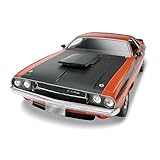
- Choice of two versions - factory stock or street machine with dual 4-barrel high-rise intake
- Optional custom hood and high rise dual four barrel intake, rear spoiler, colorful custom graphics, and centerline wheels
- Highly detailed interior, chrome plated parts, and black vinyl tires
- Revell skill level 4 model kit #85-2596
- Illustrated assembly instructions. Requires paint and glue. (not included)
What the car promised—and what the figures mean
Chrysler promoted smooth operation, fewer moving parts than a reciprocating engine, and the ability to burn a range of liquid fuels. Its 1962 announcement said the engine could use combustible liquids that flowed through a pipe, naming gasoline, kerosene, alcohol, and furnace oil among them. That was a period company claim about fuel flexibility, not evidence that every fuel produced equal performance, economy, emissions, or suitability.
The same announcement reported an average of 17¼ miles per gallon for earlier turbine cars in controlled testing that ranged from city driving to 80 mph. Chrysler described extended drives with an overall road speed around 52 mph. This is a company test claim for earlier cars—not a verified economy figure for every car in the later 50-car program, nor a directly comparable modern fuel-economy result.
What’s actually slowing this PC down?
Pick the symptom - the matching free tool is one click away.
Rank #3

- 【F35 Fighter Jet Engine Model Kit】: This F35 engine block set realistically reproduces the structure and operation of an F35 fighter jet engine. With 3-bearing swivel duct, exhaust pipe, nozzle, rotating turbine, beautifully crafted stickers. Perfectly constructed lifelike mechanical engine models, showing the beauty of real military engineering.
- 【Interactive Features】: The F35 engine's nozzle rear section can be expanded and narrowed, high-speed turbine can be rotated by motor, some parts can be disassembled to clearly see the internal multi-gear linkage mechanism. Perfectly replicates the jet engine mechanics and operation of the F35 fighter jet.
- 【Precision Craftsmanship】: This F35 engine building sets consists of 1,812 bricks for a longer building experience. Each part is smoothly and precisely crafted with metallic paintwork and comes with detailed illustrated step-by-step instructions to make this F35 jet engine model perfect to build.
- 【Space Decorations】 this F35 engine buiding block sets for adults measures 9.25*27.16*14.56 inches after assembled, which can be perfectly displayed in any space such as desks and shelves at home or office collection. It is an attention-grabbing choice for military enthusiasts and collectors.
- 【Ideal Gift】 This F35 engine building toy combines creativity, engineering and hands-on fun, making it an ideal gift for adults. Whether it's a birthday, Valentine's Day, Christmas or Thanksgiving, it's the perfect gift for military, fighter, engine and technical modeling enthusiasts.
Why it did not become a production car
No single cause is established as the decisive reason Chrysler did not put the turbine car into production. The evidence points to several connected obstacles: efficiency, emissions, acceleration response, and the distance between a small evaluation fleet and a manufacturable consumer product.
Efficiency and emissions
The Smithsonian’s account identifies poor fuel efficiency and high emissions among the barriers to mass production. This does not invalidate Chrysler’s 17¼-mpg period figure: that figure concerned earlier cars under controlled test conditions, while the Smithsonian is assessing the turbine’s broader production prospects. The claims describe different contexts and should not be treated as a head-to-head test.
Rank #4
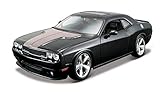
- These highly detailed kits come with everything you need to build them including the screwdriver
- Opening parts and rolling Wheels
- Easy assembly, pre-painted metal body
- When finished the vehicles are fully functional
- Rolling die-cast replica
Acceleration lag
The Smithsonian also points to peculiar acceleration lag. A turbine’s smooth running and unusual power delivery were engineering attractions, but responsiveness in ordinary driving mattered too. A car could function on public roads without delivering the familiar, immediate response buyers expected from a mass-market automobile.
Manufacturing readiness
Chrysler engineer George J. Huebner Jr. wrote in a 1966 technical summary: “The turbine engine for the 50 cars was not considered to be a final production design.” He also noted that the limited run relied on tool-room methods rather than production-plant processes. The fleet therefore tested a working concept and possible route toward production; it was not proof of mature manufacturing costs or a production-ready engine.
Best Value

- The most innovative modeling company in the industry. We engineer and produce a variety of kits from classic cars to giant space ships.
- Our die cast models are next level – when it comes to detail we are the best in the collectible business
- Racing is in our company DNA, our slot car brands and themes keep creativity racing around this retro hobby
- The newest hobby to our line up. Our detailed pieces bring your train layouts to life.
- South Bend, IN
These limits matter when interpreting the outcome. The cars were more than a publicity exercise, but the program did not establish that Chrysler could build and support turbine-powered cars economically at scale. The available accounts identify technical and manufacturing challenges without documenting one definitive internal decision memorandum or a complete sequence of corporate decisions.
Independent reader supportYour contribution helps us test, update, and keep practical guides available for everyone.What the public-use experiment established
Chrysler’s stated objective was to test driver and market reaction while collecting service data and experience under varied geographic conditions. J.M. Sturm, Chrysler’s Plymouth product-planning manager and chief engineer, described that aim in remarks prepared for a 1965 user-car delivery. The program put the cars into real use for a rotating group of motorists; it did not produce a complete public dataset establishing universal satisfaction or a single verdict from drivers.
Its lasting significance is therefore two-sided: Chrysler demonstrated that a turbine-powered automobile could be driven by ordinary users, while the fleet also exposed the gap between a technically functioning vehicle and one ready for mass-market manufacture and sale.
Where to see one today
The National Museum of Transportation describes its Chrysler Turbine Car as the only operational example on public display. That is the museum’s own exhibit claim, and display status can change. Check the museum’s current visit information before making a trip.
Quick Recap
Product prices and availability are accurate as of the date/time indicated and are subject to change. Any price and availability information displayed on Amazon at the time of purchase will apply.




