Quick wins for a faster PC:
Scan for outdated or missing drivers - takes under a minuteDriver Scan →Clear out junk files and repair common Windows errorsFree Scan →China is making autonomous vehicles a national industrial and infrastructure priority, but it is not simply removing the rules that stand between testing and widespread driverless operation. Beijing is combining national admission pilots, city demonstration zones, connected-road construction, domestic technology support, technical standards, data requirements, remote supervision, and increasingly strict safety reviews.
The clearest description is that China is all in on building and deploying autonomous-vehicle capability—especially robotaxis, freight vehicles, and smart-city services—while keeping operation inside approved locations, conditions, and safety frameworks.
As an Amazon Associate I earn from qualifying purchases.
China’s autonomous-vehicle strategy is bigger than robotaxis
China’s government is not treating autonomous driving as merely a feature that private car companies may eventually add to their vehicles. It is trying to build the institutional system around the technology: testing permissions, vehicle access rules, intelligent roads, vehicle-to-everything communications, data governance, cybersecurity, safety evaluation, manufacturing standards, and international regulation.
The Tool Desk
Outbyte Driver Updater FREEScan for outdated or missing drivers - takes under a minuteDriver Scan →Outbyte PC Repair FREERepair Windows errors before they cause bigger problemsFix Now →That distinction explains both sides of the story. China has created one of the world’s most coordinated environments for testing and commercializing autonomous vehicles. At the same time, a robotaxi operating in one approved district is not evidence that privately owned cars can drive themselves anywhere in the country.
#1 Best Overall

- for Universal Hobbies for FIAT for Centenario for Concept for New Holland Autonomous Agricultural Tractor Red 1:32 Truck Pre-built Model
- Size in INCHES: Length: 6.24, Width: 3.12
- Material: DIECAST
China’s 2023 intelligent-connected-vehicle framework created national admission and road-operation pilots for vehicles equipped with Level 3 conditional automation and Level 4 high automation. The program is jointly administered by the Ministry of Industry and Information Technology, the Ministry of Public Security, the Ministry of Housing and Urban-Rural Development, and the Ministry of Transport. It is intended to move beyond closed-course demonstrations toward limited real-world operation, but within designated areas and subject to approval requirements.[C001]
An earlier national standards guide set a staged objective: establish by 2025 a standards system supporting combined driving assistance and automated driving, then develop a more comprehensive system by 2030. It also positioned intelligent-connected vehicles as part of a broader system joining automobiles, communications, smart cities, infrastructure, cybersecurity, and data.[C002]
In other words, the policy objective is not just “put more autonomous cars on the road.” It is to make the roads, communications networks, manufacturers, software, regulators, and operating companies work together well enough for automated mobility to become an industrial capability.
What the driving levels mean
Much of the confusion around China’s progress comes from treating every advanced driver-assistance feature as “self-driving.” The automation level and the operating conditions matter.
| Level | What the system does | What it does not mean |
|---|---|---|
| Level 2 | Controls steering and speed together in some situations while assisting the driver. | The driver remains responsible for monitoring the road and taking control. |
| Level 3 | Can handle the driving task within defined conditions, with a human expected to respond to a takeover request. | It is not unrestricted automation and still depends on a defined operating domain. |
| Level 4 | Can operate without a human driving the vehicle within a specified operating domain. | It does not mean the vehicle can operate autonomously on every road, in every type of weather, or in every city. |
| Level 5 | Would operate without human control in all normal driving conditions. | Commercial robotaxi pilots should not be described as Level 5 simply because there is no onboard safety driver. |
Some services may be fully driverless in their approved area; others may use an onboard safety operator, remote supervision, or both. The relevant question is not only whether a person is sitting behind the wheel. It is the service’s permitted operating design domain: its roads, speed limits, weather conditions, vehicle type, supervision arrangement, and emergency procedures.
The policy stack: how China is creating an AV ecosystem
1. National pilots create a route from testing to operation
China’s national framework is important because it addresses a problem that can stop autonomous driving from scaling: a company may have a technically capable vehicle but no clear legal route to put it into limited commercial or public operation.
The 2023 admission and road-operation pilots provide that route for qualifying Level 3 and Level 4 vehicles. They do not amount to a nationwide driverless license. Instead, they create a controlled process in which vehicles, manufacturers, operators, and local authorities can demonstrate capability under specified conditions.[C001]
Do these 3 things before closing this tab:
1Scan for outdated or missing drivers - takes under a minute2Clear out junk files and repair common Windows errors3Fix the driver behind crashes, sound loss and screen glitches2. Standards turn broad policy into technical requirements
The standards agenda covers more than sensor performance. China’s planning includes test scenarios, simulation testing, sensor fusion, vehicle software, data security, artificial-intelligence safety, and the interaction between the vehicle and its environment.[C013]
This matters because a national standard can influence what automakers build, what suppliers must provide, how vehicles are tested, what data must be retained, and how regulators assess failures. It also gives domestic companies a common technical and compliance environment as they move from pilot fleets toward mass production.
3. Cities provide the roads and the operating laboratories
National policy alone cannot test a robotaxi in real traffic. Municipal governments must designate roads, prepare infrastructure, coordinate police and transport authorities, establish application procedures, and decide where commercial services may run.
China’s cities are therefore acting as deployment partners. They are not just waiting for companies to bring finished products to them; many are building demonstration zones and setting their own thresholds for road use.
Recommended Free Tools
Beijing is turning its demonstration zone into a regulatory system
Beijing approved regulations supporting and governing autonomous-driving technologies in January 2025, with the rules taking effect on April 1, 2025. The policy builds on the city’s high-level autonomous-driving demonstration zone, which the municipal government says had developed intelligent infrastructure across roughly 600 square kilometers.[C003]
The significance is institutional as much as geographic. A demonstration zone can provide mapped roads, connected infrastructure, testing permissions, and a concentrated place for regulators to observe how vehicles behave in traffic. It can also give companies a clearer process for applying to expand from testing into road-use pilots.
Beijing has continued formalizing the next layer of that process. A 2025/2026 municipal measure covering safety testing sets requirements for autonomous vehicles used in road-application pilots. It illustrates how broad national encouragement is being converted into operational rules covering vehicle safety and permitted use.[C004]
Shanghai’s plan shows how local policy links AVs to transport and manufacturing
Shanghai’s 2026 policy plan sets unusually concrete ambitions. It calls for the city’s open testing area to expand to 2,000 square kilometers and more than 5,000 kilometers of connected roads by 2027.
The plan also targets Level 4 deployment in public transportation and freight services, expects more than 90% of new vehicles to carry Level 2 or Level 3 capabilities by 2027, and supports the mass production of Level 4 autonomous vehicles.[C005]
Those are municipal targets, not proof that every target has already been achieved. But they reveal how city governments view autonomous driving: as a combination of public transportation policy, freight modernization, connected infrastructure, and advanced manufacturing—not only as a premium consumer-car feature.
Shanghai’s approach also highlights a likely deployment pattern. Lower levels of assistance can spread through large numbers of newly sold vehicles, while Level 4 systems initially appear in controlled commercial services such as buses, freight routes, and robotaxis. That creates a wider base of connected vehicles while reserving the most demanding forms of autonomy for defined environments.
Shenzhen uses demonstrated operating experience as a gate
Shenzhen’s Nanshan district offers a more specific example of “permission through demonstrated maturity.” Its pilot measures require vehicles seeking unmanned commercial operation to show substantial prior operation in the relevant pilot area: at least 1,200 hours or 5,000 kilometers. The measures also include minimum trip-distance and traffic-accident requirements.[C006]
Rank #2
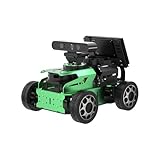
- Empowered by Large Al Model, Human-Robot Interaction Redefined. JetAcker robot car deploys multimodal models with ChatGPT at its core, integrating 3D vision and a 6-microphone array. This synergy enhances its perception, reasoning, and actuation capabilities, enabling advanced embodied AI applications and delivering natural, context-aware human-robot interaction.
- Driven by AI & ROS, powered by Jetson. JetAcker AI robot car is a high-performance educational robot developed for ROS learning scenarios. Equipped with Jetson Nano/Orin Nano controllers and compatible with both ROS1 and ROS2, it integrates deep learning frameworks with TensorRT acceleration, making it ideal for advanced AI applications such as SLAM and vision recognition.
- SLAM Development and Diverse Configuration. JetAcker smart robot car is equipped with a powerful combination of a 3D depth camera and Lidar. It utilizes a wide range of advanced algorithms, including gmapping, hector, karto, cartographer and RRT, enabling precise multi-point navigation, TEB path planning, and dynamic obstacle avoidance. Using 3D vision, it can capture point cloud images of the environment to achieve RTAB 3D mapping navigation.
- Classical Ackermann Steering Mechanism. The Ackermann chassis combines maneuverability and steering precision, facilitating the learning and validation of real-world vehicle steering principles. This design enables realistic simulation of autonomous driving scenarios for enhanced educational experiences.
- Comprehensive Learning Tutorials. Through JetAcker's structured curriculum, master cutting-edge technologies including ROS development, SLAM mapping and navigation, 3D depth vision, OpenCV, YOLOv8, MediaPipe, Large Al model integration, Movelt and Gazebo simulation, and voice interaction.
This is a significant qualification to the idea that China is simply allowing companies to deploy quickly. The local approach makes prior performance part of the approval process. A company must establish an operational record before it can receive permission for a more commercially consequential form of service.
Requirements of this kind can slow expansion, but they also give regulators a way to distinguish a controlled demonstration from a mature service. They create incentives for companies to collect operating data, resolve recurring edge cases, and prove that their safety performance is not limited to a short public-relations demonstration.
Robotaxis are China’s most visible commercial test bed
Robotaxis are the clearest public evidence that China has moved beyond laboratory demonstrations. They offer a practical middle ground: a company can deploy a highly automated vehicle in selected districts without solving every problem associated with autonomous driving for privately owned cars across an entire country.
Robotaxi operators can use defined routes or mapped operating areas, fleet-level maintenance, remote operations, centralized software updates, and a controlled customer experience. The same approach can later inform autonomous buses, freight services, industrial parks, ports, and other fleet applications.
Baidu Apollo Go
Baidu describes Apollo Go as an autonomous ride-hailing service and identifies robotaxi fleets as a core part of its intelligent-driving business.[C007] Its investor materials describe Apollo Go as a global robotaxi leader and report continued expansion of autonomous ride-hailing operations.[C008]
Company figures need careful interpretation. A reported number may refer to completed rides, active vehicles, vehicles in testing, or vehicles capable of driverless service. Those are not interchangeable measurements. Any claim about Apollo Go’s scale should therefore preserve the exact metric and date used in the relevant company filing rather than reduce everything to a single fleet-size figure.
WeRide
WeRide’s 2026 annual filing says the company planned to expand robotaxi operations into additional Chinese Tier-1 cities and describes operations in both China and overseas markets. The filing also reports a dedicated Middle Eastern fleet of more than 200 robotaxis.[C009]
That international activity is strategically important. Domestic deployment gives Chinese autonomous-driving companies a place to develop operating procedures, gather data, and refine fleet management before taking their services into other regulatory environments. It does not mean that a system approved in China automatically satisfies another country’s safety, insurance, data, or road-use rules.
Pony.ai
Pony.ai’s filings report commercial robotaxi activity and growing utilization, alongside robotruck operations and logistics partnerships. The company has also disclosed average daily orders per robotaxi for part of 2025.[C010]
That type of utilization figure is useful because it points toward the economic question behind the demonstrations: how much service can each vehicle provide, and can that revenue cover sensors, maintenance, mapping, remote operations, charging, insurance, and safety validation? It remains a company disclosure, not an independently audited industry-wide benchmark.
Why robotaxi deployment is still bounded
A paid ride does not automatically mean a car is ready for unrestricted autonomy. Robotaxi operations may depend on:
- an approved geographic service area or route;
- high-definition maps or a prepared road environment;
- limits on weather, time of day, speed, or traffic conditions;
- remote supervision and an emergency-response process;
- vehicle and operator permits;
- fleet maintenance and software-update controls; and
- data recording and incident-reporting obligations.
These constraints are not evidence that the technology is fake. They are evidence that the technology is being deployed inside an operating design domain. A Level 4 system can be genuinely driverless within its approved domain while remaining unable to handle roads or conditions outside it.
PC Slower Than It Used to Be?
A free scan shows the junk files, broken settings and background clutter dragging Windows down - then fixes them in one click.Free scan · Windows 10 & 11Outdated Drivers Are Slowing You Down
One free scan finds every outdated or missing driver and matches the right update for your exact hardware.Free scan · exact hardware matchChina is accelerating deployment and tightening safety rules at the same time
The regulatory story is not one of simple deregulation. Chinese authorities have encouraged pilots while building stronger mechanisms to investigate incidents and impose safety obligations.
On April 14, 2026, central authorities convened a national meeting on intelligent-connected-vehicle road testing and demonstration applications after recent safety events. The meeting called for company self-inspections, corrective action, stronger safety supervision, improved emergency-response capacity, and a three-level maturity and safety-evaluation mechanism involving national, local, and enterprise actors.[C011]
The message is straightforward: deployment is welcome, but an incident can trigger scrutiny and corrective measures. That is a different model from allowing companies to expand first and leaving safety rules to catch up later.
The mandatory assisted-driving standard is a major safety floor
In July 2026, the Ministry of Industry and Information Technology announced GB 47955—2026, a mandatory national standard for combined driving-assistance systems. It is scheduled to take effect on January 1, 2027.[C012]
What’s actually slowing this PC down?
Pick the symptom - the matching free tool is one click away.
The standard addresses categories of assisted-driving systems, functional requirements, data recording, manufacturer safety responsibilities, human-machine interaction, user instructions, user training, and layered evaluation through track tests, road tests, and document review.
Its most important public distinction is between assisted driving and autonomous driving. The standard covers systems in which the human driver must continuously observe traffic and control the vehicle when required. It therefore creates a safety floor for the much larger population of Level 2 and Level 2-plus vehicles; it is not a blanket authorization for driverless cars.
That distinction matters because “smart driving” marketing can blur the line between a system that helps a driver and one that assumes the driving task. The standard’s requirements for driver monitoring, instructions, training, recording, and manufacturer responsibility are designed to make that line harder to ignore.
Rank #3

- For Raspberry Pi 5 & ROS2 Robot Car. MentorPi A1 smart AI robot car is powered by Raspberry Pi 5, compatible with ROS2, and programmed in Python, making it an ideal platform for AI robot development.
- High-Performance Hardware. Equipped with Ackerman chassis, closed-loop encoder motors, TOF lidar, depth camera, AI voice interaction box, and other advanced components to ensure optimal performance and efficiency.
- Advanced AI Capabilities. Supports SLAM mapping, path planning, multi-robot coordination, vision recognition, target tracking, and more, covering a wide range of AI applications.
- Autonomous Driving with Deep Learning. Utilizes YOLO model training to enable road sign and traffic light recognition, along with other autonomous driving features, helping users explore and develop autonomous driving technologies.
- Empowered by Large AI Model, Human-Robot Interaction Redefined. MentorPi AI robot car deploys multimodal models with ChatGPT at its core, integrating 3D vision and Al voice interaction box. This synergy enhances its perception, reasoning, and actuation capabilities, enabling advanced embodied AI applications and delivering natural, context-aware human-robot interaction.
The next standards will cover the harder technical problems
MIIT’s 2026 automotive-standardization plan says China is continuing work on mandatory standards for automated-driving systems, simulation testing, test scenarios, sensor fusion, data security, artificial-intelligence safety, and vehicle software.[C013]
Free tools Windows power users keep installed
One-click scans. No signup required.
This is a sign that Chinese policymakers are trying to institutionalize autonomous driving before scaling it nationally. Simulation and scenario standards can make testing more repeatable; sensor-fusion requirements can address how vehicles combine cameras, radar, lidar, maps, and other inputs; and software and data rules can assign clearer responsibilities when a system changes after delivery.
Independent reader supportYour contribution helps us test, update, and keep practical guides available for everyone.China is also seeking influence over global AV rules
China participated in developing the first global technical regulation for automated-driving systems adopted through the United Nations World Forum for Harmonization of Vehicle Regulations in June 2026.[C014]
International standards do not eliminate differences between national approval systems. However, participation in standard-setting can help Chinese manufacturers operate across markets, shape the technical language used by regulators, and align domestic development with rules that may influence future vehicle exports.
The industrial-policy logic resembles the EV playbook—but autonomy is harder
Autonomous vehicles fit several Chinese strategic priorities simultaneously:
- electric vehicles and advanced vehicle manufacturing;
- artificial intelligence and high-performance computing;
- 5G and vehicle-to-everything communications;
- smart-city construction and digital infrastructure;
- logistics and freight modernization;
- domestic software, sensors, and technology platforms; and
- international influence over technical standards.
The national standards guide explicitly connects intelligent vehicles with environmental perception, intelligent decision-making, automatic control, external information exchange, and coordinated control.[C002] This cross-sector fit helps explain why local governments are prepared to open roads, build demonstration zones, support testing, and integrate vehicles with transport systems.
The model resembles China’s electric-vehicle strategy in one important respect: establish domestic standards and supply chains, use public-sector coordination to create early markets, allow companies to accumulate operational experience, and gradually move from pilots toward mass production.
Autonomous driving, however, is not guaranteed to follow the same trajectory. An electric vehicle can be sold once it meets applicable safety and certification requirements. A driverless vehicle must continue making decisions in a changing environment while managing liability, privacy, cybersecurity, emergency behavior, public trust, and interactions with human road users. The safety and regulatory burden is therefore much more dynamic.
What “all in” does—and does not—mean
It does mean a coordinated national push
China is supporting autonomous vehicles through multiple layers of government and industry:
- National ministries create admission pilots, standards, safety requirements, and data or cybersecurity expectations.
- Municipal governments designate demonstration zones, prepare connected roads, and write local operating procedures.
- Automakers and technology firms develop vehicles, software, maps, sensors, fleet systems, and commercial services.
- Public transport and logistics operators provide realistic use cases beyond private car ownership.
- Standards bodies and international forums help define the technical rules that may govern future deployment and exports.
That is a durable form of support because it addresses the ecosystem around the vehicle, not just the vehicle itself.
It does not mean unrestricted nationwide driverless driving
A permit to test or provide service in a designated area is not equivalent to nationwide capability. Chinese rules distinguish conditional, high, and full automation and can restrict even highly automated services by route, district, weather, vehicle type, supervision arrangement, or other operating conditions.[C015]
Nor does government backing solve the economic problem. Robotaxis require expensive sensor suites, mapping, remote operations, maintenance, charging, fleet management, insurance, and repeated safety validation. A large number of rides or a large testing footprint does not by itself prove that the business has reached sustainable economics.
Finally, official targets and corporate plans should not be confused with completed results. Shanghai’s 2027 goals, Baidu’s descriptions of Apollo Go, and WeRide’s expansion plans show direction and intent. They do not independently verify that every planned road kilometer, vehicle, or service area is already operating at the stated scale.
What to watch next
- January 1, 2027: whether GB 47955—2026 changes the design, marketing, data recording, training, and driver-monitoring practices for assisted-driving systems.
- Commercial operating domains: whether robotaxi and freight services expand from prepared districts to more complex roads, weather conditions, and cities.
- Utilization and costs: whether companies can increase rides or freight trips enough to offset fleet hardware, remote operations, maintenance, and compliance costs.
- Incident response: whether safety events produce transparent corrective action and better evaluation, or lead to abrupt restrictions that slow deployment.
- Mass production: whether Level 4 vehicles become repeatable products rather than individually managed pilot fleets.
- International expansion: whether Chinese companies can adapt their systems to foreign rules on vehicle certification, data, liability, insurance, and cybersecurity.
The most important indicator will not be a single impressive ride count or a new demonstration-zone announcement. It will be whether China can turn controlled pilots into repeatable, safe, economically viable services while maintaining public and regulatory confidence.
Source references: The policy and company claims above are identified with the supplied source references C001–C015. Company-reported fleet, ride, order, and expansion figures are presented as company disclosures rather than independent industry measurements.
Frequently Asked Questions
Is China allowing fully autonomous cars everywhere?
No. China is allowing selected Level 3 and Level 4 vehicles to test or operate through national and local pilots, but those permissions generally apply to designated areas, routes, conditions, vehicle types, and supervision arrangements. A permitted robotaxi service is not the same as nationwide driverless capability.
Are Chinese robotaxis truly driverless?
Some approved services may operate without an onboard safety driver, while others use an onboard operator, remote supervision, or both. The answer depends on the company, city, vehicle, and permit. “Driverless” should not be treated as synonymous with Level 5 autonomy.
Does China’s GB 47955—2026 standard legalize self-driving cars?
No. The mandatory standard, scheduled to take effect on January 1, 2027, establishes requirements for combined driving-assistance systems in which the human driver must continue to observe traffic and take control when required. It is primarily a safety framework for assisted driving, not blanket approval for unrestricted autonomous operation.
Why are robotaxis important to China’s autonomous-driving strategy?
Robotaxis provide a controlled commercial environment in which companies can operate high-automation vehicles, gather real-world data, test fleet management, and develop revenue models. They can scale within approved operating domains without requiring fully autonomous private vehicles on every road.
The Bottom Line
China is all in on developing autonomous vehicles as a strategic industrial capability, but it is not all in on removing constraints. Its approach is controlled acceleration: create roads, standards, pilots, domestic companies, and commercial use cases, then expand permissions as vehicles and operators demonstrate safety. The country’s advantage is coordination and deployment scale; its unresolved challenges are technical reliability, economics, liability, data governance, and public trust.
Quick Recap
Product prices and availability are accurate as of the date/time indicated and are subject to change. Any price and availability information displayed on Amazon at the time of purchase will apply.




