Free tools Windows power users keep installed
One-click scans. No signup required.
Short answer: no independent evidence shows that this helmet eliminates 100% of motorcycle blind spots. The product behind the headline is the iC-R smart motorcycle helmet from Intelligent Cranium Helmets, or ICH. Its design combines dual rear-facing cameras, a heads-up display, connectivity features, crash detection, and a claimed 240-degree rear view to expand the rider’s awareness.
That is an interesting safety concept, but a wide camera view is not the same thing as guaranteed hazard detection. The available evidence does not establish that the iC-R detects every vehicle, works reliably in every lighting or weather condition, prevents lane-change crashes, or makes shoulder checks unnecessary. In fact, ICH’s own February 2025 development update said its original proximity sensors would be disabled by default while the company developed a motorcycle-mounted radar solution.
As an Amazon Associate I earn from qualifying purchases.
What the 100% blind-spot claim is based on
The headline originated from a January 16, 2025 New Atlas report about the iC-R. The basic idea is geometric: the helmet’s two rear cameras are said to create a stitched view covering 240 degrees behind the rider. If that is combined with a roughly 120-degree forward visual field, the result appears to cover the full circle around the motorcycle.
Crashes, No Sound, or Screen Glitches?
Random freezes, missing sound and display glitches usually trace back to one bad driver. Find and replace yours safely.Free scan · under a minuteWindows Errors? Fix Them Before They Spread
Repair common Windows errors and clear accumulated junk for a smoother, more stable PC - no reinstall needed.Free scan · no reinstallBut that calculation describes theoretical coverage, not verified real-world performance. A camera may have a nominal field of view while still leaving practical gaps because of its mounting position, the rider’s posture, the helmet’s shell, nearby vehicles, road curvature, or the way the two images are stitched together. The HUD must also display the information clearly enough for the rider to understand it quickly without diverting attention from the road.
#1 Best Overall

- DUAL 2K FRONT AND REAR CAM & SUPERIOR NIGHT VISION – Capture every detail of your ride with stunning clarity. Equipped with front and rear 2K lenses and a large F1.7 aperture, MUFU V40 delivers crisp, high-definition footage of the road ahead and behind. The advanced low-light sensor ensures vivid, noise-free recording even on unlit roads or in tunnels, keeping you protected day and night.
- 4000mAh BATTERY LONG-LASTING MAX 8-HOUR RUNTIME: The built-in 4000mAh battery outperforms standard action cams by delivering up to 8 hours of continuous recording. It is the ultimate companion for long-distance motorcycle touring, full days of snowboarding, or mountain bike rides without the hassle of swapping batteries or mid-ride charging
- IP66 WATERPROOF & QUICK POWER-ON/OFF DESIGN: V40 resists rain, mud, dust, and snow, making it essential gear for extreme outdoor sports. the Quick Power Buckle allows for fast, secure mounting and removal—even when wearing thick gloves
- LOOP RECORDING & EMERGENCY LOCK: Functioning as both an action cam and a safety dash cam, it features continuous loop recording to overwrite old footage automatically. V40 features intelligent tilt detection to lock and save the current footage from being overwritten when a tilt has occurred
- INTUITIVE LED INDICATOR – Stay focused on the road, not your settings. High-visibility LED indicators on the camera body provide immediate feedback on battery levels and recording status. Check your mode instantly without needing to take out your phone and check app
The defensible description is that the iC-R aims to reduce rear and side visibility gaps through camera-based rear awareness and HUD presentation. Calling it a 100% blind-spot-elimination system goes considerably further than the available testing supports.
How the iC-R works
Dual rear cameras and a HUD
According to the product reporting, the iC-R uses two rear cameras to stitch together a 240-degree rear image. That feed is shown through a heads-up display positioned above the rider’s normal eyeline. In principle, this gives the rider a digital rear view without requiring a conventional mirror or a full head turn.
The camera view can be useful for seeing what is behind the motorcycle, but it should not be confused with a system that understands every object or predicts every collision. A visual feed may show a vehicle without reliably determining its closing speed, lane position, intention, or whether it is hidden by another object.
Other reported equipment
The iC-R is described as a connected smart helmet rather than a camera-only accessory. Reported and listed features include:
- Dual rear cameras with a claimed 240-degree rear field of view
- A HUD display unit
- A front action camera
- Rider-to-rider communication
- Crash detection
- Rear-awareness LEDs
- 128GB of storage
- Proximity warning hardware, subject to the sensor update discussed below
New Atlas reported that the crash-detection system could call 911 if the rider remained immobile for more than 15 seconds. That is a reported feature, not proof that an emergency call will always be completed. Availability may depend on connectivity, configuration, location, and the system’s ability to correctly identify a crash and the rider’s condition.
What comes in the package
ICH’s March 2025 product document identifies a package containing the smart helmet, helmet bag, handlebar controller and mounting kit, HUD display unit, USB-C cable, screwdrivers, a front-shell attachment accessory, and a quick-start guide. Buyers should confirm the contents of the exact variant and current shipment before ordering because ICH has also announced hardware, liner, and battery revisions during development.
iC-R model range and listed prices
ICH’s current product page lists four versions of the helmet family. These are listed prices, not an independent assessment of value, performance, or availability:
What’s actually slowing this PC down?
Pick the symptom - the matching free tool is one click away.
| Model | Listed edition | Listed price | General positioning |
|---|---|---|---|
| iC-Re | Economy Edition | $650 | Entry version of the iC-R family |
| iC-R | Rider Edition | $1,165 | HUD, dual rear cameras, communications, crash detection, storage, and rear-awareness features |
| iC-Rs | Sport Edition | $1,675 | Sport-oriented version of the platform |
| iC-Rs+ | Sport Plus Edition | $1,850 | Highest-priced listed version |
Prices, specifications, market availability, and included equipment can change. A buyer should verify the exact model, shell size, certification markings, shipping status, and software or sensor configuration rather than assuming that every feature applies identically across the range.
Rank #2

- Package Dimensions :30.48 Cm L X33.02 Cm W X39.37 Cm H
- Product Type :Powersports Vehicle Part
- Country Of Origin :United States
- Package Weight :16.0Lbs
Camera awareness is not the same as blind-spot detection
This distinction is central to understanding the headline.
| Capability | What it does | What it does not prove |
|---|---|---|
| Rear camera and HUD | Shows a digital view of areas behind the rider | That every hazard is visible, correctly stitched, or understood by the system |
| Proximity sensors | Attempt to identify nearby objects and provide a warning | That the warning is accurate in all traffic, weather, speed, or road conditions |
| Motorcycle-mounted radar | Can potentially detect and track nearby moving targets independently of a camera image | That the planned iC-R radar system was already proven or included in every shipment |
| Crash detection | Attempts to recognize a crash and trigger an emergency response | That it will identify every crash or successfully contact emergency services |
A camera feed answers a question such as What is behind me? A radar-based warning system attempts to answer a different question: Is a nearby object approaching or occupying a hazardous position? Those functions can complement one another, but they are not interchangeable.
The important February 2025 sensor update
ICH’s February 23, 2025 development update is one of the most important qualifications to the 100% claim. The company said it was disabling the current proximity sensors by default through an over-the-air update and was developing a motorcycle-mounted radar sensor that would communicate over Bluetooth Low Energy.
ICH described the radar as intended initially for backers and future shipments. That means readers should not assume that the proximity-warning capability described in early coverage represents the final hardware or the active default configuration of every iC-R helmet.
The same update discussed battery revisions and liner improvements. ICH also said it had announced passage of ECE 22.06 certification but was still awaiting the official report for final review and record keeping. This is the profile of a commercially listed product with an evolving hardware and software platform, not a fully mature rider-assistance system with a settled performance record.
Why the system may still have blind spots
Even a genuinely wide camera view can fail to provide complete situational awareness. Practical limitations may include:
- Camera placement: The cameras cannot see through the helmet, the rider, another vehicle, or an object that physically blocks their lenses.
- Stitching artifacts: Two camera images must be joined. Objects near the seam may be distorted, duplicated, delayed, or temporarily lost.
- Lighting: Headlights, glare, low sun, darkness, and rapid transitions between bright and shaded roads can reduce image quality.
- Weather and contamination: Rain, spray, fog, snow, dust, and a dirty lens can make the rear image harder to interpret.
- Latency: A video feed and warning system take time to capture, process, transmit, display, and interpret.
- Rider position: A camera view that looks complete in one posture may not provide the same practical coverage when the rider leans, turns, stands on the pegs, or rides on a bend.
- HUD workload: A display placed in the rider’s field of view can be helpful, but it can also become a distraction if the rider spends too much attention reading it.
- Human interpretation: Seeing a vehicle is not the same as recognizing its speed, trajectory, or intention in time to respond.
ICH’s warranty documentation itself lists possible problems involving dual-camera stitching, low video quality, incorrect field of view, the dual time-of-flight proximity sensors, and emergency-alert functions. Those listed failure modes reinforce that the electronics are aids with potential failure points, not an infallible safety envelope.
Is the iC-R really an AI helmet?
The headline calls the product an AI motorcycle helmet, but the available product information does not establish a specific artificial-intelligence detection system or independently measured AI performance. The documented design is more precisely described as a connected smart helmet built around cameras, a HUD, communications, crash detection, proximity sensing, and planned radar integration.
Rank #3

- 【SAFETY CERTIFICATION】- The Motorcycle Helmets meets the safety standard requirements of DOT FMVSS-218 This means that it has been approved for all road traffic in American. It is a very important safety tool in your outdoor life.
- 【BLUETOOTH HEADSET】- The Motorcycle Bluetooth Helmet uses high-quality Bluetooth technology to provide stereo bass surround sound quality, automatic answering, song playback, and active noise reduction during calls. Ultra strong signal transmission, ultra low power consumption, supports all Bluetooth devices, and can display power directly on the phone.
- 【DUAL VISOR】- The external sunshade is sturdy and elastic, with good impact resistance, while the large area design also maintains a wide field of view; The internal dark sunshade can protect the eyes from sunlight and can be hidden or opened.
- 【COMPOSITE SHELL】 - The body of the technical ABS helmet is of excellent quality, excellent performance and very durable and stable. The interior is made of high density EPS foam, which can be used as a buffer layer and has a strong cushioning effect.
- 【SERVICE AND WARRANTY】- Any questions ,contact us at first time.We are always at your service. FRBRK is fully responsible for all FRBRK products.
That does not make the technology uninteresting. It does mean buyers should avoid assuming that the helmet recognizes every vehicle, classifies hazards, or autonomously prevents a collision simply because the product is described with AI language.
Certification: what U.S. riders need to verify
Smart features do not substitute for a properly fitted, compliant motorcycle helmet. In the United States, NHTSA says motorcycle helmets must meet FMVSS No. 218 and carry the required DOT/FMVSS 218 labeling. NHTSA also explains an important distinction: DOT compliance is a manufacturer self-certification, not a government approval issued to each helmet before sale. NHTSA conducts marketplace testing and can take enforcement action when helmets fail the standard.
ICH’s certification timeline has changed over time:
Quick wins for a faster PC:
Scan for outdated or missing drivers - takes under a minuteDriver Scan →Clear out junk files and repair common Windows errorsFree Scan →- In an August 2024 backer update, ICH said DOT certification had passed, ECE 22.06 confirmation was expected, and SNELL testing was still in progress.
- In an October 2024 update, ICH described DOT as passed, ECE 22.06 as undergoing retesting, and SNELL as pending further review.
- In its February 2025 update, ICH said ECE 22.06 had been passed but that the official report was still pending.
Those are company announcements. They should be distinguished from an independently accessible certification record or the physical compliance marking on the exact helmet being sold. SNELL status in the available research remained unresolved.
Before buying, a U.S. rider should:
- Confirm the exact model and size being shipped.
- Check the physical helmet for the required DOT/FMVSS 218 labeling.
- Ask the seller for current certification documentation rather than relying on an old campaign update.
- Confirm whether the helmet is intended for the buyer’s country and applicable road rules.
- Verify the return policy and fit procedure, since electronics cannot compensate for a loose or incorrectly sized helmet.
Availability and product maturity
ICH’s current site presents the iC-R family as purchasable products, with the range starting at $650. In its February 2025 update, the company said it was shipping remaining pre-orders and newer backers, with another batch expected in April.
That information establishes that the iC-R is more than a purely speculative concept, but it does not establish uniform retail availability or a finished, independently validated product. The announced changes to the battery, liner, proximity sensors, and radar are especially relevant for anyone comparing an early backer unit with a later shipment.
No independent hands-on review, controlled blind-spot test, crash-prevention study, or universal detection trial was identified in the research for this article. There is therefore no basis for claiming that the iC-R works equally well in all traffic, weather, lighting, speeds, or riding positions.
Alternatives if you want radar without replacing your helmet
The iC-R integrates its technology into the helmet. A different approach is to keep an existing compliant helmet and add a motorcycle-mounted radar or camera system. That can be attractive for riders who already have a helmet that fits well or who do not want to depend on a helmet battery and electronics package.
Rank #4
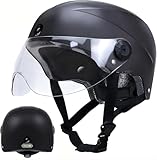
- Upgraded Dual Front & Rear Sport Cameras : Enjoy smooth HD capture of every scenic ride and unexpected moment with the EKUZO smart helmet with sport cameras.The front camera upgrades to 2K resolution(need to be set in App), while the rear camera captures in 1080P
- Edit and Share Your Recordings Even More Easily : Now you can use the brand new "Smart Helmet Pro" App to connect with loved one
- EPS Protective Shell & Adjustable Fit : Ensuring Safety with unmatched comfort,fits head circumferences from 21 to 24.8 inches
- Bluetooth Connectivity for Smart Device : Hands-Free Calls, Voice Navigation, and Music Playback,bringing more fun to your rides (Bluetooth works uninterrupted when the smart helmet App is closed — If you open the App, the safety system will disconnect Bluetooth, yet recording never stops.)
- IPS5 Water Resistance & 4-Hour Battery Life : Ride through any weather and keep recording your jounery
Garmin zūmo R1 Radar
The Garmin zūmo R1 Radar is a separately mounted motorcycle rearview and blind-spot radar system. Its listed features include external warning lights, audio alerts through a compatible headset, a heads-up indicator, a license-plate mounting design, and support for a smartphone or zūmo XT2 display. An Amazon listing identifies model 010-02902-00 and ASIN B0DQBJ1NS9.
Unlike the iC-R, the Garmin is not a helmet-integrated rear-camera/HUD platform. It is a dedicated motorcycle accessory, so the installation, wiring, display, and headset requirements matter. It also should be viewed as a rider aid rather than proof that every blind spot is eliminated.
INNOVV ThirdEYE Motorcycle Blind Spot Detection
INNOVV ThirdEYE Motorcycle Blind Spot Detection is a motorcycle-mounted 77GHz millimeter-wave radar system. INNOVV says it can detect targets up to 50 meters, track multiple targets, and provide visual and audible alerts. The company explicitly warns that the system is a rider aid and should not be relied upon as the sole safety system.
Do these 3 things before closing this tab:
1Repair Windows errors before they cause bigger problems2Scan for outdated or missing drivers - takes under a minute3Clear out junk files and repair common Windows errorsThat warning is the right standard for evaluating any product in this category. A stated detection distance is not the same as a demonstrated warning range in every environment, and radar alerts still require the rider to interpret the warning and make a safe decision.
Other adjacent products
| Product | Approach | What is advertised | Important qualification |
|---|---|---|---|
| AlienRider M12S | Motorcycle-mounted display and dash-camera system | 77GHz radar blind-spot warning, rearview streaming, lane-change assistance, 1080p recording, TPMS, and smartphone connectivity | The manufacturer lists it at $399 and links to Amazon, but independent performance verification was not located |
| Side Eye | Removable helmet-mounted blind-spot detection prototype | Sensor-based detection with LED alerts | The official site describes it as still in active prototype development, not a final consumer product |
| MOTOEYE HUD E6+ | Helmet-attachable HUD and rear-camera accessory | HUD, navigation, Bluetooth, intercom, voice command, and rear-camera functions | It is marketed as reducing blind spots, but independent performance testing was not established |
These products are not interchangeable. A radar unit may provide an alert without showing a detailed image. A camera accessory may show the rear road without reliably measuring closing speed. A helmet-integrated system may offer cleaner integration but creates more dependence on battery life, software, fit, service, and the particular sensor configuration shipped.
Disclosure: As an Amazon Associate I earn from qualifying purchases.
Independent reader supportYour contribution helps us test, update, and keep practical guides available for everyone.How to judge the iC-R—or any blind-spot aid
Before treating a product claim as a safety result, look for evidence that answers specific questions:
- What objects were tested, at what distances and approach speeds?
- What were the false-negative and false-positive rates?
- Was testing performed at night, in rain, in glare, and around large vehicles?
- How much delay exists between detection and the rider’s warning?
- What happens when a camera is dirty, blocked, disconnected, or exposed to vibration?
- Does the system warn about a stationary object, a fast-approaching vehicle, or both?
- What happens when the motorcycle leans or the rider turns their head?
- Can the rider still use ordinary mirrors and make a shoulder check?
- What is the fallback if the battery, HUD, phone connection, Bluetooth link, or emergency-alert function fails?
For the iC-R, the current public evidence answers some product-specification questions but not the core performance questions. The 240-degree figure describes the claimed camera view. It does not provide a detection-rate study or prove that the view remains usable under all real riding conditions.
Best Value

- DOT-rated Smart Motorcycle Helmet. Complies with Federal Motor Vehicle Safety Standard 218 (FMVSS 218)
- Built-Ins speakers and microphone, no installation necesary
- Integrated 4-way Bluetooth communication system for rider to rider communication
- Smartphone Connectivity to listen to music, GPS or take phone calls
- Retractable Sun Visor; Compatible with all Sena Bluetooth-equipped devices
Should you buy it?
The iC-R may make sense for a rider who specifically wants a helmet-integrated camera, HUD, communication, storage, and crash-detection platform and is comfortable with a product whose sensor and hardware configuration has been changing. That buyer should treat the blind-spot claim as an aspiration and verify the current shipment details directly.
A separately mounted radar system may be more practical for someone who already owns a well-fitting, compliant helmet and wants proximity alerts without replacing it. A conventional helmet with properly adjusted mirrors and disciplined head checks remains essential whichever electronic accessory is chosen.
The most important buying decision is not whether a product uses the word AI. It is whether the exact unit fits correctly, meets the applicable helmet standard, gives warnings the rider can understand without distraction, and has a clearly documented failure mode. No electronic aid should be treated as permission to stop looking.
The Tool Desk
Outbyte PC Repair FREEClear out junk files and repair common Windows errorsFree Scan →Outbyte Driver Updater FREEScan for outdated or missing drivers - takes under a minuteDriver Scan →Source and evidence note
This assessment draws on the January 16, 2025 New Atlas report describing the iC-R; ICH’s current product listings; the March 2025 iC-R product document; ICH’s August and October 2024 backer updates; ICH’s February 23, 2025 development update; ICH’s warranty documentation; NHTSA’s FMVSS No. 218 and DOT-compliance guidance; and the manufacturer information available for the comparison products. The research did not locate independent hands-on testing or a controlled study proving 100% blind-spot elimination.
Frequently Asked Questions
Does a 240-degree rear camera view mean the iC-R has no blind spots?
No. It describes the claimed rear-camera coverage, not a verified 100% detection result. Stitching, lens obstruction, weather, lighting, latency, rider position, and the rider’s ability to interpret the HUD can all create practical limitations.
Can the iC-R replace shoulder checks?
No. The helmet should be treated as a supplemental rear-awareness and warning system. Riders should continue using mirrors, maintaining attention, and making appropriate shoulder checks before changing lanes or turning.
What changed in the iC-R’s proximity system?
In a February 23, 2025 development update, ICH said the current proximity sensors would be disabled by default through an over-the-air update while it developed a motorcycle-mounted radar sensor communicating over Bluetooth Low Energy.
Recommended Free Tools
What should a U.S. buyer verify before purchasing?
Verify the exact model and size, the physical DOT/FMVSS 218 labeling, current certification documentation, market suitability, included equipment, shipping status, and the current sensor and software configuration. DOT compliance is a manufacturer self-certification subject to NHTSA marketplace testing, not a pre-sale government approval.
The Bottom Line
Bottom line: The Intelligent Cranium Helmets iC-R is a real, commercially listed smart-helmet platform with dual rear cameras, a HUD, communications, crash detection, and a claimed 240-degree rear view. But the evidence supports saying that it aims to reduce rear and side visibility gaps—not that it guarantees 100% blind-spot elimination. Its changing proximity-sensor and radar plans, unresolved certification details in the available record, and lack of independent performance testing make ordinary rider attention, mirrors, and shoulder checks indispensable.
Quick Recap
Product prices and availability are accurate as of the date/time indicated and are subject to change. Any price and availability information displayed on Amazon at the time of purchase will apply.




