Quick wins for a faster PC:
Repair Windows errors before they cause bigger problemsFix Now →Scan for outdated or missing drivers - takes under a minuteDriver Scan →No. Do not drive a car when you suspect a brake-fluid leak. Pull over safely, switch off the engine, and arrange roadside assistance or a tow to a qualified repair facility. A leak can reduce hydraulic pressure, weaken braking, lengthen stopping distances, and leave you with less braking capacity as fluid continues to escape. Adding fluid may raise the reservoir level temporarily, but it does not repair the leak or make driving safe.
Why a brake-fluid leak is an immediate safety problem
Most passenger-car brakes use hydraulic pressure. When you press the pedal, the master cylinder moves brake fluid through sealed lines to the wheel brakes. That pressure applies the pads or shoes. If fluid escapes, the system may not build or maintain the pressure needed for normal braking.
| # | Preview | Product | Price | |
|---|---|---|---|---|
| 1 |

|
Valvoline DOT 3 Synthetic Brake Fluid, 32 oz | $10.73 | Buy on Amazon |
| 2 |

|
Valvoline DOT 3 & 4 Synthetic Brake Fluid, 32 oz | $9.88 | Buy on Amazon |
| 3 |

|
Prestone AS401 DOT 3 Synthetic Brake Fluid - 32 oz. | $10.98 | Buy on Amazon |
| 4 |
|
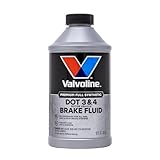
Valvoline DOT 3 & 4 Synthetic Brake Fluid, 12 oz | $5.79 | Buy on Amazon |
| 5 |
|
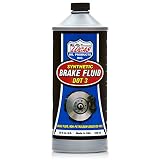
Lucas Oil 10826 Brake Fluid - 1 Quart | $9.62 | Buy on Amazon |
As an Amazon Associate I earn from qualifying purchases.
The result is not limited to a messy driveway. You may need more pedal travel, more distance to stop, or substantially more force to slow the car. If enough fluid is lost, one or more brakes can stop contributing effectively. Air entering the hydraulic system can also make the pedal feel soft or spongy and reduce the consistency of braking.
NHTSA consumer driving-preparation guidance treats visible brake-fluid leakage as a reason to have the vehicle serviced. AAA’s brake-service guidance, updated in March 2026, gives the practical rule: “Don’t drive a car with weak brakes: Contact AAA Roadside Assistance for a tow to your nearest certified service station.”
#1 Best Overall
- Exceeds DOT 3 regulations: Formulated to meet or surpass DOT 3 requirements, ensuring consistent braking performance and dependable stopping power in all conditions
- Premium high boiling point: Helps prevent vapor lock and brake fade under extreme heat, maintaining safe and reliable braking even in demanding situations
- Full synthetic formula: Provides superior resistance to moisture absorption and corrosion, helping protect vital brake system components for long-lasting performance
- Superior protection and performance: Designed to deliver reliable braking under extreme temperatures while supporting the safety and efficiency of the braking system
- Recommended applications: Suitable for ABS, disc, and drum brake systems; surpasses SAE J1703, FMVSS 116, and ISO 4925 DOT 3 specifications
A General Motors recall FAQ hosted by NHTSA describes longer braking distances and crash risk when a leak affects certain recalled Silverado MD 4500HD, 5500HD, and 6500HD vehicles. That FAQ concerns those specified vehicles and recall conditions; it is evidence of the possible consequence of a hydraulic leak, not a claim that every car has the same defect.
How to recognize a possible brake-fluid leak
No single symptom proves the source remotely. Other brake faults can feel similar, and fluid on the ground can come from another system. Treat the following signs as reasons to stop using the car until it has been inspected.
A soft, spongy, or unusually low pedal
A pedal that feels softer than usual, sinks farther toward the floor, or requires pumping is a warning that the hydraulic system may not be maintaining pressure. Do not repeatedly pump the pedal and assume the problem is solved. A temporary change in feel does not restore the underlying system.
Recommended Free Tools
A brake or red warning light
The brake warning lamp can indicate low fluid, a hydraulic fault, or another brake-system condition. Use the vehicle handbook to identify the exact symbol. If the lamp appears with a change in pedal feel, stop driving and arrange a tow rather than trying to clear the warning by restarting the car.
Rank #2
- Mixes well with conventional fluids
- Low-moisture formula provides excellent vapor lock protection
- Ideal for hydraulic and disc brakes
Longer stopping distances or a change in braking response
If the car takes longer to stop, pulls unexpectedly, or feels different under braking, assume braking performance is compromised until a technician proves otherwise. Do not conduct a road test to “see how bad it is.”
Fluid around the car or in the engine compartment
Brake fluid may appear near a wheel, beneath the engine bay, or along the route from where the car was parked. It is commonly clear to amber when fresh, but color varies with age and contamination. Oil, coolant, washer fluid, and water from air-conditioning condensation can look different or appear in nearby locations, so visual inspection alone is not a diagnosis.
Check the brake-fluid reservoir only while the vehicle is parked on a safe, level surface and the engine is off. A low level can result from a leak, worn brake components, or both. Do not remove caps or crawl under the vehicle beside traffic, and do not touch an unknown fluid with bare skin.
What to do if you suspect a leak while driving
- Reduce speed smoothly. Avoid abrupt steering or hard pedal applications. Turn on hazard lights if your situation requires them.
- Move to a safe stopping place. Choose a shoulder, parking area, or other location away from moving traffic. If the pedal is very low or braking is weak, use the least-risk route available and avoid downhill roads where possible.
- Stop and secure the vehicle. Select Park or a suitable gear, apply the parking brake only as appropriate for the situation, and switch on hazard lights.
- Do not continue the trip. Do not drive slowly to a parts store, home, or repair shop. The leak can worsen without warning.
- Call roadside assistance or a towing service. Tell the dispatcher that you suspect a brake-fluid leak or weak brakes so the vehicle is sent for transport rather than a routine jump-start or tire service.
- Tell the repair facility what you noticed. Report warning lights, pedal feel, where fluid was seen, and whether the car was recently serviced. These details help the technician begin safely.
If you are stopped in an unsafe location, stay buckled inside the vehicle when that is safer than standing near traffic, and follow local emergency guidance. Never place yourself under the car to search for the leak on a roadside.
Rank #3
- Provides an extra margin of safety in extreme braking conditions (packaging may vary)
- Mix of polyglycol ethers ensures hot brake-system operation will not create dangerous vapor
- Excellent for ABS, disc and drum brake systems
- Delivers braking power when needed by avoiding a spongy pedal
- Both wet and dry boiling points exceed the minimum government standards
Why adding brake fluid is not a workaround
Do not treat a refill as permission to drive. A NHTSA-hosted owner-manual excerpt states: “Do not top off the brake fluid. Adding fluid does not correct a leak.” The same material directs the owner to have a low reservoir checked for a hydraulic-system leak.
Adding fluid can hide how quickly the level is falling and can create false confidence. It also introduces the risk of using the wrong specification or contaminating the reservoir. If a qualified technician has already repaired the system and the owner’s manual calls for a level check, follow that vehicle-specific procedure; that is different from using a top-up to keep a leaking car on the road.
Brake-fluid specification varies by vehicle
Use only the fluid type specified by the vehicle manufacturer. One manual excerpt cited in the safety guidance specifies DOT 3 for that vehicle, but DOT 3 is not a universal recommendation. Other vehicles may require a different specification, and some systems have additional compatibility requirements.
PC Slower Than It Used to Be?
A free scan shows the junk files, broken settings and background clutter dragging Windows down - then fixes them in one click.Free scan · Windows 10 & 11Outdated Drivers Are Slowing You Down
One free scan finds every outdated or missing driver and matches the right update for your exact hardware.Free scan · exact hardware match| Situation | Correct response |
|---|---|
| Suspected leak before inspection | Do not drive; arrange a tow. Do not use fluid as a temporary repair. |
| Low reservoir after a warning light appears | Stop using the vehicle and have the hydraulic system inspected. |
| Fluid selection after professional repair | Follow the owner’s manual or reservoir marking exactly; use the manufacturer-recommended specification. |
| Unidentified fluid or contaminated reservoir | Do not guess at the type. Have a technician identify and service the system. |
Driving versus towing: the safer decision
| Choice | What could happen | Recommendation |
|---|---|---|
| Continue driving, even a short distance | Fluid loss may continue; pedal travel and stopping distance can increase, and braking capacity may drop unexpectedly. | Do not choose this when a leak, weak pedal, warning light, or unexplained fluid loss is present. |
| Arrange a flatbed or suitable tow | The vehicle reaches a repair facility without relying on a potentially compromised hydraulic system. | Preferred response for a suspected brake-fluid leak. |
There is no reliable distance, speed, or time limit that makes a leaking brake system safe to drive. A car that still stops once in a driveway may not stop adequately in traffic, on a slope, in rain, or during an emergency maneuver.
Rank #4
- Ideal for hydraulic and disc brakes
- Mixes well with conventional fluids
- Low-moisture formula provides excellent vapor lock protection
What a professional inspection should establish
A repair professional needs to locate the source, determine how much braking function remains, and verify that the entire hydraulic system is safe after repair. Depending on the vehicle, inspection may include:
- Checking the reservoir level, cap, and fluid condition.
- Inspecting steel lines, flexible hoses, fittings, and connections for wetness, corrosion, or damage.
- Examining calipers, wheel cylinders, and the areas behind the wheels.
- Checking the master cylinder and, where fitted, the anti-lock braking system’s hydraulic components.
- Looking for evidence that fluid has reached friction material, tires, suspension parts, or electrical connectors.
- Testing pedal feel and hydraulic integrity after the defective part is replaced and the system is serviced according to the manufacturer’s procedure.
The exact repair depends on the failed component and the vehicle design. A leak may involve a hose, line, seal, caliper, wheel cylinder, master cylinder, reservoir, or another hydraulic connection. Because the source cannot be confirmed safely from a description alone, avoid ordering parts based only on where a puddle appears.
Independent reader supportYour contribution helps us test, update, and keep practical guides available for everyone.If you find fluid after the car has been parked
Leave the vehicle parked until it has been assessed. Photograph the fluid’s location and the dashboard warnings, and note whether the pedal changed before parking. Place a warning notice on the vehicle if other household drivers might use it, but do not rely on a note as a substitute for disabling access or arranging service.
What’s actually slowing this PC down?
Pick the symptom - the matching free tool is one click away.
Do not start the engine merely to move the car a few feet. If it must be moved to prevent an immediate hazard, call emergency or roadside services for guidance; moving a vehicle with compromised brakes can create a greater risk than leaving it where it is.
Best Value
- High quality blend of polyethylene glycol ethers and additives
- Compatible with all brake system rubber components and other brake fluids
- Prevents seal hardening or softening
- Protects against rust and corrosion
- Provides excellent lubricity
Common mistakes that increase the risk
- “The reservoir is only slightly low, so it is fine.” The rate of loss and the failed component are unknown; a small visible loss can precede a rapid change.
- “The pedal feels normal again after pumping.” Pumping can temporarily alter pedal feel without repairing the hydraulic fault.
- “I can drive with the parking brake.” The parking brake is not a substitute for the vehicle’s service brakes and is not designed to control normal traffic stops.
- “Any DOT fluid will work.” The required specification is vehicle-specific. Using the wrong type can impair performance or damage the system, as the cited manual guidance warns.
- “The puddle must be brake fluid.” Identification from appearance alone is unreliable, but a suspected brake-fluid leak must still be treated as a brake emergency until ruled out.
After the repair
Before accepting the vehicle, ask what component leaked, what fluid specification was used, and whether the system was checked for contamination or damage to friction parts. Confirm that warning lights are addressed and that the pedal has the normal firmness specified for the vehicle. Follow the manufacturer’s maintenance schedule and return immediately if the pedal changes, the warning lamp reappears, or fresh fluid is visible.
A repaired leak is not a reason to ignore other brake symptoms. Continued softness, pulling, noise, or increased stopping distance requires another inspection before normal driving resumes.
Bottom line
A suspected brake-fluid leak is a no-drive condition. Stop safely, do not rely on topping up the reservoir, and have the vehicle towed for professional inspection. Only return to regular driving after the leak and any related brake damage have been repaired and the system has been verified safe.
Quick Recap
Product prices and availability are accurate as of the date/time indicated and are subject to change. Any price and availability information displayed on Amazon at the time of purchase will apply.




