Yes. An electric vehicle can be charged with electricity from a grid that includes renewable generation even when wind output is low at that moment. The grid balances supply and demand across many generators, while batteries can store electricity produced earlier and release it later. Managed charging can also move a charging session to a time when renewable output is higher or the grid is less stressed.
That answer has an important qualification: an ordinary grid-connected charger cannot prove that the electrons entering your car came from a particular wind turbine. Your result depends on the local grid mix, the time of charging, available storage, utility controls and the capabilities of your vehicle and charger.
As an Amazon Associate I earn from qualifying purchases.
What “renewable-powered charging” can mean
People use the phrase in several different ways. Separating them prevents a smart-charging feature or a renewable-energy claim from promising more than the equipment can deliver.
Renewables serving the grid over time
Electricity on a connected grid is pooled. Wind farms, solar plants, hydroelectric facilities, nuclear plants, fossil-fuel generators and storage resources all affect the supply available to loads. When one wind farm is producing less, other generators or stored electricity can help meet demand. Renewable generation can therefore contribute to EV charging at the system level even when wind output is temporarily low.
#1 Best Overall

- Charge with Confidence: ChargePoint builds reliable, flexible EV charging stations for home, business, and fleets. Get 24/7 support and access to hundreds of thousands of North American charging locations.
- Charge Smart: With the user-friendly ChargePoint Mobile App, you can control your electric car charger, manage reminders, connect to smart home devices, find stations, get data and charging info, and access the latest features. Note: WiFi is needed for certain functionalities and troubleshooting steps if connectivity issues arise.
- Vast Network: Wherever you go, ChargePoint’s network includes 274k+ stations across North America and Europe and 565k+ roaming partner stations.
- Safe & Durable: Rely on this UL-certified EV charger for safe home charging. It can be installed indoors or outdoors by an electrician and includes a cold-resistant cable.
- Fast & Powerful: This EV charger charges 9× faster than a 120V outlet, delivering up to 45 mi/hr., dependent upon your vehicle. It features a J1772 connector for all non-Tesla EVs and requires a 20A or 80A circuit. For Tesla EVs, this will require an adapter.
Electricity physically stored for later
A battery or another storage technology can absorb electricity when generation is plentiful or demand is low, then discharge it when demand rises or renewable output falls. This is the clearest physical bridge between a renewable generator’s production time and an EV’s charging time. Storage is not lossless: energy is lost during conversion into the stored form and during retrieval.
Contractual or accounting claims
A utility plan, energy contract or certificate system may let a customer claim renewable electricity based on accounting rules. That claim is different from proving that wind-generated electrons traveled directly to the car at a specific second. Local program terms determine what a customer is actually purchasing; availability and accounting treatment vary by location.
How the grid handles a calm period
Without storage, production and use must coincide
In a system without storage, generation and consumption have to be balanced continuously. If wind output drops while EV demand rises, grid operators can increase output from other generators, import electricity, reduce flexible demand or use another available resource. The EV still receives electricity, but the marginal source at that instant may not be wind.
With storage, timing becomes flexible
Storage changes the timing relationship. It charges when electricity is available and discharges later. The U.S. Department of Energy explains that energy storage allows flexible use at times different from generation, while noting that using storage is never 100% efficient because some energy is lost in conversion and retrieval. The amount lost depends on the technology and the charging and discharging path.
| Storage term | What it describes | Why an EV owner should care |
|---|---|---|
| Energy capacity (kWh or MWh) | The total amount the system can hold | Determines how long it can support charging before needing a recharge |
| Power capacity (kW or MW) | How quickly the system can deliver electricity | Determines whether it can support a low-power top-up or a high-power charging load |
| Conversion and retrieval losses | Energy that does not come back out after storage | More renewable generation must be produced than the EV ultimately receives |
Duration matters as much as size. A system designed for a short power burst is not automatically capable of carrying an EV load through a long period of weak wind. The required energy capacity, power capacity and controls depend on the charging demand and the length of the renewable shortfall.
Rank #2

- [Up to 9x Faster Charging Speed]: Provides up to 46 miles/hour charging speed via hardwired connection (48 amp - up to 9x faster than a standard wall outlet) or up to 38 miles/hour via the NEMA 14-50 plug (40 amp). Professional installation recommended for optimal safety and performance. [Install The Power Outlet Cord]: No smaller than 8AWG if charge 40-48A, we suggest 6AWG cord.(1.The input side is belongs to the electrician electric automobile regulation scope, need to use three 6AWG cable wires for 48A; 2.The charging cable belongs to the automotive connector certification standard, so the 8AWG cable can meet the 48A.)
- [DESIGNED WITH J1772 Connector for All North America j1772 Connector EVs/PHEVs. Not fits for Tesla/Nacs Connector Cars(j1772 to Tesla adapter needed)]: Compatible with Tesla cars (Adapter needed, not included), Ford, GM, Audi, Kia, Honda, Kia, Hyundai, Gmc, Chevrolet Bolt, VW ID 4, Nissan Leaf, Ford Mustang Mach-E, IONIQ 5 2024 and before, BMW i3, i4, iX, Jeep Wrangler 4xe, etc. [Not fits for Nac connector cars-Kia EV6 2025/EV9,Ariya 2025&2025 loniq 5(J1772 to Tesla adapter needed)]
- [Safety & Faster Charging with ETL, FCC, Energy Star Certified]: Meets the Safety Criteria Defined by: SAE J1772, UL2231-1/-2, UL 991, UL 2231, UL 2251, UL1998 and UL 2594. (ETL and FCC certified EV car charger with 3-year Warranty)
- [Plug-play Mode(The Default Setting), Smart Touch Screen, No APP Needed]: Clearly show the charging amperage, charging speed, input voltage, delay time, etc. For the touch buttons: 1. Pull out the charging gun before press the buttons, otherwise no respond; 2. Long press "Ⓐ" or "Time" button to enter the setting interface, then you can adjust the amperage from 16A to 48A freely or Set the charging start time; 3. You can do "factory reset" if doesn't charging.
- [Smart WIFI APP, You can Set the Charging Period]: By APP, you can wirelessly check the charging cost, history, fully-charged notification, track the charging status, during off-peak period, etc. [Wi-Fi Reset/Factory Reset Function, Add New Device Quickly]: If you can't find your device or you have replaced a new phone, just pull out the charging latches, simultaneously long press the Ⓐ button and time adjustment button on the product screen until it shows "Factory Reset", then wait 3-5 seconds and re-start your device.
Four ways renewable electricity can support EV charging
Utility- or grid-scale storage
Large batteries and other storage assets can be connected to the transmission or distribution system. They absorb electricity when supply is high and release it where and when the grid needs it. An example on the Department of Energy’s storage page is the AES Lawai Solar Project in Kauai, Hawaii, which pairs solar photovoltaic generation with a 100-megawatt-hour battery. That is a project-specific specification, not a typical household or EV-charging system size.
Behind-the-meter storage
A home, workplace or charging site can install storage behind its utility meter. The battery may charge from on-site generation or from the grid and later serve the building or EV. This arrangement can reduce the site’s reliance on grid power during a selected period, but it still has finite energy and power ratings and incurs conversion losses. The available evidence does not establish a universal price, payback period or recommended battery size.
What’s actually slowing this PC down?
Pick the symptom - the matching free tool is one click away.
Managed charging
Managed charging changes when a vehicle charges or how much power it draws. A simple schedule might start charging at a chosen time. Networked controls can adapt the session to utility rates, building demand, equipment limits and the vehicle’s departure requirement. A fleet system can stagger vehicles so that many cars do not begin charging simultaneously.
Managed charging is a flexibility tool, not a guarantee that wind supplied every kilowatt-hour. A control system can respond to a renewable-output signal only if the utility, charger network or energy-management platform provides that signal and the customer permits the adjustment.
Bidirectional charging
With a compatible EV, bidirectional charger and control system, energy can flow from the vehicle battery to a building or the grid. The Department of Energy’s January 2025 vehicle-grid assessment identifies possible services including frequency regulation, voltage support, peak reduction and backup power. Not every EV or charger supports this function, and the vehicle’s transportation duty limits how much energy can be made available. The car must retain enough charge for its next trip.
Rank #3
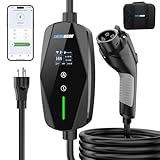
- 📱【2026 SMART CHARGING — FULL CONTROL, ZERO GUESSWORK】Built for modern EV owners, The Level 1 ev charger features adjustable current settings and intelligent scheduling via the mobile app. Easily set charging times, manage power output, and optimize energy usage—whether charging overnight or during off-peak hours. Smarter charging means lower costs, safer operation, and complete convenience on your schedule
- 🚗【ONE CHARGER, ALL J1772 EVs & PHEVs READY】Compatible with all SAE J1772 electric vehicles and plug-in hybrids. Designed to work seamlessly with most EV brands including Ford, GM, Nissan, Audi, BMW, Kia, Hyundai, Honda, Chevy, and more. Ideal for both home and on-the-road charging, this 16A portable Level 1 & Level 2 charger keeps your EV ready for every journey.
- 🔌🔌【LEVEL 1 & 2 PORTABLE EV CHARGER — CHARGE ANYWHERE】Designed for everyday flexibility, this portable EV charger supports both NEMA 5-15 outlets and NEMA 6-20 adapter. Charge at home, at a friend’s house, or while traveling. Level 2 (240V, 16A): up to 3.68kW, approx. 9–12 miles/hour Level 1 (120V): automatically limits current to 12A for safe household use,Smart current management protects your vehicle and your home’s electrical system.
- 🖥️📊【LCD SCREEN + SMART APP — REAL-TIME CHARGING INSIGHT】Unlike basic chargers that hide key data, this portable EV charger features a clear LCD screen and smart app control. Instantly view voltage, current, charging power, energy usage, and temperature—on the charger or remotely from your phone. One glance gives you full confidence and control over every charge.
- 🛡️【BUILT FOR SAFETY, DESIGNED TO LAST】Engineered with multiple safety protections—including over-temperature, over-current, over-voltage, and short-circuit protection. The intelligent control box continuously monitors charging status in real time. Rated IP65 for water resistance and built with flame-retardant materials, this charger is ready for daily use in any environment
| Approach | Where energy is controlled | Power flow | Main constraint |
|---|---|---|---|
| Grid-scale storage | Utility or regional system | Supports many loads, including EV chargers | Availability and dispatch are controlled by the grid operator |
| Behind-the-meter battery | Home, workplace or charging site | Can serve local loads after charging | Finite capacity, power limits and conversion losses |
| Scheduled or adaptive charging | Vehicle charger or energy-management software | Usually one-way, from grid to vehicle | Must preserve the vehicle’s required departure energy |
| Vehicle-to-building or vehicle-to-grid | EV battery plus bidirectional equipment | Two-way | Vehicle and charger compatibility, controls and mobility needs |
How to charge when wind output is low
The following process works for a household or a small workplace. Exact menu names differ by vehicle, charger and utility.
- Check what your local program can see. Ask the utility or charging provider whether it offers time-of-use rates, managed-charging enrollment or signals based on grid conditions. Do not assume that a charger’s word “smart” means it tracks renewable generation.
- Set the vehicle requirement first. Record the next departure time and the minimum state of charge needed for the trip. A schedule that follows low-carbon periods but leaves the car short of its required range is not a workable schedule.
- Choose the control window. If the program supplies renewable-output or grid-load information, allow charging during the specified windows. Otherwise, select a time-of-use period or a manually chosen period that fits your utility’s plan. The schedule shifts demand; it does not identify individual electrons.
- Use a networked Level 2 charger when you need automation. A connected charger can start, stop or reduce power remotely. Confirm that the vehicle, home network, electrical panel and service all support the intended operating current before installation.
- Enable adaptive limits. At a workplace or fleet depot, configure the system to respect building demand, circuit capacity and other vehicles. Staggering sessions can avoid a simultaneous peak even when all cars arrive together.
- Add stationary storage only for a defined purpose. Decide whether the goal is backup, load shifting, use of on-site generation or support during a known high-demand period. Match the battery’s kWh capacity and kW output to that purpose; a battery that can deliver high power briefly may not sustain a long charging session.
- Verify the result. Review charging history, departure readiness and any utility credits. If the car is repeatedly undercharged, widen the allowed window or reduce the renewable-following constraint.
What a smart charger can and cannot promise
What it can do
- Start charging at a scheduled time.
- Pause or resume a session as rates, building loads or grid signals change.
- Limit power so a site stays within its electrical capacity.
- Coordinate multiple vehicles while accounting for their required departure energy.
What it cannot do by itself
- Guarantee that electricity at the connector came from wind at that instant.
- Create renewable electricity when the grid has no renewable output.
- Provide backup power without a battery, a compatible vehicle and equipment designed for safe islanding.
- Turn a one-way charger or an incompatible EV into a vehicle-to-grid system.
A smart Level 2 charger is therefore an enabling tool for timing and load control. It is not a substitute for grid-scale storage, and it is not proof of a particular generation source.
Independent reader supportYour contribution helps us test, update, and keep practical guides available for everyone.Understanding one-way and two-way charging
Ordinary charging
In conventional charging, electricity flows from the grid or site supply into the vehicle. The charger can vary the rate or pause the session, but the battery does not send energy back to the building or grid.
Vehicle-to-building
Vehicle-to-building uses a compatible bidirectional charger and controls to support selected building loads. The system may reduce a site’s peak demand or provide backup during an outage if it is designed and permitted for that operation. The car’s departure requirement remains the priority.
Vehicle-to-grid
Vehicle-to-grid exports power under coordination with a grid operator or approved program. Frequency regulation, voltage support and peak reduction are potential services, but participation depends on local rules, communications, interconnection requirements and equipment compatibility. It should not be presented as a feature every EV automatically has.
Quick wins for a faster PC:
Clear out junk files and repair common Windows errorsFree Scan →Fix the driver behind crashes, sound loss and screen glitchesFind Drivers →Repair Windows errors before they cause bigger problemsFix Now →Rank #4

- WORKS WITH EVERY NON-TESLA EV: Standard J1772 connector plugs straight into Ford, Chevrolet, Hyundai, Kia, Nissan, BMW, Volkswagen, Audi, Rivian, Lucid and every other EV or plug-in hybrid sold with a J1772 port - no adapter needed. Tesla drivers can charge too, using the J1772 adapter that comes with the car.
- PLUG IN, NO HARDWIRING: Level 2 charger delivers up to 40A to fully charge most EVs overnight. Plugs into a 240V, 4-prong NEMA 14-50 outlet (the RV/range type - NOT a dryer outlet) on a dedicated 50A circuit. The extra-long 25 ft cable easily reaches across a garage or driveway. Before ordering, check your car's port type and that you have the right outlet.
- CONTROL & SAVE FROM YOUR PHONE: A stronger built-in antenna keeps the charger online even in a garage or basement. Use the free app to start/stop charging, set speed (6-40A), get reminders, and track energy use and cost. Schedule off-peak overnight charging to cut your electric bill. Requires 2.4 GHz WiFi.
- SAFETY-CERTIFIED & WEATHERPROOF: Independently tested and certified (UL, ETL, FCC, Energy Star). A fully sealed IP66 / NEMA 4 housing stands up to rain, snow, heat and dust indoors or out, and internal steel shielding protects the electronics for years of reliable use.
- GLOW-IN-THE-DARK HOLSTER: The included high-visibility holster glows in the dark so you can find and dock the plug easily at night. Holds the connector securely when not in use.
Common misconceptions and failure modes
“No wind means no renewable charging.”
Wind is only one source in a connected system. Other renewable generation, stored electricity and other grid resources can serve the load. The relevant question is the mix and controls serving your location at the charging time.
“The charger can select wind electrons.”
An ordinary outlet does not trace individual electrons to a turbine. A charger can follow a schedule or a grid signal, while renewable-energy accounting follows separate contractual rules.
“A battery returns everything put into it.”
Storage loses energy in conversion and retrieval. The usable output is therefore lower than the energy originally charged into the system.
“A larger kWh number always means faster charging.”
Energy capacity and power capacity are different. A system can hold a great deal of energy but release it slowly, or deliver high power for a short period. Both ratings must fit the EV load.
“Vehicle-to-grid is available on every EV.”
Export requires a compatible vehicle, bidirectional charger, control software and an approved connection. The vehicle may also be unavailable because it is needed for transportation.
How to evaluate a proposed setup
- Vehicle compatibility: Confirm whether the car supports scheduled charging, variable current and, if relevant, bidirectional operation.
- Charger capability: Check whether the unit is one-way or bidirectional, network-connected and able to integrate with the utility or site-management platform.
- Electrical capacity: Verify the circuit, panel, service and installation requirements for the intended charging power.
- Control signal: Identify exactly what causes a session to move: a clock schedule, a tariff, building load, a utility dispatch signal or renewable-output data.
- Energy requirement: Set a minimum state of charge and departure time for every vehicle, especially in a fleet.
- Storage sizing: Compare both kWh and kW ratings and allow for conversion losses and the duration of the expected shortfall.
- Local rules: Confirm utility enrollment, interconnection, outage operation and any export restrictions before relying on vehicle or stationary storage.
What can be stated—and what cannot
It is accurate to say that renewable generation can support EV charging over time, that storage can move energy from a high-generation period to a later charging period and that managed charging can make EV demand more flexible. It is not accurate to promise a universal percentage of renewable electricity for a particular charging session without location-specific data. The available evidence also does not establish a standard household battery size, a typical cost or a guaranteed financial payback.
For an individual driver, the most defensible claim is conditional: use a charger and utility program that shift demand when the system has more renewable electricity, and add compatible storage if you need to bridge a longer gap. The actual electricity mix remains dependent on the grid and the equipment operating at that time.
Quick Recap
Product prices and availability are accurate as of the date/time indicated and are subject to change. Any price and availability information displayed on Amazon at the time of purchase will apply.




