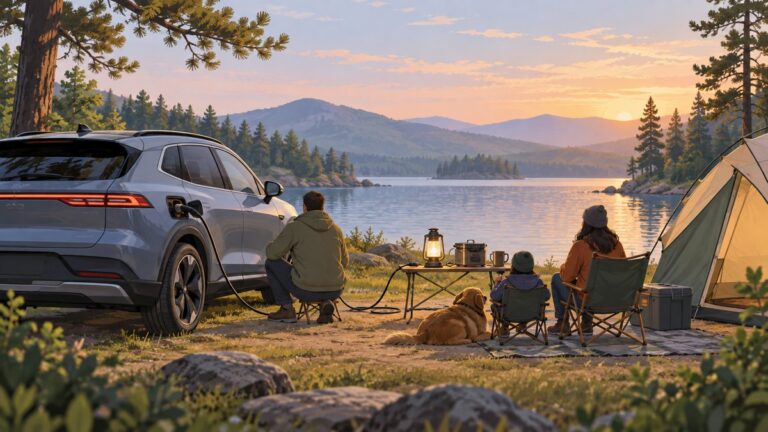
Yes, an electric car can catch fire and a fire can spread to a nearby home, but available evidence does not show that electric cars routinely set houses on fire. The risk depends on the circumstances: a damaged or defective high-voltage battery is different from a charging-equipment or household-wiring fault, and neither should be confused with a count of house fires caused by EVs. The sources cited here do not establish how many homes have been ignited by electric cars or provide a reliable fire-rate comparison with gasoline vehicles.
What the evidence says about EV and house fires
Fires involving electric-vehicle traction batteries are a documented hazard. But a vehicle fire is not automatically a house fire: the available figures do not tell us how often an EV fire spreads to a structure.
A 2026 National Institute of Standards and Technology (NIST) analysis estimated 5,718 fires involving electric and plug-in hybrid vehicles since 2011, with a 95% confidence interval of 2,866 to 10,846. NIST cautions that the underlying sources are fragmented and mostly incomplete, so this is an estimate—not a verified incident census or a rate per vehicle. The same analysis estimated 198,000 fires involving lithium-ion batteries in structures since 2011 (95% confidence interval: 84,000–465,000). That broad category includes lithium-ion battery fires generally; it is not a count of houses ignited by EVs. NIST’s analysis and methods explain the limits.
NIST also estimated that plug-in vehicle fires grew about 45% per year (±11.3%) over the period it studied. Because the incident data are incomplete and the figure is a trend in estimated fire counts, it should not be read as an individual EV becoming 45% more likely to catch fire each year. The sources available here do not provide a reliable apples-to-apples fire rate per vehicle or mile for EVs versus gasoline vehicles.
Recommended Free Tools
#1 Best Overall

- 【Vehicle Fire Containment for EVs & Cars】 Designed to help isolate fires involving electric, hybrid, and gasoline-powered vehicles. This large car fire blanket helps contain flames, radiant heat, and smoke while limiting exposure to nearby vehicles, equipment, and surrounding property.
- 【Heavy-Duty Basalt Fiber Construction】 Made from durable heat-resistant basalt fiber fabric for demanding vehicle fire containment applications. The dense woven material creates a substantial thermal barrier and provides reliable protection in high-temperature emergency environments.
- 【Extra-Large 20 x 24 FT Coverage】 Measuring 20 FT × 24 FT, this large fire blanket provides generous coverage for passenger cars, electric vehicles, SUVs, pickup trucks, and other common vehicles, helping create a more complete containment area around the affected vehicle.
- 【Designed for Emergency Deployment】 The oversized flexible blanket can be positioned over and around an affected vehicle to help isolate the fire area and reduce the spread of flames and heat. Designed for coordinated deployment by trained personnel during vehicle fire emergencies.
- 【Professional Fire Safety Applications】 Ideal for EV charging stations, parking garages, automotive repair shops, dealerships, towing yards, fleet facilities, warehouses, workshops, and other vehicle-dense locations where emergency fire preparedness is important.
Why a damaged EV battery can remain hazardous
In a high-voltage lithium-ion battery, damage to cells can trigger thermal runaway—a self-heating reaction that can spread within the battery. A battery can retain energy after a crash, creating electric-shock hazards and the possibility of reignition even after visible flames are out. The National Transportation Safety Board (NTSB) documented these risks in a study of four EV fires; it describes hazards to emergency responders, not how often fires occur or spread to homes. NTSB’s safety study provides more detail.
Damage need not cause an immediate fire. NHTSA warns that a damaged lithium-ion battery may release toxic or flammable gases and catch fire immediately or later. Flooding can also create shock and fire hazards. These possibilities are reasons to treat a damaged or flooded vehicle seriously, not evidence that an undamaged EV in ordinary use will ignite a home.
Is it safe to charge an electric car in a garage?
The U.S. Fire Administration (USFA) says, “Charging an EV is safe when done with certified equipment.” Its consumer guidance focuses on charger condition, proper equipment, and suitable wiring. It does not guarantee that a vehicle is free of a battery defect, nor does correct charging setup remove every fire risk.
Rank #2

- Efficient Fire Control: Our fiberglass fire blanket rapidly cuts off oxygen and withstands extreme heat up to 2012°F (1100°C)—the same high-risk fire performance as silicone-coated versions. Ideal for EV battery fires, gasoline leaks, and other emergencies where traditional extinguishers fall short
- Must-Have Car Safety Essential: Compact enough to fit in your trunk yet expansive (4m × 6m / 13ft × 19.7ft) to fully cover a small car. A critical addition to any emergency car kit. Comes with a sturdy storage bag for quick access
- Cost-Effective & Lightweight Alternative: Without the silicone coating, this blanket offers a more affordable option while maintaining excellent heat resistance and tear strength. Slightly lighter than coated versions for easier handling. Note: Fiberglass fibers may cause skin irritation—gloves are recommended during use
- Versatile Fire Protection: Effective across multiple scenarios: car engines, EV batteries, parking lots, workshops, and industrial environments. A reliable solution for protecting vehicles and large valuable equipment from fire
- Single-Use or Limited Reuse: Designed for 1–2 uses. High-temperature exposure may cause darkening, stiffening, or burn holes—once damaged, the blanket should be replaced. For repeated use and longer service life, consider our double-sided silicone-coated version
- Have a qualified electrician install a new dedicated circuit for home charging; older wiring may not be suitable for EV supply equipment. Tennessee’s State Fire Marshal’s Office reiterated the dedicated-circuit and licensed-electrician advice in July 2025.
- Use charging equipment certified by a nationally recognized testing laboratory and follow both the vehicle and charger manufacturers’ instructions.
- Plug a Level I charger directly into a properly rated outlet. Do not use an extension cord or multiplug adapter.
- Maintain the charging equipment and stop using it if it is visibly damaged.
These precautions address the home electrical installation and charging equipment; they do not prevent or repair a defect in the car’s traction battery. See the USFA’s EV charging and fire-safety guidance and the Tennessee State Fire Marshal’s July 2025 advisory.
Do these 3 things before closing this tab:
1Scan for outdated or missing drivers - takes under a minute2Repair Windows errors before they cause bigger problems3Fix the driver behind crashes, sound loss and screen glitchesWhat to do after a crash, fire, or flood
If a fire or another emergency is happening, call 911. Do not assume a damaged vehicle’s high-voltage system is switched off: NHTSA advises treating high-voltage components as energized. Contact the dealer promptly about a damaged vehicle, even if there is no immediate emergency. After suspected flood damage, contact the dealer and/or emergency services and follow current official and manufacturer instructions. NHTSA’s electric and hybrid vehicle guidance covers battery, charging, and safety concerns.
NHTSA says not to park a damaged lithium-ion vehicle in a garage or within 50 feet of a house, other structure, vehicle, or combustible material. The distance is specific to its guidance for damaged vehicles; it is not a general parking rule for every EV. If your vehicle has been damaged, follow current NHTSA and manufacturer advice rather than relying on a normal charging routine.
Rank #3

- Fast – isolates fire in seconds – Once the car spontaneously combusts, quickly unfold the car fire blanket and cover the car to isolate the oxygen, prevent the fire from further spreading and reduce the damage.
- Effective – extinguishes fire in minutes – It is worth noting that the car fire blanket is only suitable for the initial stage of the fire, before the fire has not spread, the use of car fire blanket to quickly extinguish the fire.
- Simple – can be used by anyone – Automotive fire blankets are quick and easy to use and two adults can do the job, while other firefighting equipment requires more specialized firefighters to use.
- Eco-friendly – no toxic fumes or liquids – There are thousands of car fires around the world every single day. Most of them are extinguished using foam or water. But these methods throw toxic fumes into the air and drain hazardous substances in the groundwater. FLASLD Car Fire Blankets don’t. They isolate smoke immediately without spreading toxic fumes or substances – making them safer for people and the environment.
- Universal – even works on electric cars – Ideal for spaces with a high concentration of cars, such as parking garages, road tunnels, car ferries and car repair shops.Suitable for professional firefighters and other organizations that may have to deal with multiple fires. Blocks and isolate fire in electric vehicles.
USFA notes that substantial scientific gaps remain in guidance for identifying, confining, and extinguishing EV fires. Its overview is directed to emergency-response issues, so drivers should not try to apply responder tactics themselves. USFA’s July 29, 2025 overview explains those limitations.
How to check whether your EV or plug-in hybrid has a fire recall
Fire recalls apply to specific vehicles, not automatically to every car from the same brand or to all EVs. Check the vehicle identification number (VIN) and the current remedy status using NHTSA’s recall information, then follow the manufacturer’s instructions for the affected vehicle. A recall example illustrates why checking matters: in an alert dated November 4, 2025, NHTSA told owners of affected 2020–2025 Jeep Wrangler and 2022–2026 Jeep Grand Cherokee plug-in hybrids to park outside and not charge until remedied. Those instructions apply to the affected vehicles in that recall, not every Jeep or plug-in vehicle. Read NHTSA’s recall alert and review its Battery Safety Initiative for safety information.
What’s actually slowing this PC down?
Pick the symptom - the matching free tool is one click away.
Quick Recap
Product prices and availability are accurate as of the date/time indicated and are subject to change. Any price and availability information displayed on Amazon at the time of purchase will apply.