Windows Errors? Fix Them Before They Spread
Repair common Windows errors and clear accumulated junk for a smoother, more stable PC - no reinstall needed.Free scan · no reinstallCrashes, No Sound, or Screen Glitches?
Random freezes, missing sound and display glitches usually trace back to one bad driver. Find and replace yours safely.Free scan · under a minuteThe meaningful period comparison is the Bugatti Type 41 Royale against the 1925 Rolls-Royce New Phantom, later called Phantom I—not against a modern Phantom. The Royale was Bugatti’s ultra-low-volume, exceptionally large flagship, using a 12.7-litre inline-eight. The New Phantom was the Silver Ghost successor, powered by a 7.7-litre overhead-valve six-cylinder engine. Both were supplied as chassis-based luxury cars whose final identities depended heavily on independent coachbuilders.
That makes this less a contest between two fixed specifications than a comparison of two different ideas of prewar prestige. Bugatti pursued mechanical and physical extravagance for royal-level clients; Rolls-Royce established a flagship model that would continue through eight generations. The figures below are historical specifications from the manufacturers and the National Motor Museum, not results from a common road test.
As an Amazon Associate I earn from qualifying purchases.
Which Rolls-Royce Phantom belongs in this comparison?
“Rolls-Royce Phantom” is an ambiguous label. Rolls-Royce introduced the New Phantom in 1925. After the Phantom II arrived in 1929, the original car became known retrospectively as Phantom I. Rolls-Royce Motor Cars now describes the nameplate as an eight-generation line, so a general reference to “the Phantom” can accidentally place a 1920s car beside a modern limousine.
For a historically fair comparison, this article uses the 1925 New Phantom, or Phantom I, alongside the Type 41 Royale. Later Phantom generations belong to different engineering, regulatory and market eras and should be treated as separate cars.
#1 Best Overall

- AUTHENTIC REPLICA: Highly detailed 1:40 scale model of the iconic 1957 Chevrolet Bel Air Coupe, measuring 5 inches in length with classic finish
- WORKING FEATURES: Functioning doors that open and close, plus pull-back motor action for interactive play value
- QUALITY CONSTRUCTION: Die-cast metal body construction provides durability and authentic feel, enhanced with detailed plastic components
- REALISTIC DETAILS: Features rubber tires for enhanced realism and smooth rolling action on various surfaces
- DISPLAY WORTHY: Perfect size for collectors and enthusiasts, combining playability with showcase appeal
The Type 41 Royale’s starting point
Bugatti’s own history dates the Royale’s creation to 1926. It was conceived as a top-level luxury car for royal families and heads of state rather than as a mass-market model. Economic conditions restricted the intended production run, leaving a car that became notable as much for scarcity and scale as for its engineering.
The New Phantom’s starting point
Rolls-Royce introduced the New Phantom in 1925 as the successor to the Silver Ghost. The National Motor Museum’s account of a 1925 car identifies its 7.7-litre six-cylinder engine and explains why the Phantom I designation is retrospective. Both the Royale and the New Phantom belong to the same broad prewar world of chauffeur-driven, coachbuilt automobiles, but they arrived with different corporate histories and design priorities.
At-a-glance comparison
| Category | Bugatti Type 41 Royale | Rolls-Royce New Phantom / Phantom I |
|---|---|---|
| Period | Prototype in 1926; production model developed in the same era | Introduced in 1925; called Phantom I retrospectively after Phantom II appeared in 1929 |
| Engine | 12.7-litre inline-eight, three valves per cylinder | 7.7-litre six-cylinder with overhead valves |
| Published output | Approximately 300 PS below 2,000 rpm, according to Bugatti’s 2013 specification | The National Motor Museum says it produced 33% more horsepower than the Silver Ghost predecessor at just over 2,000 rpm; an equivalent absolute figure is not stated in the cited material |
| Length and wheelbase | Almost 6.5 metres long; 4.3-metre wheelbase | Comparable dimensions are not stated in the cited sources |
| Weight | About three tonnes in one Bugatti account; another says body-dependent examples could reach 3.5 tonnes | Not stated in the cited sources |
| Fuel capacity | 190-litre tank, according to Bugatti’s 2013 specification | Not stated in the cited sources |
| Body construction | Customers received a chassis, drive and grille; specialist coachbuilders created the body | Rolls-Royce supplied a rolling chassis; independent coachbuilders built bodies to owners’ specifications |
| Production and survival | Six built; Bugatti says four were sold and all six survive | First-generation production total is not established in the cited sources; Phantom as a nameplate has eight generations |
| Intended status | Flagship luxury car aimed at royal families and heads of state | Rolls-Royce’s flagship line, with early owners commissioning individual coachbuilt forms |
How do their engines differ?
Bugatti’s 12.7-litre inline-eight
Bugatti’s 2013 specification gives the production Royale a 12.7-litre inline-eight with three valves per cylinder. It reports approximately 300 PS below 2,000 rpm. A separate Bugatti retrospective rounds the displacement to 12.8 litres and describes output as about 300 horsepower. The 12.7-litre and approximately 300 PS figures are the more specific combination for the 2013 specification; the rounded 12.8-litre and horsepower wording belongs to the later retrospective.
The engine’s eight cylinders were arranged in line, an architecture that allowed a very large displacement in one long power unit. Bugatti’s stated output at an engine speed below 2,000 rpm is a specification point, not a modern-style acceleration test. No common dynamometer procedure or independent period road test is provided here, so it would be misleading to turn the figures into a claimed 0–60 mph result, top speed or torque comparison.
Phantom I’s 7.7-litre six
The original Phantom used a 7.7-litre six-cylinder engine with overhead valves, according to the National Motor Museum. The museum reports that it delivered 33% more horsepower than the Silver Ghost predecessor at just over 2,000 rpm. That is a generational comparison within Rolls-Royce, not a direct test against the Royale.
The different cylinder counts and displacements show the contrast in engineering scale. The Royale’s 12.7 litres exceed the Phantom’s 7.7 litres by 5.0 litres, but displacement alone does not establish which car was faster or more effortless in real traffic. Cooling, gearing, body weight, chassis setup, final-drive ratios and the coachbuilt body would all influence how either car behaved. Those comparative measurements are not established in the cited sources.
Why PS and horsepower should not be merged
Bugatti’s figure is approximately 300 PS, while the later Bugatti account uses approximately 300 horsepower and the museum describes a percentage improvement without giving a matching absolute number. PS and mechanical horsepower are closely related units but are not identical. Retaining each source’s wording avoids creating a false precision that the historical material does not support.
Was the Royale bigger than the original Phantom?
Bugatti reports that the Royale was almost 6.5 metres long, with a 4.3-metre wheelbase and a weight of roughly three tonnes. Its 2013 specification also lists a 190-litre fuel tank. Another Bugatti historical account says that weight could reach 3.5 tonnes depending on the body fitted.
Rank #2

- 1:18 Special Edition. Detailed die-cast precision model. Large - approx 9.5" replica.
- Die-cast metal body. Opening doors and engine compartment.
- Full functioning steering. Four-wheel suspension.
- Detailed chassis with separate exhaust system.
- Mounted on plastic stand.
Those measurements establish the Royale as an exceptionally large automobile. They do not, by themselves, prove a specific percentage advantage over the Phantom I because the cited Phantom sources do not provide comparable length, wheelbase or weight figures. A responsible answer to “was it bigger?” is therefore limited: the Royale was extraordinarily large, but the available specifications here do not support a measured dimension-by-dimension claim against a particular Phantom I body.
Body choice changes the numbers
Neither car existed as one universal silhouette. The body selected by the owner altered mass, roofline, seating arrangement, luggage provision and the way the car occupied a road. A Royale’s approximately three-tonne figure should be read alongside Bugatti’s warning that some bodies could push weight toward 3.5 tonnes, rather than treated as a single immutable curb weight.
The 190-litre tank is another useful indicator of the Royale’s intended scale, but it is not evidence of a particular touring range. Fuel consumption, gearing, road conditions and body mass would all be needed for that calculation, and no verified range figure is supplied for either car.
Do these 3 things before closing this tab:
1Clear out junk files and repair common Windows errors2Fix the driver behind crashes, sound loss and screen glitches3Repair Windows errors before they cause bigger problemsWhy coachbuilding is central to the comparison
In the 1920s, a prestigious car was often a rolling mechanical package awaiting its body. The customer’s coachbuilder and design brief could be as important to the finished car’s identity as the engine badge.
Royale coachbuilt bodies
Bugatti says selected Royale customers received the chassis, drive and grille, after which independent specialists created the body. Its historical material names Kellner, Weymann, Binder, Bugatti, Weinberger and Park Ward among the coachbuilders associated with Royale bodies. These firms did not merely apply decorative trim. They determined the passenger compartment, doors, roof treatment, glazing, seating and much of the final visual character.
Phantom I coachbuilt bodies
Rolls-Royce followed the same broad rolling-chassis model for the original Phantom. Owners could commission independent coachbuilders to construct bodywork to their specifications. Consequently, “a Phantom I” identifies a mechanical generation, not one fixed body style. Two examples can share the same basic engine and chassis lineage while differing substantially in proportions, seating and use.
How to compare individual cars fairly
When examining a specific Royale and a specific Phantom I, record the body before drawing conclusions about size, weight or purpose. A formal limousine body, a touring body and another specialist design can produce different passenger capacity and mass. The coachbuilder also affects historical provenance and collector interest, although no verified market valuation is established in the cited material.
Free tools Windows power users keep installed
One-click scans. No signup required.
This also explains why photographs can be misleading. A dramatic Royale limousine and a more open Phantom touring body may appear to represent different classes of automobile even when the underlying comparison is between two flagship chassis. The fair unit of comparison is therefore the complete documented car: chassis, engine specification, coachbuilder, body style and surviving history.
Rank #3

- Approximately 7-1/2" Long
- Scaled replicas of cars and trucks
- Die-cast metal body with plastic details
- Opening doors on all- some with opening hoods and trunks
- Detailed chassis
How rare is the Bugatti Royale?
Six built is not the same as four sold
Bugatti’s 2013 material states that six Royales were built. Its 2020 retrospective says four were sold and that all six survive. These are different measures: six is the total production figure, while four refers to customer sales in that account. It is incorrect to describe four as total production.
The survival claim is extraordinary: Bugatti says every one of the six built still exists. Because the production run is so small, each car’s chassis history and coachbuilt body are integral to understanding the model. The rarity is not a marketing estimate or an auction guess; it is the manufacturer’s published historical account.
What can be said about Phantom I numbers?
The cited Phantom sources establish the 1925 launch, the later Phantom I designation, the engine and the broader coachbuilding practice, but they do not provide a first-generation production total that can be set beside six Royales. A numerical rarity ranking would therefore overstate what these sources establish.
It is also important not to compare six Royales with the total output of every Phantom ever made. Phantom is a nameplate spanning eight generations, while the Royale is one model with a tightly defined production story. Any rarity statement must specify whether it concerns the original 1925 generation or the entire Rolls-Royce lineage.
Purpose and status: two kinds of flagship
The Royale as an engineering spectacle
Bugatti presents the Royale as a car intended for royal families and heads of state. Its enormous engine, almost 6.5-metre length, 4.3-metre wheelbase and multi-tonne mass fit that brief. Bugatti also characterizes it in superlative terms such as “largest” or “most powerful”; those descriptions should be understood as the marque’s historical characterization rather than an independently verified ranking of every contemporary luxury car.
The Phantom as a continuing pinnacle
Rolls-Royce Motor Cars describes Phantom as its pinnacle model through successive generations. In a 2025 centenary release, chief executive Chris Brownridge said the nameplate had retained that fundamental role through eight generations and called it the “very best of the best.” That is the company’s positioning statement, not an independent comparative judgment against the Royale.
The distinction is important. The Royale’s story is concentrated in a tiny run of surviving cars. Phantom’s story is a continuing nameplate whose meaning was renewed through successive generations, beginning with the 1925 New Phantom.
Quick wins for a faster PC:
Repair Windows errors before they cause bigger problemsFix Now →Fix the driver behind crashes, sound loss and screen glitchesFind Drivers →Clear out junk files and repair common Windows errorsFree Scan →What would ownership or collecting comparisons require?
A credible ownership comparison would need information beyond the historical specifications: verified sale prices, restoration records, parts availability, specialist labor rates, fuel consumption and maintenance schedules for particular chassis. Those figures are not established here, so neither car can responsibly be declared cheaper to maintain, more valuable or easier to operate.
Rank #4

- 1/24 Scale Diecast Model Car
- Opening doors, hood & trunk
- Size 8x3x3 inches
- Window box measures: 9.75"L x 4.5"W x 4"H
For a collector, documentation is especially important. On a Royale, the six-car production total means chassis identity, body provenance and the claimed survival of all six are central facts. On a Phantom I, the exact coachbuilt body and its history distinguish one example from another. A generic model label is not enough to assess an individual car.
Which car is more impressive depends on your comparison axis
| If you care most about… | The stronger fit is… | Why the evidence supports that choice |
|---|---|---|
| Mechanical scale | Type 41 Royale | Its documented 12.7-litre inline-eight is substantially larger in displacement than the Phantom I’s 7.7-litre six-cylinder. |
| Physical presence | Type 41 Royale | Bugatti publishes almost 6.5 metres of length and a 4.3-metre wheelbase, with body-dependent weight up to 3.5 tonnes. |
| Documented scarcity | Type 41 Royale | Bugatti states that six were built, four sold and all six survive. |
| Period Rolls-Royce engineering | Phantom I | The 1925 New Phantom is the direct Rolls-Royce contemporary, with a 7.7-litre overhead-valve six-cylinder engine. |
| Coachbuilt individuality | Neither has an automatic advantage | Both were delivered through chassis-based arrangements in which independent coachbuilders shaped the finished body. |
| Long-term nameplate continuity | Phantom | Rolls-Royce identifies eight generations of the Phantom nameplate, whereas the Royale was a single, exceptionally limited model. |
| Direct performance winner | Not established | The cited material provides no common acceleration, top-speed, torque or instrumented road test. |
What the comparison does—and does not—prove
The documented specifications make the Royale the more extravagant machine on engine displacement and published dimensions. They do not prove that it accelerated faster, reached a higher top speed or delivered a smoother ride than every Phantom I. Nor do they establish a value or maintenance-cost advantage for either car.
Likewise, the Phantom’s continuing prestige does not make every Phantom generation equivalent to the 1925 car. A modern Phantom carries the nameplate’s legacy but belongs to a different technological and regulatory context. Keep the generation explicit whenever discussing engineering, dimensions, performance or ownership.
What’s actually slowing this PC down?
Pick the symptom - the matching free tool is one click away.
Frequently asked questions
How does the Bugatti Type 41 Royale compare with the Rolls-Royce Phantom?
Against the 1925 New Phantom, later called Phantom I, the Royale is the larger and rarer documented machine: 12.7 litres versus 7.7 litres, almost 6.5 metres long and six built. The Phantom is the period Rolls-Royce contemporary and the starting point of a nameplate that now spans eight generations. Neither car has a verified performance victory in the material cited here.
Was the Bugatti Royale bigger than the original Rolls-Royce Phantom?
The Royale was unquestionably very large by the figures Bugatti publishes—almost 6.5 metres long, with a 4.3-metre wheelbase and roughly three tonnes, potentially 3.5 tonnes depending on body. The Phantom sources used here do not give matching dimensions, so an exact percentage difference cannot be stated.
What engine did the Bugatti Royale have?
The production Type 41 used a 12.7-litre inline-eight with three valves per cylinder. Bugatti lists approximately 300 PS below 2,000 rpm. A separate Bugatti retrospective rounds the engine to 12.8 litres and the output to about 300 horsepower; those are rounded descriptions rather than a reason to merge the units.
How many Bugatti Royales were made?
Bugatti states that six Royales were built. Its 2020 historical account says four were sold and all six survive. “Four sold” is a customer-sales count, not the production total.
Which Rolls-Royce Phantom generation is comparable to the Royale?
The correct period counterpart is the 1925 New Phantom, retrospectively called Phantom I after Phantom II appeared in 1929. Later Phantom generations, including modern cars, belong to different technical and regulatory eras.
Best Value
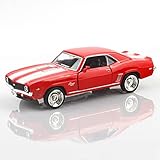
- High-Quality Materials:The 1969 Camaro SS die-cast car is made of zinc alloy,plastic parts and rubber tires,making it safe for children to play with.It features detailed interior and exterior trim, and is very sturdy.
- Function:No batteries are required, but the vehicle has a powerful pull back feature. Simply pull it back, then release your hand, and the car will go for a long distance. The doors may be opened to view the whole inside of the vehicle. So appealing to children and collectors alike.
- Size:1/36 scale vehicle model with beautiful English packaging,ideal for toddlers to play with and carry. Car collectors will appreciate the perfect small size, which allows them to collect a complete set of cars without taking up too much space.
- Grow From Play:Help children learn more about car ,expand their knowledge ,increase the hand-eye coordination and the reaction speed of the children in the play.
- Ideal Christmas Festival Gift:All of TOKAXI die-cast model cars are attractively packaged in English, making them the perfect Christmas, Birthday, Children's Day, New Year gift for kids, party favors, home decorations, or travel toys for boys and girls.gifts for boys girls.
Did either car have a single standard body?
No. Both were chassis-based luxury cars whose bodies were commissioned from independent coachbuilders. Royale bodies are associated with firms including Kellner, Weymann, Binder, Bugatti, Weinberger and Park Ward; Phantom I owners likewise specified coachbuilt forms. Body style must be identified before comparing weight, seating or appearance.
Which car is faster or more valuable?
The available historical specifications do not provide a common acceleration test, top speed, torque comparison or verified market valuation. Displacement and published output alone cannot answer those questions, and no reliable maintenance-cost comparison is established either.
Bottom line: spectacle versus continuity
Interpreted through the cited manufacturer and museum histories, the Bugatti Type 41 Royale is the choice for engineering spectacle, physical scale and documented scarcity: a 12.7-litre, approximately 300-PS flagship built only six times. The 1925 Rolls-Royce New Phantom, later Phantom I, represents a different achievement: a technically substantial 7.7-litre successor to the Silver Ghost that established the Phantom name as a recurring pinnacle of the Rolls-Royce range. Neither replaces the other. The Royale is the rarer historical event; the Phantom is the enduring flagship concept.
Recommended Free Tools
Frequently Asked Questions
How does the Bugatti Type 41 Royale compare with the Rolls-Royce Phantom?
Compared with the 1925 New Phantom, later called Phantom I, the Royale has the larger documented engine, greater published dimensions and a six-car production run. Phantom I is the direct Rolls-Royce contemporary and the beginning of an eight-generation nameplate.
Was the Bugatti Royale bigger than the original Rolls-Royce Phantom?
Bugatti lists the Royale at almost 6.5 metres long, with a 4.3-metre wheelbase and roughly three tonnes, potentially 3.5 tonnes depending on body. The cited Phantom sources do not provide comparable dimensions for an exact percentage comparison.
What engine did the Bugatti Royale have?
A 12.7-litre, three-valve-per-cylinder inline-eight producing approximately 300 PS below 2,000 rpm, according to Bugatti’s specific 2013 figures.
How many Bugatti Royales were made?
Six were built. Bugatti separately says four were sold and all six survive.
The Tool Desk
Outbyte PC Repair FREERepair Windows errors before they cause bigger problemsFix Now →Outbyte Driver Updater FREEScan for outdated or missing drivers - takes under a minuteDriver Scan →Which Phantom generation is comparable?
The 1925 New Phantom, retrospectively designated Phantom I after Phantom II arrived in 1929.
Did both cars use coachbuilt bodies?
Yes. Buyers received chassis-based cars and independent coachbuilders created bodies to individual specifications, making body style and provenance essential when comparing examples.
The Bottom Line
Bottom line: The Type 41 Royale delivers unmatched documented scale and scarcity, while the 1925 New Phantom—Phantom I—represents the beginning of Rolls-Royce’s enduring flagship nameplate. Choose the Royale for spectacle; choose the Phantom for continuity and period Rolls-Royce character.
Quick Recap
Product prices and availability are accurate as of the date/time indicated and are subject to change. Any price and availability information displayed on Amazon at the time of purchase will apply.




