PC Slower Than It Used to Be?
A free scan shows the junk files, broken settings and background clutter dragging Windows down - then fixes them in one click.Free scan · Windows 10 & 11Crashes, No Sound, or Screen Glitches?
Random freezes, missing sound and display glitches usually trace back to one bad driver. Find and replace yours safely.Free scan · under a minuteBMW began construction on 30 September 2026 on a roughly two-kilometre pipeline intended to connect its Leipzig vehicle plant directly to the hydrogen grid. The connection is planned to be completed and commissioned in the first half of 2028; it is not yet in service. BMW describes Leipzig as the first vehicle plant worldwide planned to have a direct hydrogen-grid connection.
What the pipeline will do at BMW’s Leipzig plant
The new link is intended to let the plant use more hydrogen in energy-intensive production, particularly in its paint shop. Hydrogen is already used at Leipzig for intralogistics and in dual-fuel paint-shop furnaces. A direct supply is expected to make greater use possible in high-temperature processes such as paint drying, while supporting energy resilience and further production decarbonisation.
BMW Plant Leipzig Director Petra Peterhänsel said the pipeline would allow the paint shop to be powered with hydrogen “to a far greater extent than ever before,” and called it a milestone for energy resilience and production decarbonisation. BMW has not published a project cost, expected hydrogen volume or quantified emissions reduction, so the announcement does not establish how much energy use or emissions the connection will ultimately displace.
Hydrogen equipment already on site
BMW reports that Leipzig operates more than 230 hydrogen fuel-cell forklifts and tug trains, as well as eleven dual-fuel paint furnaces. Those figures describe equipment at the plant, not the capacity or output of the new pipeline.
Do these 3 things before closing this tab:
1Repair Windows errors before they cause bigger problems2Fix the driver behind crashes, sound loss and screen glitches3Clear out junk files and repair common Windows errors#1 Best Overall

- [Simple Operation] The PQ125E water leak detectors for home utilizes a factory-developed UI interaction system. Its touchscreen displays each functional module clearly with operational guidance and error pop-ups, enabling even inexperienced users to easily detect leak points. For professional leak detection personnel, it proves an invaluable asset.
- [Precise Localization] The water leak detector has two leak detection modes.Users can quickly scan large areas to identify leak locations via GENERAL DETECTION MODE.In LOCATION MODE, signals from sixteen points are captured and retained in the screen's data collection box. By comparing signal strengths, the exact leak point is pinpointed.
- [High-Precision Sensors]The PQ125E water leaks detector features dual membrane resonance sensors DMR-V40 and DMR-H59,the acoustic resonance sensors RCS-L3and RC-S6,and the trace leak detection sensor TLS-H8, it offers flexible adaptation to various detection needs such as external main pipelines and indoor branch lines.
- [Original Manufacturer] The PQ125E water leaks detector is independently developed and manufactured by PQWT—Hunan Puqi Geologic Exploration Equipment Institute. As a precision instrument manufacturer collaborating with multiple universities, we have specialized in pipeline leak detection for 19 years, possessing mature production lines and a robust R&D team.
- [Warranty and Languages] The main unit comes with a two-year warranty and lifetime maintenance. Available in 12 languages: English, Turkish, Italian, French, Spanish, Arabic, Russian, Korean, German, Portuguese, Polish, Vietnamese.
Who is building and supplying the connection
BMW has a capacity reservation contract with ONTRAS Gastransport GmbH, which is responsible for developing the regional core hydrogen network. MITNETZ GAS GmbH is to build the roughly two-kilometre plant connection, including its gas pressure regulation and metering station. These are distinct roles: ONTRAS develops the regional network, while MITNETZ constructs the spur and associated station.
Wirtschaftsförderung Sachsen says the project is co-financed by the European Regional Development Fund and the Free State of Saxony. The published information does not state the funding amount.
Rank #2

- Portable gas analyzer with fast response for various gas applications.
- Compact handheld design for convenient carrying in industrial workplaces.
- Clear display for quick viewing in different working environments.
- Suitable for gas leakage checking in pipelines, equipment areas, and factories.
- Stable sensing performance with efficient gas analysis capability.
Why the current target is 2028
BMW’s schedule has changed. Its 1 October 2025 release expected delivery from mid-2027, but the newer announcement, dated 30 September 2026, sets completion and commissioning for the first half of 2028. The 2028 window is the current stated target; the earlier date is no longer the forecast to use.
Independent reader supportYour contribution helps us test, update, and keep practical guides available for everyone.How the plant connection fits Germany’s hydrogen network
The Leipzig project is a short industrial spur, not a national trunk network. Germany’s Federal Ministry for Economic Affairs and Energy described a planned hydrogen core network of 9,040 kilometres, with around 60 percent of its pipeline length intended to come from converting natural-gas pipelines. The ministry’s 2024 plan also set 2032 feed-in capacity of 101 GW and take-off capacity of 87 GW.
Rank #3

- 【Professional Teaching Demonstration】 Designed for chemistry teaching and science demonstration, the Hydrogen and Oxygen Separation Electrolyzer, with a capacity of 0.4GAL (1.5L), is large enough to clearly show the generation and separation of hydrogen and oxygen in the process of water electrolysis. Suitable for college classrooms, chemistry interest classes, small science labs and chemistry research exhibition rooms, it is an ideal teaching tool for educators and students.
- 【Independent gas piping ensures pure separation】 This science education instrument adopts double outlet design, hydrogen and oxygen are output through two independent pipelines to ensure that the two gases will not be mixed to meet the precise teaching needs. Transparent acrylic electrolyzer makes the process of gas production clear at a glance, making it easy to observe the generation of bubbles and separation of gases in the Electrolysis reaction, which enhances the teaching effect.
- 【High-efficiency electrolysis technology to enhance the reaction efficiency】 Built-in multiple stainless steel tubes greatly increase the electrolysis contact area, promote electrolysis reaction more fully and faster. 400W power, with 12V low voltage power supply, not only to ensure high efficiency electrolysis, but also to ensure the safety of the operation, no risk of heating.
- 【Safe and easy to operate】 Safety is always the primary consideration, this machine adopts 12V low voltage design, no heating during use, safe and reliable. The operation process is simple and clear, just dissolve the catalyst and cool it down, inject it into the electrolyzer and connect it to the power supply to start the demonstration. Clear instructions ensure that even beginners can easily get started and enjoy the fun of scientific exploration.
- 【Easy Maintenance, Long-term Durability】 After long-term use, just pour out all the liquid and wash it with tap water, easy and convenient maintenance. The compact size of the hydrogen and oxygen separation electrolyzer makes it easy to carry and store for teaching demonstrations anytime, anywhere.
Those national figures describe planned network scale and capacity targets, not the Leipzig pipeline’s capacity or a guarantee of hydrogen supply to the plant by a particular date. The roughly two-kilometre connection is intended to link one factory to the wider system; BMW’s announcement does not give its throughput.
Quick Recap
Best Value

- 1. Electrical part: motor with wind shoulder, ammeter, voltmeter.
- 2. Ammonia fuel cell.Hydrogen's electrons travel from the anode to the cathode through an external circuit, generating an electric current. At the cathode, the electrons, protons, and oxygen in the air combine to produce water, which is the main by-product of the fuel cell.
- 3. PEM (proton exchange) water electrolyzer.Gaseous hydrogen is sent to the anode of the membrane, and air is sent to the cathode. The hydrogen atoms are stripped of electrons on the anode side, and the positively charged protons pass through the membrane to reach the cathode. In order for this reaction to occur, a platinum catalyst must be used.
- 4. The two proton exchange membrane electrodes in the organic base and the presenter are 35mm*35mm. Experimental steps. Add deionized water to the water level in the PEM water electrolyzer. The amount of water should not be too much to prevent water from flowing into the battery. After adding water, connect the hydrogen gas outlet on the water electrolyzer to the hydrogen gas inlet on the electrical energy with a gas pipe.
- 5.Then connect the 6V-12V DC power supply to the positive and negative wiring of the water electrolyzer part, and connect the transportation line of the electrical part to the electric energy after 2-3 minutes, the small motor starts to work, and the current is displayed on the current and voltmeter. Positive value.
Rank #4
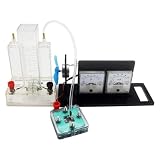
- In the high school chemistry hydrogen fuel cell, the main components such as proton exchange membrane, electrodes, catalysts, etc. are all made of imported materials. The instrument has stable performance and is very suitable for teaching demonstrations.
- PEM fuel cells (fuel cell proton exchange membrane) are made of a polymer membrane connecting two electrodes (cathode and anode).
- A fuel cell is an electrochemical device that converts the chemical energy of hydrogen and oxygen into electrical energy without pollution or harmful release.
- The hydrogen in the electrons flows from the anode to the cathode through an external circuit, generating an electric current. At the cathode, electrons, protons, and oxygen from the air combine to form water, which is the main byproduct of the fuel cell.
- You can use it for educational purposes in experiments. Please use only deionized water and make sure to operate under the correct instructions to avoid accidents.
Product prices and availability are accurate as of the date/time indicated and are subject to change. Any price and availability information displayed on Amazon at the time of purchase will apply.




