Measure all four tires before buying anything, then follow the vehicle maker’s tread-depth or circumference limit. Match the exact tire size, brand, model, construction, load index, speed rating and inflation pressure. If one tire must be replaced, pair it with the tire that has the deepest remaining tread and install that pair on the rear axle unless the owner’s manual says otherwise. When the new tire is outside the permitted mismatch, the non-shaving choices are a matched axle pair or a complete four-tire set.
AWD and 4WD vehicles need the most care: even a small outside-diameter difference can make differentials, transfer cases and transmissions work harder. A qualified tire shop may be able to shave a new tire on a specialized lathe, but that service is vehicle-specific, not universally available, and should be considered only after the manufacturer’s limits are known.
As an Amazon Associate I earn from qualifying purchases.
Why matching tread depth matters
Tread depth changes a tire’s effective rolling radius. Two tires that complete slightly different distances in one revolution make the vehicle’s driveline compensate for a speed difference. On a front- or rear-wheel-drive vehicle, the differential normally permits speed differences between the driven wheels while cornering, so a modest mismatch is often less critical than it is on an AWD or 4WD vehicle. On an AWD or 4WD system, however, clutches, differentials and transfer-case components may be forced to absorb a continuous difference.
Windows Errors? Fix Them Before They Spread
Repair common Windows errors and clear accumulated junk for a smoother, more stable PC - no reinstall needed.Free scan · no reinstallCrashes, No Sound, or Screen Glitches?
Random freezes, missing sound and display glitches usually trace back to one bad driver. Find and replace yours safely.Free scan · under a minuteThe United States Tire Manufacturers Association (USTMA) warns that even small outside-diameter differences may cause drivetrain damage or mechanical malfunction on 4WD and AWD vehicles. Tire Rack similarly cautions that a small circumference difference can make differentials and transmissions work harder and may eventually lead to expensive damage. These are not universal numerical limits; the vehicle manufacturer’s specification controls.
#1 Best Overall

- 1.Accurate and Efficient: Different colors on the bar represents different scopes, the red range on bar: 0 - 3/ 32; Yellow range on bar: 3/ 32 - 6/ 32; Green range on bar: 6/ 32 - 32/ 32, allowing you easy and fast to read and calibrated
- 2.Reusable:Tire tread gauge is made of sturdy material, reusable and long lasting, which is an efficient tool to moenitor tire tread levels, make driving safer
- 3.Convenient:Tire tread Depth gauge measures approx 3.35 x 1.06 inch, small size, also features a pocket clip for easy carrying, you can clip it on your pocket, ideal for quick and convenient getting and using
- 4.Simple to use :Place the black flat edge of the tire tread gauge on both sides of the tire tread, press down the color bar until it reaches the bottom of the tread groove, and read the depth measurement on the indicator bar.
- 5.Easy to read: There are 3 different color codes of areas on the bar that add simplicity and convenience, which show you a clear result of your tyre condition, really easy to read, giving you a fast and accurate measurement to tread depth, smart, high efficiency
Tread depth is also a traction issue. A tire with more tread generally has more water-evacuation reserve. If a single replacement is unavoidable, placing the deeper-tread tire with the other deeper tire on the rear axle helps preserve wet-road stability. The Tire Industry Association (TIA) and USTMA give that rear-axle recommendation because rear grip loss can produce sudden oversteer.
Start with the owner’s manual and tire placard
Record the vehicle’s requirements
Before shopping, read the tire-information placard, owner’s manual and any AWD/4WD service section. Write down:
- Original tire size, including width, aspect ratio and wheel diameter.
- Load index and speed rating.
- Whether the vehicle requires the same tire model on all positions.
- Any stated maximum tread-depth, rolling-radius or circumference difference.
- Whether the manufacturer specifies a particular axle for new tires.
- Cold inflation pressures for the front and rear axles.
Do not substitute a general internet rule for a vehicle-specific instruction. USTMA specifically advises following alternate recommendations from the vehicle maker. Some manufacturers publish a tread-depth limit; others publish a circumference or rolling-radius limit. If the manual and a generic tire-shop guideline conflict, ask the dealer or a qualified tire professional to interpret the vehicle maker’s requirement.
Examples of published limits are not universal limits
| Figure | What it represents | How to use it |
|---|---|---|
| 2/32 inch | TIA’s current consumer replacement threshold at the wear indicators | Replace a tire at or below this level; it is not an AWD matching allowance. |
| Within 2/32 inch | Tire Rack’s general AWD matching recommendation | Use only as general guidance when the vehicle maker gives no different specification; the manual still controls. |
| 1/4 inch (6 mm) circumference | An example tolerance cited by Tire Rack from manufacturers, including Subaru | This is a manufacturer-example circumference limit, not a rule for every AWD or 4WD vehicle. |
Measure every tire before you buy
A tread-depth estimate based on appearance is not sufficient. Discount Tire’s AWD/4WD guidance recommends measuring all four tires with a tread-depth gauge at several points and checking inflation first. A basic mechanical or digital gauge is inexpensive and more reliable than comparing tread blocks by eye.
Rank #2

- Accurate and precise tire tread depth readings in 1/32 inch increments (1/128 inch resolution)
- Durable dial type gauge with easy-to-read 32nds scale (max. tread depth 14/32 inch)
- Color coded scale shows true tire health - safe range (green), showing wear (yellow), or needs replacement (red)
- Calibrated to meet or exceed industry standards for precise accuracy of tire tread depth (+/- 0.25%)
- Rugged, convenient, and compact design for easy storage with included leather pouch
- Set cold inflation. Park the vehicle for several hours and adjust each tire to the pressure on the placard, not the maximum pressure molded into the sidewall. Record the pressure and correct leaks before measuring.
- Inspect the tire. Look for wear-indicator bars, exposed cords, bulges, cuts, punctures, separated tread or damage to the sidewall. A structurally damaged tire must not remain in service merely because its tread measurement matches.
- Measure several grooves. Insert the gauge into the main grooves, avoiding tread-wear indicators, and take readings at the inner, center and outer portions of the tread. Repeat at several positions around the circumference.
- Record the lowest credible reading. Note the readings for each tire separately. A tire with one badly worn shoulder may have a very different rolling radius and handling behavior from a tire with even wear, even if their center-groove readings look similar.
- Compare the tires as a set. Identify the deepest and shallowest tire, calculate the approximate difference, and compare that result with the manual’s limit. Keep the gauge readings with your purchase notes.
Measure after correcting pressure because inflation changes the loaded radius. The SAE technical paper 2020-01-5070 by Kan, Hoffman and Carter found that rolling radius was less sensitive to tread depth than to tire brand and model and to inflation pressure. That finding is why a depth-only match can still be a poor rolling-radius match.
Match the tire identity, not only the remaining tread
The replacement should match the existing tires in every specification the vehicle requires. A tire with the same nominal size can have a different casing, tread profile and loaded radius.
| Specification | What to match | Why it matters |
|---|---|---|
| Size | Exact size designation on the placard and sidewall | Width, aspect ratio and diameter affect clearance, gearing and rolling radius. |
| Brand and model | Same manufacturer and model family whenever possible | The SAE 2020 study found brand and model had a stronger effect on rolling radius than tread-depth differences in its analysis. |
| Construction | Radial type, run-flat or other construction required by the vehicle | Casing stiffness and deflection alter the loaded radius and handling balance. |
| Load index | At least the placard value, with the same configuration across the axle | Load capacity and sidewall deflection change under the vehicle’s weight. |
| Speed rating | Meet or exceed the placard requirement | A different rating can involve a different construction and response. |
| Inflation | Placard pressure, checked cold | Pressure changes rolling radius; the SAE study identifies correct inflation as essential for equal rolling radii. |
Do not assume that shaving a tire makes an otherwise different tire equivalent. Shaving changes tread depth, not the casing, tread profile, compound, load rating or speed rating. For AWD/4WD, the safest match is normally four identical tires at the same pressure and similar wear.
Free tools Windows power users keep installed
One-click scans. No signup required.
Choose one tire, two tires or four
A single replacement can work only within the vehicle’s tolerance
Replacing one tire may be acceptable when the remaining tires are in good condition, wear evenly, the replacement is the exact same specification, and the measured difference is within the manufacturer’s limit. This situation is more common on two-wheel-drive vehicles, but the owner’s manual still governs. Confirm that the replacement’s actual measured circumference or tread depth will remain within the permitted range after installation.
Rank #3

- 1. Accurately measures tire tread depth gauge, Calibrated from 0 to 1 inch in 1/32 inch
- 2. Color coded tire tread depth gauge clearly indicates the tire different phase by colors
- 3. Tire tread depth gauge of Red range on bar: 0-3/32; Yellow Range on bar: 3/32 - 6/32; 5. Green Range on bar: 6/32-32/32
- 4. Comes with a pocket clip, easy to carry a tire tread depth gauge
- 5. Tire tread depth gauge reads in 32nds Suitable for trucks, motorcycles, automobiles and any passenger vehicle
A matched axle pair is the non-shaving fallback
If one new tire is too far from the existing set, buy two matching tires for the same axle. The pair should be the same brand, model, size, construction, load index and speed rating. If the other axle has the deeper pair, follow the manufacturer’s rotation and placement instructions; otherwise, the TIA and USTMA recommendation is to put the deeper or newer pair on the rear axle.
A complete set is preferred when feasible
TIA, USTMA and Michelin all present a full matched set as the preferred approach, particularly for AWD and 4WD vehicles. Four tires with the same model and similar tread depth minimize rolling-radius differences, maintain predictable handling and avoid mixing old and new traction characteristics. A complete set is also the clearest solution when the existing tires show irregular wear, have different models or are near the 2/32-inch wear-indicator threshold.
| Measured condition | Drivetrain | Recommended non-shaving action |
|---|---|---|
| Same model and specification; difference within the manual’s limit | FWD or RWD | A single replacement may be acceptable; verify pressure, balance and alignment. |
| Same model and specification; difference within the manual’s limit | AWD or 4WD | Follow the manual exactly and have the shop verify circumference or tread tolerance. |
| Difference exceeds the manual’s limit | Any drivetrain | Replace with a matched axle pair or complete set; do not rely on a generic tolerance. |
| Different brands, models or constructions already installed | Especially AWD or 4WD | Use a complete matched set unless the vehicle maker explicitly permits the mixture. |
| Irregular wear, exposed cords, bulge or other structural damage | Any drivetrain | Replace the damaged tire and correct the underlying alignment, pressure or suspension problem before judging tread matching. |
AWD and 4WD: use circumference rules carefully
There is no single safe tread-depth difference for every AWD or 4WD vehicle. Systems use different clutch, differential and transfer-case designs, and manufacturers measure tolerance differently. One manual may specify tread depth; another may specify circumference; another may require a particular tire model and a maximum rolling-radius difference.
Quick wins for a faster PC:
Scan for outdated or missing drivers - takes under a minuteDriver Scan →Clear out junk files and repair common Windows errorsFree Scan →Fix the driver behind crashes, sound loss and screen glitchesFind Drivers →For perspective, Tire Rack publishes a 1/4-inch (6 mm) circumference example from manufacturers including Subaru and also gives a general recommendation of keeping AWD tires within 2/32 inch of one another. Those figures illustrate how small the permitted difference can be. They do not override your vehicle’s manual, and they should not be converted from circumference to tread depth with a guess.
Rank #4
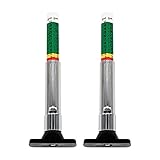
- Accurate measures tire tread depth gauge tool
- Calibrated from 0 to 1 inch in 1/ 32 inch
- Red range on bar: 0-3/32; Yellow Range on bar: 3/32 - 6/32; 5. Green Range on bar: 6/32-32/32
- Pocket-sized gauge, easy handy
- 2 pack
When the manual does not state a number, ask the vehicle manufacturer’s service department or a qualified tire professional to identify the correct test method. A shop may measure each tire’s circumference directly, compare rolling circumference data from the tire maker, or use the vehicle maker’s diagnostic procedure. Keep the answer in writing if the vehicle is under warranty or has a sensitive electronically controlled AWD system.
If replacing one tire is unavoidable
Collision damage, a road hazard or a discontinued model can make a single replacement unavoidable. Use this sequence:
- Locate an exact same-model tire with the same size, construction, load index and speed rating.
- Measure the three tires that remain and the candidate replacement at correct cold pressure.
- Pair the new tire with the deepest-tread existing tire, provided the pair meets the vehicle maker’s tolerance.
- Install that pair on the rear axle unless the owner’s manual specifically directs another arrangement.
- Move the other two tires to the front only if the vehicle maker’s service instructions permit the rotation.
- Have the assembly balanced and the vehicle’s alignment checked, especially if the removed tire was unevenly worn.
The rear-axle placement is a stability precaution, not a way to make an out-of-specification tire acceptable. If the new tire still exceeds the permitted mismatch, stop and choose two or four tires instead.
Do these 3 things before closing this tab:
1Repair Windows errors before they cause bigger problems2Fix the driver behind crashes, sound loss and screen glitches3Clear out junk files and repair common Windows errorsWhat professional tire shaving does—and does not do
Professional shaving uses a specialized tire lathe to remove tread rubber from a new tire until its measured circumference or tread depth more closely matches the vehicle’s existing tires. Tire Rack describes an example street-tire shaving price of $25–$35 per tire. That is a published example, not a guaranteed local price, and the service may not be available in your area.
Best Value

- 1. Accurately measures tire tread depth gauge tool, Calibrated from 0 to 1 inch in 1/32 inch
- 2. Color coded tire tread depth gauge tool clearly indicates the tire different phase by colors
- 3. Tire tread depth gauge of Red range on bar: 0-3/32; Yellow Range on bar: 3/32 - 6/32; 5. Green Range on bar: 6/32-32/32
- 4. Comes with a pocket clip, easy to carry a tire tread depth gauge tool
- 5. Tire tread depth gauge tool reads in 32nds Suitable for trucks, motorcycles, automobiles and any passenger vehicle
When shaving may make sense
- A vehicle requires a close AWD/4WD match and one tire is otherwise unusable because it is too new.
- The exact same model is available but replacing three good tires would create unnecessary waste.
- A qualified shop confirms the tire’s construction, warranty and vehicle application are suitable.
When shaving is the wrong solution
- The replacement is a different model, construction, load index or speed rating.
- The existing tires have irregular wear, hidden damage or very little tread remaining.
- The vehicle maker prohibits shaving or requires a complete matched set.
- No shop can document the final measurement and provide a safe, balanced installation.
Ask the shop what final tread depth or circumference it will target, how it will measure the tire, whether the tire maker’s warranty is affected and how it will dispose of removed rubber. Never attempt to shave a tire with a home tool or by driving it aggressively to wear it down; uncontrolled wear can damage the casing and create an unsafe tire.
Installation checks after matching
- Mount in the specified position. Confirm front/rear placement and directional or asymmetric sidewall requirements.
- Balance every wheel. A new tire can have a different force variation even when its tread depth matches.
- Check alignment and suspension. Uneven wear will quickly destroy the match. Correct toe, camber, worn bushings or bent components as needed.
- Set cold pressure again. Use the placard values for the vehicle’s normal load, not a pressure chosen to imitate another tire.
- Reset monitoring systems. Follow the vehicle’s procedure for direct or indirect tire-pressure monitoring after the pressures are correct.
- Recheck after driving. Confirm pressure, lug-nut torque and that no warning light appears after the first drive and again at the interval specified by the service facility.
Common mistakes and how to avoid them
Using the 2/32-inch number as an AWD rule
2/32 inch is TIA’s wear-indicator replacement threshold. It tells you when a tire is worn out, not how much mismatch an AWD system can tolerate. Use the vehicle maker’s stated tolerance for matching.
Comparing only the center tread groove
Shoulder wear, cupping and one damaged section can change the tire’s effective radius. Measure several grooves and positions and use the lowest reliable readings alongside a visual inspection.
Matching nominal size but changing the model
Two tires marked with the same size can have different loaded radii. Match brand and model whenever possible, and keep inflation equal, because the SAE study found those factors can matter more than a small tread-depth difference.
Putting the new pair on the front by habit
Unless the manufacturer says otherwise, TIA and USTMA recommend the deeper pair on the rear to preserve wet-weather stability. A tire professional should explain any deviation required by a specific vehicle.
Assuming shaving is automatically cheaper
Compare the shaving charge, mounting and balancing, shipping, warranty implications and local availability with the price of a matched pair or full set. A $25–$35 example shaving charge does not include every service cost and is not a promise of local pricing.
Quick Recap
A practical decision checklist
- Owner’s manual and placard read; AWD/4WD tolerance recorded.
- All four tires inflated to placard pressure before measurement.
- Several gauge readings taken across each tire and around its circumference.
- Wear indicators, cords, bulges, punctures and irregular wear inspected.
- Replacement matched for size, brand, model, construction, load index and speed rating.
- Single replacement confirmed to be within the vehicle maker’s tolerance.
- If not, matched axle pair or complete set selected instead of an unapproved mismatch.
- Deeper/newer pair assigned to the rear axle unless the manual specifies otherwise.
- Qualified shop consulted about shaving, including final measurement, warranty and availability.
- Installation completed with balancing, correct pressure, alignment review and monitoring-system reset.
Product prices and availability are accurate as of the date/time indicated and are subject to change. Any price and availability information displayed on Amazon at the time of purchase will apply.




