What’s actually slowing this PC down?
Pick the symptom - the matching free tool is one click away.
There is no single best tire chain for every SUV. The right choice depends on the exact vehicle, the tire size currently installed, available clearance, and the vehicle maker’s instructions. Check those details before buying: a chain that fits one SUV may be prohibited on another, even if both have the same model name.
This guide explains how to choose an approved traction device, verify fit, install it safely, and use it without treating one chain type or axle position as right for every SUV.
Start with your SUV’s manual and the tires on it
Before comparing products, find the snow-chain or traction-device instructions in your owner’s manual and read the full size marking on the sidewall of each tire. A model name alone is not enough: restrictions can vary by model year, wheel and tire configuration, and the tires currently installed. Hyundai and Ford manuals illustrate how specific those instructions can be: Hyundai owner resources and the Ford owner-manual library.
Look for four things: whether traction devices are allowed, which device types are permitted, which axle or wheel positions to use, and any clearance, wheel, or spare-tire restrictions. If the manual calls for cables, a low-profile or Class S device, fabric traction devices, or no chains, follow that direction rather than choosing a product based on a general SUV label.
Recommended Free Tools
#1 Best Overall
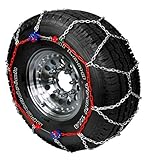
- Worry-Free Self-Tightening Ratchets Provide Automatic Tightening And Centering
- Easy Installation And Removal In Minutes
- Do Not Exceed 30 Mph With These Chains On
- Diamond Pattern Cross Chain Provides A Smoother Ride And Superior Traction
- Meets Class "S" clearance requirements, even in light truck sizes
How to choose among tire-chain options
Only compare products that the vehicle manual permits. The sources available here support fitment and safety guidance, not comparative traction rankings or a claim that one product performs best across SUVs.
| Option | What to check | What the available instructions establish |
|---|---|---|
| SUV snow chains | Match the full tire size to the product’s fit chart and packaging; confirm that the vehicle permits the chain type and has enough clearance. | Vehicle manuals provide configuration-specific restrictions; they do not establish one universally suitable chain. See Hyundai owner resources and Ford owner manuals. |
| Low-clearance cable chains | Verify the exact size fit and any Class S or other clearance requirement against both the vehicle manual and product instructions. | SCC’s Super Z instructions discuss Class S clearance and direct users to consult the vehicle manual; they do not confirm fitment for a particular SUV without a vehicle-and-tire-size check. See SCC Super Z instructions. |
| Fabric traction devices | Confirm that the specific vehicle configuration permits the device and follow its maker’s instructions. | Hyundai manuals mention AutoSock for certain configurations; this is not blanket approval for every SUV. See Hyundai owner resources. |
Fit and clearance
Match the complete tire size, including wheel diameter, to the chain maker’s fit chart. Then check the vehicle’s clearance restrictions. Some manuals limit chain thickness or require a low-profile device. The 2026 Ford Explorer manual advises choosing chains with clearly labeled body-to-tire restrictions; a Ford manual result specifies a 10 mm maximum for named tire sizes. Those figures are model- and tire-specific, not universal SUV limits. Consult the current manual for your exact configuration.
Rank #2
- Worry-Free Self-Tightening Ratchets Provide Automatic Tightening And Centering
- Easy Installation And Removal In Minutes
- Do Not Exceed 30 Mph With These Chains On
- Diamond Pattern Cross Chain Provides A Smoother Ride And Superior Traction
Device type and installation method
A cable product, conventional chain, or fabric device is a valid choice only if the vehicle manual permits it. Compare the maker’s mounting and tensioning steps for the exact product, not just the product family. SCC’s Super Z instructions discuss Class S clearance and emphasize checking the vehicle manual before installation (manufacturer instructions).
Axle, wheels, and spare tires
Use the axle and number of devices specified by the vehicle manual. Do not assume AWD means chains belong on all four wheels, or that chains always go on the driven axle. Reviewed manuals vary: Hyundai examples specify rear tires for one configuration and front tires for another, while a Ford manual specifies rear wheels. These examples show why the exact manual matters; they are not interchangeable advice. Check for restrictions involving aluminum wheels or a temporary spare as well.
Rank #3
- Worry-free self-tightening ratchets provide automatic tightening and centering
- Easy installation and removal in minutes
- Do not exceed 30 MPH with these chains on
- Diamond pattern cross chain provides a smoother ride and superior traction
- Note-Chains should be fitted to tire before actual use. Fitment can be affected by age of tire, tire manufacturer and/or tread type
Install and check chains safely
- Prepare a safe place. Park on level ground away from traffic. Follow the vehicle manual’s directions for securing the SUV; the cited Hyundai manual also instructs drivers to use hazard warnings while mounting chains.
- Confirm fit and placement. Use the tire size, permitted device type, and axle positions specified by the vehicle manual. Follow the chain maker’s installation instructions exactly.
- Tension the device as directed. Do not assume a chain is secure because it appears centered. Use the product’s specified tensioning method.
- Drive a short distance and recheck if your manual requires it. Hyundai’s cited 2026 manual calls for checking and retightening after about 0.3–0.6 miles (0.5–1.0 km). This is a model-specific instruction, not a universal interval.
- Stop if anything rubs or bangs. Inspect the chain and its clearance. Ford directs drivers to stop and tighten a chain that rubs or bangs, and to remove it if the problem persists.
Drive slowly and remove devices when they are no longer needed
Follow the lower speed limit stated by the vehicle manual or the chain maker. Limits are vehicle-specific: the 2026 Ford Explorer manual sets 50 km/h (30 mph), or the chain maker’s lower recommended speed, whichever is lower. The cited 2026 Hyundai manual result advises less than 20 mph (30 km/h), or the chain maker’s lower limit. Neither figure should be generalized to every SUV.
Remove chains or other traction devices when conditions no longer require them. Ford warns against using chains on snow-free roads. Also check the transportation authority for the route and jurisdiction where you plan to drive; chain-control requirements vary by location.
Quick Recap
Best Value
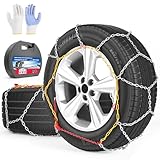
- 【EASY INSTALLATION】- No need to move the vehicle or use tools. The snow chains can be manually and quickly installed within one minute
- 【STRONGER GRIP】- Our tire chains is designed with a diamond-shaped pattern structure, which can provide stronger grip and traction
- 【MORE DURABLE】- The snow chains for car tires is made of high-quality steel and can be used for a long time
- 【APPLICABLE VEHICLE TYPES】- Snow chains are suitable for Commuter Car and SUVs and will not cause damage to the wheel hubs
- 【THE PERFECT GIFT】- Our snow chains are ideal as winter gifts for friends and family
Rank #4
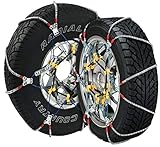
- Country of origin : China
- Designed for cars, pickups, and SUVs with very limited operating clearance around the drive tires
- Fast easy installation with no need to move the vehicle
- Designed-in rubber tightener means there is no need to stop and retighten after installation
A pre-purchase checklist
- Read the snow-chain or traction-device section of the owner’s manual for the exact model year and configuration.
- Read the full size marking on the tires currently installed and match it to the product’s fit chart.
- Confirm the permitted device type and any clearance, thickness, wheel, or spare-tire restrictions.
- Confirm the required axle and number of devices; do not infer placement from AWD or drivetrain alone.
- Read the exact product’s installation, tensioning, and speed instructions before setting out.
- Check chain-control rules for your route with the relevant transportation authority.
Product prices and availability are accurate as of the date/time indicated and are subject to change. Any price and availability information displayed on Amazon at the time of purchase will apply.