The best Rockford Fosgate amplifier is the one whose channels, continuous RMS output, impedance range, inputs, size and electrical demands match your actual speakers and subwoofer. There is no defensible one-size-fits-all winner. A mono amplifier is usually the logical layout for a subwoofer, two channels can power a stereo pair, four channels suit front-and-rear speakers, and a five-channel design can run a complete speaker system plus a subwoofer when its ratings and wiring requirements fit.
Use the selection process below to avoid choosing by peak-watt marketing alone. Rockford Fosgate’s own buying guidance treats amplifier choice as a system-matching exercise, while its manuals provide model-specific ratings and installation requirements. Those documents do not establish a universal sound-quality ranking among the Prime, Punch and Power lines, and they are not independent listening tests.
As an Amazon Associate I earn from qualifying purchases.
What “best” means for a car amplifier
An amplifier does not improve every system in the same way. The right model supplies clean, adequately controlled power to the connected speakers at their actual impedance, accepts the signal from your source unit, fits the available space and can be installed safely in the vehicle. An amplifier that is electrically mismatched can clip, overheat, enter protection or damage speakers even if its advertised peak-watt number looks impressive.
Start with the equipment you already have or intend to install. Write down each speaker’s continuous (RMS) power rating, nominal impedance and number of channels needed. Do the same for every subwoofer, including whether voice coils are wired in series or parallel. Then compare those figures with the exact amplifier model’s ratings at the load you will use. Rockford Fosgate’s manuals identify continuous output by impedance; use those tables rather than a peak or “maximum” headline.
#1 Best Overall
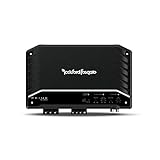
- The R2-1200X1 full-range class-D mono amplifier (1.9" x 6.8" x 11.3") is packed with features and performance to deliver power and bass on demand with 1200 Watts of RMS power
- Class D technology makes this amp extremely efficient by reducing demand on the vehicles electrical system (RMS Power: 400 Watts x 1 @ 4Ω OR 800 Watts x 1 @ 2Ω OR 1200 Watts x 1 @ 1Ω)
- Featuring C.L.E.A.N. circuitry to help you adjust your gain settings, a P.O.W.E.R. Supply that generates more power as voltage increases, and integrated Punch EQ that corrects for acoustic deficiencies while delivering up to 3X the bass
- Designed for subwoofers, a variable infrasonic filter and remote level control allows you to tune the bass for the desired level for the music
- Famous Rockford Fosgate build quality with a full 1-year warranty
- Channel plan: mono for one subwoofer section, two channels for a stereo pair, four channels for front and rear speakers, or five channels for four speakers plus a subwoofer channel.
- Continuous RMS power: compare the amplifier’s RMS output at your planned impedance with the speaker or subwoofer’s continuous-power specification.
- Load capability: confirm the minimum supported impedance and whether a multi-channel model may be bridged at that load.
- Signal compatibility: check for RCA preamp outputs or compatible speaker-level inputs when retaining a factory radio.
- Installation constraints: verify dimensions, ventilation, cable and fuse requirements, grounding and the vehicle’s charging capacity.
No independent comparative listening test is cited for these models, so claims that one product line universally sounds better than another would be speculation. Treat Prime, Punch and Power as different product families and select the documented model that fits your system.
Quick decision guide
| Your system plan | Likely amplifier format | What to verify before buying |
|---|---|---|
| One subwoofer, speakers powered by the radio or another amp | Mono (one-channel) subwoofer amplifier | Subwoofer RMS rating, final voice-coil impedance, mono amp output at that impedance, enclosure space and power-cable requirements |
| One pair of aftermarket speakers | Two-channel amplifier | RMS per channel at the speakers’ impedance, high- or low-level input compatibility and whether bridging is needed |
| Front and rear speakers | Four-channel amplifier | RMS per channel, four-channel input routing, available mounting space and whether unused channels may be bridged safely |
| Four speakers plus one subwoofer | Five-channel amplifier, or separate four-channel and mono amplifiers | Four speaker-channel ratings, subwoofer-channel rating, combined current draw, minimum loads and thermal ventilation |
| Factory radio with no RCA preamp outputs | Any model that accepts the vehicle’s signal through compatible speaker-level inputs, or an installation using the required integration hardware | Exact input type and voltage range in the model manual; do not assume every amplifier accepts factory speaker wiring |
This table is a starting point, not a product ranking. The final choice depends on the exact speakers, wiring and vehicle.
Choose channels before you choose a model
Mono amplifiers for subwoofers
A mono amplifier dedicates its output stage to a subwoofer system. It is often the simplest match when the door and dash speakers are already powered by the factory radio or a separate multi-channel amplifier. Confirm the subwoofer’s final wired impedance, not merely the impedance printed on one voice coil. Two dual-voice-coil subwoofers can present several different loads depending on series or parallel wiring, and the amplifier must be rated for the final result.
Two-channel amplifiers
Two channels suit a left/right speaker pair. Some two-channel models can be bridged to one subwoofer or a single speaker system, but bridging changes the load each channel sees. Use the manufacturer’s bridged rating and minimum impedance; never infer safe operation by simply adding the two channel numbers.
Four-channel amplifiers
Four channels are useful for front and rear speakers, active front-stage systems or other layouts that need independent level control. A four-channel unit may also be bridged for a subwoofer while the remaining channels run speakers, provided the manual lists that configuration and the impedance is allowed. Bridging is a wiring mode, not a reason to ignore the amplifier’s thermal and current limits.
Rank #2
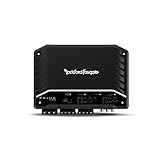
- The R2-500X4 full-range class-D 4-channel amplifier (1.9" x 6.8" x 10.1") is packed with features and performance to deliver power and bass on demand with 500 Watts of RMS power
- Class D technology makes this amp extremely efficient by reducing demand on the vehicles electrical system (RMS Power: 75 Watts x 4 @ 4Ω OR 155 Watts x 4 @ 2Ω OR 250 Watts x 2 @ 4Ω Bridged/Mono)
- Featuring C.L.E.A.N. circuitry to help you adjust your gain settings, a P.O.W.E.R. Supply that generates more power as voltage increases, and integrated Punch EQ that corrects for acoustic deficiencies while delivering up to 3X the bass
- Featuring fully adjustable 12 dB/octave high and low pass Butterworth crossovers, balanced differential inputs with RCA pass through outputs, high level input capable, defeat able auto turn on circuit and top mounted controls
- Famous Rockford Fosgate build quality with a full 1-year warranty
Five-channel amplifiers
A five-channel amplifier combines four full-range channels with a dedicated subwoofer channel. It can reduce installation space and simplify signal routing, but compare the subwoofer channel and speaker channels separately. The aggregate electrical demand can be significant, so check the recommended fuse, cable size, grounding and the vehicle’s battery and alternator capacity.
Match continuous RMS power and impedance
“How many watts does my car amp need to produce?” The useful answer is the amplifier’s continuous RMS output at the speaker’s actual impedance. A peak-watt figure describes a short-duration maximum and is not a reliable basis for system matching. Choose a model whose documented RMS output is appropriate for the speaker or subwoofer’s continuous rating and intended application, allowing the gain to be set correctly rather than using the gain control as a volume boost.
The Tool Desk
Outbyte PC Repair FREEClear out junk files and repair common Windows errorsFree Scan →Outbyte Driver Updater FREEScan for outdated or missing drivers - takes under a minuteDriver Scan →Rockford Fosgate states in its amplifier manual: “Power ratings on Rockford Fosgate amplifiers conform to CEA-2006 industry standards. These guidelines mean your amplifier’s output power ratings are REAL POWER numbers, not inflated marketing ratings.” This is the manufacturer’s statement about its ratings; it is not an independent ranking of amplifier sound quality.
Impedance is equally important. A model rated at 2 ohms per channel is not automatically safe at 1 ohm, and a bridged channel pair commonly requires a higher minimum impedance than a single channel. Read the exact revision of the manual for the exact model, then verify how your speaker wiring presents the load.
One documented Prime example
The Prime R150X2 manual excerpt lists 50 watts x 2 at 4 ohms, 75 watts x 2 at 2 ohms and 150 watts x 1 at 4 ohms when bridged. Those are continuous ratings for that listed model and loads; they are not a claim that the R150X2 is the best choice for every system, nor proof that the model remains in current stock.
Rank #3

- The Power T1500-1bdCP mono amplifier featuring Constant Power, is truly the best of the best and delivers 1500 Watts of POWER
- Proprietary Constant Power amps are the most powerful on the market, delivering up to 25% more power across all impedance loads (1000 Watts x 1 @ 4-Ohm or 1500 Watts x 1 @ 2-Ohm or 1500 Watts x 1 @ 1-Ohm)
- Highly efficient Class bd produces max power with minimal strain on the vehicle's electrical system. Our full chassis amp (2.14” x 8.14” x 14.91”) is optimized for use with subwoofers in cars/trucks
- Balanced differential RCA pass-thru outputs, On-board Punch EQ with +18dB boost @ 45Hz and 24dB/octave Butterworth crossover make the T1500-1bdCP an impressive POWER house
- Famous Rockford Fosgate build quality insures that the T1500-1bdCP will handle everything you throw at it - Full 2-year parts and labor warranty
Why peak power leads to bad purchases
Two amplifiers can display similar peak numbers while producing very different continuous output at the impedance you need. A lower-rated amplifier with a documented match may outperform a larger-looking unit that cannot safely drive your load. Compare RMS-by-load tables, not the largest number printed on a carton or listing.
What’s actually slowing this PC down?
Pick the symptom - the matching free tool is one click away.
Prime, Punch and Power: product families, not a quality ladder
Rockford Fosgate’s troubleshooting guidance identifies Prime, Punch and Power mobile amplifier lines as serving different budget and performance needs. That description does not create a neutral best-to-worst ranking. The available manufacturer documents do not provide independent measurements showing that every Power model sounds better than every Punch or Prime model.
Use the family name only as a way to narrow the catalog, then compare the exact model documentation. A suitable Prime amplifier can be the correct answer for a modest speaker upgrade, while a Punch or Power model may be appropriate when the system needs a different channel layout, output level or feature set. The deciding specifications remain channels, RMS output, impedance, inputs, dimensions and installation requirements.
Model documentation you can use—and its limits
The Prime manual excerpt includes the following model names: R150X2, R250X4, R300X4, R400-4D, R600-4D, R600X5, R250X1, R500X1D, R750-1D and R1200-1D. The Punch manual excerpt includes P300X2, P400X2, P500X2, P1000X2, P400X4, P600X4, P1000X5, P300X1, P400X1, P500X1BD and P1000X1BD. The excerpts provide useful model-specific comparison inputs, but they do not establish that every name is a current product or that any listed price or stock position is current.
| Documented example | Channels or role indicated by model/manual context | Continuous rating available in the cited manual excerpt | How to use the information |
|---|---|---|---|
| Prime R150X2 | Two-channel; bridgeable configuration listed | 50 W x 2 at 4 ohms; 75 W x 2 at 2 ohms; 150 W x 1 bridged at 4 ohms | Compare with the intended speaker RMS rating and final impedance; verify the current manual and listing |
| Prime R250X4, R300X4, R400-4D, R600-4D | Four-channel models identified in the Prime manual | Not stated in the available excerpt | Obtain the exact model’s current RMS-by-load table before selecting |
| Prime R600X5 | Five-channel model identified in the Prime manual | Not stated in the available excerpt | Check the four speaker channels and subwoofer channel separately |
| Prime R250X1, R500X1D, R750-1D, R1200-1D | Mono/subwoofer-oriented models identified in the Prime manual | Not stated in the available excerpt | Match the mono output to the subwoofer’s final load and RMS rating |
| Punch P300X2, P400X2, P500X2, P1000X2 | Two-channel Punch models identified in the manual | Not stated in the available excerpt | Confirm stereo and bridged ratings in the precise manual revision |
| Punch P400X4, P600X4, P1000X5 | Four- and five-channel Punch models identified in the manual | Not stated in the available excerpt | Check channel-specific RMS, bridge limits and total current demand |
| Punch P300X1, P400X1, P500X1BD, P1000X1BD | Mono/subwoofer-oriented Punch models identified in the manual | Not stated in the available excerpt | Verify minimum impedance, RMS output and wiring before purchase |
The excerpts do not provide a live inventory list. Confirm the exact revision, dimensions, fuse recommendation and availability on the manufacturer’s current product page or through an authorized dealer before ordering.
Free tools Windows power users keep installed
One-click scans. No signup required.
Rank #4
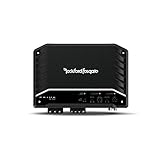
- The R2-750X5 full-range class-D 5-channel amplifier (1.9" x 6.8" x 11.2") is packed with features and performance to deliver power and bass on demand with 750 Watts of RMS power
- Class D technology makes this amp extremely efficient by reducing demand on the vehicles electrical system (RMS Power: 50 Watts x 4 + 200 Watts x 1 @ 4Ω OR 100 Watts x 4 + 350 Watts x 1 @ 2Ω OR 200 Watts x 2 + N/A @ 4Ω Bridged/Mono)
- Featuring C.L.E.A.N. circuitry to help you adjust your gain settings, a P.O.W.E.R. Supply that generates more power as voltage increases, and integrated Punch EQ that corrects for acoustic deficiencies while delivering up to 3X the bass
- Featuring fully adjustable 12 dB/octave high and low pass butterworth crossovers, balanced differential inputs with RCA pass through outputs, high level input capable, defeat able auto turn on circuit and top mounted controls
- Famous Rockford Fosgate build quality with a full 1-year warranty
Check the source unit and signal path
Factory radios often lack RCA preamp outputs. If yours does, select an amplifier with compatible speaker-level inputs or budget for the integration hardware specified by the installer. If the amplifier expects low-level RCA input and your radio supplies only speaker wiring, connecting the two directly can produce noise, distortion or damage.
Aftermarket receivers may offer front, rear and subwoofer preamp outputs, but their output voltage and channel routing still matter. Follow the amplifier’s input-labeling and level-setting procedure. Keep signal cables separated from the main power cable where the installation layout permits, and make every connection secure and insulated.
Use this purchase workflow
- Inventory the system. Record every speaker and subwoofer’s continuous RMS rating, nominal impedance, voice-coil configuration and location. Note whether the factory radio remains.
- Choose the channel layout. Select mono, two, four or five channels according to the speakers that need amplification. Do not buy a five-channel unit merely because its total watt number is larger.
- Calculate the final load. Determine the impedance presented after series or parallel wiring. For a bridged configuration, use the manual’s bridged minimum load.
- Filter candidate models. Keep only models whose RMS output at that load suits the speakers, whose inputs accept your source signal and whose dimensions fit the mounting location.
- Check the installation plan. Verify power-cable gauge, fuse type and location, ground point, ventilation clearance and the vehicle’s battery and alternator capacity against the exact manual.
- Confirm current status. Check the current manufacturer listing or an authorized dealer for availability, revision, dimensions and warranty terms. Older manual examples are not proof of present stock.
- Have the work completed safely. Disconnect the battery’s negative terminal before installation as the Prime and Punch manuals advise. If you are uncertain about routing, fusing, grounding or load calculations, use a qualified car-audio installer.
Installation details that affect reliability
Mount the amplifier where it can receive adequate ventilation and where moisture, cargo movement and accidental short circuits are unlikely. The power cable needs an appropriately rated fuse close to the battery, with the cable gauge and fuse value specified by the model manual. The ground connection should be short, secure and attached to clean vehicle metal; a loose or painted ground can create voltage drop and intermittent protection events.
Route wiring so it cannot chafe on sheet metal, interfere with pedals or steering components, or become pinched under trim. Protect pass-throughs with suitable grommets. Confirm that the alternator and battery can support the amplifier’s current demand alongside the vehicle’s normal loads. A high-output amplifier in a vehicle with inadequate charging capacity may shut down even when every audio connection is correct.
Do not stack an amplifier against carpet, block its heat sink or hide it in an unventilated compartment. Dimensions in a product listing may exclude connector clearance, so measure the full installation area and leave room for service access.
Best Value
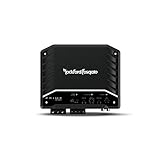
- The R2-500X1 full-range class-D mono amplifier (1.9" x 6.8" x 8.5") is packed with features and performance to deliver power and bass on demand with 500 Watts of RMS power
- Class D technology makes this amp extremely efficient by reducing demand on the vehicles electrical system (RMS Power: 300 Watts x 1 @ 4Ω OR 500 Watts x 1 @ 2Ω)
- Featuring C.L.E.A.N. circuitry to help you adjust your gain settings, a P.O.W.E.R. Supply that generates more power as voltage increases, and integrated Punch EQ that corrects for acoustic deficiencies while delivering up to 3X the bass
- Designed for subwoofers, a variable infrasonic filter and remote level control allows you to tune the bass for the desired level for the music
- Famous Rockford Fosgate build quality with a full 1-year warranty
Set gain and filters without creating distortion
Gain is an input-sensitivity adjustment, not a second volume control. Begin with the source unit at a known clean listening level, disable any extreme bass boost, and set the amplifier according to its manual while monitoring for audible clipping. Excessive gain can overdrive the input stage and speakers; too little gain can tempt you to run the source at its limit.
Use the amplifier’s crossover and subwoofer controls only for the speakers connected to that channel group. A high-pass filter can keep small full-range speakers from receiving deep bass they cannot reproduce safely; a low-pass setting can reserve deep-bass content for a subwoofer. Exact filter controls and ranges vary by model, so use the documented controls rather than assuming two models share the same switch positions.
When an amplifier goes into protection
Rockford Fosgate identifies several common causes of protection or shutdown: an impedance mismatch, overheating, inadequate voltage or current, poor connections and incorrectly set gain. Check these in a controlled order rather than repeatedly cycling power.
Windows Errors? Fix Them Before They Spread
Repair common Windows errors and clear accumulated junk for a smoother, more stable PC - no reinstall needed.Free scan · no reinstallCrashes, No Sound, or Screen Glitches?
Random freezes, missing sound and display glitches usually trace back to one bad driver. Find and replace yours safely.Free scan · under a minute- Impedance: Recalculate the final speaker or subwoofer load and compare it with the model’s minimum rating, especially when bridged.
- Heat: Inspect ventilation, mounting orientation and whether the chassis is covered by carpet or other material.
- Voltage and current: Check battery and charging-system condition, power-cable gauge, fuse condition and ground integrity.
- Connections: Look for loose terminals, damaged insulation, shorted speaker wires and RCA or speaker-level plugs that are not fully seated.
- Gain: Return gain and boost controls to conservative settings, then follow the model’s setup instructions.
Disconnect power before repairing wiring. If the amplifier still protects after the external causes are corrected, Rockford Fosgate recommends diagnosis and repair through an authorized dealer. Do not bypass protection circuits or substitute an unknown fuse.
Warranty and installation-kit qualification
The manufacturer states that select amplifiers may receive an additional one-year warranty when used with a matching installation kit. Eligibility, kit compatibility and current terms must be confirmed in the applicable warranty documentation; not every kit automatically qualifies. Keep receipts, model numbers and installation records, and use an authorized dealer when warranty or repair support is important.
Price, availability and version checks
No current prices, inventory, exact manual revision dates or present model status are published in the cited manufacturer material. Those details change by region and over time, so verify them immediately before purchase. A manual excerpt can remain online after a model has been replaced, and a retailer can list an old revision. Compare the serial/model designation, dimensions, RMS table, input type, fuse requirement and warranty language on the current listing.
Do not treat a low price as evidence of inferior sound or a high price as evidence of superior sound. In this product range, the practical value comes from a correct electrical match, dependable installation and controls that suit the system.
Quick wins for a faster PC:
Clear out junk files and repair common Windows errorsFree Scan →Scan for outdated or missing drivers - takes under a minuteDriver Scan →Repair Windows errors before they cause bigger problemsFix Now →Final selection checklist
- Is the channel count exactly what the system requires?
- Does continuous RMS output match the speaker or subwoofer rating at the final impedance?
- Is the load above the model’s minimum, including any bridged requirement?
- Will the amplifier accept the factory or aftermarket source signal?
- Do its dimensions, connector access and ventilation needs fit the vehicle?
- Are cable gauge, fuse, ground and charging-system capacity adequate?
- Have you checked the current model page, manual revision and warranty terms?
- Will a qualified installer handle the work if any of those answers is uncertain?
If all eight answers are clear, you have identified the best Rockford Fosgate amplifier for your car—not by a generic ranking, but by a documented match to the system you are actually building.
Quick Recap
Product prices and availability are accurate as of the date/time indicated and are subject to change. Any price and availability information displayed on Amazon at the time of purchase will apply.




