What’s actually slowing this PC down?
Pick the symptom - the matching free tool is one click away.
Audi’s R8 V12 TDI was never a showroom model. Revealed at the Detroit auto show in January 2008, it was a road-car concept built around a 5,934cc twin-turbo diesel V12. Audi quoted 500 hp, 1,000 Nm of torque, a 4.2-second 0–100 km/h time and a top speed well over 300 km/h. The company later confirmed that the car never entered series production, making it one of the most extraordinary unrealized versions of the R8.
What the Audi R8 V12 TDI actually was
The R8 V12 TDI was an Audi concept car, not a production trim that customers could order. Audi’s January 2008 technical release described it as “a concept car based on the Audi R8.” The design used the first-generation R8’s mid-engine layout and styling as a starting point, then replaced the production car’s petrol powertrain with a large-displacement diesel V12.
As an Amazon Associate I earn from qualifying purchases.
The concept appeared at the Detroit auto show in January 2008, during a period when Audi was using diesel racing success to demonstrate that compression-ignition engines could deliver exceptional speed as well as efficiency. Its proportions, large air intakes and prominent exhaust treatment made the engineering change visible, but the important distinction is status: there was no customer production run, no published sale price and no customer-delivery total.
The Tool Desk
Outbyte Driver Updater FREEScan for outdated or missing drivers - takes under a minuteDriver Scan →Outbyte PC Repair FREEClear out junk files and repair common Windows errorsFree Scan →Audi’s later history of the R8 describes the turbocharged V12 diesel car as a concept that never made it to series production. That is the confirmed outcome. The official material does not establish one definitive reason for the decision, so claims that it was shelved specifically because of an emissions rule, the financial crisis, reliability concerns or a projected sales problem go beyond what these Audi sources document.
#1 Best Overall

- Scaled replicas of cars and trucks
- Die cast metal body with plastic details
- Opening doors on all- some with opening hoods and trunks
- Detailed chassis
Engine and performance specifications
The headline numbers were remarkable even for a technology demonstrator. Audi’s technical material rated the engine at 500 hp and 1,000 Nm (737.56 lb-ft) of torque. The Japanese-market announcement identified the displacement as 5,934 cc, with an 83.0 mm bore and a 91.4 mm stroke.
| Specification | Audi-published figure | Qualification |
|---|---|---|
| Engine | V12 TDI diesel | Installed in a concept based on the Audi R8 |
| Displacement | 5,934 cc (described generally as six liters) | Figure from Audi Japan’s January 18, 2008 announcement |
| Power | 500 hp | Audi’s January 2008 technical release |
| Peak torque | 1,000 Nm (737.56 lb-ft) | Audi said peak torque arrived at 1,750 rpm; the Japanese release gave a 1,750–3,000 rpm peak-torque range |
| Bore × stroke | 83.0 × 91.4 mm | Audi Japan specification |
| Turbocharging | Two turbochargers | Audi Japan description |
| Fuel injection | Common rail with two newly developed high-pressure pumps | Audi Japan description |
| 0–100 km/h | 4.2 seconds | Audi-published claim for the concept |
| Top speed | Well over 300 km/h (186.41 mph) | Audi did not publish a more precise maximum in the cited release |
The torque figure explains why the car attracted so much attention. One thousand newton-metres is a very high output for a road-car concept, and Audi placed it in a low engine-speed band rather than at the top of the rev range. The published 1,750–3,000 rpm range indicates that the engine was designed to deliver a broad, forceful mid-range rather than rely solely on high-rpm power.
How the diesel V12 was configured
The Japanese announcement specified two turbochargers and two newly developed high-pressure pumps for the common-rail injection system. Those details matter because they show that this was not simply a larger version of a regular passenger-car diesel. The engine needed substantial airflow and fuel-system capacity to produce 500 hp while maintaining the strong low-speed torque characteristic Audi wanted.
Audi’s general description called the engine a six-liter V12 TDI, while the Japanese release supplied the more exact 5,934cc displacement. Both refer to the same concept power unit. The official figures do not provide a production fuel-consumption rating, emissions certification, service interval or durability test result, and none should be inferred from the performance claims.
Rank #2

- High-Quality Materials:The Audi R8 die-cast car is made of zinc alloy,plastic parts and rubber tires,making it safe for children to play with.It features detailed interior and exterior trim, and is very sturdy.
- Function:No batteries are required, but the vehicle has a powerful pull back feature. Simply pull it back, then release your hand, and the car will go for a long distance. The doors may be opened to view the whole inside of the vehicle. So appealing to children and collectors alike.
- Size:1/36 scale vehicle model with beautiful English packaging,ideal for toddlers to play with and carry. Car collectors will appreciate the perfect small size, which allows them to collect a complete set of cars without taking up too much space.
- Grow From Play:Help children learn more about car ,expand their knowledge ,increase the hand-eye coordination and the reaction speed of the children in the play.
- Ideal Christmas Festival Gift:All of TOKAXI die-cast model cars are attractively packaged in English, making them the perfect Christmas, Birthday, Children's Day, New Year gift for kids, party favors, home decorations, or travel toys for boys and girls.gifts for boys girls.
Was the engine really from Le Mans?
The short answer is that Audi described the road-car engine as closely related to the V12 used in the R10 TDI endurance racer. That is a documented engineering relationship, not proof that the R8 contained an unchanged racing engine.
The distinction is important. A Le Mans prototype and a road-car concept have different packaging, calibration, cooling, noise, durability and regulatory requirements. Audi’s wording supports the idea that the concept drew directly on the company’s diesel-racing technology and architecture. It does not establish that every component, setting or specification was identical to the race car’s.
| Comparison point | R8 V12 TDI concept | R10 TDI |
|---|---|---|
| Intended use | Road-car technology concept based on the Audi R8 | Endurance racing prototype |
| Relationship described by Audi | V12 diesel was closely related to the R10 TDI engine | Reference engine for Audi’s Le Mans diesel program |
| Production status | Never entered series production | Competed in Audi’s factory endurance-racing program |
| Published figures in the cited material | 500 hp, 1,000 Nm, 4.2 seconds to 100 km/h, well over 300 km/h | The cited releases do not provide a directly comparable road-car specification set |
Why the Le Mans connection mattered in 2008
The R8 V12 TDI arrived when Audi’s diesel racing program was an important part of the company’s technical identity. In its June 18, 2008 account of the Le Mans result, Audi said the 2008 victory was its eighth overall win in ten races. The company also stated that the R10 TDI remained unbeaten in its third running at the event.
Audi’s same release counted 16 victories by its diesel-powered sports cars through that race. These are contemporaneous Audi figures from 2008, not a current historical tally revised for later events. They explain the concept’s timing: the diesel R8 was presented while Audi could point to an active, successful diesel endurance program rather than merely claim a theoretical motorsport link.
Rank #3
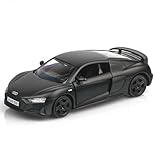
- High-Quality Materials:The R8 die-cast car is made of zinc alloy,plastic parts and rubber tires,making it safe for children to play with.It features detailed interior and exterior trim, and is very sturdy.
- Function:No batteries are required, but the vehicle has a powerful pull back feature. Simply pull it back, then release your hand, and the car will go for a long distance. The doors may be opened to view the whole inside of the vehicle. So appealing to children and collectors alike.
- Size:1/36 scale vehicle model with beautiful English packaging,ideal for toddlers to play with and carry. Car collectors will appreciate the perfect small size, which allows them to collect a complete set of cars without taking up too much space.
- Grow From Play:Help children learn more about car ,expand their knowledge ,increase the hand-eye coordination and the reaction speed of the children in the play.
- Ideal Christmas Festival Gift:All of TOKAXI die-cast model cars are attractively packaged in English, making them the perfect Christmas, Birthday, Children's Day, New Year gift for kids, party favors, home decorations, or travel toys for boys and girls.gifts for boys girls.
For Audi, the concept therefore worked as a bridge between two audiences. It gave the R8 an aggressive technical halo, while the R10 TDI supplied a credible competition background. The road car’s 1,000 Nm headline was a way to make that connection understandable to people who would never see an endurance prototype run at Le Mans.
How fast was it supposed to be?
Audi quoted 0–100 km/h in 4.2 seconds and a top speed “well over 300 km/h.” The first figure is a stated acceleration claim; the second is deliberately broad. It should not be rewritten as an exact 300 km/h, 305 km/h or 310 km/h result because the cited release does not give that precision.
The 4.2-second claim also needs the correct context. It describes the concept as presented by Audi, not an independently verified instrumented test of a customer car. Because the R8 V12 TDI never became a production model, there is no normal series-production test data, owner fleet or standardized comparison set for it.
Do these 3 things before closing this tab:
1Clear out junk files and repair common Windows errors2Fix the driver behind crashes, sound loss and screen glitches3Repair Windows errors before they cause bigger problemsThe combination of 500 hp and 1,000 Nm would have made the concept’s character different from a high-revving petrol sports car. The diesel’s torque peak arrived from 1,750 rpm, giving the stated performance a forceful low- and mid-range foundation. Audi did not publish a full gear-ratio sheet, kerb weight, fuel capacity or braking specification in the cited releases, so those aspects cannot be used to calculate a more exact performance result.
Rank #4

- Item Package Weight: 1.11 kilograms
- Brand: Maisto
- Quality product
What happened to the diesel R8?
It remained a concept. Audi’s retrospective R8 history explicitly confirms that the turbocharged V12 diesel version never made it to series production. There was no announced production allocation, regular-market configurator listing or customer ordering process to follow.
The available official account does not identify a single cancellation cause. That means the most accurate answer to “Why was it shelved?” is that Audi’s cited retrospective confirms the non-production outcome but does not explain the internal decision in detail. A responsible account should separate that documented fact from later speculation.
- Confirmed: the car was a concept based on the R8.
- Confirmed: Audi later said it never reached series production.
- Not established by the cited Audi material: a specific emissions, financial, reliability or sales reason for the decision.
- Not applicable: production totals, a retail price and customer deliveries.
Why Audi’s diesel hypercar concept is still remembered
The R8 V12 TDI combined several ideas that rarely appeared together: a dramatic mid-engine sports-car body, a twelve-cylinder diesel, twin turbochargers, common-rail injection and a direct link to a successful endurance program. Most performance concepts choose one headline. This one presented its identity through torque, cylinder count and racing lineage at the same time.
Its timing also gave it unusual historical weight. In January 2008, diesel technology was being promoted as a performance technology as well as a fuel-saving technology. Audi could show a concept with 1,000 Nm and point to the R10 TDI’s Le Mans record. Later changes in the market and in regulatory priorities may make the idea feel improbable, but the cited sources do not assign those later developments as the reason this specific car failed to reach production.
Best Value

- AUTHENTIC DETAILS: Precisely crafted 1:36 scale die-cast model of the 2020 Audi R8 Coupe with accurate exterior details and striking finish
- INTERACTIVE FEATURE: Built-in pull back action mechanism allows the car to zoom forward when released after pulling backward
- PERFECT SIZE: Compact 5-inch length makes it ideal for display and play while maintaining impressive detail and proportion
- QUALITY CONSTRUCTION: Durable die-cast metal body with plastic components ensures long-lasting performance and play value
- COLLECTOR'S ITEM: Detailed replica features signature R8 design elements including side blades, LED-style headlights, and rear spoiler
The concept’s rarity is therefore part of the story. It is not a forgotten production special with a handful of surviving examples; it is a documented engineering statement that stopped before the customer-car stage. That makes its published specifications more important than any supposed collector-market value, because there was no normal production market to establish one.
Common questions, answered precisely
Could an ordinary buyer order an Audi R8 V12 TDI?
No. Audi presented it as a concept, and its later history confirms that it never entered series production.
Did it use the exact Le Mans engine?
Audi said the V12 TDI was closely related to the R10 TDI engine. The official wording supports a close technical relationship, not a claim that the road-car concept used an unchanged race engine.
Free tools Windows power users keep installed
One-click scans. No signup required.
What was its exact top speed?
Audi’s release said “well over 300 km/h.” No more exact maximum is established by the cited material.
Why was it cancelled?
The non-production outcome is documented, but the reviewed Audi retrospective does not give a definitive internal reason. Specific explanations require evidence beyond these releases.
How much did one cost?
There was no production sale price because the concept was not offered as a series model.
Quick Recap
Product prices and availability are accurate as of the date/time indicated and are subject to change. Any price and availability information displayed on Amazon at the time of purchase will apply.




