Recommended Free Tools
America’s concept-car “firepower” was mostly visual: jet intakes, fighter-inspired bodies and atomic-age predictions made technological confidence visible. Underneath the spectacle, these cars tested very different ideas—from features that later reached production to turbine powertrains and a nuclear car that remained a scale model.
What American concept cars were designed to prove
A concept car is more than an unusual shape. It can let a manufacturer gather advanced styling and technology in one vehicle, test a feature, or imagine a future that production engineering cannot yet deliver. General Motors describes the 1938 Buick Y-Job as the first concept car and an early example of that approach. Its account traces a tradition in which a car could function as a design testbed as well as a public statement about the future. GM Heritage’s Y-Job history and GM’s account of concept-car history explain that lineage.
1938 Buick Y-Job: advanced features, not just advanced styling
Built on a 1937 Buick chassis, the Y-Job combined a distinctive body with equipment that suggested practical futures: hidden headlights, flush door handles, a convertible top concealed beneath a metal deck, and electric windows. GM says several of those features later appeared in production cars. The car’s significance is not that every detail became standard, but that a single, working design exercise could make once-unusual features legible to the public and useful to designers.
Why the jet age shaped American concept-car design
After World War II, aviation supplied a powerful visual vocabulary for cars. Aircraft-like noses, intake-shaped grilles and sweeping forms suggested speed and engineering ambition, even when the car’s actual powertrain was conventional. GM’s 1951 Le Sabre helped make that vocabulary prominent: its name referenced the U.S. Air Force Sabre jets, and its grille evoked a jet intake. The Henry Ford describes it as a fully functional automobile; the military connection here is styling and symbolism, not evidence that the car had aircraft-like capability. GM’s history credits the Le Sabre’s fighter-jet inspiration with helping set a pattern for the space-age concepts that followed. The Henry Ford’s concept-car guide and GM’s concept-car history provide those details.
Quick wins for a faster PC:
Clear out junk files and repair common Windows errorsFree Scan →Scan for outdated or missing drivers - takes under a minuteDriver Scan →#1 Best Overall

- Licensed through Motormax
- Classic Styling: Faithful reproduction of the 1957 Chevy Bel Air with authentic taxi cab livery, roof sign, and period-correct detailing.
- Detailed Interior: Realistic dashboard, seating, and trim elements reflecting 1950s style.
- Functionality: Opening doors, hood, and trunk for interactive display.
- Quality Build: Die-cast metal body with plastic parts for precision and durability.
GM’s Firebirds: turbine engineering behind the spectacle
1954 Firebird I: a turbine car, not a jet on wheels
GM’s XP-21 Firebird I was an engineering and styling experiment built around a gas turbine. Its Whirlfire turbine drove the rear wheels through a transmission; it was not a jet engine simply propelling the car through the air. GM Heritage calls it the first gas-turbine automobile built and tested in the United States. Harley J. Earl originated the idea and designed the aircraft-inspired body in fiberglass-reinforced plastic, while Charles L. McCuen directed engine development. GM says the car’s body surfaces were refined in a California Institute of Technology wind tunnel. The company gives the turbine an output of 370 horsepower, but its page presents inconsistent rpm figures, so the horsepower is more useful here than an unqualified engine-speed claim. GM Heritage’s Firebird I record describes the car and its development.
1956 Firebird II: turbine ideas aimed at a passenger car
Firebird II moved beyond the single-seat fighter-plane look toward a four-passenger engineering concept, introduced at the 1956 GM Motorama. GM lists a titanium body, regenerative gas turbine, independent suspension with automatic load-leveling, power disc brakes, electric gear selection and individually controlled air conditioning. These systems made the car a showcase for comfort and chassis experimentation as well as turbine power. It was still an experimental concept, not a production-ready family car. GM Heritage’s Firebird II record lists its features.
Rank #2

- Motormax Premium American Classics
- 1932 Ford Coupe Hard Top
- 1:24 scale diecast collectible model car
- diecast metal with openable doors, hood & trunk, workable steering, and free wheels
- This Ford Coupe measures 7"L x 2.75"W x 2.5"H
Ford and Lincoln: concepts as laboratories and cultural icons
1953 Ford X-100: a “laboratory on wheels”
The X-100 shows that American concept-car ambition was not limited to aircraft styling or turbine engines. The Henry Ford calls it a fully functional “laboratory on wheels” and says it presented more than 50 ideas. Heated seats and a telephone are among the features the museum says eventually became commonplace; a variable-volume horn and an in-car electric shaver did not. The contrast is revealing: a concept can be useful as a testbed even when most of its experiments do not become everyday equipment. The Henry Ford’s guide covers the X-100 and its features.
1955 Lincoln Futura: a design with a second life
Designed by William M. Schmidt, the Lincoln Futura paired a double-dome canopy with push-button transmission controls and a 300-horsepower V-8, according to The Henry Ford. Its later fame came from outside the showroom: George Barris bought the car and converted it into the Batmobile used in the 1966–1968 Batman television series. The Futura’s afterlife illustrates a different kind of influence—an experimental design can outlast its original purpose by becoming part of popular culture. The Henry Ford’s concept-car guide documents its design and transformation.
Do these 3 things before closing this tab:
1Scan for outdated or missing drivers - takes under a minute2Repair Windows errors before they cause bigger problems3Fix the driver behind crashes, sound loss and screen glitchesRank #3

- AUTHENTIC REPLICA: Die-cast metal 1:43 scale model of the 1953 Cadillac Series 62, featuring detailed exterior finish and classic vintage styling.
- FUNCTIONAL FEATURES : Working doors that open and close , plus pull-back action mechanism for interactive play.
- QUALITY CONSTRUCTION : Built with die-cast metal body , rubber tires, and precise plastic components for durability and authentic look.
- PERFECT SIZE : Measures 5 inches in length , making it ideal for display or play while maintaining impressive detail.
- REALISTIC DETAILS : Features authentic chrome trim accents, detailed interior, and period-correct wheel designs true to the original 1953 Cadillac.
When the future was more speculative than buildable
1958 Ford Nucleon: an atomic-age proposal, not a running prototype
Ford’s Nucleon imagined a car powered by a self-contained reactor mounted at the rear. What existed was a 3/8-scale model exploring how future energy technology might reshape automobile design—not an operational nuclear-powered car. The full-size idea depended on solving reactor size, weight and safety problems that the concept did not solve. It is best understood as an artifact of atomic-age optimism, not a practical vehicle awaiting production. The Henry Ford’s guide describes the model and its unresolved assumptions.
Chrysler’s turbine sedans: a real-world trial with real drawbacks
Chrysler took a different route from the Nucleon: in 1963, it lent 50 turbine sedans to potential customers for feedback. The Henry Ford reports that drivers liked low maintenance and the lack of vibration but objected to sluggish acceleration and poor fuel economy. The Smithsonian’s National Museum of American History also cites low fuel efficiency, high emissions and peculiar acceleration lag as reasons the technology did not lead to mass production. Rising gasoline prices contributed to the program’s end, according to The Henry Ford. This trial shows how a promising engineering demonstration can encounter practical and economic limits once people use it on the road. The Henry Ford’s guide describes the customer program; the Smithsonian’s collection record explains additional technical obstacles.
Rank #4
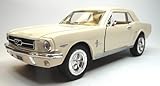
- Authentic 1:36 Scale: Meticulously crafted 1964 1/2 Ford Mustang model car with impressive 5-inch length.
- Realistic Details: Die-cast metal body with opening doors and eye-catching blue finish.
- Interactive Play: Engaging pull-back action for thrilling motion across smooth surfaces.
- Collectible Quality: Ideal for model car enthusiasts and collectors seeking miniature automotive replicas.
- Brand: KiNSMART, a trusted name in die-cast vehicle models and toys.
How to read the “firepower” in these cars
The phrase works best as a metaphor for technological confidence, not a literal claim about military capability. Across these cars, aircraft and space-age imagery communicated force and speed; engineering experiments tested what could be done; and only some ideas translated into production or lasting public influence.
- Design translated into production: GM says features previewed by the Y-Job later appeared on production cars.
- Engineering pushed beyond conventional power: the Firebird I and II explored turbine propulsion, with Firebird II also emphasizing passenger comfort and chassis systems.
- Features were tested selectively: the X-100’s heated seats and telephone had futures, while its other novelties did not catch on.
- Ideas could outlive their engineering purpose: the Futura became a pop-culture icon as the television Batmobile.
- Ambition did not guarantee viability: the Nucleon’s reactor challenges remained unresolved, and Chrysler’s turbine sedans exposed practical drawbacks.
That range is what makes these cars more than a parade of dramatic shapes. Some made plausible future equipment visible; others asked whether an entirely different powertrain or energy source could work. Their shared confidence was real, but so were the limits between an exciting concept and a usable production car.
Outdated Drivers Are Slowing You Down
One free scan finds every outdated or missing driver and matches the right update for your exact hardware.Free scan · exact hardware matchWindows Errors? Fix Them Before They Spread
Repair common Windows errors and clear accumulated junk for a smoother, more stable PC - no reinstall needed.Free scan · no reinstallQuick Recap
Best Value

- Brand new box. Real rubber tires. Officially licensed product. Has opening hood and doors. Made of diecast with some plastic parts. Manufacturer's original unopened packaging. Detailed interior, exterior, engine compartment. Dimensions approximately L-8.25, W-3.25, H-3.25 inches.
Product prices and availability are accurate as of the date/time indicated and are subject to change. Any price and availability information displayed on Amazon at the time of purchase will apply.




