Recommended Free Tools
Car transmissions fall into five main families: manual, conventional automatic, continuously variable (CVT), automated manual (AMT) and dual-clutch (DCT). They differ in how they connect engine power to the wheels and change ratios, which affects how they feel to drive, their efficiency potential and their service needs. No type is best for every vehicle or driver; design, tuning and maintenance all matter.
What are the different types of car transmissions?
A transmission changes the relationship between engine speed and wheel speed so a vehicle can start, accelerate and cruise. The five common families are distinguished by who or what selects the ratio and by the hardware that transfers power.
- Manual: The driver selects fixed ratios and operates a clutch.
- Conventional automatic: A torque converter and planetary gearset work with clutches or bands to shift forward gears automatically.
- CVT: The transmission varies its ratio continuously rather than stepping through a fixed set of gears.
- AMT: A manual-type gearbox and clutch are operated by electronic, pneumatic or hydraulic controls.
- DCT: Two friction clutches manage selectable ratios, allowing the transmission to shift automatically or, in some designs, respond to driver-selected shifts.
SAE J645 provides standardized terminology for automotive transmission types: SAE J645.
How do the transmission types compare?
| Type | How it changes ratios | Driver involvement | Typical driving character | Efficiency and application notes |
|---|---|---|---|---|
| Manual | Fixed gears selected by the driver, with a manually operated clutch. | Highest; the driver shifts and operates the clutch. | Direct control; smoothness depends on the driver’s clutch and shift technique. | Vehicle-specific; no universal fuel-economy advantage follows from the layout alone. |
| Conventional automatic | Torque converter, planetary gearset, and clutches or bands select forward gears automatically. | Low during ordinary driving. | Often associated with smooth launches and familiar automatic operation; behavior varies by calibration and application. | A broad-use design. EPA describes DCTs as avoiding some internal resistance of a traditional automatic by eliminating its torque converter. |
| CVT | Ratio changes continuously rather than in fixed steps. | Low in normal operation. | Engine speed may not rise and fall in stepped shifts; response can therefore feel different from a geared automatic. | Can keep an engine in an efficient operating range. EPA treats hybrid CVTs as a distinct technology category from traditional CVTs. |
| AMT | Manual-type gearbox and clutch, with controls automating clutch and shift actions. | Usually automatic, with manual-mode override defined in EU rules. | Clutch and gear changes may feel different from a torque-converter automatic. | Retains manual-type hardware; operation depends on the control system and vehicle application. |
| DCT | Two friction clutches operate selectable ratios. | Automatic shifting; some systems also permit driver-selected shifts. | Can shift very quickly and provide direct mechanical response; low-speed behavior varies. | Eliminates the conventional torque converter, reducing one source of internal resistance. |
The comparison describes mechanisms, not a guarantee of fuel economy, smoothness, durability or repair cost for a particular car. Tuning, vehicle use and maintenance history influence real-world behavior.
Free tools Windows power users keep installed
One-click scans. No signup required.
#1 Best Overall

- 【V8 Model Engine Kit That Runs】This V8 engine replica accurately restores every detail of the real engine, from the electroplated metallic sheen to the exhaust system and precise structural reproduction. The motor-driven design lets you explore the core of power as pistons move and valves operate—an ideal model engine kit for adults and mechanical enthusiasts. Should you encounter any problems assembling your model kit, please contact us by email. Our after‑sales team is always ready to offer support
- 【Realistic Mechanical Features】Movable parts show how engines work for educational fun; the breathing exhaust assembly replicates real pulsing exhaust motion for authentic mechanical experience
- 【Motor-Driven Mechanism with Four-Speed Gears】The integrated tiny motor activates realistic engine movement. Simulate shifting gears to watch the engine’s working principle in action
- 【Fully Flip-Open Hood】The adjustable hinged hood exposes the entire inner engine structure, ideal for displaying the model’s elaborate craftsmanship
- 【STEM Mechanical Build Set】Perfect for both teens and adults to study mechanical structures, motion transmission and engineering logic through entertaining creative model assembly
Is a dual-clutch transmission an automatic?
Yes. A DCT is an automatic-shifting transmission, even though its internal operation is closer to a manual than to a conventional torque-converter automatic. The U.S. Environmental Protection Agency describes DCTs as “essentially automatic transmissions that operate internally much more like traditional manual transmissions.” Its two clutches allow one ratio to be ready while the other is engaged, helping enable very quick shifts. Because a DCT does not use the conventional automatic’s torque converter, it can also avoid some of that mechanism’s internal resistance. These design advantages do not establish that every DCT is more efficient or smoother in every vehicle.
How do CVTs, AMTs and conventional automatics differ?
CVT versus conventional automatic
A conventional automatic shifts among distinct gear ratios; a CVT changes ratio continuously. A CVT can keep an engine near an efficient operating range, but its engine-speed response may feel unlike the familiar rise and fall of stepped shifts. Hybrid CVTs are not simply grouped with traditional CVTs in EPA technology analysis, so the label alone does not tell you the full mechanical design.
Rank #2

- - The gearbox model can work with M motor and battery case
- - You will 1set gearbox bricks pack
- - Please note that it is a loose part,need install it by yourself
- - Suitable for ages 15+ / Keep children away from - as sharp edges and small parts
- - If you need 6 speed gearbox, please search asin B0DWLL4YJH
AMT versus conventional automatic
An AMT automates the clutch and gear changes of manual-type hardware. A conventional automatic instead uses a torque converter and planetary gearset as part of its shifting arrangement. Both shift without routine driver clutch operation, but an AMT’s clutch engagement and shift feel can differ from the smoother launch behavior many drivers associate with conventional automatics. EU definitions describe an AMT as selecting and engaging the most suitable forward gear automatically, with an option to override in manual mode.
DCT versus AMT
Both draw on manual-transmission principles, but their clutch arrangements differ. An AMT automates a manual-type clutch and gearshift; a DCT uses two friction clutches. DCTs are designed to make rapid shifts, while an AMT’s feel reflects its automated clutch and shift actions. Actual performance and low-speed manners depend on the individual vehicle.
The Tool Desk
Outbyte Driver Updater FREEFix the driver behind crashes, sound loss and screen glitchesFind Drivers →Outbyte PC Repair FREERepair Windows errors before they cause bigger problemsFix Now →Rank #3

- EDUCATIONAL VALUE: Detailed 6-speed manual transmission model with differential gear system provides hands-on learning experience in mechanical engineering principles
- COMPREHENSIVE BUILD: Features fully functional gear shifting mechanism, clutch system, and differential components for authentic mechanical simulation
- SKILL DEVELOPMENT: Assembly process enhances problem-solving abilities, spatial reasoning, and understanding of automotive mechanics
- INTERACTIVE DESIGN: Moving parts allow users to observe and understand the internal workings of a manual transmission system in action
- TARGET AUDIENCE: Perfect STEM learning tool for teens and adults interested in automotive engineering and mechanical systems
Which transmission is best for fuel economy?
There is no universal winner based on transmission type alone. A CVT can help keep an engine in an efficient operating range, while a DCT can reduce some internal resistance by dispensing with the conventional torque converter. Those are design characteristics, not a promise that either will use less fuel than every competing transmission in a specific car. Vehicle design, calibration and driving conditions matter, and the EPA separates hybrid CVTs from traditional CVTs in its technology categories.
The prevalence of automatics is clear in U.S. production: the Department of Energy reported that more than 99% of light-duty vehicles produced in 2022 came with automatic transmissions. That statistic describes production in that year, not the performance or efficiency of any particular transmission type: U.S. Department of Energy.
Rank #4
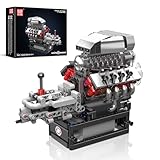
- Mould King V8 engine model kit come with 855+ building block parts and has colorful paper instructions to help you easily assemble it. --Note: If you find a missing item in the package, please contact us via email, we will immediately send the missing item to you.
- V8 engine is an internal combustion engine with 8 cylinders arranged in a V shape, divided into 2 groups. It includes many realistic details and features. The precise coordination of its structural details fully demonstrates the mechanical movement principle of the internal combustion engine.
- This charger V8 engine with transmission is electrically driven mode, with 1*M motor and 1* battery box. (Requires 6 AA batteries, NOT included) which can be run after assembly. Providing strong power and excellent acceleration performance.
- All our building blocks are made of high-quality ABS materials and carbon fiber materials. It is designed in accordance with common standards and can be compatible with your existing brand toys. All parts are easy to assemble and will not fall apart
- Mould King engine model building sets for teenagers, adults and collectors. And it is a good collection. For any occasion such as New Years Day, Christmas, Birthday, Easter, Halloween, STEM, Summer Camp Activities, Back To School.
Which transmission type should you choose?
- Choose a manual if direct control over gear selection matters to you and you are comfortable operating a clutch.
- Consider a conventional automatic if you want automatic shifts and value familiar operation and broad application.
- Consider a CVT if keeping the engine in a useful operating range is a priority and you are comfortable with a response that may not feel like stepped gears.
- Consider an AMT if you want automated operation built around manual-type hardware and accept that clutch and shift behavior can feel different from a conventional automatic.
- Consider a DCT if rapid shifts and direct mechanical response appeal to you, while recognizing its clutch behavior may differ from a conventional automatic.
For a specific purchase, compare the exact vehicle’s operation and service requirements rather than relying on the transmission label as a proxy for comfort, economy or reliability.
Independent reader supportYour contribution helps us test, update, and keep practical guides available for everyone.What transmission fluid does your car take?
Use only the fluid specification listed in the owner’s manual or the vehicle manufacturer’s service information. “Automatic transmission fluid” is not a single interchangeable formula: the required specification depends on the transmission and vehicle. Do not choose fluid by color, a generic label or the assumption that all automatics use the same product. Regulations define factory-fill oil as oil intended to remain in the transmission, torque converter or another torque-transferring component through the first service interval; that definition does not identify the correct replacement fluid for your car. Check the vehicle-specific requirement before topping up or servicing the transmission.
PC Slower Than It Used to Be?
A free scan shows the junk files, broken settings and background clutter dragging Windows down - then fixes them in one click.Free scan · Windows 10 & 11Crashes, No Sound, or Screen Glitches?
Random freezes, missing sound and display glitches usually trace back to one bad driver. Find and replace yours safely.Free scan · under a minuteBest Value

- MUSCLE V8 ENGINE THAT RUNS - Inspired by the raw power of classic American muscle, this functional V8 engine model brings mechanical motion to life. Watch pistons, crankshaft and flywheel move in perfect sync, capturing the energy and spirit of high-performance engines.
- DETAILED V8 STRUCTURE - From the reciprocating pistons and spinning supercharger rotors to the oscillating "ONE" intake, is linked via precision gears. With the included handle, manually crank the engine to watch the entire system spring to life, or add the electric motor for an even more dynamic experience. Perfect for enthusiasts who enjoy a more interactive, educational building experience.
- PRECISION ENGINEERING - Featuring a realistic chain transmission system, detailed flywheel assembly and simulated cooling structure, every component reflects the complexity and craftsmanship of real mechanical engineering.
- ADVANCED BUILD FOR ADULTS & ENGINEERING ENTHUSIASTS - With 1145 precision parts, this engine building kit offers a challenging and rewarding assembly experience. Perfect for hobbyists, collectors and anyone passionate about mechanical design and automotive engineering.
- STRIKING DISPLAY - Once completed, this V8 engine model will serve as a striking mechanical centerpiece on your desk, in your office, or in your workshop. Its exposed mechanics and dynamic movement create a strong industrial aesthetic, making it perfect for display on a shelf, tabletop, or in your personal collection.
What affects transmission service and repair?
Service needs follow the particular transmission design and the vehicle maker’s instructions. A manual has a driver-operated clutch; an AMT automates clutch and shift actions; a DCT has two clutches; a conventional automatic uses a torque converter and planetary gearing; and a CVT varies ratio continuously. These differences mean that fluid requirements and repair work cannot safely be inferred from a generic “automatic” label. Consult the maintenance schedule and correct service specification for the exact vehicle, and have symptoms assessed in that context rather than assuming one transmission family is always cheaper or more reliable.
Definitions of manual, AMT and DCT systems appear in EU regulations: EUR-Lex, Regulation (EU) 2017/1151. EPA’s transmission categories and discussion of DCTs are available in its Automotive Trends materials; Edmunds also explains the types of car transmissions.
Quick Recap
Product prices and availability are accurate as of the date/time indicated and are subject to change. Any price and availability information displayed on Amazon at the time of purchase will apply.




