The biggest difference is the rear suspension: the 2005–2014 S197 uses a solid live rear axle, while the S550, introduced for 2015, uses independent rear suspension. The change is part of a broader redesign that also brought a new chassis, a turbocharged four-cylinder option, and updated cabin and driver-assist technology. Which generation suits you better depends on the exact model year, trim, condition, and how you plan to drive it.
1. Rear suspension: live axle versus independent rear suspension
The S197’s solid live rear axle connects the rear wheels through a shared axle assembly. The S550 switched to an integral-link independent rear suspension, allowing each rear wheel to respond more independently to road inputs. Ford described the S550 setup’s geometry, springs, dampers, and bushings as tuned for the car, with improved mechanical grip and ride and handling among its aims. That is the manufacturer’s design rationale, not proof that every S550 is better in every driving situation. MotorTrend’s S197 overview; Ford’s 2014 S550 announcement.
For cornering and uneven pavement, independent rear suspension offers a different way of managing wheel movement and is central to the S550’s revised road behavior. A live axle can still appeal to drivers prioritizing straight-line or drag use. Neither layout guarantees a better result regardless of setup, surface, or driver preference.
2. Chassis and front suspension
Ford introduced the S550 with a new chassis, a non-isolated perimeter subframe, and double-ball-joint front MacPherson struts. Ford presented those components as a foundation for steering, ride, handling, braking, and wheel control. Treat those statements as design goals rather than an independent head-to-head test against the S197. Ford’s 2014 announcement; Ford’s 2015 Mustang product information.
Crashes, No Sound, or Screen Glitches?
Random freezes, missing sound and display glitches usually trace back to one bad driver. Find and replace yours safely.Free scan · under a minutePC Slower Than It Used to Be?
A free scan shows the junk files, broken settings and background clutter dragging Windows down - then fixes them in one click.Free scan · Windows 10 & 11#1 Best Overall

- FD. MUSTANG V8 64.5-73
3. Engine choices at the S550’s 2015 launch
The 2015 North American S550 launch range included three engines. These are launch-year figures, not specifications that apply to every S550 model year or market.
| 2015 North American engine | Ford’s launch output |
|---|---|
| 3.7L Ti-VCT V6 | 300 hp and 280 lb-ft of torque |
| 2.3L EcoBoost | 310 hp and 320 lb-ft of torque |
| 5.0L Ti-VCT V8 | 435 hp and 400 lb-ft of torque; Ford specifies 93-octane fuel for the horsepower figure |
Figures are from Ford Motor Company’s 2014 product-information booklet for the 2015 North American lineup. Engine availability and output vary by year, market, and trim. Ford’s 2015 Mustang product information.
Rank #2

- Comprehensive Repair Guide: This Haynes Manual provides detailed instructions for servicing and repairing Ford Mustang models from 2015 to 2023.
- Extensive Repair Information: Offers over 10 times more details than previous manuals, ensuring complete coverage of all repairs.
- Interactive QR Codes: Access extra repair content, continuously updated, via QR codes for more in-depth information.
- Multi-Device Accessibility: Supplementary content is available on any computer or mobile device for added convenience.
- Full-Color Visuals: Clear, full-color illustrations enhance ease of use compared to black-and-white manuals.
4. The S550 added a turbocharged four-cylinder route
The 2.3L EcoBoost gave S550 buyers a turbocharged four-cylinder option not listed in the S197 generation overview. Ford described it as the first turbocharged Mustang engine in nearly 30 years. It broadened the lineup beyond the V6 and V8 choices, but that alone does not establish that an EcoBoost is cheaper to own, more fuel-efficient, or more reliable than a particular S197. Those comparisons require the exact model years and vehicles. Ford’s 2015 Mustang product information; MotorTrend’s S197 overview.
5. S550 fastback dimensions and packaging
Ford’s 2014 product-information booklet gives the 2015 S550 fastback a 107.1-inch wheelbase, 188.3-inch length, and 75.4-inch width measured without mirrors. It lists four seats and 13.5 cubic feet of luggage capacity for the fastback. The available figures do not provide a comparable S197 measurement set, so they do not establish that one generation is larger than the other. Body style and model year matter when comparing actual cars. Ford’s 2015 Mustang product information.
What’s actually slowing this PC down?
Pick the symptom - the matching free tool is one click away.
Rank #3
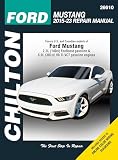
- Comprehensive Coverage: Designed for U.S. and Canadian models of Ford Mustang (2015-23) with 2.3L EcoBoost and 5.0L V8 Ti-VCT gasoline engines.
- Access to Online Resources: Includes access to color wiring diagrams, fuses/relays, troubleshooting guides, and a glossary to simplify complex repairs.
- Step-by-Step Instructions: Easy-to-follow guidance for routine maintenance, engine repair, transmission work, and more.
- Professional-Grade Detail: Features workshop-backed data, high-resolution images, and detailed diagrams for precise repairs and adjustments.
- Comprehensive Coverage: Designed for U.S. and Canadian models of Ford Mustang (2015-23) with 2.3L EcoBoost and 5.0L V8 Ti-VCT gasoline engines.
6. Exterior, interior, and technology
Ford’s 2015 launch booklet describes the S550’s exterior and interior as all-new and identifies driver-assist technologies among its key features. That marks a generational redesign, but the generation name does not tell you which equipment a particular car has. Feature availability depends on model year and equipment, and a used car’s condition matters too. Check the specific vehicle’s infotainment, safety equipment, controls, and cabin condition rather than assuming every S550 includes a particular feature. Ford’s 2015 Mustang product information.
Independent reader supportYour contribution helps us test, update, and keep practical guides available for everyone.7. Year, trim, and use matter more than the generation label alone
The S197 spans 2005–2014, and the S550 begins with the 2015 model year. Cars within either generation are not interchangeable: a 2005 S197 differs from a 2014 S197, just as an early S550 differs from a later facelift. The available specifications do not provide a complete year-by-year comparison of engines, dimensions, transmissions, safety equipment, reliability, or ownership costs. MotorTrend’s S197 overview; Ford’s 2015 Mustang product information.
Rank #4
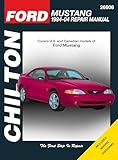
- Detailed repair and maintenance coverage trusted by professional technicians and DIYers for decades.
- Clear step-by-step instructions supported by wiring diagrams, diagnostic charts, and technical illustrations.
- Covers routine maintenance through advanced repairs, making it the go-to resource for keeping your vehicle running reliably.
When comparing two listings, use the cars’ exact details rather than treating a generation as a trim level:
- Driving use: decide whether commuting, rough roads, track cornering, or straight-line driving matters most to you.
- Powertrain: compare the specific engine, transmission, and equipment for each model year.
- Technology: confirm the driver aids and cabin features actually fitted to each car.
- Condition: review mileage, service records, modifications, and an inspection. The available evidence does not support a generation-wide reliability verdict.
- Parts fitment: verify compatibility by year, trim, and body style before buying parts.
For a vehicle-specific reference, Ford provides an online 2015 owner-manual page. Ford cautions that online content can differ from the manual originally supplied with a vehicle, so use the manual that matches the car when possible. Ford 2015 Mustang owner manuals.
The Tool Desk
Outbyte Driver Updater FREEScan for outdated or missing drivers - takes under a minuteDriver Scan →Outbyte PC Repair FREERepair Windows errors before they cause bigger problemsFix Now →Quick Recap
Best Value

- Complete Repair Coverage: Step-by-step repair procedures specific to your vehicle — from routine maintenance like oil changes and air filter replacement to complex engine and transmission repairs
- 700+ Photos & Illustrations: Every procedure is visually supported with clear, close-up photography taken during an actual vehicle teardown and rebuild — no guesswork required
- Beginner to Advanced: Written in plain language so a DIY owner with basic tools can tackle most repairs confidently, while still serving as a valuable reference for experienced mechanics
- Full Troubleshooting Section: Quickly diagnose problems with dedicated troubleshooting guides for engine, electrical, brakes, and drivetrain systems
- Time-Saving Tips Throughout: Pro shortcuts and notes highlight common pitfalls, helping you avoid costly mistakes and get your vehicle back on the trail faster
Product prices and availability are accurate as of the date/time indicated and are subject to change. Any price and availability information displayed on Amazon at the time of purchase will apply.




