Free tools Windows power users keep installed
One-click scans. No signup required.
A fourth-order subwoofer box is a bandpass enclosure with one sealed chamber and one vented chamber. The subwoofer sits between them, and the vent is the enclosure’s sound outlet. Its response is shaped around a designed frequency range, so it can focus bass where a system needs it—but it is not automatically louder, cleaner, or better than a sealed or ported box.
What a fourth-order sub box is
In a fourth-order, or single-reflex bandpass, enclosure, the driver separates a sealed rear chamber from a vented front chamber. Sound from the enclosure exits through the vent rather than directly from the cone. The chamber volumes and port tuning work together to shape the frequencies the box emphasizes. MTX describes this arrangement and its tuning dependence in its car speaker enclosure design guide.
That layout distinguishes a fourth-order bandpass from a sixth-order bandpass, which has vented chambers on both sides of the driver. The order is not a rating of sound quality or power; it describes the enclosure alignment.
How it changes the bass response
A bandpass enclosure is designed to deliver a particular passband, not uniform output across the entire bass range. The builder chooses chamber volumes and tuning to shape that range. A narrow or strongly emphasized response can make some bass notes stand out while others sound less present; that is a possible consequence of the chosen design, not an inevitable trait of every fourth-order box.
#1 Best Overall

- Custom fit for talon x/r 4 seater
- 400 Watts
- 10 inch Subwoofer
- Dimensions 12.5 inches length x 12.5 inches width x 5 inches height
MTX notes that enclosure choices can involve tradeoffs between efficiency and low-frequency extension. The result depends on the driver, enclosure dimensions, tuning, and installation, so a bandpass box should not be described as categorically louder than a ported or sealed box. MTX also cautions that improving one parameter can compromise another.
The enclosure and the car must be considered together. Ground Zero’s modeling examples show that adding a vehicle’s transfer response can materially alter the predicted curve compared with the enclosure-only response. Trunk-to-cabin coupling, the opening between trunk and passenger area, port location, and the cabin itself all influence what reaches the listener.
Rank #2

- Crisp, Powerful Bass for Your Vehicle: Upgrade your car & truck audio system with the QPower single sealed subwoofer enclosure; purpose-built to deliver tight, accurate bass you can feel on every track.
- Heavy-Duty MDF Construction: Built with a 1-inch MDF front panel and 3/4-inch MDF body for enhanced stability and long-lasting performance; covered in premium charcoal gray carpet for a sleek, professional finish.
- Spring-Loaded Gold-Tipped Terminals for Easy Install: Circular recessed panel features spring-loaded, gold-tipped terminals for a secure, corrosion-resistant wiring connection to your amplifier — no soldering required.
- Single Sealed Chamber Design: Airtight 1.2 cu ft enclosure maximizes bass accuracy and protects your subwoofer from internal pressure during high-power operation; fits standard trunk and cargo spaces.
- Built by QPower: Specializing in car audio enclosures across sealed, ported, and custom configurations; each sub box is dedicated audio enthusiasts in cars, trucks, and SUVs.
When this alignment may suit a car-audio build
A fourth-order box may make sense when the goal is a deliberately shaped bass response or when the installation is designed to route output from a trunk into the cabin. It is less suitable as a guess-based upgrade: without a defined target range and a model for the specific driver and vehicle, there is no reliable promise of stronger or more satisfying bass.
- Consider it when the desired passband, available enclosure space, and vehicle coupling can be modeled together.
- Compare alternatives when you need broader response, different low-frequency extension, a simpler build, or fewer port and packaging constraints.
- Check excursion at and below the intended passband using the chosen driver’s modeled limits. Do not assume the sealed chamber protects every design at all frequencies.
- Account for serviceability because a partitioned enclosure and its port can make access and construction more involved than a basic box.
What to compare before choosing an enclosure
| Factor | What to evaluate |
|---|---|
| Response width and shape | Decide whether you want a wider useful range or stronger emphasis over a narrower range. Neither is universally preferable. |
| Output and extension | Compare modeled output in the intended band with low-frequency extension and driver excursion; do not treat a potential efficiency benefit as a guaranteed real-world gain. |
| Chamber and port fit | Check the enclosure envelope, port opening, and port length. A theoretically attractive tuning may require a port too long for the available space. |
| Vehicle integration | Evaluate the cabin transfer response, trunk-to-cabin path, installation opening, and port placement—not just the box response in isolation. |
| Build demands | Plan for partitioning, sealing, bracing, accurate dimensions, airflow, and driver service access. |
How to plan a fourth-order enclosure
- Choose the exact subwoofer. Obtain its Thiele/Small parameters and the manufacturer’s operating limits. A chamber ratio, volume, or tuning frequency cannot be chosen universally from the enclosure type alone.
- Define the target and space. Set the desired passband and measure the usable enclosure envelope, including the route into the cabin if the sub is in the trunk.
- Model both chambers and the port together. Include driver and port displacement when determining net volumes, and examine the modeled response and driver excursion.
- Check port practicality. Confirm that the required opening and length fit, and assess airflow and noise. Ground Zero recommends a port flared at both ends in its guidance, but dimensions still have to match the particular design.
- Include the vehicle in the assessment. Consider cabin transfer and installation geometry; an enclosure-only curve is not the final in-car result.
- Build to the validated design. Seal and brace the partitioned enclosure, preserve the modeled port dimensions, and allow access to service the driver.
Ground Zero’s volume ranges and center-frequency suggestions are examples of manufacturer guidance, not universal specifications. Its presentation also illustrates a case where an attractive modeled result would require an impractically long port. The AES paper “Bandpass Loudspeaker Enclosures” by Earl Geddes and David Fawcett develops general bandpass theory and transfer-function analysis; it does not establish a typical sound-pressure improvement for consumer builds.
Rank #3
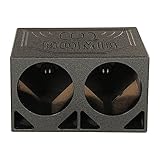
- Dual triangle-ported design optimizes airflow within the subwoofer box, allowing the subwoofers to move air more efficiently for an immersive audio experience
- Built with 0.75-inch medium-density fiberboard wood to provide exceptional durability to the subwoofer box that can withstand an exhaustive, heavy bass output
- Equipped with spring-loaded terminals to simplify the process of connecting your subwoofers, offering secure connections and minimizing signal loss or interruptions
- Comes with a black bedliner spray finish that not only adds a sleek and stylish appearance to your subwoofer box but also provides essential protection
- Features 1.2 cubic feet of air space per subwoofer to help optimize the environment within the box and a mounting depth of 14 inches; Measures 22 inches long, 18.5 inches wide, and 13 inches tall
Why the port and construction matter
Because the vent is the enclosure’s sound outlet, its dimensions, placement, and airflow are part of the acoustic design. Changing port length or opening can change tuning and response. A double-flared port is one option recommended by Ground Zero, not a universal component prescription; diameter, length, and fit must be selected for the modeled enclosure.
Construction must preserve the intended chamber volumes and prevent unwanted air leaks between chambers. Bracing, reliable sealing, and accurate assembly help keep the finished box close to the modeled design. There is no one-size-fits-all recipe for chamber ratio, volume, port diameter, port length, or driver selection.
Rank #4

- Designed to hold one 12-inch car audio subwoofer, offering 1.65 cubic feet of air space that pumps out great sound for optimal audio performance by reducing vibration and enhancing sound clarity
- Sturdy construction with solid MDF wood construction with a tabletop mounting feature for portability, enhanced bass response, and lessened floor vibration as you boost the volume of your speaker
- Efficient heat management with vented design that improves bass performance; Ensures safety of both you and your speakers by allowing air to move within the box freely
- Seamlessly blends into your vehicle with a charcoal carpeting cover and also doubles as a subwoofer, speaker and box protection for a superior audio performance
- Tuned-to-42-hertz design that adds more bump to your ride with powerful bass and smooth audio and has dimensions of 16 by 18 by 13.25 inches that can be easily tucked in your car
Technical background
The AES record for Geddes and Fawcett’s 1986 paper describes a general theory of bandpass loudspeaker enclosures, including transfer functions and designs from fourth through eighth order. That technical foundation is useful for understanding why response depends on enclosure variables; it is not proof that every fourth-order box produces a particular SPL gain.
Quick Recap
Best Value

- 18 Ft.- 1/0 Gauge Red Power Wire CCA (Copper Clad Aluminum)/ 3 Ft.-1/0 Gauge Black Ground Wire CCA (Copper Clad Aluminum)
- 16 Ft.- 14 Gauge Clear Speaker Wire/ 18 Ft.- 18 Gauge Blue Remote Turn-On Wire
- 18 Ft.- Twisted Pair RCA Interconnect Cable/ 0 Gauge Black Wire Loom
- Heat Tested, Water Resistent InLine ANL Fuse Holder/ 200 Amp ANL Fuse/ 3 Positive (+) and 2 Negative (-) Connecting Terminals/ Wire Ties
- Wire Gauge Set To International Wire Gauge (Not AWG). Bulk Packaged. Not for Resale.
Product prices and availability are accurate as of the date/time indicated and are subject to change. Any price and availability information displayed on Amazon at the time of purchase will apply.
What’s actually slowing this PC down?
Pick the symptom - the matching free tool is one click away.




