The Tool Desk
Outbyte Driver Updater FREEScan for outdated or missing drivers - takes under a minuteDriver Scan →Outbyte PC Repair FREEClear out junk files and repair common Windows errorsFree Scan →The 1970 Dodge Charger R/T came standard with the 440 Magnum four-barrel V-8. The 426 Street Hemi was an expensive optional engine, while the 440 Six-Pack was a separate option rather than the standard 440. In Dodge’s published ratings, the 440 Magnum made 375 horsepower and the Hemi made 425 horsepower.
The headline numbers do not tell the entire story. A model-specific specification source reports 480 lb-ft at 3,200 rpm for the 440 and 490 lb-ft at 4,000 rpm for the Hemi, so the torque figures were measured at different engine speeds. The cars also could have differed in transmission, axle ratio, tires, equipment and condition. That is why the specifications establish the engines’ output and factory status, but do not by themselves prove a particular acceleration advantage in every Charger.


As an Amazon Associate I earn from qualifying purchases.
The short answer: standard 440, optional 426 Hemi
For a 1970 Charger R/T, the 440 Magnum was the normal starting point. Dodge’s 1970 brochure and a period-model fact sheet identify the 375-hp 440-cubic-inch V-8 as the standard R/T engine. Buyers could order the 426 Street Hemi as an option, and they could also choose a 440 Six-Pack option. Those are three distinct configurations: a four-barrel 440 Magnum, a three-two-barrel 440 Six-Pack, and the 426 Hemi.
Do these 3 things before closing this tab:
1Fix the driver behind crashes, sound loss and screen glitches2Clear out junk files and repair common Windows errors3Scan for outdated or missing drivers - takes under a minuteThe Hemi therefore was not the engine every R/T received, nor was every 440-powered car a Six-Pack. A car described simply as a “1970 Charger R/T 440” normally refers to the standard 440 Magnum unless its build documentation identifies the Six-Pack package.
#1 Best Overall
1970 Charger R/T 440 vs. 426 Hemi at a glance
| Specification | 440 Magnum | 426 Street Hemi |
|---|---|---|
| Factory role in 1970 Charger R/T | Standard high-performance V-8 | Optional engine |
| Displacement reported by the cited specification page | 440 cubic inches | 426 cubic inches |
| Published horsepower | 375 hp | 425 hp |
| Reported peak torque | 480 lb-ft at 3,200 rpm | 490 lb-ft at 4,000 rpm |
| Carburetion reported by the cited specification page | Single Carter four-barrel | Dual Carter four-barrels |
| Reported compression ratio | 9.7:1 | 10.25:1 |
| Historical availability | Included as the standard R/T engine | Rare, higher-cost option; Hagerty reports 112 buyers |
The horsepower figures come from Dodge’s period model material and later vehicle reporting. The detailed torque, carburetion and compression figures come from a secondary model-specific specification page. These are advertised or published specifications, not modern chassis-dynamometer measurements.
What “440” meant on a 1970 R/T
The standard 440 Magnum
The standard R/T 440 was the 440 Magnum four-barrel. Its published rating was 375 horsepower, and the cited specification page describes it with one Carter four-barrel carburetor, a 9.7:1 compression ratio and 480 lb-ft at 3,200 rpm. The 440’s larger stated displacement than the Hemi did not give it the higher advertised horsepower rating; Dodge rated the optional Hemi at 425 hp.
Because the 440 Magnum was standard equipment, it is the configuration most directly associated with an ordinary factory 1970 Charger R/T. A seller or registry entry that says only “440” has not, by that description alone, established that the car was a Six-Pack or that it left the factory with a Hemi.
The separate 440 Six-Pack option
Dodge also offered a 440 Six-Pack option. The Six-Pack designation identifies a different induction package from the standard four-barrel 440. It should not be used as a synonym for the 440 Magnum, and it should not be treated as evidence that a car had the 426 Hemi. The registry’s broadcast-sheet decoder lists separate identifiers for the 440 four-barrel, 440 Six-Pack and 426 Hemi, along with different engine-label and exhaust identifiers.
That distinction matters when checking a restored or modified car. A 440-powered Charger can have the wrong induction system, replacement labels or a later engine while still looking broadly correct from a distance. The engine currently installed is only one piece of the originality question.
Why the Hemi carried the higher horsepower rating
375 hp versus 425 hp
The clearest numerical difference is 50 advertised horsepower: 375 hp for the standard 440 Magnum and 425 hp for the 426 Street Hemi. Hagerty’s February 16, 2026 vehicle report and the cited specification page give the 425-hp Hemi figure. Dodge’s 1970 brochure and the model fact sheet identify the 375-hp 440 rating.
Those ratings belong to the period’s published system and should not be read as equivalent to a current chassis-dyno result at the rear wheels. A chassis dynamometer measures power after drivetrain losses, while the historical figures describe the engines under the rating conventions used when the cars were new. The safe comparison is therefore the published factory-style output, not an assumed wheel-horsepower difference.
Recommended Free Tools
Torque is close, but the rpm is different
The cited specification page reports 480 lb-ft for the 440 at 3,200 rpm and 490 lb-ft for the Hemi at 4,000 rpm. The Hemi’s reported peak is only 10 lb-ft higher, but it occurs 800 rpm later. That difference in engine speed is essential: two peak-torque numbers cannot be treated as though they describe the same point in the rev range.
Rank #2

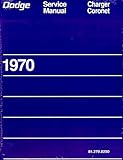
- Dodge Charger & Coronet Service Manual." The manual set is a page-for-page reproduction of the book that Dodge mechanics used to service cars. You will find detailed service procedures for front suspension, rear axle, body and sheet metal, brakes, clutch, cooling, electrical, engine, exhaust, frame, fuel system, lubrication, shock Charger, Coronet, Super Bee, R/T, Coronet Deluxe, Coronet 440, and Coronet 500 R/T series.
Peak torque is one point on an engine’s torque curve, not a complete description of how the car responds everywhere. The published figures do not provide a full curve, gear-by-gear acceleration data or a controlled test with identical gearing and tires. They show that both engines were rated for substantial torque, with the Hemi’s listed peak occurring higher in the rpm range.
Displacement, carburetion and compression
Displacement
The model-specific specification page identifies the 440 Magnum as a 440-cubic-inch engine and the Street Hemi as a 426-cubic-inch engine. The larger displacement number belongs to the 440, but displacement alone does not determine the advertised horsepower ranking. The Hemi’s 425-hp rating was higher despite its smaller stated displacement.
Carburetion
The same source describes the 440 with a single Carter four-barrel carburetor and the Hemi with dual Carter four-barrel carburetors. This is another reason to keep “440,” “440 Magnum” and “440 Six-Pack” separate in descriptions and listings. The standard 440’s four-barrel arrangement is not the Six-Pack package, and neither is the dual-four-barrel Hemi arrangement.
Compression ratio
The reported compression ratios are 9.7:1 for the 440 and 10.25:1 for the Hemi. These numbers are attributed to the secondary specification page rather than to a directly quoted factory brochure table. They are useful identification and specification points, but an individual engine may differ after machining, rebuilding, parts substitution or a complete engine swap.
How rare was the 426 Hemi option?
The Hemi’s rarity was tied to its cost as an option. Hagerty’s February 16, 2026 report says it recorded 112 Hemi buyers. That is a Hagerty-reported buyer count and should not be presented as a reconciled factory production total.
For context, the 1970 Dodge Charger Registry lists 9,509 Charger R/Ts overall and notes that its total includes cars shipped in September 1970. The two numbers have different scopes: 112 refers to Hemi buyers in Hagerty’s report, while 9,509 is the registry’s total for R/T production. The available sources do not reconcile the Hemi figure against a complete factory production ledger, so a precise percentage of all R/Ts should not be calculated from them.
Registry totals can also change as owners submit documentation. They are valuable enthusiast records, but they are not automatically a complete factory archive. Treat the counts as attributed figures, not as a definitive census of every surviving or originally built car.
Quick wins for a faster PC:
Clear out junk files and repair common Windows errorsFree Scan →Scan for outdated or missing drivers - takes under a minuteDriver Scan →Repair Windows errors before they cause bigger problemsFix Now →Does the Hemi automatically make a Charger faster?
The published ratings establish a higher advertised horsepower figure for the Hemi, but they do not establish a universal acceleration result for every 1970 Charger R/T. The sources reviewed do not provide a same-condition road test comparing otherwise identical Charger R/Ts with the 440 Magnum and 426 Hemi.
Acceleration would also depend on details that are not held constant by the engine specifications alone:
- Transmission type and gear ratios
- Rear-axle ratio and whether an available performance axle package was fitted
- Tire size, compound and traction
- Vehicle weight and optional equipment
- Engine tune, fuel system condition and ignition setup
- Driver technique, weather, surface and test method
The registry lists examples of 4.10 axle packages with both engines, but that registry information should not be generalized into a complete factory option count. A Hemi car with one axle and transmission combination cannot be used as a controlled stand-in for every Hemi R/T, just as a 440 car with different gearing cannot represent all 440 cars.
How to tell whether a 1970 Charger R/T is originally a 440 or Hemi car
Start with the paperwork
The strongest starting point is the car’s surviving documentation: a broadcast sheet, window sticker, factory invoice or other period record that can be tied to the vehicle identification number. The registry’s broadcast-sheet decoder lists distinct engine identifiers for the 440 four-barrel, 440 Six-Pack and 426 Hemi. It also lists different engine-label and exhaust identifiers.
PC Slower Than It Used to Be?
A free scan shows the junk files, broken settings and background clutter dragging Windows down - then fixes them in one click.Free scan · Windows 10 & 11Outdated Drivers Are Slowing You Down
One free scan finds every outdated or missing driver and matches the right update for your exact hardware.Free scan · exact hardware matchUse those identifiers as a cross-check rather than as a substitute for the document itself. A decoder can explain what a code means, but it cannot prove that a loose sheet belongs to the car in front of you.
Compare the documented configuration with the car
Once the paperwork is matched to the vehicle, compare the listed engine configuration with the physical components and labels. Check the installed engine, intake and carburetion arrangement, exhaust details, markings and other relevant components. A qualified marque specialist can identify mismatched parts, reproduction labels and signs of a replacement drivetrain more reliably than a casual visual inspection.
Do not use the installed engine as the sole proof
A swap can leave a car with a different engine from the one recorded on its factory paperwork. Conversely, a rebuilt original block may contain replacement internal parts while retaining its original identity. The practical conclusion is that “has a Hemi installed” and “was factory-built as a Hemi car” are different claims. The latter requires documentation and a coherent set of supporting components.
Independent reader supportYour contribution helps us test, update, and keep practical guides available for everyone.What to check when reading a sales listing
- Whether “440” means the standard 440 Magnum or the separate 440 Six-Pack option
- Whether the seller identifies the car as factory Hemi or merely Hemi-swapped
- Whether a broadcast sheet or other period document is shown and tied to the vehicle
- Whether engine, carburetion, exhaust and label details agree with the claimed configuration
- Whether registry information is presented as a record aid rather than absolute proof of production history
- Whether performance claims identify the transmission, axle ratio, tires, test method and vehicle condition
Be especially careful with listings that combine a correct-looking engine bay with an unsupported claim about factory status. Appearance can establish that parts are present; it cannot establish what Dodge installed when the car was built.
What’s actually slowing this PC down?
Pick the symptom - the matching free tool is one click away.
Which engine is the better choice for a restoration?
Choose the 440 Magnum when factory-standard R/T identity matters
The 440 Magnum is the historically correct baseline for a standard 1970 Charger R/T. It is the appropriate reference point when the goal is to restore an ordinary R/T to its documented factory configuration rather than create a rare-option tribute. Confirm the car’s paperwork before selecting parts, because a documented Six-Pack or Hemi car has a different originality target.
Choose the Hemi configuration only when the documentation supports it
A documented Hemi car deserves Hemi-specific research because its engine, induction, labels and exhaust identifiers differ from the 440 configurations. If a non-Hemi R/T has been converted, describe it accurately as a conversion or swap rather than implying that the conversion changes the car’s original factory status.
Use the Six-Pack description precisely
If the paperwork and components identify the 440 Six-Pack, retain that designation. Calling every 440 a Six-Pack erases an important difference between the standard four-barrel engine and the separate option, and it can mislead future buyers or restorers about what parts belong on the car.
Common mistakes in 440-versus-Hemi comparisons
Calling the Hemi the standard R/T engine
The 426 Hemi was optional. The 440 Magnum was standard. Reversing those roles changes the basic history of the model.
Confusing the 440 Magnum with the 440 Six-Pack
The standard 440 used the four-barrel arrangement reported by the specification source. The Six-Pack was a separate option. A listing should name the exact configuration instead of using “440” as a catch-all.
Comparing torque without the rpm
Write 480 lb-ft at 3,200 rpm for the 440 and 490 lb-ft at 4,000 rpm for the Hemi when using the cited figures. Omitting rpm makes the comparison less precise and suggests that the peaks occurred under identical conditions.
Turning a registry count into a factory total
Hagerty’s 112-buyer figure and the registry’s 9,509-R/T figure come from different sources and cover different populations. Keep their attribution and scope attached whenever they are used.
Assuming a current engine proves original specification
Engine swaps and replacement parts are common enough that documentation, codes and specialist inspection are necessary for an originality claim.
Bottom line
The 1970 Charger R/T 440 and 426 Hemi were not equivalent factory configurations. The 440 Magnum four-barrel was standard and rated at 375 hp; the 426 Street Hemi was optional and rated at 425 hp. The cited specification page reports 480 lb-ft at 3,200 rpm for the 440 and 490 lb-ft at 4,000 rpm for the Hemi, along with different carburetion and compression figures. The Hemi’s rarity and cost made documented examples especially significant, but only matched factory paperwork and a specialist inspection can show whether a particular Charger was born with that engine.
Quick Recap
Product prices and availability are accurate as of the date/time indicated and are subject to change. Any price and availability information displayed on Amazon at the time of purchase will apply.




