Chevrolet’s 1969 Camaro ZL1 was a factory-built drag-racing homologation special, ordered through the Central Office Production Order system as COPO 9560. Its all-aluminum 427-cubic-inch V-8 made it fundamentally different from an ordinary Camaro, yet the car could still be driven on the street and covered by Chevrolet’s five-year/50,000-mile warranty. The combination was so expensive and specialized that only a tiny number were produced for the 1969 model year.
That scarcity was not an accident or a marketing stunt. Chevrolet needed customer cars to satisfy NHRA Stock Eliminator rules, and the ZL1 package cost more than many complete performance cars. The result was one of the most consequential and least frequently seen Camaros ever sold.
As an Amazon Associate I earn from qualifying purchases.
What the 1969 Camaro ZL1 actually was
The ZL1 was Chevrolet’s answer to a specific racing problem: build enough nearly stock cars with a competition-grade 427 engine to qualify for NHRA Stock-class racing. Dealers could request unusual combinations through Chevrolet’s Central Office Production Order system, commonly called COPO. Code 9560 identified the aluminum 427 package.
The Tool Desk
Outbyte Driver Updater FREEFix the driver behind crashes, sound loss and screen glitchesFind Drivers →Outbyte PC Repair FREERepair Windows errors before they cause bigger problemsFix Now →Unlike a regular option that a customer could select from a showroom order form, COPO allowed a dealer to obtain a car Chevrolet did not broadly advertise. The ZL1 therefore began as an internal production and racing strategy rather than a mass-market trim level. Its purpose was to put a legal, supportable drag car into customers’ hands while keeping the car recognizable as a Camaro.
#1 Best Overall

- High-Quality Materials:The 1969 Camaro SS die-cast car is made of zinc alloy,plastic parts and rubber tires,making it safe for children to play with.It features detailed interior and exterior trim, and is very sturdy.
- Function:No batteries are required, but the vehicle has a powerful pull back feature. Simply pull it back, then release your hand, and the car will go for a long distance. The doors may be opened to view the whole inside of the vehicle. So appealing to children and collectors alike.
- Size:1/36 scale vehicle model with beautiful English packaging,ideal for toddlers to play with and carry. Car collectors will appreciate the perfect small size, which allows them to collect a complete set of cars without taking up too much space.
- Grow From Play:Help children learn more about car ,expand their knowledge ,increase the hand-eye coordination and the reaction speed of the children in the play.
- Ideal Christmas Festival Gift:All of TOKAXI die-cast model cars are attractively packaged in English, making them the perfect Christmas, Birthday, Children's Day, New Year gift for kids, party favors, home decorations, or travel toys for boys and girls.gifts for boys girls.
Chevrolet’s own historical account identifies 69 Camaro ZL1 engines installed for the 1969 model year. NHRA’s account separately notes two ZL1-powered Corvettes, so the Camaro total should not be combined with the Corvette figure.
Why Chevrolet built so few
NHRA’s minimum-car requirement
NHRA homologation rules required a manufacturer to make a minimum number of customer cars before a configuration could compete in the relevant Stock categories. Chevrolet’s modern COPO history describes a 50-vehicle requirement. Building a limited batch just above that threshold made sense: Chevrolet could legalize the package without committing to thousands of expensive, highly specialized cars.
The ZL1’s production count ended up well below what a normal Camaro option would attract. Dealers had to know about the program, convince a customer to accept the price and performance compromises, and then navigate a special-order process. Every one of those steps narrowed demand.
Recommended Free Tools
The price was extraordinary
RM Sotheby’s archival material lists the ZL1 engine package at $4,160 in 1969. A documented test car carried a $7,800 sticker in an auction description archived in 2016, roughly twice the price of an L78 SS 396. That surcharge was not for cosmetic trim; it paid for an expensive aluminum racing engine and the hardware needed to support it.
For a buyer who wanted a streetable Camaro, a less costly big-block or small-block offered easier drivability and a lower financial risk. For a racer, however, the price bought a factory-installed engine that could compete immediately and retain Chevrolet warranty coverage. The market was therefore limited to a very specific group of serious drag racers and collectors.
Rank #2

- Revell Model Kit #85-7457, Skill Level 4, Contains 113-Parts, Recommended for ages 12 and up
- Special rally sport option.
- Hood opens to reveal detailed 302 cu. in. V-8 engine with dual carbs.
- Optional center console. Chambered dual exhausts.
- Molded in white, transparent red and clear with chrome plated parts and soft black tires. Requires paint and glue. (not included)
What COPO 9560 means
COPO was Chevrolet’s internal ordering channel for combinations that normal dealer order forms did not cover. In the ZL1 case, code 9560 delivered the all-aluminum 427-cubic-inch V-8 package. The code itself does not mean every COPO Camaro was a ZL1; other COPO combinations used different engine codes and equipment.
The distinction matters when evaluating a car today. A 1969 Camaro with an ordinary big-block, an iron 427 or later replacement engine is not automatically a ZL1. Authenticity depends on factory paperwork, identifying components, production records and a credible ownership history.
PC Slower Than It Used to Be?
A free scan shows the junk files, broken settings and background clutter dragging Windows down - then fixes them in one click.Free scan · Windows 10 & 11Crashes, No Sound, or Screen Glitches?
Random freezes, missing sound and display glitches usually trace back to one bad driver. Find and replace yours safely.Free scan · under a minuteAluminum 427 hardware and specifications
The engine was an aluminum-block-and-head development based on the L88 427. Aluminum reduced mass dramatically compared with a conventional iron big-block. Mecum describes the complete engine as weighing about 500 pounds, comparable to a small-block 327, which helped the Camaro’s front-to-rear balance and made it more competitive in drag racing.
| Item | ZL1 specification or documented description |
|---|---|
| Engine | All-aluminum 427-cubic-inch V-8 |
| Factory-rated output | 430 horsepower, the conservative 1969 Chevrolet/NHRA rating |
| Observed potential | NHRA reports examples commonly producing 505–535 horsepower; Mecum describes the engine as exceeding 500 horsepower |
| Compression | 12:1 forged-piston specification in NHRA’s description; Mecum lists 12.5:1 for the auction car it describes |
| Valves | 2.19-inch intake and 1.88-inch exhaust valves |
| Carburetor | 850-cfm Holley |
| Top-end hardware | Large-port cylinder heads, high-lift camshaft and race-oriented valvetrain |
| Approximate engine weight | About 500 pounds, according to Mecum’s description |
The 430-horsepower figure needs careful interpretation. It was the factory rating used for the 1969 specification, not a statement of the engine’s maximum dynamometer output. NHRA’s later feature and Mecum’s auction description both distinguish that rating from the more than 500 horsepower that properly prepared examples could deliver.
The high compression, large ports, aggressive camshaft and big carburetor favored high-rpm acceleration over quiet operation, low-speed manners or fuel economy. Those choices explain why the ZL1 could be devastating on a drag strip while demanding more care than an ordinary road-going Camaro.
Rank #3
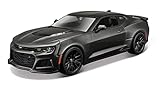
- Officially Licensed Replica – Authentic styling and branding from the original manufacturer
- Die-Cast Metal Construction – Durable metal body with detailed plastic components
- Highly Detailed Design – Realistic exterior styling and interior details
- Free-Rolling Wheels – Smooth movement for display or play
- Perfect for Collectors & Kids – Great gift for automotive fans
How the ZL1 performed on the drag strip
Chevrolet identifies the 1969 Camaro specialty car as the beginning of the COPO legacy in NHRA Stock Eliminator. The ZL1’s aluminum engine supplied a strong power-to-weight combination, and the factory package arrived ready for serious tuning rather than casual cruising.
Free tools Windows power users keep installed
One-click scans. No signup required.
A period High Performance Cars test, quoted in RM Sotheby’s 2016 archival description, recorded 13.16 seconds at 110.21 mph. That figure is a period test result, not a universal promise for every surviving car; tire choice, track preparation, launch technique, gearing and engine tune all affect elapsed time.
The car also produced notable competition results. Mecum reports that Dick “Mr. Chevrolet” Harrell’s ZL1 set an AHRA world record and won the AHRA World Championship. Those results helped turn a low-volume homologation exercise into a benchmark for Chevrolet drag racing.
Smokey Yunick captured the visual and mechanical shock of Chevrolet’s earlier 427 development when he called it “a 200-pound Marilyn Monroe,” a line quoted by NHRA in 2025. The phrase reflected the engine’s unusual combination of low mass and intimidating performance.
How many were built, and which transmissions they used
Only 69 Camaro ZL1s were built for the 1969 model year. RM Sotheby’s production breakdown records 47 cars with four-speed manual transmissions and 22 with automatics. That split is useful when checking a car’s claimed identity, but transmission type alone cannot prove authenticity because components can be changed during a car’s life.
What’s actually slowing this PC down?
Pick the symptom - the matching free tool is one click away.
Rank #4

- Authentic Fast X Design – Features the sleek and powerful 2024 Chevrolet Camaro ZL1 1LE from the Fast & Furious franchise.
- Highly Detailed Interior and Engine – Showcases intricate interior details and a realistic engine for maximum authenticity.
- Interactive Features – Includes opening doors, hood, and trunk for dynamic display and play possibilities.
- Premium Diecast Construction – Built with high-quality diecast metal and free-rolling rubber tires for durability and a premium feel.
- Jada Toys – Known for delivering screen-accurate, Hollywood-inspired diecast collectibles of unmatched quality.
The small production run also explains why surviving cars do not all look alike today. Some were raced hard, some were stored, and others were restored decades later. Their current condition can range from highly original to heavily reconstructed, even though all may trace their history to the same COPO program.
A street-legal race car with a factory warranty
The ZL1’s dual identity is central to its appeal. It was technically street legal, and Mecum’s auction narrative states that Chevrolet’s five-year/50,000-mile warranty applied. A buyer could therefore drive the car on public roads with factory backing while owning an engine designed around competition hardware.
That did not make it a comfortable daily driver. The high compression, radical camshaft, large carburetor and race valvetrain imposed practical compromises. Cold starting, idle quality, fuel consumption and maintenance requirements were closer to a competition car than to an ordinary family coupe. The warranty made the concept more credible, but it did not erase the mechanical demands.
What surviving ZL1s are worth to collectors
Chevrolet says the rarity of the surviving cars pushed values into six- and seven-figure territory. A specific reference point is Mecum’s Indy 2023 sale of car No. 36 of 69 for $770,000. That result reflects one documented car at one venue and date, not a guaranteed price for every ZL1.
Documentation is a major part of the value. The Mecum lot included a factory invoice, dealer shipping order, a signed Fred Gibb letter and a COPO Vehicle Verification certificate. RM Sotheby’s has also presented a documented No. 53 car as one of the rarest and most desirable COPO Camaros.
Best Value

- Ornament is in mint condition. See condition description for information on box condition.
- Approximate Size: Height: 1.0" x Length: 4.0" x Width: 1.5"
- MPN: QXE3169 / 01349
- Images are Stock Photos
- A part of the 50th Anniversary
Condition, originality and history can move the value substantially. A car retaining its original aluminum engine, correct components and traceable paperwork generally commands more confidence than one assembled from replacement parts. A documented competition history can add importance, but poorly executed modifications or uncertain provenance can reduce buyer interest even when the car looks fast.
Independent reader supportYour contribution helps us test, update, and keep practical guides available for everyone.How to authenticate a claimed ZL1
Because the production number is so small, the cost of a mistake is unusually high. A serious inspection should involve a marque specialist, independent mechanical examination and verification of the paper trail.
- Start with factory records. Check the original invoice, dealer shipping documents, build records and any COPO verification paperwork. Confirm that the documents agree on the vehicle identification number and equipment.
- Inspect the engine and major components. Verify that the car has the correct aluminum block and heads, appropriate casting and assembly details, and the expected race-oriented hardware. A later replacement engine may be valuable, but it changes the originality assessment.
- Trace ownership continuously. Match names, dates, registrations, race results and restoration invoices. Gaps do not automatically disqualify a car, but unexplained gaps require more caution.
- Assess restoration quality. Look for correct finishes, fasteners, wiring, decals and underbody details rather than judging only the paint. A fresh appearance can conceal incorrect components.
- Separate description from proof. Auction catalog language is supplied by consignors and can contain caveats. Mecum explicitly advises buyers to rely on personal inspection and notes that information on the auction block supersedes earlier descriptions.
How the ZL1 compares with other 1969 COPO Camaros
The closest comparison is a COPO Camaro fitted with the iron L72 427 rather than the aluminum ZL1 engine. Both belong to the same broader factory-ordering world, but their engines, production context and collector appeal differ. A useful comparison should examine the following points rather than rely on badges or horsepower claims alone.
Quick wins for a faster PC:
Clear out junk files and repair common Windows errorsFree Scan →Fix the driver behind crashes, sound loss and screen glitchesFind Drivers →| Comparison point | Why it matters |
|---|---|
| Engine package | ZL1 uses the aluminum 427; an L72 COPO uses an iron 427. The material difference affects weight, rarity and historical identity. |
| Transmission | The ZL1 population includes 47 four-speed cars and 22 automatics, so the documented configuration must match the individual vehicle. |
| Factory documentation | Invoices, shipping orders and COPO verification records establish whether the claimed option was factory installed. |
| Originality and restoration | Correct components and workmanship influence both historical credibility and market value. |
| Competition history | NHRA or AHRA records can add significance when the identity of the car is securely documented. |
| Sale venue and date | Auction prices are time- and venue-specific; one result should not be treated as a universal market price. |
Why the ZL1 still matters
The ZL1 established the pattern later associated with Chevrolet’s COPO performance cars: use a special ordering system to put a narrowly targeted race package into customer hands, satisfy homologation rules and create a factory-backed competition advantage. Russ O’Blenes, GM’s director of the Performance and Racing Propulsion Team, said Chevrolet’s goal was for COPO cars to be “a better, nicer race car than anything else somebody could go and buy from any OEM.”
That philosophy remains visible in the ZL1’s engineering. Chevrolet did not simply add a larger engine to a regular Camaro. It chose an aluminum 427, competition-grade internal and valvetrain parts, and a production strategy calibrated to racing rules. The car’s legend comes from that alignment of regulation, engineering and scarcity.
O’Blenes also recalled that more than 3,000 people expressed interest when Chevrolet later invited potential buyers to “raise their hand” for a COPO. That level of interest contrasts sharply with the tiny 1969 ZL1 run and shows why the original cars occupy such a different place in Chevrolet history.
The bottom line
The 1969 Camaro ZL1 was a homologation tool first, a street car second and a collector artifact today. COPO 9560 delivered an aluminum 427 with genuine drag-racing capability, but the $4,160 engine package and the specialized driving experience kept demand narrow. Its documented production, race results, unusual engineering and surviving paperwork explain why an authentic ZL1 can command a six- or seven-figure price while an ordinary big-block Camaro cannot.
Do these 3 things before closing this tab:
1Fix the driver behind crashes, sound loss and screen glitches2Clear out junk files and repair common Windows errors3Scan for outdated or missing drivers - takes under a minuteQuick Recap
Product prices and availability are accurate as of the date/time indicated and are subject to change. Any price and availability information displayed on Amazon at the time of purchase will apply.




