The Koenigsegg One:1 paired a manufacturer-claimed 1-megawatt output with a 1,360 kg ready-to-drive weight, but the figures only tell part of its story. Its name, unusual production count, road-car equipment and unverified 273 mph theoretical top speed all need a little context.
1. “One:1” refers to a power-to-weight concept
Koenigsegg’s name for the car reflects its headline ratio: one horsepower for each kilogram of curb weight. The company described that 1:1 power-to-weight ratio as a dream previously thought impossible in a road-legal sports car. It also called the One:1 the world’s first production “megacar,” a company label tied to its stated 1 MW output—not an independent classification. Koenigsegg’s model overview describes the concept and the car’s production history.
2. The “one megawatt” claim has a specific rating
Koenigsegg lists the One:1’s output as 1 MW at 7,500 rpm, with the engine’s limiter at 8,250 rpm. The model page also states 1,360 hp. These are the manufacturer’s published figures; hp, metric PS and kilowatts are different units, so the company’s numbers should not be casually relabeled or treated as directly interchangeable.
3. Its 1,360 kg weight is not a dry-weight figure
The current Koenigsegg specification gives a curb weight of 1,360 kg, defined as ready to drive with 50% fuel and all fluids. The published weight distribution is 44% at the front and 56% at the rear. That precise condition matters when comparing the One:1 with cars whose published figure is dry weight or uses another fuel load. See the Koenigsegg technical specifications.
Recommended Free Tools
#1 Best Overall

- 🏁 Comes in a stackable crystal clear acrylic collectors case. 1:64 Scale, 64 times smaller than the real car. Collect them all.
- 🏁 The most desirable high-performance vehicles, made in 1:64 scale. Created using 3D CAD data and paint chips for accuracy, the models features a diecast metal body, detailed exterior and interior, rubber tires, painted wheels, and static brake discs. Every model is licensed and approved by it's automaker .
- 🏁Founded in 2020, PosterCars was born from the cross section of nostalgia, passion for collectibles, and the love of cars. As our namesake suggests, our ambition is to recreate "poster cars" cars that lived on bedroom posters and captured the imaginations of many. Whether it is for children picturing someday of driving the poster car, or for adult motor enthusiasts continuing on this journey, we hope to bring the joy of cars and collecting through our creations .
4. The V8 was designed to use different fuels
Under the bodywork is an aluminum 5.0-liter V8 with four valves per cylinder, double overhead camshafts and twin variable-geometry turbochargers. Koenigsegg specifies flex-fuel capability; its model overview says the car can run on E85 biofuel, race fuel or regular gasoline. The company does not establish that the engine makes identical output on every fuel, so the 1 MW figure should not be assumed to apply equally to all of them.
- Dry-sump lubrication and a carbon-fiber intake manifold are among the listed engine features.
- Koenigsegg specifies 1.8 bar of boost and an engine weight of 197 kg.
- Maximum torque is listed as 1,371 Nm at 6,000 rpm; the technical page says torque exceeds 1,000 Nm from 3,000 to 8,000 rpm.
5. A seven-speed dual-clutch gearbox handles the power
The One:1 uses a specially developed seven-speed dual-clutch transmission with one input shaft and paddle shifting. Koenigsegg also lists an electronic differential. The combination is part of the factory specification, rather than evidence by itself of a particular independently measured acceleration time.
Rank #2

- Brand new box
- Real rubber tires.
- Detailed interior, exterior.
- Made of diecast metal with some plastic parts.
- Manufacturer's original unopened packaging.
6. The 0–400–0 km/h figures are factory specifications
Koenigsegg publishes an approximate 20 seconds for 0–400 km/h and approximately 10 seconds for 400–0 km/h. The same technical page lists a 28 m braking distance from 100–0 km/h and maximum lateral force of 2.0 g. These are the manufacturer’s stated figures, not independent test results established here.
7. The downforce figures depend on speed
Koenigsegg lists total downforce of 610 kg at 260 km/h and 830 kg at 440 km/h. The system includes adaptable rear wings, active aero at the front and rear underside, a flat underside and venturi tunnels. The stated values are manufacturer claims at those speeds; they should not be mistaken for independently verified measurements.
Rank #3
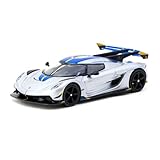
- Brand new box
- Real rubber tires.
- Detailed interior, exterior.
- Made of diecast metal with some plastic parts.
- Manufacturer's original unopened packaging.
The technical page also gives a drag coefficient range of 0.45–0.50, associated with the adaptable rear wing. Its specially developed Michelin Cup 2 tires are listed as 265/35–19 at the front and 345/30–20 at the rear, with a 440 km/h speed rating. That rating is not proof that the car itself made a 440 km/h run.
8. Track-focused suspension did not mean a stripped-out race car
The One:1’s chassis is a high-modulus carbon-fiber structure with an F1-style honeycomb core. Koenigsegg lists the chassis at 72 kg and monocoque torsional rigidity at 65,000 Nm/degree. Suspension details include double wishbones, active ride-height control, carbon-fiber springs with a variable spring ratio and a rear Triplex damper; the overview also refers to active shock absorbers.
Rank #4

- Koenigsegg Jesko Absolut Livery Edition - 5473DF Kinsmart Model Vehicle
- 1/36 Scale Collectible Model Sports Car
- This is a 5"Lx 2.25"Wx 1.25"H Diecast Metal model with some plastic parts
- Openable Front Doors, Pullback Motor Action
- 1 car, no box
Despite the track focus, the car retained road-car equipment. In a 2014 Top Gear report, Koenigsegg spokesman Andreas Petre said the track-car idea came from the Chinese distributor and customers who wanted a Koenigsegg track car. Petre said the condition was that it remain street legal, so equipment such as air conditioning, a stereo, central locking, ESP, ABS and electric windows had to be integrated while weight was reduced.
Independent reader supportYour contribution helps us test, update, and keep practical guides available for everyone.9. “Six cars” and “seven cars” can both describe the production story
Koenigsegg’s current model page says the One:1 was built in 2014–2015 in seven examples. In the March 5, 2014 Top Gear report, Petre described “just six of the extreme hypercars” as customer cars, and said the count was seven including the company’s own R&D car. The two counts use different definitions: six customer cars, plus one development car.
Free tools Windows power users keep installed
One-click scans. No signup required.
Best Value
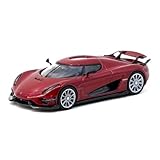
- Brand new box. Limited edition.
- True-to-scale detail. Detailed interior, exterior.
- Real rubber tires.
- Comes in a blister pack
- Officially licensed product
10. The often-repeated 273 mph figure was theoretical
Top Gear quoted Petre saying the One:1’s top speed was “around 273mph,” then clarified that the number was theoretical and that a top-speed run was not a priority. It is not evidence of a verified 273 mph record. Koenigsegg’s current specification lists downforce and tire-speed-rating figures at 440 km/h, but those figures do not establish that the car reached that speed.
Quick Recap
Product prices and availability are accurate as of the date/time indicated and are subject to change. Any price and availability information displayed on Amazon at the time of purchase will apply.




