What’s actually slowing this PC down?
Pick the symptom - the matching free tool is one click away.
A turbocharged car does not require a universal ritual of premium fuel, driveway warm-ups, or timed idle cooldowns. A turbo uses exhaust energy to force more air into the engine, and the correct driving habits depend on the exact engine, calibration, fuel market, and instructions in your owner’s manual. Use the ten points below to separate sound advice from turbo folklore.
1. A turbo borrows energy from the exhaust
Exhaust gas spins a turbine. A shaft connects that turbine to a compressor on the intake side, which packs additional air into the engine. More air allows the engine management system to burn more fuel when appropriate, increasing power potential without requiring a proportionally larger engine. Garrett Motion explains the operating principle in its Turbocharging Facts.
As an Amazon Associate I earn from qualifying purchases.
The hardware works extremely hard: Garrett describes typical turbocharger fan speeds of 200,000 to 300,000 rpm and typical gasoline-turbo operating temperatures of about 1,000 degrees Fahrenheit. Those are engineering context figures, not specifications that apply identically to every car.
2. Turbo lag is a response delay, not automatically a defect
Garrett defines turbo lag as “a delayed response between throttle input and torque delivery from a turbocharged engine.” The delay exists because exhaust flow, turbine speed, compressor pressure, engine speed, gearing, and electronic controls all have to reach the conditions needed for the requested torque.
#1 Best Overall
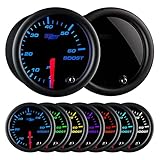
- GlowShift Tinted 7 Color Series 60 PSI Mechanical Boost Gauge is Designed to Monitor Boost Pressure Levels of Your Diesel Truck's Turbo or Supercharged Engine
- Mechanical Boost Readings from 0 to 60 PSI - 2-1/16" (52mm) Diameter Gauge with a Black Dial, Illuminated Red Needle, Tinted Lens, Matte Black Trim Ring & Aluminum Housing
- 7 Solid Color Modes & 2 Color Cycle Modes Allow You to Match Your Factory Dashboard Lights or Add a Custom Style to the Interior of Your Vehicle - Colors Include Blue, Red, Green, Teal, Purple, White & Yellow - Connecting the Dimmer Wire to the Headlight Switch Reduces Brightness of the Gauge by 30% When the Headlights are On
- Includes 1/8-27 NPT Compression Fittings, 9' Nylon Boost Hose, 2' Power Wire, Gauge Visor, Mounting Bracket, Mounting Bracket Hardware & Step-By-Step Instructions that Help Walk You Through the Installation Process
- Established Since 2004, GlowShift Has Always Been Committed to Customer Satisfaction by Offering a One-Year Limited Warranty, Free Lifetime Technical Support & 30 Day No Hassle Returns with Each Purchase
Lag varies widely by engine and control design. A small modern turbo may respond quickly, while a larger turbo, tall gear, low engine speed, or a sudden throttle request can make the pause more noticeable. Do not treat every momentary delay as a failure, and do not assume every current turbo car has eliminated lag.
3. “Turbocharged” does not automatically mean premium fuel
Fuel grade is set by the vehicle manufacturer, not by the word “turbo” on the badge. Check the owner’s manual and the fuel-door label for the required octane and any permitted alternatives. Garrett’s FAQ specifically directs drivers to the manufacturer’s fuel requirement.
Using a lower grade than specified can promote knock and cause the engine controls to reduce performance; using a higher grade than required is not guaranteed to add power. Requirements can also differ by market, engine version, and model year.
Do these 3 things before closing this tab:
1Clear out junk files and repair common Windows errors2Fix the driver behind crashes, sound loss and screen glitches3Repair Windows errors before they cause bigger problemsRank #2

- Boost Gauge is Designed to Monitor Boost Pressure & Vacuum Compression Levels of Your Car's Turbo or Supercharged Engine
- Boost Readings from 0 to 35 PSI & Vacuum Readings from -30 to 0 inHg - 2-1/16" (52mm) Gauge with Red LED Digital Display
- Easily display at night:Our Turbo Boost Gauge is highly visible with a RED Light,easy viewing at all angles during any lighting conditions,practically and safely when driving at night
- Includes Boost Sensor and Power Harness and Installation Instructions
- One Year Limited Warranty For Non-Human Factor Damage & Free Lifetime Technical Support.
4. One turbo car’s fuel rule cannot be generalized
For a concrete example, Subaru lists the 2026 WRX as a turbocharged 2.4-liter model requiring 91-octane-or-higher premium unleaded in its official vehicle resources: Subaru’s 2026 WRX resource. That is a specification for that model and market, not evidence that every turbocharged car needs premium.
If you buy a used car, verify the requirement for its exact engine and market rather than relying on a previous owner’s habit or an online generalization.
5. A cold engine usually does not need a long stationary warm-up
Ford India’s fuel guide says modern electronically fuel-injected engines do not need preheating and recommends normal driving after a cold start. The practical qualification is important: drive gently while oil and coolant temperatures rise, avoid full-throttle boost immediately after starting, and follow the instructions for your own model. The Ford page is a Ford India guide, not a universal policy for every turbocharged vehicle: Ford’s fuel and refueling guide.
Rank #3

- High Quality: The boost gauge is made of high-quality ABS and metal material, which is wear-resistant and durable.
- Easy to Read: Numbers and pointing clearly show the turbo boost, the blue light on the dial for easy reading in the darkness.
- Application: Used to measure the turbo of automobile. Suitable for all 12V car models, which is a practical modification accessory. Measurement Range: 0~30in.Hg / 0~30PSI.
- Easy Installation: Compact and practical design makes it works more stable. Easy to install and operate, convenient to use.
- Package Included: 1 x Turbo Boost Gauge Meter, 1 x Sensor, 1 x Bolts Pack.
A prolonged idle may warm the engine less efficiently than light driving, while the turbo and oil system still benefit from reaching operating temperature under modest load. If your manual gives a specific cold-start procedure, that instruction takes priority.
6. Smooth acceleration is kinder to the whole powertrain
Gradual throttle application is useful everyday advice, not a special ceremony for turbo owners. It reduces abrupt torque changes, makes traction easier to manage, and generally improves fuel economy. Ford’s guide also recommends gradual acceleration.
Once the engine is warm and conditions are safe, use the power the car was designed to provide. The point is to avoid unnecessary shock loads and repeated full-throttle requests on a cold engine, not to drive permanently below boost.
Rank #4

- Turbosmart 52 millimeter 30 pascals per square inch pneumatic boost gauge
- High-grade brass and billet aluminum
- Minimizes wastegate creep
- Improve turbo response by up to 800 revolutions per minute
- Increases performance
7. An idle cooldown timer is not automatically necessary
Older turbocharging advice often says to idle for several minutes after every drive. Garrett says contemporary vehicle controllers account for turbo heat after shutdown, so a timed cooldown is not automatically required in ordinary use.
That does not override model-specific instructions or demanding conditions. After sustained high load—such as a long climb, towing, repeated hard acceleration, or track use—consult the owner’s manual for any prescribed procedure. If the manual gives no special instruction, shut down as directed rather than inventing a fixed timer.
Free tools Windows power users keep installed
One-click scans. No signup required.
8. Oil specification matters more than turbo folklore
Turbo bearings and the engine’s lubrication system depend on oil that meets the manufacturer’s viscosity and performance specification. There is no single “best turbo oil” or universal change interval for all makes.
Best Value
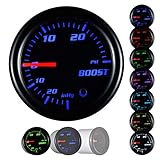
- 【Accurate Pressure Measurement】Turbo Boost Gauge is Designed to Provide Accurate Pressure Measurements of Vehicle's Turbocharger System, with a Range of up to 30PSI, Monitoring Engine Performance more Precisely.
- 【Easy-to-Read Display】With Clear and Easy-to-Read Display, Turbo Boost Gauge Provides Real-Time Readings of Turbocharger System Pressure, Allowing toMake Informed Decisions about Driving Style and Keep Engine Running at Optimal Performance.
- 【Improve Driving Experience】By Monitoring Turbocharger System Pressure, Allowing You to Get the most out of Engine Performance and Enjoy a Smoother and more Responsive Driving Experience.
- 【High-Quality Construction】Made from High-Quality Materials, Turbo Boost Gauge is Durable and Built to Withstand the Rigors of Daily Use, Ensuring Reliable Performance and Long-Lasting Durability.
- 【Easy to Install】With Simple Installation Process, Boost Gauge can be Installed easily and quickly, the Package includes Silicone Hose, T-Fitting, 2' of Power Harness, Gauge Visor, Gauge Swivel Dashboard Pod, Bottom, Mounting Hardware, Installation Instruction
- Use the exact viscosity and specification listed for your engine and climate.
- Observe the time- or mileage-based service interval, whichever the manual requires.
- Check the level correctly and investigate repeated oil loss instead of simply topping up indefinitely.
- Use the service schedule for your model, including inspections of intake, charge-air, cooling, and emissions systems where specified.
Garrett’s guidance, Ford’s owner information, and Subaru’s vehicle resources all defer maintenance details to the vehicle manufacturer. The manual for your car remains the controlling source.
9. Unusual symptoms deserve attention, but one sound is not a diagnosis
A new warning light, persistent knocking, smoke, oil loss, severe hesitation, or a major change in boost response warrants checking the manual and arranging qualified service. Do not diagnose a turbocharger from one whistle or from a single brief hesitation: normal intake and wastegate sounds vary by vehicle, load, and temperature.
Record when the symptom occurs—cold or warm, under boost or at idle, and with which warning lights—so a technician can reproduce it. Stop driving and seek prompt assistance if the car shows severe power loss, heavy smoke, dangerous noises, or an oil-pressure warning.
PC Slower Than It Used to Be?
A free scan shows the junk files, broken settings and background clutter dragging Windows down - then fixes them in one click.Free scan · Windows 10 & 11Crashes, No Sound, or Screen Glitches?
Random freezes, missing sound and display glitches usually trace back to one bad driver. Find and replace yours safely.Free scan · under a minute10. The owner’s manual beats generic turbo advice
Before changing your routine, verify four items for the exact vehicle, engine, model year, and market:
- Fuel: the required octane and whether any alternative grade is permitted.
- Oil: the approved viscosity, performance specification, capacity, and service interval.
- Cold starts: whether the manufacturer gives any temperature-related operating instruction.
- Heavy use and shutdown: whether towing, steep climbs, repeated high-load driving, or track use requires a special procedure.
Garrett’s broad technical FAQ is useful background, but it is not a substitute for the manual written for your car. When generic turbo advice conflicts with that manual, follow the manual.
What this means when choosing or living with a turbo car
For comparisons between actual models, focus on the manufacturer-required fuel grade, how torque is delivered across the rev range, the documented oil and maintenance schedule, and the model’s cold-start and high-load guidance. “Turbocharged” alone does not tell you whether ownership requires premium fuel, extra idling, or unusual service.
Quick Recap
Product prices and availability are accurate as of the date/time indicated and are subject to change. Any price and availability information displayed on Amazon at the time of purchase will apply.




